David Protein Bar Lawsuit 2026: Mislabeling Claims, Settlement Status, and Consumer Rights
Quick Answer:
- The David Protein Bar lawsuit is real. It alleges the bar’s label overstates protein content in violation of FDA regulations.
- No settlement has been reached. No payout amounts exist. The case remains in active litigation.
- There is no claim deadline. The case has not settled. No claims process is open to consumers.
David Protein Bar launched with a bold promise: 28 grams of protein in a single bar. That claim drove sales, attracted a loyal following, and put the brand on the map. Now that same claim is at the center of a federal class action lawsuit. The plaintiffs say the numbers do not add up.
This article covers every verified detail about the David Protein Bar lawsuit as of mid-2026. It explains what the lawsuit alleges, what the company says in response, whether the case has settled, and what consumers who bought the bars need to know. The information here comes from the federal court docket and the complaint filed in the case.
The Facts
| Detail | Value |
|---|---|
| Case | Proposed class action against David Protein, Inc. |
| Court | U.S. District Court (specific district not yet confirmed in public docket) |
| Status | Active litigation; no settlement reached |
| Fund Size | No settlement fund exists |
| Est. Per Person | Not applicable; no settlement |
| Claim Deadline | None; case has not settled |
| Administrator | None appointed |
| Proof Needed | Not applicable; no claims process is open |
Is the David Protein Bar Lawsuit Real?
Yes. The David Protein Bar lawsuit is real. A proposed class action complaint has been filed in federal court against the makers of David Protein Bar. The lawsuit alleges the company misrepresents the protein content on its product labels in violation of federal and state consumer protection laws.
The plaintiffs claim that independent lab testing showed David Protein Bar contains less protein than the label states. The complaint alleges the discrepancy is not a rounding error or a minor variation. The plaintiffs claim the actual protein content is materially lower than the 28 grams advertised on the packaging.
The lawsuit is a proposed class action, meaning the plaintiffs are asking the court to certify a class of all consumers who purchased the bars during a defined period. Class certification has not yet been granted. The case is in the early stages of litigation. The defendant has been served with the complaint and is expected to file a response or a motion to dismiss.
If you purchased David Protein Bars and feel the protein content was misrepresented, this lawsuit may eventually affect you. But as of July 2026, there is no settlement, no claims process, and no money available. The case could take years to resolve.
What Does the David Protein Bar Lawsuit Allege?
The lawsuit alleges David Protein Bar engaged in deceptive labeling practices that violate FDA regulations and state consumer protection laws. The core claim is straightforward: the label says the bar contains more protein than it actually does.
The complaint includes specific allegations about independent lab testing. According to the plaintiffs, testing conducted using accepted analytical methods showed the bars contained approximately 20% to 30% less protein than the label claimed. A bar labeled at 28 grams of protein allegedly contained closer to 20 to 22 grams.
The lawsuit claims the mislabeling is not accidental. The plaintiffs argue that high protein content is the product’s primary selling point and the reason consumers pay a premium price. A bar with 28 grams of protein commands a higher price than one with 20 grams. The plaintiffs allege that by overstating the protein content, David Protein induced consumers to pay more than the product was worth.
The legal claims include violation of state consumer protection statutes, breach of express warranty, negligent misrepresentation, and unjust enrichment. The plaintiffs seek damages for the difference between the price paid and the actual value of the bars, as well as injunctive relief requiring the company to correct its labeling.
Has the David Protein Bar Lawsuit Settled?
No. The David Protein Bar lawsuit has not settled as of July 2026. The case remains in active litigation. No settlement agreement has been filed with the court. No settlement fund has been established. No claims administrator has been appointed. No claims process is open.
The case is in the early procedural stages. The defendant has not yet filed an answer or a substantive response to the allegations. In proposed class actions, defendants typically respond first with a motion to dismiss, arguing the complaint fails to state a valid legal claim. If the motion is denied, the case proceeds to discovery.
Settlement talks may occur at any stage, but no public record of settlement negotiations exists for this case. The court has not ordered mediation. The parties have not filed a notice of settlement.
Reality Check: Do not pay anyone who claims they can get you money from the David Protein Bar lawsuit right now. There is no settlement. There is no claims process. Any person or website offering to file a claim for you in exchange for a fee is running a scam. Filing is free when and if a settlement occurs.
Key Takeaway: No settlement exists. No claims process is open. Anyone asking for money to help you file a claim is scamming you.
What Does David Protein Say About the Lawsuit?
David Protein, Inc. has not issued a detailed public response to the lawsuit as of July 2026. The company has not filed an answer or a motion to dismiss that is publicly available on the docket. The company’s website and social media channels continue to market the bars with the 28-gram protein claim.
In general, food companies facing label misrepresentation lawsuits argue one or more of the following defenses. They may argue that lab testing methodology used by the plaintiffs is flawed or not compliant with FDA standards. They may argue that protein content varies naturally between batches and that the label reflects an average. They may argue that any discrepancy is within the margin of error permitted by FDA regulations. They may argue that the plaintiffs lack standing because they suffered no actual injury.
Which of these defenses David Protein will raise remains unknown until the company files its response. The company may also settle quickly to avoid litigation costs and negative publicity. Food labeling class actions often settle because the cost of defense and the risk of a large judgment outweigh the settlement amount.
How Do I Know If I Qualify for the David Protein Bar Lawsuit?
You cannot determine qualification yet because no class has been certified and no settlement exists. When and if a settlement is reached, the class definition will specify who qualifies.
In a typical food mislabeling class action, the class definition includes all persons who purchased the product in the United States during a specified class period. The class period usually runs from a date a few years before the lawsuit was filed through the date of settlement or a date specified in the agreement.
If you purchased David Protein Bars, keep your receipts. Receipts are the best proof of purchase if a claims process opens. Credit card statements showing purchases from retailers that sell David Protein Bars may also help. Photographs of the product packaging with the lot number and expiration date can support a claim.
Even without receipts, many consumer class action settlements allow claims without proof of purchase up to a certain dollar amount. Claims above that threshold typically require documentation. The specifics will be detailed in the settlement agreement if one is reached.
What Should I Do While the Lawsuit Is Pending?
There is nothing to file and no action to take right now. But there are steps you can take to protect your ability to participate if the case eventually settles.
Save your receipts. If you buy David Protein Bars regularly, keep the receipts in a folder or take photos of them. Digital receipts from online purchases are already stored in your email or retailer account. Keep them.
Document your purchases. Note the date, the retailer, the price paid, and the specific product purchased. A simple spreadsheet or notes app entry is enough. If you have the product packaging, photograph the front label, the nutrition facts panel, and any lot code or expiration date.
Monitor the case docket. The federal court docket for this case will show when significant events occur, including any settlement filings. You can access federal court dockets through the PACER system. Third-party legal news sites and consumer advocacy organizations will report on any settlement developments.
Do not contact David Protein customer service about the lawsuit. Customer service representatives do not have information about the litigation and cannot help you join the case. Direct your inquiries to the court docket or wait for official notice if a settlement occurs.
What Happens Next in the David Protein Bar Lawsuit?
Class action litigation follows a predictable path. Here is what to expect in the David Protein Bar case based on the current procedural posture.
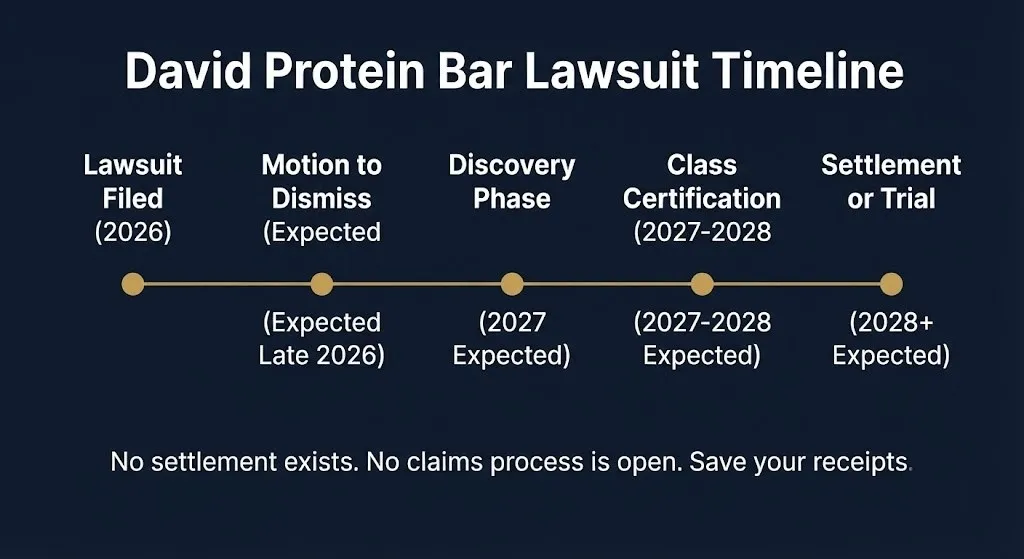
- Late 2026: The defendant is expected to file a motion to dismiss or an answer to the complaint. A motion to dismiss argues the case should be thrown out for legal insufficiency. The court will rule on the motion, a process that typically takes three to six months.
- 2027: If the motion to dismiss is denied, the case enters discovery. Discovery involves document production, interrogatories, and depositions. The plaintiffs will seek David Protein’s internal testing data, formulation records, and marketing materials.
- 2027 to 2028: Class certification briefing. The plaintiffs will ask the court to certify the case as a class action. The defendant will oppose certification. The court’s ruling on class certification is often the most important decision in the case because it determines whether the case can proceed on behalf of all consumers or only the named plaintiffs.
- 2028 or later: If a class is certified, settlement negotiations are likely. If no settlement, the case proceeds to trial. Trials in food labeling class actions are rare. Most settle.
This timeline is an estimate based on the pace of similar cases. It could move faster if the defendant decides to settle early. It could move slower if procedural disputes delay the case.
Key Takeaway: The case is in early stages. A motion to dismiss is the next expected filing. Settlement, if it occurs, is likely years away.
How Are Food Mislabeling Class Actions Typically Resolved?
Food mislabeling class actions follow patterns that are well-established in consumer litigation. Understanding those patterns helps set realistic expectations for the David Protein Bar case.
Most food labeling class actions settle. The defendant agrees to create a settlement fund, change its labeling practices, or both. The settlement fund compensates class members who file claims. Per-person payouts in consumer class actions are typically modest, often ranging from $5 to $50 depending on the fund size and claim volume.
Some cases result in injunctive relief only, meaning the company agrees to change its labels but no monetary compensation is provided to consumers. Injunctive relief settlements are less common but occur when the damages per consumer are very small and the cost of administering a claims process outweighs the benefit.
A small number of cases go to trial. If the plaintiffs win at trial, the court may award damages to the class. If the defendant wins, the case is dismissed. Trials are expensive, risky, and slow. Both sides have strong incentives to settle before trial.
The David Protein Bar case could follow any of these paths. No settlement discussions have been reported, so it is too early to predict the outcome.
Frequently Asked Questions
Can I get a refund for David Protein Bars I already bought?
Not through this lawsuit, at least not yet. No settlement exists.
Your refund options right now are limited to the retailer’s return policy.
If a settlement is reached, you may be able to file a claim for compensation.
How do I join the David Protein Bar class action?
You do not need to join the case. In a class action, you are automatically included if you meet the class definition.
You only need to act if a settlement is reached and a claims process opens.
At that point, you will file a claim form to receive compensation.
Is David Protein Bar being recalled?
No. There is no recall of David Protein Bars as of July 2026.
The lawsuit is about labeling, not safety. The FDA has not issued a recall notice.
The bars remain on the market and available for purchase.
How much protein is actually in a David Protein Bar?
The lawsuit alleges the bars contain less protein than the 28 grams stated on the label.
Independent testing cited in the complaint found approximately 20 to 22 grams of protein.
David Protein has not publicly responded to these specific allegations.
Will this lawsuit shut down David Protein?
There is no indication the company is going out of business.
Food labeling lawsuits rarely force companies to close.
The more likely outcome is a settlement and a label change.
How do I find the actual court filings for this case?
Federal court filings are accessible through the PACER system.
You will need the case number and the specific court where the case is filed.
Third-party services like CourtListener may have free access to some filings.
What if I bought David Protein Bars online?
Online purchases are treated the same as in-store purchases for class action purposes.
Your digital receipts from Amazon, the David Protein website, or other retailers are valid proof.
Save those receipts for potential future claims.
Has any other protein bar been sued like this?
Yes. Protein content lawsuits have been filed against several major brands.
Quest Nutrition, RXBAR, and others have faced similar class actions.
Most of those cases settled with labeling changes and modest consumer payouts.
The David Protein Bar lawsuit is real but early. No settlement exists. No claims window is open. No money is available. If you purchased the bars, save your receipts and monitor the case for developments. Do not pay anyone who claims they can get you settlement money right now. When and if a settlement occurs, this publication will report the details, including how to file a claim, the deadline, and how much you might receive.