CVS Lawsuits in 2026: Settlements, Claims, and What Customers and Employees Should Know
Quick Answer
- CVS lawsuits in 2026 span opioid settlements, prescription pricing claims, employment disputes, and consumer protection actions.
- Some opioid settlements have established funds, but most other cases remain in litigation with no payout process.
- Claim deadlines and eligibility vary by specific settlement, and no single CVS settlement covers everyone.
If you typed “CVS lawsuit” or “CVS lawsuits” into a search bar, you probably saw a headline about a settlement, a class action, or a regulatory fine and want to know whether it affects you. This article gives you the verified picture across the major CVS legal actions in 2026, which ones pay consumers or employees, and which are corporate or government matters that do not.
CVS Health is one of the largest healthcare companies in the United States. It operates retail pharmacies, a pharmacy benefit manager called Caremark, and the health insurer Aetna. That scale means it faces lawsuits across multiple fronts.
The surprising verified detail: CVS has paid billions in opioid settlement money, but almost none of that money goes directly to individual consumers. It goes to state and local governments for addiction treatment and prevention programs.
The Facts
| Fact | Detail |
|---|---|
| Company | CVS Health Corporation |
| Major litigation areas | Opioid crisis, prescription pricing, employment, consumer protection |
| Opioid settlements | Multi-billion dollar agreements with states and localities |
| Consumer class actions | Several pending, limited payouts confirmed |
| Employment disputes | Individual and collective actions |
| Claims administrator | Varies by specific settlement |
| Individual consumer payout | Rare in current CVS cases |
Is There a CVS Class Action Lawsuit That Pays Customers in 2026?
There is no single CVS class action settlement in 2026 that pays all customers. Some consumer class actions exist, but none has produced a broad claims process available to every CVS shopper.
In recent years, CVS has faced class actions over prescription drug pricing, generic drug overcharges, and consumer protection claims. Some of these cases settled. Others were dismissed or remain in litigation.
The settlements that do exist are case-specific. A class member in a prescription overcharge settlement may qualify for a payout. A random CVS customer with no connection to that specific case does not.
If you see an ad promising a “CVS settlement” payout for all customers, treat it as unverified. Check the court docket or a legitimate settlement administrator before giving out your information.
Key Takeaway: No blanket CVS customer settlement exists. Payouts are tied to specific cases with specific class definitions.
What Are the Major CVS Lawsuits in 2026?
The major CVS lawsuits in 2026 fall into five categories. Each has different stakes and different outcomes for consumers and employees.
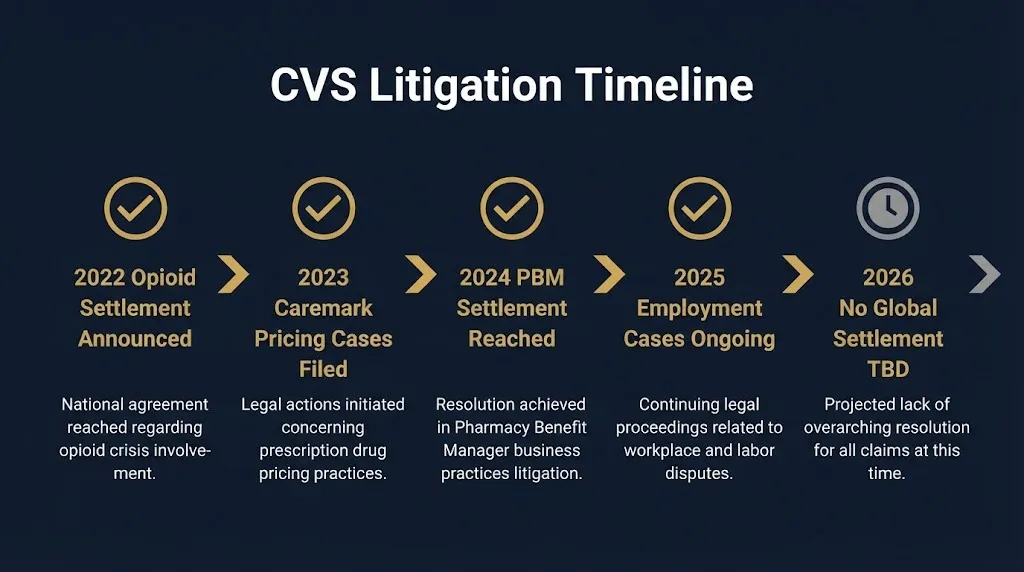
Opioid litigation is the largest. CVS, along with other pharmacy chains, agreed to pay billions of dollars to state and local governments to resolve claims that pharmacies failed to monitor opioid prescriptions. Those payments go to governments, not individuals.
Prescription pricing litigation targets CVS Caremark, the pharmacy benefit manager. Plaintiffs allege that Caremark overcharged customers for generic drugs or failed to pass on negotiated discounts. Some of these cases have settled. Others continue.
Employment litigation includes wage and hour claims, discrimination suits, and disputes over working conditions in CVS stores and distribution centers.
Consumer protection actions involve claims about deceptive marketing, gift card practices, or other consumer-facing issues.
Regulatory actions by the FTC, state attorneys general, and other agencies add another layer, though fines go to governments, not consumers.
Key Takeaway: CVS legal exposure spans opioids, drug pricing, employment, and consumer protection. Most payouts go to governments, not individuals.
Did the CVS Opioid Settlement Pay Individuals?
The CVS opioid settlement did not pay individuals directly. The money went to state and local governments to fund addiction treatment, prevention, and recovery programs.
CVS agreed to pay approximately $5 billion over ten years as part of a broader opioid settlement framework. The payments are distributed according to agreements negotiated by state attorneys general.
If you or a family member suffered from opioid addiction, you do not receive a direct payout from this settlement. The money funds public health programs, not individual compensation.
Some states have created grant programs to distribute the money. Those programs fund treatment centers, recovery services, and prevention efforts. Eligibility is for organizations, not individuals.
The distinction matters because many people misunderstand opioid settlements. They see billions of dollars and assume individual checks are coming. They are not.
Reality Check: Opioid settlement money goes to governments, not to people who suffered from addiction. No one from a legitimate settlement administrator will call you about an opioid payout. If someone offers one, it is a scam.
What Is the Status of CVS Prescription Pricing Lawsuits?
CVS prescription pricing lawsuits are active in multiple courts. The core allegation is that CVS Caremark, the pharmacy benefit manager, overcharged consumers for generic drugs or failed to pass on negotiated savings.
Some of these cases have settled. A 2024 settlement involving generic drug pricing at major pharmacy benefit managers included CVS Caremark and created a claims process for certain customers. The claims period has closed or is closing, depending on the specific settlement.
Other pricing cases remain in litigation. The outcomes will determine whether additional settlements or payouts occur.
If you believe you were overcharged for prescriptions through CVS Caremark, check the official settlement website for the specific case. Do not rely on ads or social media posts.
Key Takeaway: Some prescription pricing cases have settled with claims processes. Others remain active. Check the specific settlement website for eligibility.
Are There CVS Employment Lawsuits That Pay Workers?
CVS employment lawsuits exist, and some have produced payouts for workers. Wage and hour class actions, overtime disputes, and discrimination cases have resulted in settlements in some instances.
A common claim involves store managers or pharmacists alleging they were misclassified as exempt from overtime and should have been paid for extra hours worked. Those cases sometimes settle with funds distributed to affected employees.
Other employment cases involve meal and rest break violations, especially in California, where state law is strict. Settlements in those cases can pay affected workers.
The eligibility for any employment settlement depends on the specific case. Your dates of employment, job title, and location determine whether you qualify.
If you worked for CVS and received a notice about a settlement, check the official claims administrator website for your specific case.
Key Takeaway: Some CVS employment cases settle and pay workers. Eligibility depends on your job, dates, and location.
How Do I Know If a CVS Settlement Notice Is Real?
A real CVS settlement notice names the court, the case number, the claims administrator, and the official settlement website. It explains the class definition, the claim deadline, and what proof you need to file.
A fake notice often lacks those details. It uses vague language like “eligible customers may claim up to $500.” It asks for personal information upfront or charges a filing fee. It creates urgency without dates.
To verify a notice, search the case name in the court’s public docket. Check the claims administrator’s website independently. Do not click links in the notice itself.
Legitimate settlement notices do not ask for your password, your bank account password, or payment to file. Filing is always free.
Key Takeaway: Real settlement notices name the court, case number, administrator, and deadline. Fake ones are vague and ask for money.
Has the FTC Taken Action Against CVS?
The FTC has taken action against CVS in some matters, but no broad consumer redress fund exists for CVS customers in 2026. FTC fines and settlements sometimes include redress, but that depends on the specific case.
In the pharmacy benefit manager space, the FTC has investigated practices across the industry, including CVS Caremark. Those investigations can lead to settlements, but the terms vary.
If the FTC announces a CVS redress fund, it will appear on the FTC’s official website with a claims administrator, a deadline, and a claim form. Until then, any “FTC CVS settlement” ad is false.
Key Takeaway: The FTC has investigated CVS-related practices, but no broad CVS consumer redress fund exists in 2026.
What Should I Do If I See a CVS Settlement Ad?
Treat every CVS settlement ad as unverified until you confirm it on a court docket or official administrator website. Do not click the ad. Do not enter your phone number, email, or any personal information.
Search the case name plus the word “court” or “docket.” Look for the claims administrator’s website. Check the FTC’s consumer alert page for known scams.
If the ad asks for money, it is a scam. If the ad promises a specific dollar amount, it is probably a scam. If the ad creates fake urgency, it is a scam.
The safest move is to ignore the ad and do your own research from official sources.
Key Takeaway: CVS settlement ads are often scams. Verify before you act, and never pay to file a claim.
What Are the Most Common CVS Settlement Scam Ads?
Scammers exploit the CVS name because it is widely recognized. The most common fake ads promise a “CVS class action settlement” of $500 or more per customer.
Some fake ads use real case names but false claim links. Others invent cases that do not exist. They often use CVS’s logo or a fake court seal to look official.
The goal is usually identity theft or phishing. The fake claim form asks for your name, address, date of birth, phone number, and sometimes your bank account details or Social Security number.
No legitimate settlement asks for your Social Security number unless it is a tax reporting requirement, and even then, it is handled securely through the claims administrator, not an ad.
Key Takeaway: Fake CVS settlement ads are phishing operations. They want your data or your money, not to give you money.
What Is the Largest CVS Settlement in Recent Years?
The largest CVS settlement in recent years is the opioid settlement, which totals approximately $5 billion over ten years. That money goes to state and local governments.
Other large settlements involve pharmacy benefit manager pricing practices. A 2024 settlement involving CVS Caremark and other PBMs created a fund of several hundred million dollars for affected customers. The claims process for that settlement has specific eligibility rules.
Employment settlements are smaller, typically in the tens of millions of dollars for a class of workers.
The size of a settlement does not determine individual payouts. A $5 billion opioid settlement may pay nothing to individuals, while a $50 million employment settlement could pay thousands of dollars per worker.
Key Takeaway: The largest CVS settlement is the opioid agreement, but it pays governments, not individuals.
What Happens Next in CVS Litigation?
The next stages in CVS litigation are predictable in shape. Opioid settlement payments will continue on their scheduled timeline. Those payments go to governments.
Prescription pricing cases will continue through discovery and settlement negotiations. Some may produce consumer payouts.
Employment cases will proceed individually and as class actions. Some will settle. Some will go to trial.
Regulatory scrutiny of pharmacy benefit managers will likely intensify. The FTC and state attorneys general continue to investigate pricing practices.
For consumers and employees, the practical next step is to watch official sources. If a real settlement opens, it will be announced on court dockets and official administrator websites, not in social media ads.
Frequently Asked Questions
Is there a CVS class action settlement in 2026?
Several exist, but each covers specific groups. No blanket CVS customer settlement exists.
Did the CVS opioid settlement pay individuals?
No. The opioid settlement money goes to state and local governments, not to individuals.
Can I get money from a CVS lawsuit?
Only if you are a member of a specific class action that settles with a payout. Eligibility is case-specific.
Are CVS settlement ads real?
Most are scams. Verify any ad on a court docket or official claims administrator website before acting.
What is the CVS Caremark lawsuit about?
The Caremark lawsuits allege overcharging for prescriptions and failing to pass on negotiated savings.
Has CVS settled any employment lawsuits?
Yes. Some wage and hour cases have settled and paid affected workers. Eligibility depends on the case.
How do I file a claim in a CVS settlement?
Check the official settlement website for the specific case. Filing is free and does not require a third-party helper.
What should I do if I get a CVS settlement email?
Do not click links. Search the case name independently and verify the settlement on official sources.
The single most important fact about CVS lawsuits in 2026 is that most of them are corporate or government matters, not consumer payout cases. Opioid money goes to governments. Regulatory fines go to treasuries. Consumer payouts are rare and case-specific.
If you want to protect yourself, do not click settlement ads. Do not enter personal information on unverified websites. Check official sources before believing anything. The only legitimate payouts are announced on court dockets and official administrator websites, never in a social media ad.