ADA Lawsuit 2026: Settlement Trends, Payouts & What Businesses Need to Know
Quick Answer
- ADA lawsuits in 2026 cover two main areas: website accessibility claims against businesses and employment discrimination claims filed by the EEOC.
- Website accessibility settlements typically range from $5,000 to $75,000 for small to mid-size businesses, while EEOC employment cases have settled between $56,000 and $300,000 this year.
- There is no single “deadline” for ADA lawsuits. Each case has its own timeline, but website compliance risk is continuous and rising.
You searched for “ada lawsuit” and want a straight answer. Maybe you got a demand letter about your website. Maybe you’re an employee facing disability discrimination. Or maybe you saw a headline about the surge in filings and want to understand what’s happening.
Here’s the reality: ADA lawsuits are not one thing. They fall into two distinct categories that work very differently. Website accessibility lawsuits are exploding, driven by a handful of plaintiffs’ firms and automated scanning tools. Employment discrimination cases are filed by the EEOC and resolve through consent decrees with specific dollar amounts.
This article breaks down both tracks. You’ll see what’s driving the filing surge, what settlements actually cost, and what the EEOC has resolved so far in 2026.
The Facts
| Item | Details |
|---|---|
| Case Type | ADA Title III (public accommodations) and ADA Title I (employment) |
| Status | Active litigation and settlements throughout 2026 |
| Volume | 5,006 federal Title III filings in H1 2026 |
| Website Settlement Range | $5,000 to $75,000 typical for small/mid businesses |
| EEOC Settlement Range | $56,000 to $300,000 in 2026 cases |
| Claim Deadline | No universal deadline; case-specific |
| Administrator | N/A for employment cases; website settlements vary |
| Proof Needed | Varies by case type |
Is the ADA lawsuit surge real or just hype?
The ADA lawsuit surge is real and documented through federal court records. Midway through 2026, plaintiffs filed 5,006 federal ADA Title III lawsuits, a significant jump from the four-year average of 4,463 filings in the first half . If the trend holds, 2026 could end with over 10,000 federal filings, a record since 2021’s peak of 11,452 cases .
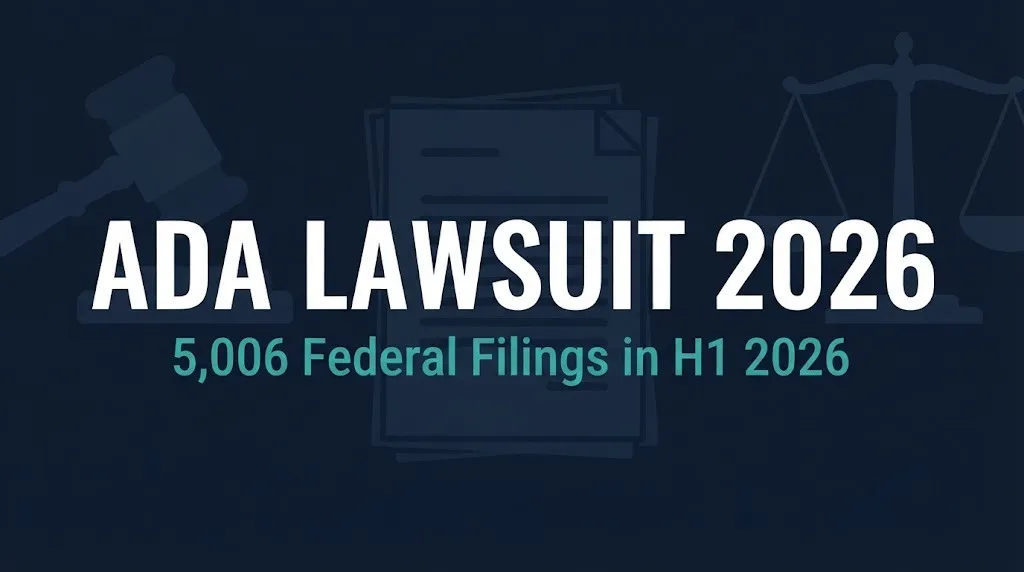
These numbers come from PACER, the federal court docketing system. Seyfarth Shaw’s ADA Title III blog tracks them methodically, removing Title II cases from the count to keep the data clean .
The concentration is striking. California leads with 2,426 filings in the first half of 2026. Florida follows with 709, then Illinois with 505, and New York with 485 . A single firm, Equal Access Law Group, filed 336 of the Illinois cases. In Minnesota, one firm filed 121 of 124 cases .
This is not a broad movement of disabled individuals seeking access. It is a structured litigation model. A small number of firms and repeat plaintiffs drive the volume. Automated WCAG scanning tools let a plaintiffs’ firm scan thousands of websites per day and generate filing-ready evidence .
How much do ADA website lawsuit settlements cost?
ADA website settlements for small and mid-size businesses typically range from $5,000 to $75,000, depending on the defendant’s size, the number of violations cited, and whether the case resolves through a demand letter or formal lawsuit .
Here is the settlement range breakdown:
| Business Size | Typical Settlement | Scenario |
|---|---|---|
| Small business | $5,000 – $10,000 | Standard demand letter, modest remediation |
| Most common range | $5,000 – $20,000 | Single plaintiff, standard WCAG failures |
| Mid-range with remediation | $25,000 – $75,000 | Formal lawsuit, consent decree, monitored remediation |
| Large company / complex | $75,000 – $400,000 | Multiple plaintiffs, class allegations |
| Class action / high-profile | $250,000 – $10M+ | Major retailers, systemic violations, DOJ involvement |
Legal defense costs add another layer. Responding to a simple demand letter costs $3,000 to $5,000 in attorney fees. Defending a full lawsuit through settlement costs $10,000 to $15,000 .
Some businesses negotiate much lower. One company received a $74,999 demand and settled for $2,000 after remediation, a 97% reduction. Another had a case dismissed entirely at zero settlement cost .
Key Takeaway: Small businesses are the primary target because they settle quickly and rarely mount aggressive defenses. A Shopify merchant doing $2 million per year is a viable target for a $5,000 to $10,000 settlement .
How do you file an ADA lawsuit claim?
Filing an ADA lawsuit claim depends on whether you are pursuing a website accessibility claim or an employment discrimination claim. The processes are entirely different.
For employment discrimination under ADA Title I, you must first file a charge with the EEOC. Here are the steps:
- File a charge of discrimination with the EEOC within 180 days of the discriminatory act.
- The EEOC investigates and may attempt conciliation with the employer.
- If conciliation fails, the EEOC may file suit on your behalf.
- You may also request a Notice of Right to Sue to file your own private lawsuit.
- Gather documentation: accommodation requests, medical records, termination letters.
- Consider consulting an employment attorney before filing.
For website accessibility claims under ADA Title III, there is no administrative exhaustion requirement. Plaintiffs can file directly in federal or state court. Tester plaintiffs visit websites, document specific WCAG violations, and file suit .
The legal theory is straightforward. The merchant’s website is a “place of public accommodation.” The tester has been denied equal access. The tester has standing to sue.
What are the most common ADA website violations in 2026?
The most common ADA website violations cited in 2026 filings are WCAG 4.1.2 Name Role Value, WCAG 1.3.1 Info and Relationships, and WCAG 2.1.1 Keyboard operability .
Here are the top five criteria appearing in filings:
- WCAG 4.1.2 Name Role Value (custom buttons missing role or name): appears in 65% to 75% of filings
- WCAG 1.3.1 Info and Relationships (form-label association, heading hierarchy): 55% to 65%
- WCAG 2.1.1 Keyboard (operability): 45% to 55%
- WCAG 1.4.3 Color Contrast: 40% to 50%
- WCAG 4.1.3 Status Messages (cart/error announcements): 30% to 40%
The first five criteria appear in approximately 70% of all citations .
Plaintiffs’ firms use automated tools like axe-core and WAVE to generate specific WCAG-criterion citations against target sites. The scan output produces evidence formatted for filing, such as “WCAG 1.4.3 fail on /products/example: contrast ratio 3.2:1 on .product-title” .
Sites running overlay widgets like AccessiBe, UserWay, or EqualWeb are over-represented in filing populations because they are detectable by automated fingerprint scanners .
Reality Check: You cannot buy your way out of an ADA website lawsuit with an overlay widget. Plaintiff firms specifically target sites using overlays because they signal a compliance posture without actual source-code fixes. Real remediation addresses the code, not the surface.
How does the EEOC resolve ADA employment lawsuits?
The EEOC resolves ADA employment lawsuits through consent decrees that combine monetary payments with mandated policy changes and training. In 2026, the agency has settled multiple cases ranging from $56,000 to $300,000 .
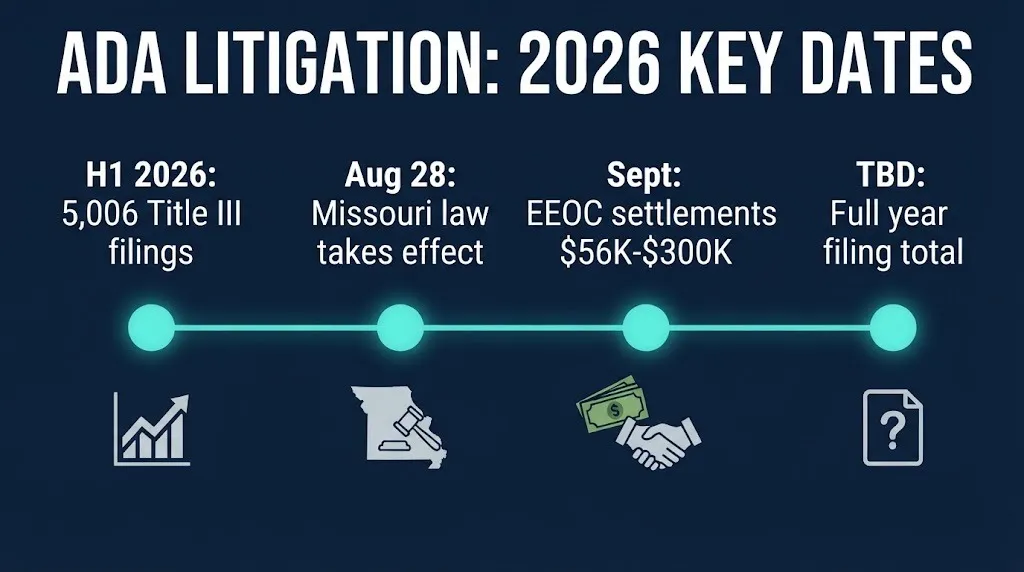
Here are the confirmed 2026 EEOC ADA settlements:
| Employer | Settlement | Key Facts |
|---|---|---|
| AMC | $56,000 | Employee with cerebral palsy forced to quit after denied accommodations |
| FedEx | $280,000 | Dispatchers denied telework accommodation, one forced into retirement |
| Butterball | $230,000 | Employee with cancer fired after third-party administrator failed to process leave |
| The Carlstar Group | $300,000 | Employees fired for lawfully using prescribed medications |
| American Airlines | $200,000 | Blind employee kept on unpaid leave for four years then terminated |
| Walmart | $230,000 | Deaf applicant denied ASL interpreter for interview |
The pattern is clear. Employers that fail to engage in the interactive process, deny accommodations without individualized assessment, or delegate ADA compliance to third-party administrators end up paying.
In the Butterball case, the EEOC’s regional attorney made the point bluntly: “An employer cannot delegate its responsibility for complying with the ADA” .
What happens next in ADA litigation in 2026?
The next steps in ADA litigation depend on whether you are tracking website accessibility cases or employment discrimination matters. Both tracks are active with no slowdown expected.
Expected late 2026: More EEOC settlements as the agency continues enforcing ADA Title I across industries.
Ongoing: Website accessibility filings continue at record pace, with California, Florida, and Illinois leading volume .
August 28, 2026: Missouri’s new law took effect, giving businesses 90 days to respond to website accessibility complaints before a lawsuit can proceed .
No deadline: ADA compliance is continuous. There is no filing window or claim period for website accessibility cases.
The Missouri law is a state-level response to the filing surge. It requires reasonable notice before a lawsuit is filed and gives businesses time to fix violations . Similar bills have been introduced in Congress, but no federal legislation has passed.
Frequently Asked Questions
What is an ADA lawsuit?
An ADA lawsuit is a civil action filed under the Americans with Disabilities Act. It can involve employment discrimination (Title I) or access to public accommodations including websites (Title III).
How much does it cost to settle an ADA website lawsuit?
Small businesses typically settle for $5,000 to $20,000. Mid-size businesses with formal lawsuits and remediation requirements may pay $25,000 to $75,000 or more depending on the scope of violations .
Do I qualify to file an ADA lawsuit?
You may qualify if you have a disability and were denied equal access to a business, service, or employment opportunity because of that disability. Employment claims require filing an EEOC charge first.
What is the deadline to file an ADA lawsuit?
For employment discrimination, you must file an EEOC charge within 180 days of the discriminatory act. For website accessibility claims, the statute of limitations varies by state but is typically two to four years.
Can I still file an ADA website lawsuit in 2026?
Yes, website accessibility lawsuits are being filed at record pace in 2026. There is no claim deadline or settlement fund to join.
How do I protect my business from ADA lawsuits?
Conduct a WCAG 2.2 AA audit, fix source-code violations, publish an accessibility statement with a feedback channel, and avoid relying solely on overlay widgets.
What is the most common ADA lawsuit?
Website accessibility lawsuits under ADA Title III are the most common. Federal filings reached 5,006 in the first half of 2026 alone .
Check Your Compliance, Document Your Accommodations, Act Before You’re Targeted
ADA lawsuits are not going away. The filing volume is climbing, the plaintiffs’ firms are organized, and the settlement costs are real. If you run a business with a website, audit it now. If you employ people with disabilities, document every accommodation request and response.
The most important number to remember: 5,006 federal filings in six months . That pace shows no sign of slowing. Do not wait for a demand letter to take accessibility seriously.