Are lawsuit papers real or could this be a scam
Quick Answer
- Real lawsuit papers are court documents (a summons and complaint) that start a legal case against you, delivered in person, by mail, or by an approved substitute method, never by unsolicited text or email.
- You typically have 21 days to respond in federal court, though state court deadlines commonly run 20 to 30 days depending on where the case was filed.
- Ignoring real lawsuit papers can lead to a default judgment, wage garnishment, or a bank levy, so the single most important date is your response deadline, not a payment demand.
If you just found an envelope on your door, got handed papers by a stranger, or saw “lawsuit papers” trending after a scam alert in your state, you’re not alone. Courts across the country issued fresh warnings in 2026 about fraudulent versions of these documents.
This guide separates what’s actually confirmed by court rules and state agencies from what’s just internet noise, so you know exactly what to check first.
The Facts
| What You Need to Know | Verified Answer |
|---|---|
| What starts a lawsuit | A summons plus a complaint or petition, filed with a court |
| Federal response deadline | 21 days after service (Federal Rule of Civil Procedure 12(a)) |
| Typical state deadline | Varies, commonly 20, 21, or 30 days depending on the state |
| Can they arrive by text or email | No, real court summonses are not served that way |
| What happens if you miss the deadline | The other side can ask the court for a default judgment |
| Cost to respond | Filing an Answer is generally low cost or free at the clerk’s window; some courts have fee waivers |
| Where to verify | The clerk of the court named on your papers |
Not every detail applies to every case. State rules differ, so treat anything not confirmed in your own papers as “check with your local court clerk.”
Are lawsuit papers real or could this be a scam
Real lawsuit papers are court documents that name a specific court, a case number, and the party suing you, the plaintiff. A document missing all three of those is a warning sign.
State attorneys general issued repeated alerts in 2026 about fake versions of this exact scenario. Indiana police flagged a text scam in April that used fake toll and traffic violation notices with no recipient name and no cited statute. Kansas’s attorney general warned in January about emails with subject lines mimicking real federal case numbers, sent to infect devices with malware. New York courts confirmed a similar text scam in March, and a Michigan sheriff’s office flagged fraudulent Department of Justice emails in July.
The pattern across every one of these alerts is the same. Scammers use urgency, a QR code, or a payment link to get you to act before you think.
Key checks for real papers:
- Your full legal name appears on the document.
- A specific court name and county or district are listed.
- There’s a case number formatted like your court’s actual filings.
- The method of delivery is in person, by mail with signature, or a formal substitute service, never a text link.
- There’s no demand to pay a fine or fee through the document itself.
If any of these are missing, don’t click, don’t scan a QR code, and don’t call a number printed on the document.
How much could ignoring lawsuit papers cost you
There’s no fixed dollar figure here. Not yet determined is the honest answer for any specific case, because the cost depends entirely on what the lawsuit is asking for.
What is confirmed is the mechanism. If you don’t respond by your deadline, the plaintiff can ask the court for a default judgment. Once granted, that judgment lets them pursue wage garnishment, a bank account levy, or a property lien, all without you ever presenting a defense.
A default judgment also becomes public record. That can affect your ability to rent an apartment, get a loan, or pass some employment background checks, separate from the underlying debt or claim itself.
| If You Respond On Time | If You Miss the Deadline |
|---|---|
| You can dispute the claim | The court may side with the plaintiff automatically |
| You control the process | The plaintiff controls the process |
| Judgment only after your side is heard | Judgment without your side being heard |
| You may negotiate before a ruling | You negotiate after a judgment already exists, which is harder |
Think of it like a store return without a receipt. You still have options, but skipping the process entirely makes every later step harder and more expensive.
What lawsuit papers actually contain
A standard set of lawsuit papers means the summons and the complaint, sometimes called a petition depending on your state. The summons tells you a case exists and gives your deadline. The complaint explains what the plaintiff claims happened and what they want the court to order.
Look for these elements on any real summons:
- The court’s name at the top of the page.
- A civil action or case number.
- The plaintiff’s name and, often, their attorney’s contact information.
- A stated deadline, usually written directly into the summons text.
- A warning line stating that a default judgment can follow if you don’t respond.
- The clerk of court’s signature or seal.
Some cases also include additional documents: exhibits, a civil cover sheet, or a request for a jury trial. None of that changes your core obligation, which is to read the deadline first and act before it passes.
Key Takeaway: Real lawsuit papers always name a specific court, case number, and deadline, and none of that information arrives through an unsolicited text link.
How to respond to lawsuit papers step by step
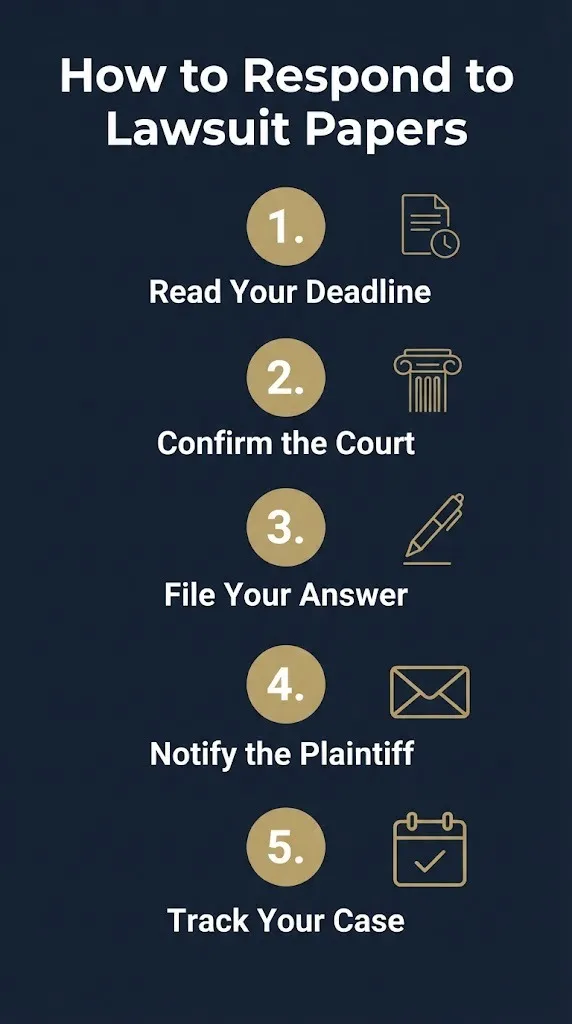
Responding correctly means filing something with the court by your deadline, not just calling the person who sued you. Courts in states like Washington and Illinois publish near-identical guidance on the basic sequence.
- Read the summons first and find your response deadline.
- Identify the exact court, county, and case number listed on the papers.
- Determine whether your case needs an Answer, an Appearance, or both, since some states require both documents.
- Use your court’s official response form if one exists for your case type.
- File your response with the clerk of that specific court, in person, by mail, or through the court’s e-filing portal if available.
- Deliver a copy of your response to the plaintiff or their attorney, and keep proof you did so.
- Calendar any scheduled court date and confirm whether it’s in person or remote.
- If you missed your deadline already, file a response anyway. A late response is usually better than no response.
If you’re not sure your case even needs a full Answer, some courts let you “join” a petition if you agree with everything in it, though that’s a narrower path and worth confirming with the clerk before you sign anything.
How many days do you have to respond to lawsuit papers
In federal court, you generally have 21 days after being served to file an answer or a motion under Rule 12. That number comes directly from Federal Rule of Civil Procedure 12(a)(1)(A)(i).
If the defendant waived formal service under Rule 4(d), the deadline extends to 60 days from when the waiver request was sent, or 90 days if you were served outside any U.S. judicial district. When the United States government, one of its agencies, or a federal officer is sued in an official capacity, that deadline is 60 days as well.
State courts vary. Deadlines of 20, 21, or 30 days are common across different states, and some calculate from the date you were served rather than the date printed on the paperwork. A few states extend timelines further in specific situations, such as family law cases involving someone in custody.
Bottom line: the deadline printed on your specific summons controls, not a generic number you saw online. Always confirm it against your own document.
What happens if you ignore lawsuit papers
Ignoring real lawsuit papers does not make a case disappear. It typically speeds up the other side getting what they asked for.
If you don’t respond by your deadline, the plaintiff can file a motion for default. The clerk or a judge then reviews whether service was proper and the deadline actually passed. Once confirmed, the court enters a default judgment against you.
From there, enforcement tools can include:
- Wage garnishment, where a portion of your paycheck is withheld directly.
- Bank account levies, where funds are pulled from your account.
- Property liens, which can block a home sale or refinance until resolved.
A default judgment isn’t necessarily permanent. If you can show a valid reason you missed the deadline, such as improper service or a documented emergency, you may be able to ask the court to set it aside. That process is harder, slower, and far less certain than responding on time in the first place.
Key Takeaway: A missed deadline doesn’t end the case, it just removes your voice from how it ends.
How lawsuit papers get delivered to you
Delivery is called “service of process,” and it follows specific rules depending on the court. The most common method is personal service, where a process server or sheriff’s deputy hands you the documents directly.
If personal service fails after reasonable attempts, many states allow substitute service, such as leaving papers with another adult at your home and mailing a copy afterward. Some states permit service by publication in narrow circumstances, typically when a defendant genuinely can’t be located.
A process server generally can leave documents at your feet even if you refuse to physically take them, according to guidance from process-serving professionals. Refusing to touch the papers doesn’t stop service from being valid.
What real service does not look like:
| Method | Legitimate for Initial Service |
|---|---|
| In-person delivery by process server or sheriff | Yes |
| Certified mail with signature, where state rules allow it | Often, depending on state |
| Substitute service on an adult at your residence | Often, with follow-up mailing |
| Unsolicited text message with a link | No |
| Unsolicited email from a non-.gov address | No |
| Social media message | No |
Can lawsuit papers be sent by text or email
Generally, no. Courts and attorneys general across multiple states confirmed in 2026 that initial service of a lawsuit is not done through unsolicited text messages or personal email accounts.
The Kansas Attorney General’s office stated plainly that “courts never serve legal documents via email” after tracking a scam using fake subject lines like “Legal Compliance Required: Court Case #USDC-2026-[Number].” New York court officials made a similar public statement after a text scam impersonating criminal court notices spread across the state in March 2026.
Legitimate federal court email addresses always end in .gov. Scammers commonly use .com or .org addresses instead, and often omit basic case-specific details a real filing would include, like your actual name or a real statute citation.
Reality Check
No court sends you a text or email demanding immediate payment to avoid a lawsuit. Filing your response with the court clerk is free or low cost, never something that requires paying a “processing fee” to a stranger first. If a message pressures you to scan a QR code or click a link before you can even see the actual case details, treat it as a scam and verify directly with the clerk’s office using a phone number from the court’s official website.
How to check if lawsuit papers are legitimate before you act
Verifying real papers takes a few extra minutes and can save you from a costly scam or a missed real deadline.
- Write down the court name, county or district, and case number exactly as printed.
- Look up that court’s official phone number independently, never using a number printed on the suspicious document.
- Call the clerk of court and ask them to confirm the case number is real and associated with your name.
- Ask whether the document was actually filed and served, or whether it’s unrecognized by the court.
- If it’s real, ask the clerk what response forms apply to your case type.
- If it’s fake, don’t respond to the sender, and consider reporting it to your state attorney general’s consumer protection division.
This single phone call is the fastest way to separate a real deadline from a scam script designed to rush you.
What to do if you can’t afford a lawyer
You don’t need to hire an attorney to file a basic response and protect your right to be heard. Many courts publish free response forms specifically for self-represented defendants.
Options worth checking before your deadline:
- Legal aid organizations in your state, which often handle civil matters for free or reduced cost based on income.
- Court self-help centers, staffed at many county courthouses specifically to help people file without a lawyer.
- Limited-scope representation, where an attorney helps with just one part of the case, like drafting the Answer, for a lower fee than full representation.
- Bar association referral services, which can connect you to a consultation, even a brief one, before your deadline passes.
Filing something on your own, even a basic Answer using a court’s standard form, is almost always better than filing nothing at all.
How to find out if you have a pending lawsuit against you
If you suspect a case exists but haven’t been formally served yet, you can often check directly with the court rather than waiting.
Most county and state courts maintain public case search portals where you can search by your name. Federal cases can be searched through the federal judiciary’s electronic records system, commonly known by its acronym among attorneys and paralegals.
If an online search isn’t available in your area, calling or visiting the clerk’s office in the county where you live or work is the most reliable next step. Bring identification, since some courts require it before releasing case information tied to your name.
Key Takeaway: You have the right to confirm whether a case exists before you respond to anything, so use the court directly instead of trusting a message’s own instructions.
What happens after you respond to lawsuit papers
Filing your Answer or Appearance is the start of the case moving forward, not the end of your involvement.
- Immediately after filing: the court has your response on record, and a default judgment can no longer be entered without further notice to you.
- Following weeks: the plaintiff or the court may schedule a hearing date, or the case may move into a discovery phase where both sides exchange information.
- If you received a 30-day summons: you may not have a court date yet until after you file, so watch for a notice by mail.
- Throughout the case: read every court notice carefully and keep your contact information current with the clerk, since missed notices can still hurt your case even after you’ve responded once.
What Happens Next
Now through your deadline: confirm the exact response date on your specific summons and decide whether you need an Answer, an Appearance, or both.
Within days of filing: the court adds your response to the case file, closing off the risk of an uncontested default judgment.
Expected weeks after filing: you should receive notice of any scheduled hearing or next procedural step, by mail or through the court’s e-filing system.
Ongoing: monitor the case for further notices, and consult the clerk’s self-help resources or a legal aid group if your situation changes.
Frequently Asked Questions
What are lawsuit papers?
Lawsuit papers usually mean a summons and a complaint or petition, the documents that officially start a civil case against you.
The summons states your deadline to respond, and the complaint explains what the plaintiff is claiming.
How many days do I have to respond to lawsuit papers?
Federal cases generally give you 21 days after service, under Federal Rule of Civil Procedure 12(a).
State court deadlines vary, commonly 20, 21, or 30 days, so always check the number printed on your own summons.
Can lawsuit papers be served by text message?
No, courts have confirmed that legitimate service of process is not done through unsolicited text messages.
Multiple state attorneys general issued warnings in 2026 about text scams impersonating court summonses.
What happens if I ignore lawsuit papers?
The plaintiff can ask the court for a default judgment against you without your side being heard.
That can lead to wage garnishment, a bank account levy, or a property lien.
Do I need a lawyer to respond to a lawsuit?
No, you can file a response yourself using your court’s standard forms, though legal advice can still help.
Legal aid organizations and court self-help centers often assist self-represented defendants for free or low cost.
How do I know if lawsuit papers are a scam?
Check for a specific court name, real case number, and your correct legal name on the document itself.
If it demands payment through a QR code or link, or came by unsolicited text or email, verify directly with the court clerk before responding.
What if I missed my deadline to respond?
File a response anyway, since a late response is generally better than no response at all.
You may also be able to ask the court to set aside a default judgment if you show a valid reason for the delay.
How can I check if a lawsuit was actually filed against me?
Search your court’s public case lookup portal by name, or call the clerk of court in your county directly.
Never rely on a phone number or link printed inside a suspicious document to verify it.
If you’ve been handed papers or found something in your mailbox, don’t wait to figure out if it’s real. Confirm the court and case number with the clerk directly, then calendar your response deadline the same day.
The single most important number here is your own deadline, whether that’s the federal standard of 21 days or whatever your state’s rules set for your specific case.