Settlement in Spanish 2026: What the Word Actually Means in Legal Cases
Quick Answer
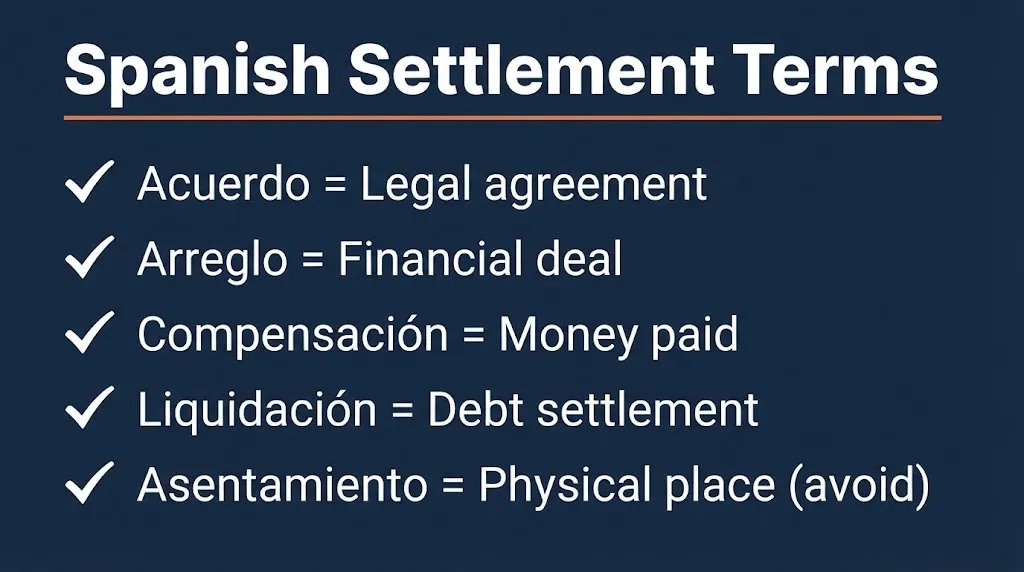
- “Acuerdo” is the standard translation for a settlement agreement in legal Spanish.
- “Arreglo” works for financial or insurance settlements, and “compensación” means the money paid out.
- “Liquidación” is used for settling debts or claims, and “asentamiento” means a physical settlement, not a legal one.
If you searched “settlement in Spanish,” you probably need the right word for a legal document, a court case, or a claims form. The answer changes based on what you’re actually describing.
Spanish legal Spanish uses different terms for a settlement agreement, the money from a settlement, and a settlement in the geographic sense. Using the wrong one can confuse a court, an insurance adjuster, or a claims administrator.
This guide breaks down each translation, shows which one fits which situation, and explains the legal terms you’ll see on official Spanish-language settlement notices. The most common mistake: using “asentamiento” for a legal settlement. That word means a place where people live, not a court resolution.
The Facts
| English Term | Spanish Translation | When to Use It |
|---|---|---|
| Settlement (agreement) | Acuerdo | Legal agreements, court resolutions |
| Settlement (financial) | Arreglo | Insurance claims, disputes |
| Settlement (money paid) | Compensación | Payouts, damages |
| Settlement (debt/claim) | Liquidación | Debts, bills, claims |
| Settlement (geographic) | Asentamiento | Physical settlements, communities |
What does “settlement” mean in Spanish legal contexts?
The standard translation for a legal settlement is “acuerdo” . This is the word you’ll see on court documents, settlement notices, and official claims forms in Spanish.
“Acuerdo” means an agreement or resolution reached between parties. In a legal context, it specifically refers to a settlement that ends a dispute without a full trial . The phrase “llegar a un acuerdo” means “to reach a settlement.”
When a class action settles, the Spanish-language notice typically uses “acuerdo” for the settlement itself. The phrase “acuerdo de acción colectiva” translates directly to “class action settlement” .
You might also see “acuerdo transaccional,” which is a more formal legal term for a settlement agreement. “Transacción” in this context means a compromise or settlement, not a commercial transaction.
What is the Spanish word for a financial settlement?
The Spanish word for a financial settlement is “arreglo” in most contexts. This term fits insurance claims, business disputes, and situations where money changes hands to resolve a disagreement.
“Arreglo” carries the sense of a deal or compromise . You’ll see it in phrases like “llegar a un arreglo con la compañía de seguros,” which means “to reach a settlement with the insurance company” .
For the actual money paid in a settlement, the correct word is “compensación.” A Collins Dictionary example shows this clearly: “she accepted an out-of-court settlement of £4000” translates to “aceptó una compensación de 4000 libras” .
So if you’re describing the agreement, use “arreglo.” If you’re describing the money, use “compensación.”
How do you say “class action settlement” in Spanish?
“Class action settlement” translates to “acuerdo de acción colectiva” in Spanish . This is the term you’ll see on official court notices for class action settlements in the United States.
The word “acción colectiva” is the standard Spanish term for a class action lawsuit. A Spanish-English legal glossary confirms this translation for court contexts .
On actual settlement notices, you’ll see phrases like “Miembro de la Demanda Colectiva” for “Class Action Member” and “Reclamante Aprobado” for “Approved Claimant” .
The notice also uses “Administrador de Reclamos” for the Claims Administrator and “Fondo de la Demanda Colectiva” for the Settlement Fund.
These terms appear on official Spanish-language versions of settlement notices, which courts require when a class includes Spanish-speaking members.
What does “liquidación” mean in a settlement context?
“Liquidación” means the settling of a debt, bill, or claim in Spanish. It carries a financial or accounting sense rather than the sense of a negotiated agreement.
Collins Dictionary defines it as the translation for “settlement” when referring to payment of a claim, bill, or debt . The example given is “in full settlement of,” which translates as “a cuenta de la total liquidación de” .
You’ll see “liquidación” in contexts like insurance payouts, debt resolution, and final accounting. It implies closing out a financial obligation, not reaching a mutual agreement.
For a legal settlement where both sides negotiate and compromise, “acuerdo” or “arreglo” fits better. “Liquidación” is more one-directional: paying what’s owed.
What is the difference between “acuerdo” and “arreglo”?
The difference between “acuerdo” and “arreglo” is subtle but real. “Acuerdo” is the broader term for any agreement or resolution. “Arreglo” leans toward a practical or financial resolution of a dispute.
“Acuerdo” works for peace treaties, court settlements, and formal agreements of any kind . It’s the safer choice in legal writing.
“Arreglo” fits situations where parties work out a compromise, especially involving money. It’s common in insurance and business contexts .
Think of it this way: “acuerdo” is the formal agreement, and “arreglo” is the deal you work out. Both can describe a settlement, but “acuerdo” carries more legal weight.
In practice, Spanish legal documents often use both terms interchangeably. If you’re drafting a formal notice, “acuerdo” is the standard choice.
What are common Spanish legal terms in settlement notices?
Spanish-language settlement notices use specific legal terms that don’t always translate word-for-word. Here are the ones you’ll see most often.
| English | Spanish | Context |
|---|---|---|
| Class Action | Demanda Colectiva | The lawsuit itself |
| Class Member | Miembro de la Demanda Colectiva | Eligible person |
| Approved Claimant | Reclamante Aprobado | Person whose claim was accepted |
| Claims Administrator | Administrador de Reclamos | Company handling claims |
| Settlement Fund | Fondo de la Demanda Colectiva | Money set aside for payouts |
| Opt-Out | Excluirse | Leaving the class |
| Pro Rata | Prorrateado | Proportional distribution |
| Cy Pres | Cy Près | Leftover funds to charity |
The phrase “opt-out” in Spanish is “excluirse del acuerdo,” which means “to exclude oneself from the settlement.” The deadline for opting out is “fecha límite para excluirse.”
“Prorrateado” describes how payments get adjusted up or down based on how many valid claims are filed. A notice might say “sujeto a un posible aumento o disminución prorrateado” .
What does “asentamiento” mean and why you should avoid it?
“Asentamiento” means a physical settlement, like a village, community, or encampment. It does not mean a legal settlement.
This is the most common translation mistake. Someone sees “settlement” and reaches for “asentamiento” because it looks similar. But using it in a legal context will confuse your reader.
The Collins Dictionary entry for “settlement” lists “establecimiento” and “colonización” for the act of settling people or land . Those are also geographic or demographic terms, not legal ones.
If you’re writing about a court case or a claims form, never use “asentamiento.” Stick with “acuerdo,” “arreglo,” or “compensación.”
Key Takeaway: Use “acuerdo” for the legal agreement, “arreglo” for the financial deal, “compensación” for the money paid, and never “asentamiento” in a legal context.
How do you use settlement terms in a Spanish sentence?
Here are practical examples of how these terms appear in real Spanish sentences.
Reaching a settlement:
“Las partes llegaron a un acuerdo para resolver la demanda.”
(The parties reached a settlement to resolve the lawsuit.)
Accepting a settlement amount:
“Ella aceptó una compensación de $4,000 a cambio de no seguir con el juicio.”
(She accepted a $4,000 settlement in exchange for not continuing the trial.)
Settling with an insurance company:
“Finalmente, llegaron a un arreglo con la compañía de seguros.”
(Finally, they reached a settlement with the insurance company.)
Class action settlement notice:
“El Acuerdo, y el hecho de que usted sea un Miembro de la Demanda Colectiva, depende de que el Tribunal conceda la aprobación final.”
(The Settlement, and the fact that you are a Class Member, depends on the Court granting final approval.)
Opting out:
“Si no desea ser parte del acuerdo, debe excluirse antes de la fecha límite.”
(If you do not wish to be part of the settlement, you must opt out before the deadline.)
What is a “cy près” settlement in Spanish?
A “cy près” settlement is called “acuerdo cy près” in Spanish. The term describes a settlement where leftover funds go to a charity or nonprofit instead of individual claimants .
The concept comes from the French phrase “cy près comme possible,” meaning “as close as possible” . When it’s too expensive to distribute small payments to many people, courts sometimes direct the money to organizations that serve the class’s interests.
In Spanish legal writing, you’ll see phrases like “acuerdos cy près en las acciones de clase” for “cy près settlements in class actions” .
The term stays in French even in Spanish documents. It’s a technical legal phrase that doesn’t have a Spanish translation.
Frequently Asked Questions
What is the Spanish word for settlement?
“Acuerdo” is the standard translation for a legal settlement. “Arreglo” works for financial settlements, and “compensación” means the money paid.
How do you say “class action settlement” in Spanish?
“Acuerdo de acción colectiva” is the standard translation. You’ll see this phrase on official Spanish-language class action notices.
What does “arreglo” mean in legal Spanish?
“Arreglo” means a settlement or compromise, especially one involving money. It’s common in insurance and business disputes.
Is “asentamiento” the right word for a legal settlement?
No. “Asentamiento” means a physical settlement, like a village. Never use it for a legal settlement.
What does “compensación” mean in a settlement context?
“Compensación” means the money paid in a settlement. It’s the translation for the financial payout, not the agreement itself.
How do you say “opt out” in Spanish for a settlement?
“Excluirse” means to opt out. The full phrase is “excluirse del acuerdo.”
What is “liquidación” in a legal settlement?
“Liquidación” means the settling of a debt or claim. It’s used for financial obligations, not negotiated agreements.
What is a “cy près” settlement called in Spanish?
It’s called “acuerdo cy près.” The French term stays the same in Spanish legal writing.
Your next step
If you’re filling out a Spanish-language settlement form, look for “acuerdo” for the settlement itself and “compensación” for the money. Never trust a document that uses “asentamiento” in a legal context.
If you’re translating a settlement notice for a class action, check the official court-approved Spanish version. Courts provide these when the class includes Spanish speakers, and they use the correct legal terminology.