DWI Defense Lawsuit 2026: What a DWI Defense Actually Is, What It Costs, and Why There Is No Settlement to Claim
Quick Answer
- A DWI defense lawsuit is not a real case type. DWI defense is criminal. DWI injury claims are civil.
- Defense costs run about $1,500 to $5,000 for a first offense and $5,000 to $25,000 for a felony.
- No claim deadline exists because there is no public settlement fund tied to this phrase.
You searched for DWI defense lawsuit because you or someone you know is facing a drunk driving charge, or you got hurt by an impaired driver and want to know who pays. The phrase mixes two different legal worlds, and that confusion is exactly what scam pages exploit.
There is no such thing as a “DWI defense lawsuit” with a settlement fund. Criminal DWI defense is about avoiding a conviction, losing your license, or jail time. A civil DWI claim is about recovering money for injuries. They can run at the same time, but they are not the same case.
The number that matters most depends on which side you are on. If you are charged, a first-time DWI defense typically costs $1,500 to $5,000, while a felony can run $5,000 to $25,000 or more . If you were hurt, your recovery depends on the driver’s insurance and your state’s injury laws.
This article separates the two paths, explains what each costs and requires, and shows you how to spot a fake “DWI settlement” offer before you hand over your information.
The Facts
| Item | Detail |
|---|---|
| Case Type | Not a settlement case. Criminal defense or civil injury claim |
| Status | No public fund, no administrator, no claim deadline |
| Fund Size | None. No settlement pool exists for this phrase |
| Est. Per Person | Not applicable. Costs and recoveries vary by path |
| Claim Deadline | None. Criminal and civil deadlines are separate |
| Administrator | None. No claims process exists |
| Proof Needed | Not applicable. No claim form exists |
Is a DWI Defense Lawsuit Real or a Scam?
A DWI defense lawsuit is not a real legal category, and any page offering a settlement for it is a scam. There is no fund, no administrator, and no claim form. The phrase is a search term, not a case type.
What exists are two separate things. First, criminal defense: you hire a lawyer to fight the DWI charge in criminal court. Second, civil claims: if someone was injured by a drunk driver, that person can sue for damages in civil court .
Scam pages use confusing phrases like “DWI defense lawsuit” because they know people are scared and searching fast. A headline that promises money or a quick fix gets clicks. A real DWI defense does not pay you. It costs you.
Key Takeaway: A DWI defense lawsuit is not a real settlement category, and no legitimate fund exists for the public to claim.
How Much Does a DWI Defense Cost in 2026?
A DWI defense costs between $1,500 and $5,000 for a first offense or misdemeanor in most markets, and $5,000 to $25,000 or more for a felony, especially if the case goes to trial . Fees are usually flat, not hourly, because the scope of a DWI case is predictable.
Public defenders are available at no cost if you qualify by income . That option is real and legitimate. Many people are well served by a public defender, especially on a first offense with no aggravating factors.
| Charge Level | Typical Fee Range |
|---|---|
| First offense or misdemeanor DWI | $1,500 to $5,000 |
| Felony DWI | $5,000 to $25,000 or more |
| Public defender | Free if income-qualified |
The fee usually covers the pre-trial stage. Ask any lawyer whether trial is included or billed separately. That one question can save you thousands later.
Reality Check
Reality Check: No one texts you money to fight a DWI. Defense costs money, and no court pays you to be a defendant. If a page promises a “DWI defense settlement” or asks for a fee to release funds, it is collecting your data or your cash. Real defense lawyers charge you, and real injury claims pay you through insurance or a civil judgment, not a public fund.
How Do You Defend Against a DWI Charge?
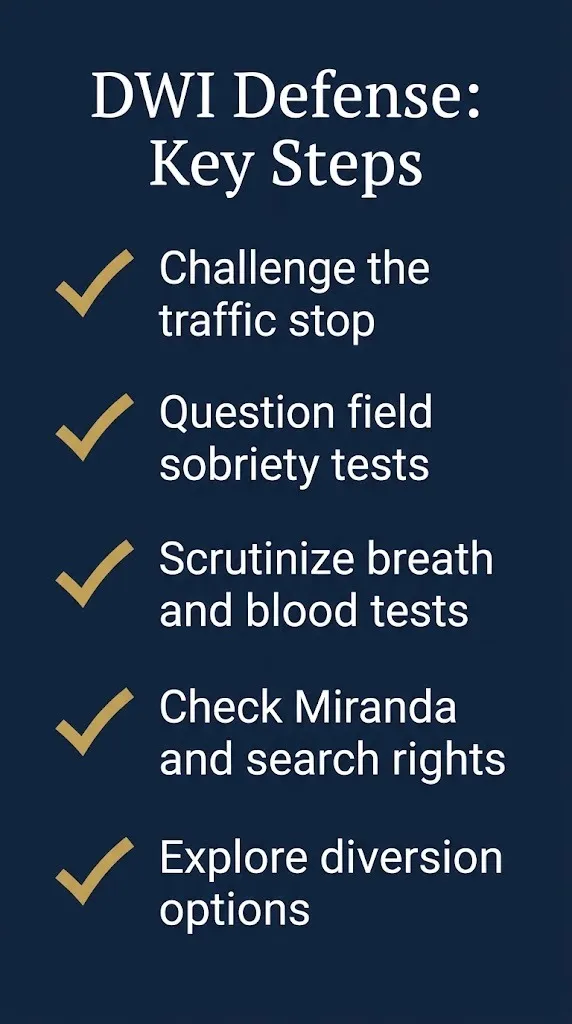
You defend against a DWI charge by challenging the state’s evidence at every stage: the traffic stop, the field sobriety tests, the chemical tests, and your constitutional rights. The prosecution must prove its case beyond a reasonable doubt, and your lawyer’s job is to find the weak links .
Here are the core defense strategies a lawyer may use:
- Challenge the traffic stop. Police need reasonable suspicion to pull you over. No valid reason means the evidence may be thrown out .
- Question the field sobriety tests. These tests are subjective and affected by lighting, pavement, and medical conditions .
- Scrutinize the breath test. The machine must be approved, calibrated, and properly maintained. The officer must be certified .
- Examine the blood test. Chain of custody, lab procedures, and storage can all create doubt .
- Check for Miranda violations. Statements made without warnings may be inadmissible .
- Explore alternative sentencing. Diversion, probation, or reduced charges may be possible for first offenders .
Key Takeaway: DWI defense is about attacking the evidence, not filing a claim, and the burden is always on the prosecution.
What Is the Difference Between DWI Defense and a DWI Civil Lawsuit?
A DWI defense is a criminal matter where you are the defendant. A DWI civil lawsuit is a personal injury case where you are the plaintiff if someone else drove drunk and hurt you. Same event, opposite sides, different courts.
If you are charged with DWI, you need a defense lawyer. Your goal is to avoid conviction, protect your license, and stay out of jail . If you were hit by a drunk driver, you need a personal injury lawyer. Your goal is to recover medical bills, lost wages, and pain and suffering .
The two cases can overlap. Statements you make in the criminal case can be used against you in the civil case, and a conviction can be used as evidence of fault in the civil case . That is why lawyers who handle both sides advise coordinated strategy from day one.
How Long Do You Have to File a DWI Civil Lawsuit?
The deadline to file a DWI civil lawsuit depends on your state, and it runs from one to four years for most injury claims. Missing it ends your right to recover, no matter how strong the evidence.
| Deadline | States (examples) |
|---|---|
| 1 year | Kentucky, Louisiana, Tennessee |
| 2 years | California, Texas, Florida, New York, Illinois, Georgia |
| 3 years | Massachusetts, New Jersey, Pennsylvania |
| 4 years | Maine |
Wrongful death claims sometimes have different deadlines in the same state . Dram shop claims against a bar or host that overserved the driver can have shorter windows than the injury claim itself.
For criminal DWI charges, there is no “filing deadline” you control. The prosecutor files, and your lawyer responds. The clock that matters is your court dates and your license hearing, which can come fast.
Key Takeaway: Civil DWI injury deadlines range from one to four years by state, while criminal DWI timelines are set by the court.
Can You Sue Your DWI Defense Lawyer for Malpractice?
You can sue your DWI defense lawyer for malpractice in some states, but the bar is high and the rules are strict. Most states require you to prove actual innocence or that you got post-conviction relief before a malpractice claim can proceed .
Texas requires exoneration before bringing a criminal malpractice claim . Tennessee requires post-conviction relief . Virginia and Washington require both post-conviction relief and actual innocence . A few states, like Utah, do not impose the same prerequisites .
This is not a quick fix for a bad outcome. A lawyer who loses your case is not automatically negligent. You have to show that the lawyer’s errors caused the conviction and that you would not have been convicted otherwise.
What Happens Next If You Are Facing a DWI Charge?
The process moves quickly after an arrest, and the first deadlines are the ones that matter most.
Within days: Arraignment and license suspension proceedings begin. In New York, for example, an immediate suspension can be challenged at a Pringle hearing, but the window is narrow .
Expected weeks 1 to 4: Hire a lawyer and request discovery. Police reports, breath or blood test records, and dashcam footage need to be preserved .
Expected weeks 4 to 12: File motions to suppress evidence, challenge the stop, or contest the chemical tests .
Expected months 3 to 6: Plea negotiations or trial setting. Many cases resolve before trial.
Not yet confirmed: Any specific timeline for your case. Every court moves at its own pace.
Frequently Asked Questions
Is a DWI defense lawsuit a real thing?
No. DWI defense is a criminal matter, and DWI injury claims are civil lawsuits. There is no settlement fund called a DWI defense lawsuit.
How much does a DWI defense lawyer cost?
A first offense or misdemeanor typically costs $1,500 to $5,000, and a felony can run $5,000 to $25,000 or more .
Can I get a public defender for a DWI?
Yes, if you qualify by income. Public defenders are available at no cost to eligible defendants .
What is the difference between DWI defense and a DWI civil claim?
DWI defense is criminal and focuses on avoiding conviction. A DWI civil claim is a lawsuit for money damages if someone was injured.
How long do I have to sue a drunk driver?
It depends on your state. Most deadlines range from one to four years, but some states are shorter for dram shop claims .
Can I sue my DWI lawyer if I lose?
In some states, yes, but you usually must prove actual innocence or get post-conviction relief first .
Does a DWI conviction affect a civil lawsuit?
Yes. A conviction can be used as evidence of fault in a civil injury case, which can increase settlement pressure .
Is there a settlement I can claim for a DWI case?
No public settlement exists. Civil DWI cases are individual claims resolved through insurance or court, not a public fund.
The Bottom Line
A DWI defense lawsuit is not a settlement you can claim. It is either a criminal defense you pay for or a civil injury claim you file if someone hurt you. The first offense defense cost runs $1,500 to $5,000, and the civil filing deadline in most states is between one and four years. Do not wait on either one.