Sales Compensation Software in 2026: What It Costs, Who It’s For, and What Buyers Get Wrong
Quick Answer
- Sales compensation software automates commission calculations, quota tracking, and payout reporting for sales teams.
- Pricing ranges from $20,000 to $500,000+ annually depending on user count and deployment size.
- Only 33% of organizations have automated their commission process end-to-end, leaving most teams reliant on spreadsheets.
If you are managing commissions in spreadsheets, you are not alone. Two-thirds of organizations still run some portion of their commission process manually, and 93% field rep inquiries every single pay period about what they are owed.
That is the problem sales compensation software exists to solve. But the market is crowded, the pricing is opaque, and the promises from vendors do not always match what users experience after implementation.
This article breaks down what these platforms actually cost, who the major players are, where implementation goes wrong, and what questions to ask before you sign a contract.
The Facts
| Item | Details |
|---|---|
| Market Size (2025) | $5.41 billion globally |
| Projected Market (2034) | $9.99 billion |
| CAGR (2026-2034) | 7.05% |
| Typical Annual Cost (10-50 payees) | $20,000 to $50,000 |
| Typical Annual Cost (50-200 payees) | $50,000 to $150,000 |
| Implementation Fees | $10,000 to $100,000+ depending on complexity |
| Payout Error Rate | 64% of organizations experienced errors in the past year |
| End-to-End Automation Rate | Only 33% of organizations |
What Is Sales Compensation Software?
Sales compensation software, also called incentive compensation management (ICM) software or sales performance management (SPM) software, automates the calculation, tracking, and reporting of variable pay for sales teams.
The core function is straightforward. You load your deal data from a CRM. You define your commission rules. The software calculates what each rep earned, generates statements, and tracks disputes.
But the category has expanded. Modern platforms now include quota planning, territory management, forecasting, and AI-powered plan design. Vendors like CaptivateIQ launched AI agents in May 2026 that build compensation plans from natural language prompts.
The market splits into two camps. Enterprise platforms like Xactly, Varicent, and Anaplan handle complex, multi-source commission structures for large organizations. Mid-market tools like QuotaPath, Everstage, and Qobra focus on speed of implementation and rep-facing transparency.
Your choice depends less on features and more on how complex your plans actually are. A company with one simple commission rate does not need a platform built for layered accelerators, SPIFs, and multi-currency territories.
Who Are the Major Sales Compensation Software Vendors?
The major vendors include Xactly, Varicent, CaptivateIQ, QuotaPath, Everstage, Performio, Anaplan, Oracle, SAP (CallidusCloud), and Qobra, with newer entrants like EasyComp and Kennect targeting specific segments.
Gartner Peer Insights shows Xactly Incent and Varicent both rated at 4.4 stars, though Xactly has significantly more reviews (274 versus 104), suggesting broader market adoption. Anaplan sits at 4.3 stars with 183 reviews.
| Vendor | Gartner Rating | Review Count | Best For |
|---|---|---|---|
| Xactly Incent | 4.4 | 274 | Enterprise, complex plans |
| Varicent | 4.4 | 104 | Enterprise, flexible data management |
| Anaplan | 4.3 | 183 | Enterprise planning and modeling |
| CaptivateIQ | Not listed on Gartner comparison | N/A | Mid-market, AI plan building |
| QuotaPath | Not listed on Gartner comparison | N/A | SaaS, rep-facing transparency |
| Everstage | Not listed on Gartner comparison | N/A | Mid-market, broad integrations |
Everstage reviewers on TrustRadius frequently cite “clear visuals,” “real-time visibility,” and “accurate calculations” as strengths, while noting that complex commission plans may require workarounds.
How Much Does Sales Compensation Software Cost?
Sales compensation software costs between $20,000 and $500,000+ annually depending on the number of payees, plan complexity, and deployment scale, with implementation fees adding $10,000 to $100,000+ to first-year costs.
Vendr transaction data breaks down typical contract values by company size:
| Deployment Size | Annual Contract Value | Implementation Fees |
|---|---|---|
| Small (10-50 payees) | $20,000 to $50,000 | $5,000 to $15,000 |
| Mid-market (50-200 payees) | $50,000 to $150,000 | $10,000 to $30,000 |
| Enterprise (200+ payees) | $150,000 to $500,000+ | $30,000 to $100,000+ |
Performio pricing follows a similar pattern. Small deployments (20-50 users) run $25,000 to $60,000 annually, mid-market (50-150 users) runs $60,000 to $150,000, and enterprise (150+ users) runs $150,000 to $300,000+, with per-user costs averaging $50 to $120 per month depending on scale.
The hidden costs matter as much as the subscription. Vendr data shows annual price escalators typically run 3% to 7%, and custom integrations, premium support, and ongoing professional services are often billed separately.
Key Takeaway: Budget for implementation and hidden costs at 20% to 30% of your first-year subscription. The software license is just the starting number.
What Are the Hidden Costs of Sales Compensation Software?
The hidden costs of sales compensation software include implementation fees, custom integrations, premium support, training, data overages, and annual price escalators that can add 20% to 40% to your total cost of ownership.
Here is what vendors often do not include in the initial quote:
- Implementation and data migration. Plan configuration, data loading, and integration setup are quoted separately. CaptivateIQ implementation alone runs $10,000 to $100,000+ depending on complexity.
- Custom integrations. Standard connectors are usually included, but connecting to proprietary systems or building custom API workflows adds $5,000 to $25,000+ annually.
- Premium support. Dedicated customer success managers and faster SLAs cost an additional 15% to 25% of annual subscription.
- Training and enablement. Initial training is often included, but advanced sessions for new hires or complex admin workshops run $2,000 to $10,000 per session.
- Annual escalators. Renewal contracts typically include 3% to 7% annual price increases unless you negotiate a cap.
A delayed tax refund gives you the same sinking feeling. You budgeted for the number you were quoted, and then the extras showed up. The difference is that software contracts lock you in for a year or more.
Which Sales Compensation Software Is Best for Small Teams?
The best sales compensation software for small teams is one that implements quickly, requires minimal admin overhead, and gives reps self-service visibility without a dedicated RevOps hire to manage it.
QuotaPath is frequently cited for fast time-to-value and ease of use in this segment. Software Advice notes that QuotaPath is “voted Best ROI and Easiest to Use in commission software” with “no minimum user requirements”.
For teams under 50 payees, the practical requirements are usually:
- Pre-built CRM connectors (Salesforce, HubSpot)
- Templates for common commission structures
- Rep-facing dashboards that do not require admin intervention
- Transparent pricing without enterprise minimums
Qobra, a French platform with 437 reviews on Software Advice, gets high marks for simplicity. One reviewer noted it “automates commission calculations, eliminating common errors associated with the use of spreadsheets”.
The trade-off is flexibility. Smaller platforms handle standard commission plans well but may struggle with highly customized structures. One Everstage reviewer said the tool is “less suited to complex commission plans where you might find yourself needing to work around it”.
Reality Check: No software will fix a broken commission plan. If your plan design is confusing to reps or your CRM data is incomplete, the software will calculate wrong numbers faster. Clean your plan logic and data pipeline before you buy.
What Are the Biggest Implementation Problems?
The biggest implementation problems are delayed timelines, data quality issues, and the gap between what vendors sell during demos and what actually works in production.
CaptivateIQ’s 2026 State of ICM report found that only 34% of organizations report from a single source of truth for planning and incentives. Only 32% are immediately aware when quotas or territories change. And 64% experienced payout errors in the past year.
The report describes the problem directly: “Nobody bought bad software. They just never finished the installation. It’s the result of modernizing tools without modernizing how those tools connect, communicate, and move together”.
Common implementation failures include:
- Dirty CRM data. The software inherits your data problems. If deal records are incomplete, commissions will be wrong.
- Underestimated complexity. Complex plans that work in Excel may not map cleanly to software rules.
- No internal owner. Assigning implementation to a busy sales ops person without dedicated time leads to delays.
- Scope creep. Adding plans, departments, or regions mid-implementation extends the timeline and cost.
Xactly has a 4.4 rating on Gartner but users note “the main screen appears to be quite outdated, slow and inconvenient to navigate”. One reviewer summarized it as “Good for comp admins, bad for sales people”.
How Do You Choose the Right Sales Compensation Software?
Choosing the right sales compensation software means matching platform complexity to your actual plan complexity, not to what vendors say you need.
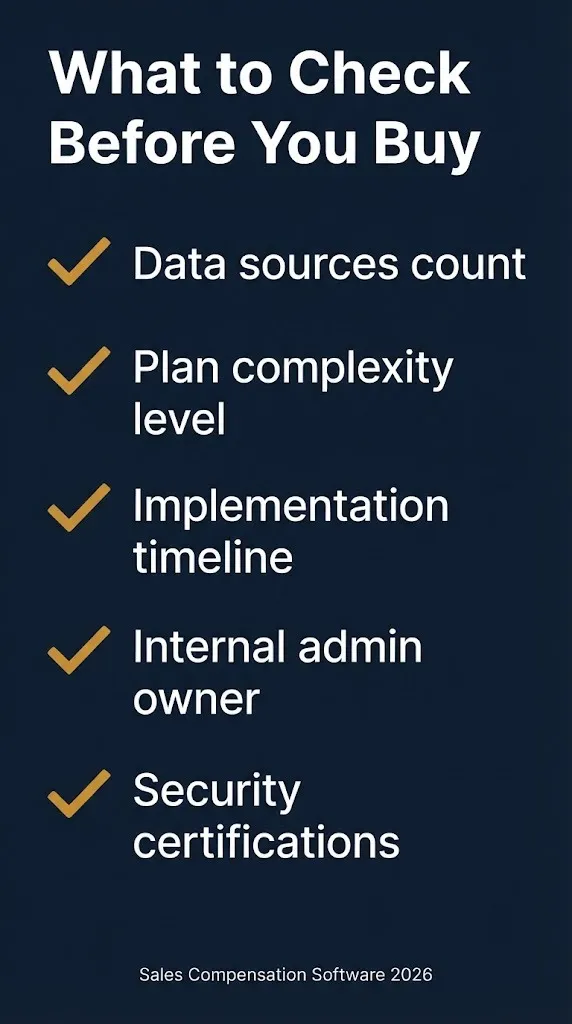
Ask these questions before you buy:
- How many sources of data feed your commissions? If deal data lives in Salesforce, invoice data in NetSuite, and employee data in Workday, you need a platform that can merge multiple sources. QuotaPath cannot merge data from multiple sources at once.
- How complex are your plans? Layered accelerators, SPIFs, clawbacks, and multi-currency structures require enterprise-grade platforms. Simple rate-based plans work on mid-market tools.
- What is your implementation timeline? Mid-market tools like QuotaPath and Everstage implement faster than enterprise platforms like Xactly or Varicent.
- Who will own the system? If you do not have a dedicated RevOps or comp admin, choose a platform with lower admin overhead.
- What are the security and compliance requirements? Public companies need SOX compliance. Regulated industries need SOC 2 Type II and ISO 27001. Everstage carries SOC 2 Type II, ISO 27001, and ISO 42001 certifications.
Key Takeaway: Match the platform to your data complexity and internal capacity, not to the vendor’s demo. The best software is the one your team can actually run.
What Happens Next for Sales Compensation Software in 2026?
May 2026: CaptivateIQ launched its AI Agents portfolio, including Comp Builder for natural-language plan creation.
Throughout 2026: Vendors are racing to add AI capabilities. EasyComp launched a Claude Cowork integration for natural-language commission workflows.
Expected late 2026: More mid-market platforms will add AI-powered plan design and anomaly detection as table stakes.
Ongoing: The gap between organizations with automated end-to-end processes (33%) and those still relying on spreadsheets remains the biggest opportunity for vendors.
Watch for: Consolidation as larger vendors acquire smaller platforms to fill gaps in their product lines.
Frequently Asked Questions
What is sales compensation software?
Sales compensation software automates commission calculations, quota tracking, and payout reporting for sales teams. It replaces spreadsheets with rules-based automation.
How much does sales compensation software cost?
Typical annual costs range from $20,000 for small deployments (10-50 payees) to $500,000+ for enterprise deployments (200+ payees). Implementation fees add $10,000 to $100,000+.
What is the difference between SPM and ICM software?
SPM (sales performance management) is the broader category that includes quota planning, territory management, and forecasting. ICM (incentive compensation management) focuses specifically on commission calculation and payout.
Which sales compensation software is easiest to use?
QuotaPath and Everstage are frequently cited for ease of use and fast implementation. Xactly and Varicent are more complex but handle enterprise-scale plan structures.
Can sales compensation software integrate with Salesforce?
Yes. Salesforce is the most common CRM integration. Xactly reports that 80% of its customers use Salesforce, and QuotaPath offers a native Salesforce AppExchange app.
What happens if your CRM data is messy?
The software will calculate wrong commissions. Clean data is a prerequisite for accurate automation. CaptivateIQ’s report found that only 34% of organizations have a single source of truth.
Do you need a dedicated admin to run sales compensation software?
It depends on complexity. Simple deployments can be managed by a sales ops generalist. Complex enterprise plans typically require a dedicated comp admin or RevOps resource.
How long does implementation take?
Mid-market tools can go live in 4 to 8 weeks. Enterprise implementations with complex data integrations often take 3 to 6 months or longer.
Before you sign a contract, get the total cost in writing, including implementation, integrations, and annual escalators. Talk to at least two reference customers who have similar plan complexity. And clean your CRM data first, because the software will expose every gap you have. The market is projected to reach $9.99 billion by 2034, and vendors are competing hard for your business. Use that leverage.