Compensation Plans in 2026: Types, Samples, and How to Build One for Your Team
Quick Answer
- What it is: A compensation plan is your company’s structured system for paying employees, covering base salary, bonuses, benefits, and non-monetary rewards.
- What types exist: Base pay, performance-based, skill-based, team-based, equity-based, and total compensation packages, often combined to fit your workforce.
- Key planning number: Average 2026 salary increase budgets sit at 3.7%, with most companies spreading raises evenly rather than targeting specific roles.
What Is a Compensation Plan?
A compensation plan is a structured system that defines how your company rewards employees for their work, covering both direct pay like salaries and bonuses, and indirect pay like health insurance and retirement contributions. It is not just a payroll number. It is the framework that determines what you pay, why you pay it, and how employees can earn more.
Your compensation plan directly affects hiring, retention, and motivation. A retail worker on straight hourly wages has no financial reason to stay late. A salesperson on a tiered commission structure has every reason to push for one more deal. The structure shapes behavior.
In 2026, compensation planning has settled into a predictable rhythm after years of volatility. Average salary increase budgets are projected at 3.7%, close to the 3.8% actual increase in 2025 and 3.9% in 2024. Employers are spending less energy reacting to market spikes and more on building fair, transparent systems.
This article explains the main types of compensation plans, provides sample structures you can adapt, and walks through how to build a plan that fits your company’s goals and budget.
The Facts
| Plan Feature | 2026 Data |
|---|---|
| Average salary increase budget | 3.7% projected for 2026 |
| 2025 actual increase | 3.8% |
| Merit increase forecast | 3.2% average, total wage growth near 3.5% |
| High performer merit | 1.5 to 2 times average performer increase |
| Pay structure adjustment | 2.2% median increase to salary ranges |
| 401(k) employer match | Average pure match 3 to 4% of salary |
| Most common match formula | 50 cents per dollar on first 6% of pay |
What Are the Main Types of Compensation Plans?
There are six main types of compensation plans, each designed for different roles and business goals. Most companies combine two or more to cover their workforce.
Base pay compensation uses fixed hourly wages or salary ranges. Pay grades are set by experience, job description, and market data. This is the foundation for nearly every other system.
Performance-based compensation rewards employees for results. Commissions, bonuses, and profit sharing fall here. It works best for sales teams and management roles where output is measurable.
Skill-based pay increases wages as employees acquire new certifications or capabilities. A consultant might earn $65,000 with basic skills and $72,000 after earning an advanced certification and applying it on projects.
Team-based compensation rewards groups for collective goals. It promotes collaboration but can frustrate high performers if teammates underperform.
Equity-based compensation gives employees stock options or shares. It aligns worker interests with long-term company performance and is common in tech and startups.
Total compensation packages combine financial pay with benefits and perks. Health insurance, retirement matching, paid time off, and flexible schedules all count.
Key Takeaway: The best compensation plan is not the most expensive one. It is the one that matches your business goals to your employees’ motivations, whether that is steady base pay, performance upside, or long-term equity.
Sample Compensation Plan: Base Salary Plus Commission
A base salary plus commission plan pairs predictable income with performance-based upside. It is the most common structure for sales roles because it gives employees a safety net while still rewarding results.
Here is a sample structure for a sales representative:
| Component | Sample Terms |
|---|---|
| Base salary | $80,000 per year |
| Commission rate | 10% of sales revenue |
| On-target earnings | $100,000 (base + $20,000 commission) |
| Quota | $200,000 in annual sales |
| Payout timing | Monthly, following close of sale |
In this example, Employee A earns $80,000 guaranteed plus $8,000 commission on $80,000 in sales, for total earnings of $88,000. If they hit quota, total earnings reach $100,000.
This structure works when your sales cycle is predictable and you want to retain salespeople during slow months. The base salary covers living expenses; the commission drives effort beyond the minimum.
Reality Check: A commission plan is not a substitute for a fair base salary. If your base is too low, you attract only desperate candidates or those willing to gamble. The best salespeople want both security and upside. Balance the two.
Sample Compensation Plan: Tiered Commission
A tiered commission plan increases the commission rate as sales grow, motivating representatives to push past their quota. The more you sell, the higher your percentage on each additional dollar.
Sample tiered structure:
| Sales Tier | Commission Rate |
|---|---|
| Up to $75,000 | 7% |
| $75,001 to $150,000 | 10% |
| $150,001 to $200,000 | 12% |
| Above $200,000 | 15% |
Employee B earning $180,000 in sales would calculate commission as: 7% on the first $75,000 ($5,250), 10% on the next $75,000 ($7,500), and 12% on the final $30,000 ($3,600). Total commission: $16,350.
This structure works best for roles where exceeding basic targets produces significant benefits for the company. It rewards your top performers disproportionately, which is the point.
Be careful with tier design. If the jump from one tier to the next is too steep, employees may game the system by holding deals to push themselves into a higher bracket. Set achievable yet challenging thresholds.
Sample Compensation Plan: Profit Sharing and Annual Bonus
Profit sharing and annual bonus plans reward employees for company-wide performance rather than individual sales. They work well for roles where output is harder to measure directly, like operations, engineering, or administration.
A sample annual incentive plan from NI Holdings, Inc. uses three goals:
| Goal | Weight |
|---|---|
| Combined Ratio | 40% |
| Strategic Initiatives | 35% |
| Personal Performance | 25% |
Payouts occur annually by April 15, with target, threshold, and stretch levels established by the compensation committee. Employees on a Performance Improvement Plan are excluded from participation.
This structure ties individual rewards to company success. When the company hits its combined ratio target, everyone benefits. When it misses, bonuses shrink or disappear.
Profit sharing is different from a bonus. A bonus is typically discretionary or tied to individual performance. Profit sharing distributes a defined portion of company profits to employees, often through a formula.
How Do You Build a Compensation Plan for Your Company?
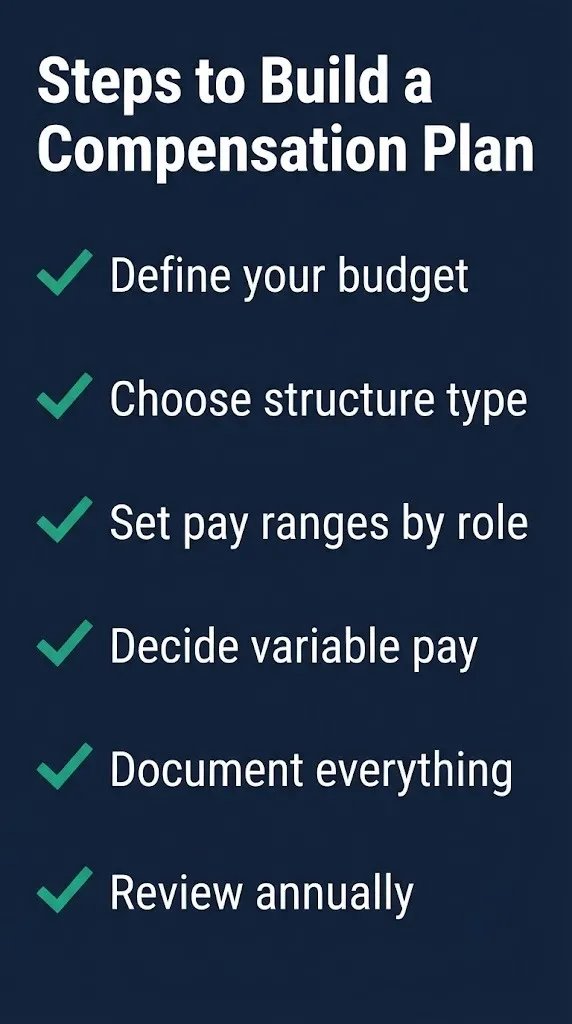
Building a compensation plan requires matching your budget, business goals, and workforce needs. Here are the steps:
- Define your budget. Start with your total compensation budget. The average increase is 3.7% for 2026, but your number depends on industry, geography, and company size.
- Choose your structure type. Base pay only? Base plus commission? Profit sharing? Match the structure to the role’s output and your ability to measure it.
- Set pay ranges by role. Use market data to set minimum, midpoint, and maximum pay for each job grade. Adjust ranges annually, typically 2.2% to 2.5%.
- Decide on variable pay. Determine commission rates, bonus targets, or profit-sharing percentages. Make the math clear and achievable.
- Document everything. Write the plan terms in plain language. Specify payout timing, eligibility, and what happens if an employee leaves mid-year.
- Communicate the plan. Employees need to understand how they earn more. Transparency builds trust.
- Review and adjust annually. Market conditions change. A plan that worked in 2025 may need updating for 2026.
What Are Common Mistakes in Compensation Planning?
The most common compensation planning mistakes are setting budgets without market data, creating plans too complex to understand, and failing to adjust for pay equity. Each one costs money and morale.
Ignoring market data. If your pay ranges are below market, you lose candidates. If they are above market, you overspend. The Pearl Meyer survey shows most companies adjust ranges by 2.2% to 2.5% annually to stay competitive.
Overcomplicating the plan. A commission structure with seven tiers and five modifiers may look sophisticated, but employees cannot calculate their own earnings. Simple plans drive behavior. Complex plans create disputes.
Failing to address pay equity. About 70% of organizations plan adjustments for pay equity reasons in 2026, including internal equity and gaps due to protected classes. Ignoring this creates legal risk and retention problems.
Not budgeting for the match. If you offer a 401(k) match, you need to fund it. The most common formula is 50 cents per dollar on the first 6% of pay, which caps employer cost at 3% of salary. A more generous formula of dollar-for-dollar on the first 3% plus 50 cents on the next 2% costs 4%.
Key Takeaway: The most common compensation planning mistake is treating the plan as a one-time project. Compensation is a living system. Budgets shift, market rates move, and employee expectations change. Review your plan every year.
What Happens Next With Compensation Planning in 2026
Q4 2026: Most companies finalize 2027 salary increase budgets based on third-quarter market data.
January 2027: New pay ranges and merit increase pools take effect for most organizations.
March 2027: Global Compensation Planning Report refreshes with updated market data.
Ongoing: Pay transparency laws expand in more states, requiring salary ranges in job postings.
Ongoing: Companies adjust plans to address pay equity gaps and retention pressures.
Frequently Asked Questions
What is a compensation plan?
A compensation plan is the structured system a company uses to pay employees, covering base salary, bonuses, commissions, benefits, and non-monetary rewards.
What are the main types of compensation plans?
Base pay, performance-based, skill-based, team-based, equity-based, and total compensation packages are the main types. Most companies combine several.
How much should salary increases be in 2026?
The projected average is 3.7% for 2026, according to Pearl Meyer’s survey. Actual 2025 increases averaged 3.8%.
What is a sample commission plan for sales?
A common structure is $80,000 base salary plus 10% commission on sales, with on-target earnings of $100,000 if the employee hits quota.
How do profit sharing plans work?
Profit sharing distributes a portion of company profits to employees, often through a formula. It rewards collective success rather than individual sales.
What is the average 401(k) employer match in 2026?
The average pure match is about 3 to 4% of salary. The most common formula is 50 cents per dollar on the first 6% of pay, capping at 3%.
How often should I review my compensation plan?
At least annually. Market rates change, budgets shift, and pay equity gaps need addressing. Most companies adjust pay ranges by 2.2% to 2.5% each year.
Do I need a lawyer to create a compensation plan?
For most standard plans, no. But commission plans with legal disputes or executive compensation tied to SEC filings may require legal review.