Distributor Settlement Agreement 2026: Key Terms, Payout Structures, and How to Protect Your Claim
Quick Answer
- A distributor settlement agreement is a legal contract ending a dispute between a manufacturer or supplier and a distributor.
- Payout amounts are private and depend on lost profits, territory violations, unpaid commissions, or termination damages.
- No standard deadline applies. Deadlines are set by the specific agreement or the court if litigation is pending.
You searched this term because you are likely a distributor facing a contract dispute, or you heard about a distributor settlement and want to know if money is available. Maybe you got a notice. Maybe a supplier terminated your agreement and you want to know what your claim is worth. This article gives you the verified framework.
Here is the most important fact: distributor settlement agreements are almost always confidential. The public rarely sees the dollar amounts. What we can verify is the structure, the typical terms, and the legal rules that control whether a settlement holds up in 2026.
What Is a Distributor Settlement Agreement?
A distributor settlement agreement is a written contract that resolves a legal dispute between a supplier, manufacturer, or brand owner on one side and a distributor on the other. It ends the dispute in exchange for agreed terms, usually money, continued supply, or both.
These agreements arise from distributor termination claims, unpaid commissions, territory encroachment, defective product claims, or breach of distribution contract. The distributor may claim lost profits. The supplier may claim unpaid invoices or unauthorized sales.
Settlement agreements are governed by contract law. They do not require court approval unless the dispute is already in litigation. Even then, many settlements are filed as private stipulations with the court.
A distributor settlement agreement works like a store return without a receipt. Both sides give up something to close the matter. The distributor may give up future claims. The supplier may give up money or supply rights. The written release makes it final.
Are Distributor Settlement Agreements Legally Enforceable in 2026?
Yes, distributor settlement agreements are legally enforceable if they meet basic contract requirements. Those requirements are the same in 2026 as they have been for decades.
A valid settlement agreement needs:
- An offer by one side
- Acceptance by the other side
- Consideration, meaning something of value exchanged
- Mutual intent to be bound
- Signatures from authorized parties
If any element is missing, a court can set the agreement aside. That happens rarely. Most settlement agreements are drafted by attorneys and reviewed carefully before signing.
One common challenge is authority. A sales manager may sign a settlement without corporate authority. The distributor later learns the agreement is not binding because the signer lacked actual or apparent authority. That is why you verify who signs and what title they hold.
Key Takeaway: A signed settlement agreement is binding, but only if the person signing has authority and all contract elements are present.
How Much Is a Distributor Settlement Agreement Worth?
The value of a distributor settlement depends on documented losses and the strength of the legal claim. No public database reports average distributor settlement amounts because most settlements are confidential.
The value formula in distributor disputes typically includes:
| Damage Category | What It Covers | Proof Required |
|---|---|---|
| Lost profits | Revenue lost due to wrongful termination or territory breach | Financial statements, sales history, projections |
| Unpaid commissions | Commissions earned but not paid | Commission statements, contracts, emails |
| Termination damages | Value of the distribution business lost | Valuation reports, goodwill analysis |
| Inventory costs | Unsold inventory the supplier refused to repurchase | Inventory records, purchase orders |
| Legal fees | Attorney fees if the contract allows recovery | Attorney invoices, retainer agreement |
Many distribution agreements include a liquidated damages clause. That sets a fixed amount for specific breaches. If your contract has one, the settlement value may be easier to calculate.
Without a liquidated damages clause, the number comes from negotiation. Each side starts far apart. The settlement lands somewhere in the middle, usually after mediation or discovery in a lawsuit.
Key Takeaway: Your settlement value starts with documented losses. Speculation about what you could have earned rarely moves the number.
What Are the Standard Terms in a Distributor Settlement Agreement?
Most distributor settlement agreements contain the same core sections. You should know them before you sign.
Payment terms. This section states how much is paid, when, and how. It may include a lump sum or installment payments. Installment settlements often require a promissory note or security interest.
Release of claims. The distributor releases all claims against the supplier, known or unknown, arising from the distribution relationship. This is the broadest and most important clause.
Confidentiality. Both sides agree not to discuss the settlement amount or terms. This is why public data on distributor settlements is scarce.
Non-disparagement. Neither side may publicly criticize the other. This clause often comes with liquidated damages for violations.
Return of property. The distributor returns unsold inventory, marketing materials, and confidential information. The supplier may pay a restocking fee or repurchase at a set price.
No admission of liability. The supplier typically denies wrongdoing. The settlement is not an admission that the supplier breached the contract.
Governing law. The agreement identifies which state’s law controls. Most distribution agreements choose the supplier’s home state.
How Do Distributor Termination Claims Affect Settlement Value?
Distributor termination claims are the most common source of distributor settlements. Many states have dealer protection statutes that change the math.
State laws like the Wisconsin Fair Dealership Law, the New Jersey Franchise Practices Act, and similar statutes in other states protect distributors from termination without good cause. If a supplier terminates a distributor without proper notice or cause, the distributor may recover lost profits, attorney fees, and sometimes punitive damages.
Here is how those state laws affect settlement value:
| State Protection | Impact on Settlement Value |
|---|---|
| Good cause required for termination | Higher value if no good cause existed |
| Required notice period, often 60 to 90 days | Higher value if notice was short |
| Attorney fees recoverable by statute | Higher value because supplier faces fee risk |
| Right to repurchase inventory | Higher value if supplier refused repurchase |
If your state has a dealership protection law, your settlement leverage increases significantly. Suppliers settle more often and for more money in states with strong distributor protection statutes.
What Should You Do Before Signing a Distributor Settlement Agreement?
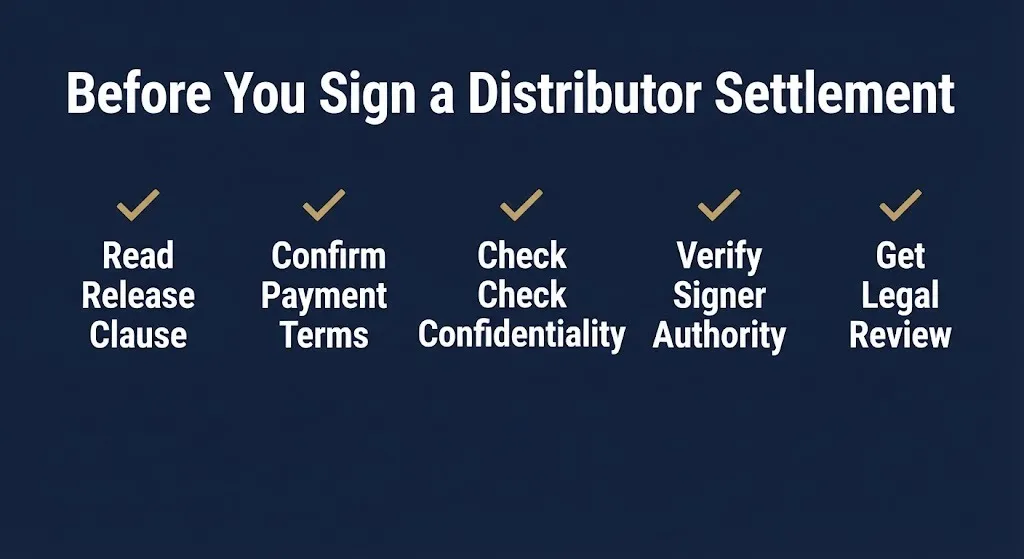
Do not sign a distributor settlement agreement without these five steps. Each one protects your money and your future.
- Read the release clause carefully. It may release claims you did not know you had.
- Confirm the payment terms are realistic. Installment payments without security are promises, not payments.
- Check the confidentiality clause. It may prevent you from discussing the settlement even with your accountant.
- Verify the signer has authority. Ask for a corporate resolution or signatory confirmation.
- Get independent legal review. Never sign a settlement drafted by the other side’s lawyer without your own review.
A settlement is a one-time event. You cannot reopen it later because you changed your mind. Treat it like a final sale.
What Happens If One Side Breaches a Distributor Settlement Agreement?
If one side breaches a settlement agreement, the other side can enforce it in court. The settlement becomes a contract claim.
The most common breach is nonpayment. The supplier signs the settlement, pays the first installment, then stops. The distributor sues for breach of the settlement agreement, not the original distribution dispute.
Courts enforce settlement agreements strictly. The breaching party may owe the unpaid amount, interest, attorney fees, and sometimes penalties. If the settlement included a confession of judgment clause, enforcement is faster.
A confession of judgment lets the winning party file the settlement directly as a court judgment without a new lawsuit. Not all states allow confession of judgment clauses. Where they are allowed, they are a powerful enforcement tool.
Key Takeaway: A settlement is only as good as the payment behind it. Secure installment payments with collateral or a confession of judgment where your state allows it.
How Long Do Distributor Settlement Negotiations Take?
Distributor settlement negotiations take anywhere from a few weeks to over a year. The timeline depends on the complexity of the dispute and the posture of any litigation.
A simple unpaid commission dispute may settle in 30 to 60 days. A contested termination with counterclaims may take 6 to 12 months. Cases in active litigation often settle at mediation, which may occur 9 to 18 months after the lawsuit is filed.
The typical sequence looks like this:
| Stage | Typical Timeframe |
|---|---|
| Demand letter sent | Day 1 |
| Initial response or denial | 2 to 4 weeks |
| Negotiation or mediation | 1 to 6 months |
| Draft settlement agreement exchanged | 2 to 4 weeks after agreement in principle |
| Final execution | 2 to 8 weeks after first draft |
Do not confuse an agreement in principle with a signed settlement. An agreement in principle is a handshake. A signed settlement is a contract. The space between the two is where deals fall apart.
Can a Distributor Settlement Agreement Be Confidential?
Yes, almost all distributor settlement agreements are confidential. The confidentiality clause is standard and strictly enforced.
Confidentiality prevents the distributor from discussing the amount, the terms, or even the existence of the settlement. Violating the clause can trigger liquidated damages or forfeiture of future payments.
This is why public reporting on distributor settlements is thin. There is no public database of distributor settlement amounts. Court records may show that a case settled, but the terms are rarely filed.
If you are looking for comparable settlement amounts to value your claim, you will not find them in public records. Your best comparables come from industry sources, trade associations, or your own attorney’s experience.
What Is the Difference Between a Distributor Settlement and a Distributor Arbitration Award?
A distributor settlement is voluntary. An arbitration award is imposed. Both end the dispute, but they work differently.
Many distribution agreements require arbitration instead of court. The American Arbitration Association or JAMS administers the proceeding. An arbitrator hears the evidence and issues an award. That award is binding and can be confirmed as a court judgment.
A settlement can happen before, during, or after arbitration. The parties may settle after seeing how the arbitration is going. The settlement terms are then memorialized in a written agreement.
| Factor | Settlement | Arbitration Award |
|---|---|---|
| Who decides | Both parties agree | Arbitrator decides |
| Confidentiality | Almost always | Often, but not always |
| Appeal rights | None after signed | Very limited |
| Enforcement | Contract claim if breached | Confirm as court judgment |
Reality Check: No legitimate distributor settlement requires you to pay a fee to receive your money. If someone contacts you claiming you are owed distributor settlement funds and asks for a processing fee, it is a scam. Real settlements come through attorneys, court filings, or verified corporate payments.
What Should the Payment Terms in a Distributor Settlement Include?
Payment terms are the most important part of the settlement after the amount. A large settlement paid over five years is worth less than a smaller settlement paid today.
A well-drafted payment section includes:
- Total settlement amount in words and figures
- Payment schedule with specific dates
- Interest rate on late payments
- Acceleration clause if a payment is missed
- Security or personal guarantee for installment payments
- Payee name and tax identification details
- Wire or check delivery instructions
If the settlement is paid over time, ask for security. A personal guarantee from the supplier’s owner, a security interest in inventory, or a letter of credit all provide protection. Without security, you hold an unsecured promise.
A $200,000 settlement paid as $40,000 per year for five years without interest is worth less than $200,000 today. The time value of money reduces the present value. A standard discount rate of 5 percent would make that stream worth about $173,000 today.
How Are Taxes Handled on Distributor Settlement Payments?
Settlement payments may be taxable. The tax treatment depends on what the payment replaces.
Payments for lost profits are ordinary income. You report them on your business tax return. Payments for physical damage to property are a recovery of basis and may not be taxable. Payments for personal injury are generally not taxable, but that is rare in distributor disputes.
The IRS looks at the origin of the claim. If the settlement replaces income you would have earned, it is taxable. If it reimburses you for a loss, it may not be.
You should ask for the settlement agreement to state the tax character of the payment. The IRS is not bound by that statement, but it helps. You should also talk to a tax professional before finalizing the settlement.
What Are Common Mistakes Distributors Make in Settlement Agreements?
The most common mistakes are signing too fast, releasing too much, and trusting too much.
Signing too fast. A supplier sends a settlement with a short deadline. You sign without reading the release. The release waives claims you did not know about. That claim is gone forever.
Releasing too much. The release may cover claims beyond the distribution dispute. It may release employment claims, franchise claims, or even personal claims against the supplier’s owners.
Trusting too much. The settlement promises installment payments with no security. The supplier misses a payment. You now have a breach claim, but collecting may be impossible.
No attorney review. You sign a settlement drafted by the supplier’s lawyer. That lawyer does not represent you. The terms favor their client.
Avoid these mistakes by slowing down. A legitimate settlement offer will still be there after you take 48 hours to review it.
Key Takeaway: The release clause is the most dangerous part of any settlement. Read it like your future income depends on it, because it does.
How Do You Negotiate a Better Distributor Settlement?
You negotiate a better distributor settlement by preparing more than the other side. Preparation beats aggression.
Start with a written demand letter that states your legal theory, your damages, and your settlement range. Attach the key documents. A demand letter that shows you understand the law and can prove your damages changes the negotiation.
Then follow these steps:
- Identify your best alternative to a negotiated agreement. That is usually litigation or arbitration.
- Calculate your settlement range. Know the minimum you will accept and the number you want.
- Anticipate the other side’s defenses. Address them before they raise them.
- Offer a specific number with a rationale. Round numbers look made up. Precise numbers look calculated.
- Be patient. The first offer is rarely the last offer.
The distributor who walks in with financial statements, commission records, and a clear legal theory gets a better settlement than the one who walks in angry.
What Happens After the Distributor Settlement Is Signed?
After the settlement is signed, the parties perform the terms. That usually means payment and release.
The supplier pays according to the schedule. The distributor dismisses any lawsuit with prejudice. Both sides exchange any required property or documents. The confidentiality obligation begins.
If the settlement requires court approval, the parties file a joint stipulation. The court enters an order dismissing the case. Most distributor settlements in active litigation end with a voluntary dismissal.
The payment should arrive within the timeframe in the agreement. If it does not, you send a written demand. If that fails, you enforce the settlement as a contract.
What Should You Do If You Receive a Distributor Settlement Notice?
If you receive a notice about a distributor settlement, verify it before responding. Some notices are legitimate. Some are scams.
Check these items:
- Who is the sender? A real settlement notice comes from a court, a law firm, or a settlement administrator.
- What case is it? The notice should identify the case name and court.
- Does it ask for money? Real settlement notices never ask you to pay a fee.
- Is there a claim form? A legitimate settlement includes a claim form or instructions for receiving your payment.
- Is there a deadline? The notice should state a specific deadline.
If the notice asks for your bank account number, your Social Security number, or a processing fee, it is likely fraudulent. Contact the court or the sender directly using verified information, not the contact in the notice.
Frequently Asked Questions
What is a distributor settlement agreement?
A distributor settlement agreement is a contract that resolves a dispute between a supplier and a distributor.
It usually includes payment terms, a release of claims, and confidentiality.
How much is a typical distributor settlement worth?
No public average exists because most settlements are confidential.
The value depends on documented lost profits, unpaid commissions, and the strength of the legal claim.
Do I need a lawyer for a distributor settlement agreement?
You are not legally required to have a lawyer, but it is strongly recommended.
The release clause can waive claims you do not know about.
How long does a distributor settlement take?
Simple disputes may settle in 30 to 60 days.
Contested termination cases with litigation may take 6 to 18 months.
Is a distributor settlement payment taxable?
Yes, payments for lost profits are ordinary income.
Payments for property damage or return of capital may not be taxable.
Can a distributor settlement be confidential?
Yes, almost all distributor settlements include confidentiality clauses.
The amount, terms, and existence of the settlement are typically private.
What happens if the supplier does not pay the settlement?
You can enforce the settlement as a contract in court.
The court may award the unpaid amount, interest, and attorney fees.
What is a release of claims in a settlement?
A release is a clause where you give up your right to sue on certain claims.
It is often the broadest and most important part of the settlement.
The single most important thing to remember about a distributor settlement agreement is that it is final. You cannot reopen it later because the money was less than you expected or because you found a new claim.
Read the release. Secure the payment. Get your own attorney. The agreement you sign controls the rest of your business life with that supplier.