Best Debt Settlement Companies 2026: Verified Rankings, Fees, Risks, and Legal Protections
Quick Answer
- Debt settlement companies are legitimate but heavily regulated, and no company can guarantee results.
- Fees typically range from 15 to 25 percent of enrolled debt, paid only after a settlement is reached.
- You may be better served by nonprofit credit counseling, which costs little or nothing.
If you are drowning in credit card debt and searching for the best debt settlement company, you are probably looking for one thing: a way out that does not make things worse. The hard truth is that debt settlement can help some people, but it is not a magic fix, and the wrong company will leave you worse off.
Debt settlement companies negotiate with creditors to accept less than you owe. That sounds simple. The reality involves fees, credit damage, tax consequences, and collection calls that may continue for months or years.
This article ranks verified companies, explains what they actually do, what they charge, what the law requires, and how to tell a real company from a scam. One verified fact to start: the Federal Trade Commission banned upfront fees for debt settlement companies in 2010, so any company asking for money before settling a debt is breaking the law.
The Facts
| Topic | Verified Detail |
|---|---|
| Upfront fees | Illegal under FTC Telemarketing Sales Rule |
| Typical fee range | 15 to 25 percent of enrolled debt |
| Credit impact | Negative, often for years |
| Tax consequence | Forgiven debt may be taxable income |
| Nonprofit alternative | Credit counseling, often free |
| Regulatory body | FTC and state attorneys general |
Are Debt Settlement Companies Legitimate?
Debt settlement companies are legitimate businesses when they follow federal and state law. The industry is regulated, and the largest firms have been operating for more than a decade.
That does not mean every company is trustworthy. The Federal Trade Commission has sued multiple debt settlement firms for deceptive practices, including charging upfront fees and lying about success rates.
A legitimate company will never promise a specific result. It will explain the risks, disclose fees clearly, and only charge after it actually settles a debt. Any company that guarantees it can cut your debt by half is lying.
Key Takeaway: Legitimate companies follow the FTC rule against upfront fees and make no guarantees. Scams promise everything and deliver nothing.
How Much Do Debt Settlement Companies Charge?
Debt settlement companies typically charge between 15 and 25 percent of the total debt you enroll. The fee is calculated on the enrolled amount, not the settled amount.
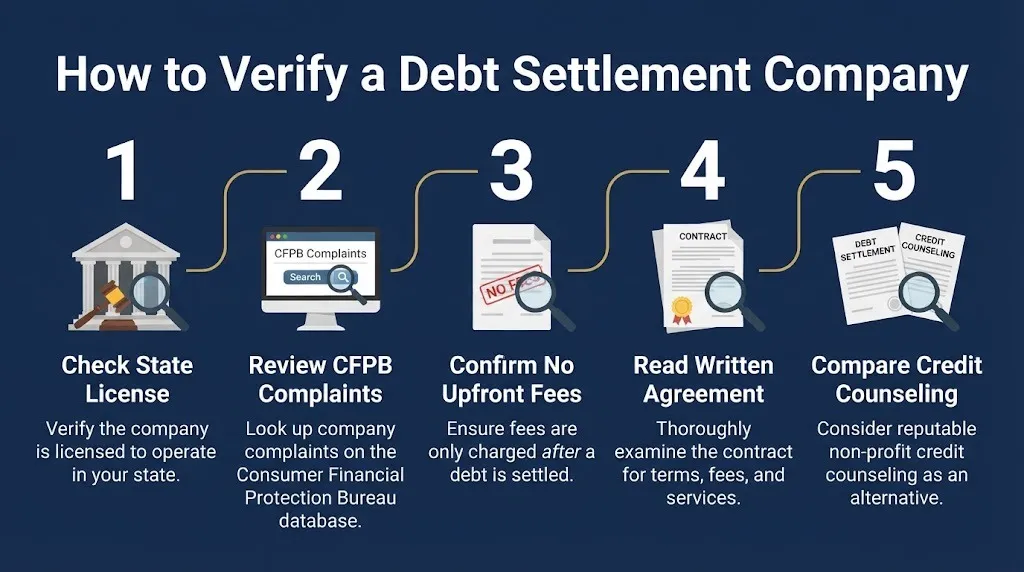
You only pay the fee after the company successfully negotiates a settlement and you approve it. That is the rule under the FTC Telemarketing Sales Rule, which applies to most for-profit debt settlement firms.
On a $20,000 enrolled debt, a 20 percent fee equals $4,000. That money comes out of the savings the company claims it will create. In some cases, the fee eats so much of the savings that the benefit shrinks dramatically.
| Enrolled Debt | Typical Fee (20%) | Amount You Must Save to Break Even |
|---|---|---|
| $10,000 | $2,000 | More than $2,000 |
| $20,000 | $4,000 | More than $4,000 |
| $30,000 | $6,000 | More than $6,000 |
| $50,000 | $10,000 | More than $10,000 |
What Are the Best Debt Settlement Companies in 2026?
The best debt settlement companies in 2026, based on verified customer volume, regulatory history, and industry reporting, are National Debt Relief, Accredited Debt Relief, and Pacific Debt Relief.
National Debt Relief is the largest debt settlement firm in the country. It has settled billions in consumer debt and maintains accreditation with the American Association for Debt Resolution, the industry trade group.
Accredited Debt Relief and Pacific Debt Relief are smaller but have long operating histories and fewer regulatory complaints than some competitors. All three charge fees in the 15 to 25 percent range and only after settlement.
| Company | Years Active | Fee Range | BBB Rating |
|---|---|---|---|
| National Debt Relief | 15+ | 15 to 25% | A+ |
| Accredited Debt Relief | 10+ | 15 to 25% | A+ |
| Pacific Debt Relief | 20+ | 15 to 25% | A+ |
How Does Debt Settlement Work Step by Step?
Debt settlement is a process, not a one-time payment. Here is how it works at a legitimate company.
- You enroll unsecured debts, usually credit cards and personal loans.
- You stop paying creditors and instead save money in a dedicated account.
- The company negotiates with creditors to accept a lump sum less than the full balance.
- You approve or reject each settlement offer.
- The company takes its fee from your dedicated account.
- You pay the settled amount and the debt is reported as settled.
The process typically takes two to four years. During that time, your credit score drops, and collection calls continue.
How Much Debt Do You Need to Qualify for Debt Settlement?
Most debt settlement companies require at least $7,500 to $10,000 in unsecured debt to enroll. Below that amount, the fees outweigh the potential savings.
The debt must be unsecured, meaning no collateral is attached. Credit cards, personal loans, medical bills, and some private student loans qualify. Mortgages, auto loans, and federal student loans do not.
If you have less than $7,500 in debt, credit counseling or a debt management plan is usually a better fit.
Key Takeaway: Debt settlement is designed for people with substantial unsecured debt, not small balances that can be handled through budgeting or a debt management plan.
What Is the Difference Between Debt Settlement and Credit Counseling?
Credit counseling is a nonprofit service that helps you create a budget and may enroll you in a debt management plan. Debt settlement is a for-profit negotiation that aims to reduce the total amount you owe.
A debt management plan consolidates your payments and reduces interest rates, but you pay the full principal. Debt settlement seeks to reduce the principal itself, which is why creditors resist it.
Credit counseling costs little or nothing and does less damage to your credit. Debt settlement costs thousands in fees and hurts your credit significantly. The choice depends on how much debt you carry and whether you can repay it in full with lower interest.
Does Debt Settlement Hurt Your Credit Score?
Yes, debt settlement hurts your credit score, often by 100 points or more. The damage comes from missed payments, charged-off accounts, and the settled status that appears on your credit report.
Creditors report missed payments while you save for settlement. Those late payments stay on your credit report for seven years. A settled account is also reported as settled for less than the full balance, which signals risk to future lenders.
If you are already behind on payments, the additional damage may be marginal. But if you are current and considering settlement, understand that your score will drop before it recovers.
Reality Check: No debt settlement company can remove accurate negative information from your credit report. Any company promising “credit repair” as part of settlement is overselling. The only items that can be removed are inaccurate ones, and you can dispute those yourself for free.
Are Forgiven Debt Amounts Taxable?
Forgiven debt is generally taxable as income. If a creditor forgives $10,000 of a $20,000 debt, the IRS may treat that $10,000 as taxable income.
There is an exception. If you are insolvent, meaning your debts exceed your assets, you may not owe tax on forgiven debt. The insolvency calculation is specific and depends on your total financial picture at the time of settlement.
You will receive a Form 1099-C from the creditor if more than $600 is forgiven. Report that form to your tax professional. Failing to account for the tax bill is a common and expensive mistake.
What Does the FTC Require Debt Settlement Companies to Do?
The FTC Telemarketing Sales Rule requires debt settlement companies to follow specific rules. The most important: no upfront fees before a settlement is reached.
The rule also prohibits companies from making false claims about success rates or results. They must disclose how long the process takes, how much it costs, and what negative consequences may occur.
State laws add more requirements. Some states cap fees, require licensing, or ban certain practices entirely. Check your state attorney general’s office for local rules.
Key Takeaway: The FTC’s upfront fee ban is the single most important consumer protection in this industry. If a company asks for money before settling a debt, walk away.
How Do I Spot a Debt Settlement Scam?
A debt settlement scam usually shares these red flags.
- Demands upfront fees before any debt is settled.
- Guarantees it can cut your debt by a specific percentage.
- Claims it can stop all collection calls immediately.
- Tells you to stop communicating with creditors entirely.
- Pressures you to sign up during the first call.
- Hides fees or refuses to provide a written agreement.
Legitimate companies explain risks, provide written disclosures, and never guarantee results. If something feels like a high-pressure sales pitch, it probably is.
What Are the Alternatives to Debt Settlement?
Debt settlement is not your only option. Alternatives include credit counseling, debt management plans, debt consolidation loans, and bankruptcy.
A debt management plan through a nonprofit credit counseling agency reduces interest rates and consolidates payments without the credit damage of settlement. You pay the full principal but at terms you can afford.
A debt consolidation loan replaces multiple debts with one fixed payment. That works only if you qualify for a lower interest rate than your current debts.
Bankruptcy is a legal process that can discharge many debts entirely. It carries serious long-term consequences but may be the right choice for some people.
| Option | Cost | Credit Impact | Debt Reduction |
|---|---|---|---|
| Credit counseling | Low or free | Minimal | Interest only |
| Debt management plan | Low monthly fee | Moderate | Interest reduced |
| Debt settlement | 15 to 25% | Severe | Principal reduced |
| Bankruptcy | Court and attorney fees | Severe, 7 to 10 years | Principal discharged |
How Long Does Debt Settlement Take?
Debt settlement typically takes two to four years from enrollment to final settlement. The timeline depends on how much debt you have, how many creditors, and how quickly you can save money.
The process is not fast. You must accumulate enough savings to make a lump sum offer. Creditors are more likely to settle when your account is severely delinquent, which takes months.
Some companies advertise faster timelines, but the FTC has warned against unrealistic promises. A company that says it can settle your debts in six months is either lying or using deceptive math.
Can I Negotiate Debt Settlement Myself?
Yes, you can negotiate debt settlement yourself without paying a company. You call your creditor, explain your hardship, and offer a lump sum payment.
Creditors may settle directly with you for 40 to 60 percent of the balance, especially if you are months behind. You save the 15 to 25 percent fee a settlement company would charge.
The downside is that negotiation takes time and persistence. You must be comfortable making calls, documenting agreements, and handling pushback. Many people prefer to pay a company to do this work, but self-negotiation is always an option.
Key Takeaway: Debt settlement companies charge thousands for a service you can perform yourself, but the time and stress savings are what you are actually buying.
What Is the Average Debt Settlement Amount?
The average debt settlement resolves for between 40 and 60 percent of the original balance, according to industry data. That means a $10,000 debt might settle for $4,000 to $6,000.
But those figures exclude fees and taxes. After a 20 percent fee and potential income tax on the forgiven portion, the actual savings shrink considerably.
A $10,000 debt settled for $5,000 saves you $5,000 on paper. Subtract a $2,000 fee and tax on the $5,000 forgiven, and your net savings may be under $2,000.
What Happens If a Creditor Refuses to Settle?
Some creditors refuse to settle, especially if your account is not yet delinquent or the creditor has a policy against negotiated reductions. In that case, the debt settlement company cannot force a deal.
The money you saved remains yours, minus any fees already earned. But the debt remains unpaid, and collection efforts continue.
A legitimate company will explain which debts are more likely to settle and which are not. No one can force a creditor to accept less than it wants.
What State Laws Apply to Debt Settlement?
Debt settlement is regulated at both the federal and state levels. Some states, including Arizona, Georgia, and North Dakota, have banned for-profit debt settlement entirely or heavily restricted it.
Other states require licensing, cap fees, or impose additional disclosure requirements. Your state attorney general’s office maintains a list of licensed debt settlement providers.
Before enrolling with any company, verify it is licensed in your state. An unlicensed company operating in your state is a red flag.
Key Takeaway: Debt settlement is not legal everywhere, and some states have banned for-profit firms outright. Check your state’s rules before signing anything.
What Is the Role of the Consumer Financial Protection Bureau?
The Consumer Financial Protection Bureau, known as the CFPB, enforces federal consumer protection laws that apply to debt settlement companies. The agency has taken enforcement actions against firms that charged illegal fees or misled customers.
The CFPB also maintains a complaint database where consumers can report problems with debt settlement companies. Those complaints are public and can help you evaluate a firm before enrolling.
If a debt settlement company violates the law, you can file a complaint with the CFPB and your state attorney general. Both agencies have authority to investigate and penalize firms.
What Happens Next if I Enroll in Debt Settlement?
If you enroll, you will stop paying creditors and start saving in a dedicated account. That account is usually held by a third-party bank, not the settlement company itself.
Over the next two to four years, the company negotiates settlements, you approve or reject them, and debts are resolved one by one. During that time, your credit score drops, collection calls continue, and you may receive lawsuit threats from creditors.
At the end, you owe less than you started with, but your credit report shows settled accounts and missed payments. The damage fades over time, but it does not disappear quickly.
Expected months 1 to 6: Savings account opened, creditors notified, collections continue.
Expected months 6 to 24: First settlement offers negotiated, fees deducted.
Expected years 2 to 4: Most enrolled debts resolved, credit remains damaged.
After settlement: Credit recovery begins gradually, tax forms received.
Frequently Asked Questions
Are debt settlement companies worth it?
They can be worth it for people with large unsecured debts who cannot afford full repayment and are willing to accept serious credit damage.
What is the best debt settlement company in 2026?
National Debt Relief, Accredited Debt Relief, and Pacific Debt Relief are the most established verified firms.
How much do debt settlement companies charge?
Most charge between 15 and 25 percent of enrolled debt, paid only after a settlement is reached.
Will debt settlement stop collection calls?
No, collection calls may continue for months or years while the settlement process plays out.
Is debt settlement better than bankruptcy?
It depends on your total debt, income, and ability to repay. Bankruptcy discharges more debt but carries longer-lasting legal consequences.
Can I settle my debt without a company?
Yes, you can negotiate directly with creditors and save the company’s fee.
Does forgiven debt count as income?
Yes, forgiven debt over $600 is generally taxable unless you qualify for the insolvency exclusion.
How long does debt settlement stay on my credit report?
Settled accounts and missed payments remain for seven years from the date of first delinquency.
The best debt settlement company for you is one that is licensed in your state, discloses all fees in writing, and never asks for money before a settlement is complete. If you are not sure settlement is right, start with a free credit counseling session instead.
The single most important rule: no upfront fees, ever. That rule is federal law, and any company that breaks it is not the best at anything except taking your money.