Life360 Settlement Claim Form 2026: Eligibility, Deadlines, and Payout Status
Quick Answer
- Life360 has faced privacy-related legal claims, but no finalized settlement claim form is verified for 2026.
- No per-person payout amount has been approved by any court.
- Do not submit personal information to any site claiming to process Life360 settlement claims.
If you saw a Life360 settlement claim form online, you probably have one question: is this real and can I get paid? The honest answer as of September 4, 2026 is that no finalized Life360 settlement with an active claim form has been verified in court records.
Life360, the family location-sharing app used by millions, has faced legal scrutiny over its data practices. Those cases have generated headlines, and headlines generate fake claim form sites. That gap between legal action and actual settlement is where scams thrive.
This article explains what Life360 legal claims actually exist, how to spot a fake settlement form, what a real one would look like, and how to track any legitimate case without giving your data to the wrong people.
The Facts
| Case | Proposed privacy class action against Life360 |
| Status | Not yet finalized; no approved settlement |
| Fund Size | Not yet confirmed |
| Est. Per Person | Not yet determined |
| Claim Deadline | None; no active claim period |
| Administrator | Not yet appointed |
| Proof Needed | Would likely require Life360 account proof |
Is the Life360 Settlement Claim Form Real?
The Life360 settlement claim form circulating online is not verified as real as of September 4, 2026. No court-approved settlement administrator has posted an official claim form.
Life360 has been the subject of legal claims and regulatory inquiries over its data practices. Those claims are real and documented. But a legal claim is not the same as a settled case with a claim form.
A real settlement claim form only exists after a judge grants preliminary approval to a settlement agreement. That step has not been verified in any public court record for a Life360 case in 2026.
Key Takeaway: Real claim forms follow court approval. No approval means no form, no matter what a website tells you.
Has Life360 Been Sued Over Privacy Issues?
Yes, Life360 has faced legal claims related to privacy and data sharing. The company has been criticized for selling location data to third parties, including data brokers.
In 2024, Life360 faced scrutiny over its data practices following reports that precise location data from family safety apps was being sold. Those reports triggered consumer complaints and legal attention.
The company has stated it changed some data-sharing practices. But legal claims filed over past practices have continued through the court system.
What Is the Life360 Class Action About?
The proposed class action concerns allegations that Life360 collected and shared users’ precise location data without adequate consent. Plaintiffs argue this violated privacy laws and consumer protection statutes.
The claims focus on whether Life360’s disclosures were clear enough for users to understand where their data was going. That is a common issue in privacy class actions.
No class has been certified in any Life360 case as of September 4, 2026. The litigation remains in early procedural stages.
How Much Could the Life360 Settlement Pay Per Person?
There is no verified per-person payout amount because no Life360 settlement has been finalized. Any dollar figure you see attached to a Life360 claim form is fabricated or speculative.
Privacy settlements vary widely. Some pay a few dollars per user. Others pay more if actual financial harm is proven. Location data cases rarely produce large individual payouts because proving direct monetary loss is difficult.
If a settlement is eventually approved, the per-person amount will depend on the number of claims filed and the total fund size. Both numbers are currently unknown.
Reality Check: A real settlement never asks you to pay to file a claim. It never asks for your Social Security number upfront. And it never texts you a link promising money. Any site doing those things is stealing your data, not paying you.
What Would a Real Life360 Settlement Claim Form Look Like?
A real claim form would come from a court-appointed settlement administrator, not a random website. It would include the case name, court name, case number, and a clear deadline.
The form would ask for proof you used Life360 during the covered period. That proof could be an email address, account ID, or other identifying information tied to your account.
It would never ask for payment to file. It would never ask for passwords. It would never require you to download anything.
Key Takeaway: Real forms identify the court and administrator. Fake forms identify nothing and ask for everything.
How Do I Check If a Life360 Settlement Is Legitimate?
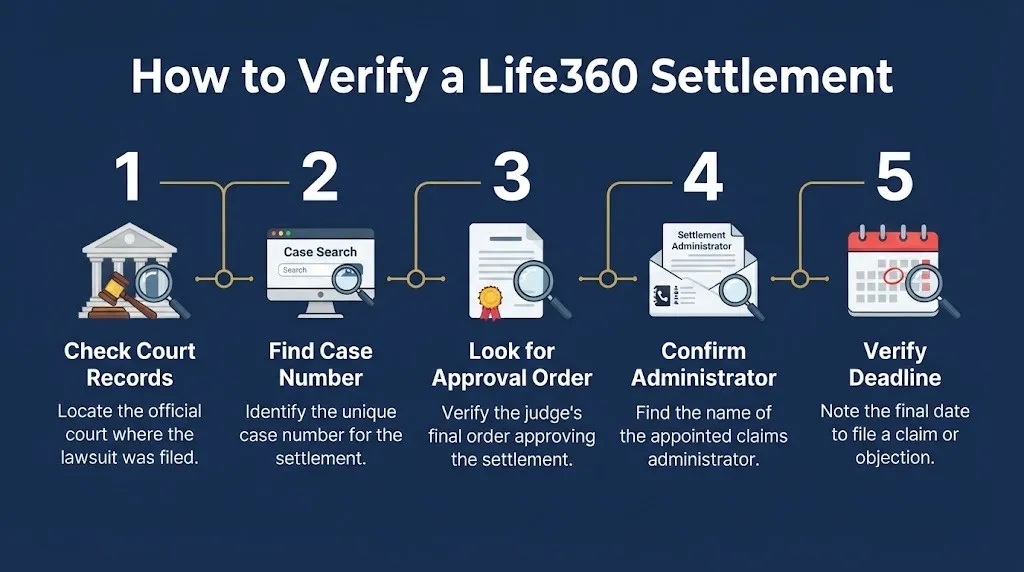
You can check a settlement’s legitimacy by following these steps.
- Search the case name in PACER or your local federal court database.
- Look for a judge’s order granting preliminary approval.
- Find the official settlement website through the court or administrator.
- Verify the claim deadline matches court records.
- Confirm the administrator’s name and contact information.
If any of those steps fail, the settlement is not yet real.
What Is the Deadline to File a Life360 Settlement Claim?
There is no verified deadline because no settlement has been finalized. If a settlement is approved, the court will set a claim deadline and publish it in a class notice.
That deadline is typically 60 to 120 days after the notice is sent. You will see it on the official settlement website, not on social media or third-party blogs.
Until a judge signs a preliminary approval order, no deadline exists. Anyone claiming otherwise is guessing or lying.
Can I File a Claim Without Proof of Using Life360?
In most privacy settlements, you must provide some proof you were a user during the covered period. That proof is usually an email address or account identifier.
If you cannot prove you used the service, your claim may be rejected. But no Life360 settlement exists yet, so the proof requirements are not established.
Keep records of any Life360 account you hold. If a settlement is approved later, those records will matter.
What Is the Current Status of Life360 Litigation in 2026?
Life360 privacy litigation remains active but unresolved as of September 2026. No court has certified a class or approved a settlement in the primary privacy cases.
The company has faced multiple legal actions, including potential arbitration demands from users. Arbitration clauses in Life360’s terms of service may limit class action participation for some users.
That arbitration issue is a key procedural hurdle. If a court enforces an arbitration clause, many users may be forced out of court and into individual arbitration.
Key Takeaway: The arbitration clause in your Life360 user agreement could determine whether you can join a class action at all.
Does Life360’s Terms of Service Affect My Right to Sue?
Yes, Life360’s terms of service likely include an arbitration clause and a class action waiver. Those provisions can limit your ability to join a class action lawsuit.
Courts sometimes refuse to enforce arbitration clauses if they are deemed unconscionable or if the company waived the right. But that is decided case by case.
If you agreed to Life360’s terms when you created your account, those terms control how you can pursue legal claims. That is true even if you never read them.
What Data Does Life360 Collect and Share?
Life360 collects precise location data from your phone through GPS. The app also collects device information, app usage data, and in some cases driving behavior data.
The company historically shared location data with third-party data brokers, which then sold that data to other companies. That practice is at the center of the legal claims.
Life360 has stated it reduced or ended some data-sharing partnerships. But the legal claims focus on what happened before those changes.
Is Life360 a Data Broker?
Life360 is not primarily a data broker, but it has acted as a data supplier to brokers. The company’s business model combines subscription revenue with data licensing.
That dual revenue model is what drew scrutiny. Users paid for a family safety service while their location data was also being monetized in ways many users did not expect.
The Federal Trade Commission has warned companies about undisclosed data sharing. Those warnings form the backdrop for consumer privacy litigation against location app companies.
What Did the FTC Say About Life360?
The Federal Trade Commission has not announced a verified public enforcement action against Life360 as of September 4, 2026. The agency has, however, taken action against other location data companies for similar practices.
Those FTC actions establish legal standards for what counts as deceptive data collection. Privacy plaintiffs often cite those standards in private lawsuits.
If the FTC does take action against Life360, that would strengthen private litigation. But no such action has been verified yet.
Key Takeaway: FTC enforcement against similar companies provides the legal framework, but no verified FTC action against Life360 exists yet.
What Should I Do If I See a Life360 Settlement Ad?
Do not click it. Do not enter any personal information. Close the page.
Fake settlement ads are designed to harvest your email, phone number, and sometimes financial information. They use the Life360 name because millions of people recognize it.
If you want to track real Life360 litigation, check court records directly. You do not need a third-party site to file a claim in any real settlement.
How Do Privacy Class Action Settlements Normally Work?
A privacy class action settlement starts with a lawsuit. The parties negotiate a settlement. A judge grants preliminary approval. A notice goes out to class members.
Class members file claims through a settlement administrator. The administrator verifies claims and distributes payments after final approval.
That process takes months or years. The gap between filing a lawsuit and distributing settlement checks is often 18 to 36 months.
What Is the Most Likely Outcome for Life360 Litigation?
The most likely outcome, based on similar privacy cases, is a negotiated settlement with no admission of wrongdoing. That settlement would include a fund for class members and changes to the company’s data practices.
But no one can predict the exact timing or terms. The arbitration issue could delay or reshape the case.
If you use Life360 and want to preserve any future claim, keep your account records and monitor official court dockets.
Expected late 2026: Further rulings on arbitration and class certification motions.
Expected 2027: Possible settlement negotiations if the case survives procedural challenges.
If settled: Court grants preliminary approval and appoints an administrator.
After approval: Class notice published with claim deadline and instructions.
Frequently Asked Questions
Is there a Life360 settlement claim form for 2026?
No verified claim form exists because no Life360 settlement has received court approval.
How much will I get from the Life360 settlement?
No payout amount has been determined because no settlement fund has been established.
What is the deadline to file a Life360 claim?
No deadline exists until a court approves a settlement and publishes a notice.
Can I join the Life360 class action?
You may be included if a class is certified and you meet the class definition.
Does Life360’s arbitration clause stop me from suing?
It may, depending on how courts rule on enforceability in the specific cases.
How do I prove I used Life360?
Keep your account email, user ID, and any subscription receipts as potential proof.
Is there an FTC action against Life360?
No verified FTC action against Life360 exists as of September 4, 2026.
What should I do with fake Life360 settlement sites?
Report them to the FTC and do not submit any personal information.
Your next step is to avoid any site offering a Life360 settlement claim form right now. None is verified. Check federal court records if you want to track the real litigation.
The single most important fact: no Life360 settlement has been approved, no fund exists, and no claim form is legitimate. Anyone claiming otherwise is not giving you the truth.