CME Lawsuit 2026: Crypto Perpetuals Fight, Dismissal Motion, and What Traders Need to Know
Quick Answer
- What is it? CME sued the CFTC in June 2026 over its approval of Kalshi’s Bitcoin perpetual futures contract.
- Is there a payout? No. This is a regulatory challenge, not a consumer class action. No settlement fund exists.
- What matters most? CME’s opposition to the dismissal motion is due October 2, 2026, in the U.S. District Court for the District of Columbia.
What Is the CME Lawsuit About in 2026?
The CME lawsuit is a regulatory challenge, not a consumer class action. CME Group sued the U.S. Commodity Futures Trading Commission in June 2026 over the agency’s approval of Kalshi’s Bitcoin perpetual futures contract.
The case is docketed as Chicago Mercantile Exchange Inc. v. Selig in the U.S. District Court for the District of Columbia . CME argues that perpetual futures contracts, which have no expiration date and use a funding rate mechanism, legally qualify as swaps under the Commodity Exchange Act and Dodd-Frank reforms.
The CFTC disagrees. The agency contends that perpetual contracts are futures and that CME lacks standing to sue because it can list the same products itself .
This is a fight over market structure and regulatory authority, not consumer compensation.
Is the CME Lawsuit a Class Action or Consumer Settlement?
No. The CME lawsuit is not a class action and has no settlement fund or payout process. It is a regulatory dispute between a major derivatives exchange and the federal agency that oversees it.
There is no claim form, no claims administrator, and no deadline for consumers to file anything. If you searched for “CME lawsuit payout” or “CME settlement claim,” you may have confused this regulatory case with a different matter.
A separate CME-related class action did exist, involving exchange members and the Aurora Data Center. That case went to trial in July 2025 and resulted in a defense verdict for CME. The court entered judgment on July 25, 2025 . That case is closed.
Key Takeaway: The CME lawsuit is a regulatory challenge with no consumer payout, no claim form, and no settlement fund.
Who Qualifies for the CME Lawsuit Settlement?
No one qualifies because no settlement exists. The CME lawsuit is a live regulatory dispute, not a settled class action.
If you are a trader or investor looking for compensation from CME, there is no legal mechanism to claim money from this case. The only parties involved are CME Group and the CFTC.
The confusion likely stems from unrelated content about a different CME class action that ended in 2025. That case involved exchange members disputing access rights to CME’s Aurora Data Center. The jury ruled for CME, and the court entered judgment in July 2025 .
What Is the CFTC’s Motion to Dismiss the CME Lawsuit?
The CFTC filed a motion to dismiss the CME lawsuit on September 2, 2026, arguing that CME lacks constitutional standing to sue . The agency called the dispute “much ado about nothing” .
The CFTC’s core argument is that CME has not suffered concrete financial harm. The May 29, 2026 order that CME challenges applies to all registered designated contract markets, including CME itself . Because CME can list the same perpetual futures products but has chosen not to, any competitive injury is self-inflicted, the agency argues .
The CFTC also pointed to CME’s own trading data. CME’s Bitcoin and Ether futures volumes were higher in June and August 2026 than in May 2026, before the order took effect .
A ruling in CME’s favor would not remove the competing products from the market, the CFTC added. Kalshi could continue offering them as swaps .
What Are Bitcoin Perpetual Futures and Why Is CME Suing?
Bitcoin perpetual futures are derivative contracts that track Bitcoin’s spot price without an expiration date. They use a funding rate mechanism to keep the contract price close to the spot market .
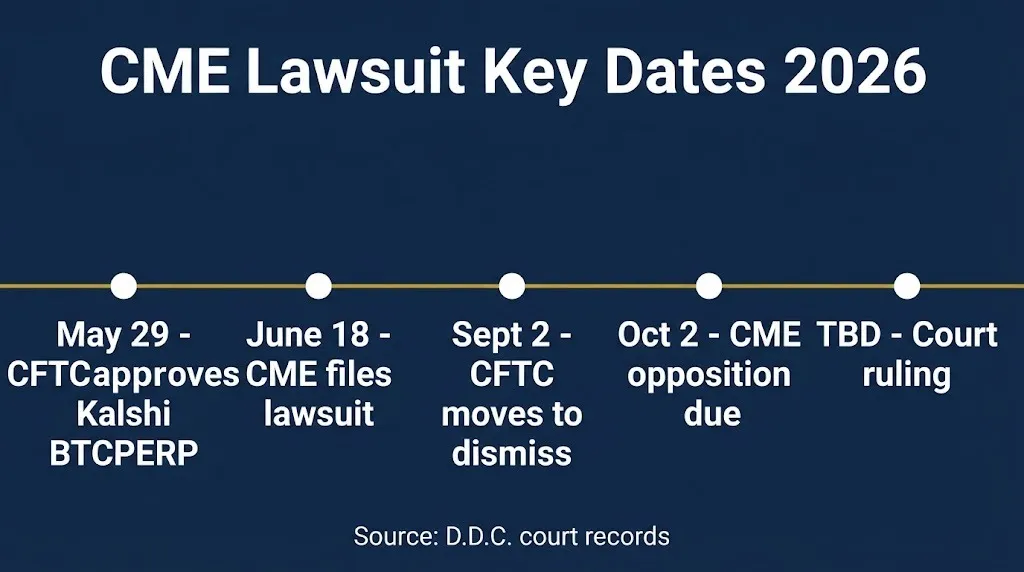
The CFTC approved Kalshi’s BTCPERP contract on May 29, 2026. It was the first time a registered U.S. exchange could list a Bitcoin perpetual futures contract . The contract trades around the clock and is cash-settled.
CME argues these contracts meet the legal definition of swaps, not futures. Swaps carry different regulatory requirements and tax treatment. CME contends the CFTC improperly classified perpetuals as futures, giving Kalshi and other platforms an unfair competitive advantage .
The CFTC maintains that its May 29 order explicitly allows any registered designated contract market, including CME, to list similar products .
What Happens Next in the CME Lawsuit?
The case is in the early procedural phase. CME must file its opposition to the CFTC’s motion to dismiss by October 2, 2026 .
Here is the expected timeline:
| Date | Event |
|---|---|
| October 2, 2026 | CME’s opposition to dismissal motion due |
| Expected late 2026 | Court ruling on motion to dismiss |
| Expected 2027 | If case survives, discovery and merits briefing |
| TBD | Trial or settlement, no date set |
Judge Colleen Kollar-Kotelly is presiding over the case. She previously rejected the CFTC’s request to withhold the administrative record, ruling it could contain evidence relevant to CME’s claimed injury .
How Does the CME Lawsuit Affect Crypto Traders?
The CME lawsuit affects where and how U.S. traders can access Bitcoin perpetual futures. If the CFTC prevails, regulated perpetual futures will continue expanding on U.S. exchanges.
If CME wins, perpetuals may need to be reclassified as swaps, potentially slowing product launches and changing compliance requirements .
For now, Kalshi’s BTCPERP contract continues trading. The CFTC has also approved similar products for Coinbase . The market is already expanding while the litigation plays out.
The stakes are significant. Crypto perpetual futures activity grew 29% in 2025 to approximately $61.7 trillion globally . U.S. regulation will shape where that liquidity flows.
What Happens If the CFTC Wins the CME Lawsuit?
If the CFTC wins, CME’s lawsuit ends and the agency’s authority to approve crypto perpetual futures as futures contracts stands. Exchanges would have more confidence to pursue similar product approvals.
The dismissal motion asks the court to throw out the case before reaching the merits. If granted, it resolves the challenge without a ruling on whether the approval itself was proper .
The CFTC has requested an oral hearing on the motion .
Key Takeaway: A CFTC win means perpetual futures stay classified as futures, and regulated U.S. crypto derivatives markets continue expanding.
What Happens If CME Wins the CME Lawsuit?
If CME wins, the court would likely order the CFTC to reconsider how perpetual contracts are classified and approved. Products might need to be reclassified as swaps, which could slow launches and change compliance structures .
But a CME victory would not necessarily eliminate perpetuals from the U.S. The CFTC itself argues that competitors could still offer similar contracts under a swap framework . The market might redirect rather than disappear.
Frequently Asked Questions
Is the CME lawsuit a class action?
No. It is a regulatory challenge filed by CME Group against the CFTC in federal court.
Can I get money from the CME lawsuit?
No. There is no settlement fund, no claim form, and no payout process connected to this case.
What is the CME lawsuit about?
CME sued the CFTC over its approval of Kalshi’s Bitcoin perpetual futures, arguing they should be classified as swaps, not futures.
When is the next deadline in the CME lawsuit?
CME’s opposition to the CFTC’s motion to dismiss is due October 2, 2026.
Did CME win its previous class action?
Yes. A jury returned a defense verdict in July 2025 in a case brought by exchange members over Aurora Data Center access. That case is closed.
Who is the judge in the CME lawsuit?
U.S. District Judge Colleen Kollar-Kotelly is presiding over the case in the District of Columbia.
What are Bitcoin perpetual futures?
Derivative contracts that track Bitcoin’s price without an expiration date, using a funding rate to stay close to spot.
Will the CME lawsuit affect Bitcoin prices?
The case is structural, not a direct price driver. It shapes where U.S. traders can access regulated crypto derivatives.
The single date to watch is October 2, 2026. That is when CME must respond to the CFTC’s motion to dismiss. If the case survives, it moves into discovery and could take years to resolve.