Divorce Settlement Agreement Template 2026: What You Need to Know Before Signing
Quick Answer
- A divorce settlement agreement template is a starting document, not a finished legal contract.
- No template guarantees a specific outcome. Division depends on state law, assets, and debts.
- The most important deadline is your state’s mandatory waiting period, which varies from zero to six months.
If you searched for a divorce settlement agreement template, you are likely at one of two moments. Either you are starting a divorce and want to see what the paperwork looks like. Or you are trying to finalize one without spending thousands on lawyers.
The template itself is not the hard part. The hard part is knowing what belongs in it, what your state requires, and what happens if you get it wrong. This article breaks down what is verified, what is state-specific, and what no template will tell you.
One verified detail most guides skip: California requires mandatory financial disclosures before any marital settlement agreement is enforceable. You cannot just sign a template and file it.
The Facts
| Case | No single case; family law varies by state |
| Status | No settlement fund; divorce is a private legal matter |
| Fund Size | Not applicable |
| Est. Per Person | Not applicable; division depends on marital assets |
| Claim Deadline | Varies by state; mandatory waiting periods apply |
| Administrator | County superior court or family court |
| Proof Needed | Financial disclosures, asset lists, income records |
Is a Divorce Settlement Agreement Template Legit?
Yes, a divorce settlement agreement template is a legitimate starting document. But it is not a universal form.
Templates circulate online for free and for purchase. Some are accurate for simple cases. Some are dangerously incomplete.
The problem is that divorce law is state law. A template written for Texas will not match California requirements. A California marital settlement agreement must include specific disclosures and language that a generic template may omit.
Courts do not provide a single national template. Each state has its own forms, and some counties add local requirements.
If you use a template, treat it as a checklist, not a contract. Verify every section against your state’s family code and local court rules before filing anything.
What Is a Marital Settlement Agreement in California?
A marital settlement agreement in California is a written contract that resolves all issues in a divorce.
It covers property division, spousal support, child custody, child support, and debt allocation. Once signed by both parties and accepted by the court, it becomes a binding judgment.
California is a community property state. That means assets and debts acquired during the marriage are generally split equally. The marital settlement agreement documents how that split happens.
The agreement must be in writing. It must be signed by both spouses. And it must follow mandatory financial disclosure rules under the California Family Code.
A generic template may capture the basics. But California courts reject agreements that omit required disclosures or that are so one-sided they shock the conscience.
How Much Does a Divorce Settlement Agreement Cost?
The cost varies widely, from zero to several thousand dollars.
A free template costs nothing. Filing fees are separate. In California, the filing fee for a divorce petition was $435 as of 2025, with additional fees for some motions.
If you hire a lawyer to draft or review the agreement, expect to pay $2,500 to $10,000 or more depending on complexity and your location.
A mediator charges less than two lawyers. Mediation for a full divorce settlement often runs $3,000 to $7,000 total.
The cheapest option is not always the best. A poorly drafted agreement can cost far more in future litigation than a lawyer would have charged upfront.
| Option | Typical Cost | Best For |
|---|---|---|
| Free template | $0 plus filing fees | Simple, no-asset, no-child divorces |
| Online service | $150 to $500 | Uncontested, low-conflict cases |
| Mediator | $3,000 to $7,000 | Couples who agree but need structure |
| Lawyer review | $500 to $2,000 | Template users who want a legal check |
| Full representation | $5,000 to $15,000+ | Complex assets, disputes, or custody fights |
What Does a Divorce Settlement Agreement Example Include?
A complete divorce settlement agreement example includes several core sections.
The first section identifies the parties and the marriage date. The second states the grounds for divorce, which in no-fault states is usually irreconcilable differences.
The property division section lists all assets and debts. It says who gets the house, the cars, the retirement accounts, and the credit card balances.
The spousal support section states whether support is paid, how much, and for how long. It also says whether support is modifiable or non-modifiable.
If there are children, the agreement includes custody, visitation, and child support. Child support follows state guidelines and is rarely left entirely to the parents.
The final sections cover attorney fees, tax consequences, and a statement that the agreement is fair and voluntary.
Key Takeaway: A template is only as good as the completeness of the asset list, debt list, and state-specific disclosures behind it.
How Do You Fill Out a Divorce Settlement Agreement Template?
Filling out the template is step one. Making it enforceable is the real work.
- Gather every financial document: bank statements, retirement accounts, mortgage statements, credit card bills, tax returns.
- List all assets acquired during the marriage, including those you think are separate.
- List all debts, including those in only one name.
- Decide how to divide each item, following your state’s community property or equitable distribution rules.
- Complete the mandatory financial disclosure forms required by your state.
- Draft the agreement using the template as a guide, not as the final word.
- Have each spouse review the agreement, ideally with separate legal counsel.
- Sign in front of a notary where required, then file with the court.
Skipping the disclosure step is the most common mistake. A signed agreement without disclosures is vulnerable to being set aside later.
What Is the Difference Between Community Property and Equitable Distribution?
This is the single biggest reason a generic template can fail.
Community property states divide marital assets equally. California, Texas, Arizona, Nevada, and several others follow this rule.
Equitable distribution states divide assets fairly, not necessarily equally. New York, Florida, and most other states follow this rule.
A template that says “divide everything equally” is wrong in an equitable distribution state. A template that says “divide fairly” is incomplete in a community property state.
You must know which system your state uses before you fill in a single number.
| State Type | Rule | Examples |
|---|---|---|
| Community property | 50/50 split of marital assets | California, Texas, Arizona |
| Equitable distribution | Fair split, not always equal | New York, Florida, Illinois |
What Is the Waiting Period for a Divorce in California?
California has a six-month mandatory waiting period.
The clock starts on the date the responding spouse is served with the divorce petition. The divorce cannot be final before six months pass.
The waiting period is not a separation requirement. You do not need to live apart for six months. You only need to wait for the court to have jurisdiction to enter judgment.
Some states have shorter periods. Some have longer. Nevada requires six weeks. Texas requires 60 days. New York has no fixed waiting period but often takes months due to court backlog.
If you are using a template, calendar your state’s waiting period. Filing too early gets rejected. Filing too late means the agreement sits unsigned.
Key Takeaway: Your state’s property division system and waiting period control the outcome more than any template language does.
Is a Marital Settlement Agreement the Same as a Divorce Decree?
No. A marital settlement agreement is a contract. A divorce decree is the court order.
The agreement becomes part of the decree once the judge signs it. The decree is the enforceable court document that legally ends the marriage.
Think of the agreement as the deal terms and the decree as the judge’s stamp of approval. You need both.
A template is not a decree. Filing a template without court approval does nothing. The court must review and accept the agreement before it becomes binding.
Can You Write Your Own Divorce Settlement Agreement?
Yes, you can write your own divorce settlement agreement. Many people do.
The risk is not in the writing. The risk is in the omissions. A missed retirement account, an unlisted debt, or a missing disclosure can unravel the entire agreement.
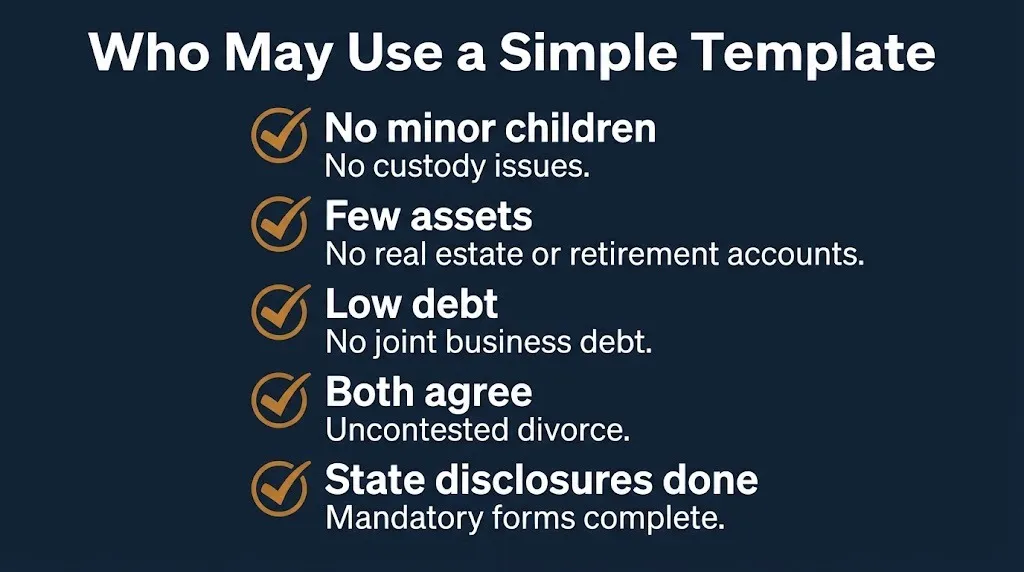
If you have no children, no real estate, and few assets, a self-written agreement using a template may work. If you have any of those, get a legal review.
A review is cheaper than a full representation. Many family law attorneys offer limited-scope services. You pay for a few hours of review, not the whole case.
Reality Check: No online template or AI-generated agreement is a substitute for knowing your state’s disclosure rules. Signing a template without disclosures is like signing a lease without reading the fine print. The problem shows up later.
What Happens If a Divorce Settlement Agreement Is Unfair?
A court can reject an agreement that is fundamentally unfair.
In California, the judge must find the agreement is not unconscionable. An agreement that leaves one spouse with nothing and the other with everything may be rejected.
The same principle applies in most states. Courts retain the power to refuse to enter a judgment based on an agreement that is grossly one-sided or that was signed under duress.
If you signed an unfair agreement and it was already entered as a judgment, your options narrow. You may need to file a motion to set aside the judgment, which has strict deadlines.
The time to object to unfairness is before signing, not after.
What Are Mandatory Financial Disclosures in a Divorce?
Mandatory financial disclosures are the backbone of an enforceable settlement.
In California, both spouses must exchange a preliminary declaration of disclosure. This includes a schedule of assets and debts and an income and expense declaration.
The disclosure must be served before the agreement is signed. It must be updated before trial or final settlement if anything changes.
The purpose is to prevent one spouse from hiding assets. If you do not know what exists, you cannot divide it fairly.
Other states have similar requirements, though the forms and deadlines differ. The principle is the same: full transparency before division.
What Is the Difference Between a Contested and Uncontested Divorce?
An uncontested divorce means both spouses agree on all issues. A contested divorce means they do not.
Templates work best in uncontested cases. If you agree on property, support, and custody, the paperwork is simpler and the path is faster.
A contested divorce requires negotiation, mediation, or trial. A template cannot resolve disagreement. It can only document the resolution once reached.
Most divorces start contested and end uncontested. The template becomes useful at the end, not the beginning.
How Does Debt Get Divided in a Divorce Settlement Agreement?
Debt division follows the same rules as asset division.
In community property states, marital debts are split equally. That includes credit card balances, car loans, and mortgages incurred during the marriage.
In equitable distribution states, debts are divided fairly based on who incurred them, who benefited, and each spouse’s ability to pay.
A template must list every debt. Missing a debt means one spouse may be stuck with it later.
Creditors are not bound by your agreement. If your ex-spouse stops paying a joint credit card, the creditor can still pursue you. Your remedy is against your ex-spouse, not the creditor.
Key Takeaway: List every asset and every debt. The one you forget is the one that causes the lawsuit later.
What Happens to Retirement Accounts in a Divorce Settlement?
Retirement accounts are often the largest asset in a marriage.
Dividing a 401(k) or pension requires a separate court order called a qualified domestic relations order, or QDRO. The divorce settlement agreement states the division. The QDRO tells the plan administrator how to pay it.
Without a QDRO, the plan will not release funds to the non-employee spouse. This is a common omission in template agreements.
IRAs are divided differently. The divorce decree itself can authorize a transfer incident to divorce without a QDRO.
If you have retirement accounts, a template alone is not enough. You need the QDRO step too.
What Is Spousal Support in a Marital Settlement Agreement?
Spousal support, also called alimony, is a payment from one spouse to the other after divorce.
The agreement states the amount, the duration, and whether it is modifiable. It also states the circumstances that end support, such as remarriage or cohabitation.
California uses a formula for temporary support but leaves long-term support to the court’s discretion. The marital settlement agreement can fix the amount by agreement.
Support is taxable to the recipient and deductible to the payer only for agreements finalized before 2019. For newer agreements, support is neither taxable nor deductible under federal law.
A template may include a support clause. Whether that clause matches your state’s law is another question.
What Happens Next After Signing the Agreement?
The process after signing is straightforward but not automatic.
Expected within 30 days: File the signed agreement with the court along with the required judgment forms.
Expected within 6 to 12 weeks: Court review. The judge signs the judgment if the agreement is complete and fair.
Expected after judgment: The divorce is final. The agreement terms become enforceable.
If the court rejects the agreement, you must fix the issues and refile. This adds weeks or months.
The most important action is to calendar your state’s waiting period and file the agreement as soon as it expires.
Frequently Asked Questions
Is a divorce settlement agreement template legally binding?
A signed template is not binding until a judge approves it and enters a judgment.
The court must review the agreement for fairness and completeness.
How much does a marital settlement agreement cost in California?
Filing fees start at $435, plus lawyer or mediator fees if used.
A free template costs nothing, but legal review is recommended for complex cases.
What is the waiting period for divorce in California?
California has a six-month mandatory waiting period from the date of service.
The divorce cannot be final before that period ends.
Can I use a free divorce settlement agreement template?
Yes, for simple, uncontested cases with no children and few assets.
For anything else, get a legal review before signing.
What happens if my spouse hides assets in the settlement?
Hidden assets can be grounds to set aside the agreement.
Mandatory disclosures are designed to prevent this.
Do I need a lawyer for a divorce settlement agreement?
You do not need a lawyer for a simple uncontested divorce.
For complex assets, custody disputes, or unfair terms, a lawyer is strongly recommended.
What is the difference between a divorce decree and a settlement agreement?
The settlement agreement is the contract between the spouses.
The divorce decree is the court order that makes it enforceable.
The single most important step is not finding a template. It is completing your state’s mandatory disclosures and listing every asset and debt before you sign.