Settlement Calculator 2026: How to Estimate Your Personal Injury Claim Value
Quick Answer:
- A settlement calculator is an online estimation tool that uses your injury type, medical costs, and lost income to suggest a claim value.
- Calculators cannot predict actual payouts because they lack access to insurance policy limits, liability disputes, and jurisdiction-specific jury data.
- No deadline applies to using a calculator, but your state’s statute of limitations sets the deadline for filing a lawsuit.
You were in a car accident. You slipped and fell. You got hurt on a construction site. Now you are sitting in front of a screen, typing numbers into a settlement calculator, trying to figure out what your claim is worth before you call a lawyer or accept an insurance offer. This article is for you.
Settlement calculators are everywhere online. Law firm websites host them. Legal information sites embed them. They ask for your medical bills, your lost wages, and your pain level, then they spit out a number. That number can feel real. It can feel like an answer. It is not. It is an estimate built on averages and algorithms that know nothing about your case, your insurance adjuster, or the court where your case might be filed.
One fact that surprises most users: insurance companies do not use consumer-facing settlement calculators. They use internal software called claims valuation tools that incorporate far more data, including jurisdiction-specific jury verdict history, adjuster discretion ranges, and policy limit constraints. The number on your screen and the number in the adjuster’s file are calculated differently.
| The Facts | |
|---|---|
| Tool Type | Online estimation algorithm, not a court or government resource |
| Data Sources | User-entered medical bills, lost wages, injury type; some tools use historical jury verdict databases |
| Accuracy | Estimates only; actual settlements vary by liability, policy limits, jurisdiction, and negotiation |
| Used By Insurers | No; insurers use proprietary claims valuation software, not consumer calculators |
| Used By Courts | No; courts do not use or endorse settlement calculators |
| Cost | Most are free; some law firm calculators require contact information |
| Legal Authority | None; calculators are marketing and education tools, not legal instruments |
What Is a Settlement Calculator?
A settlement calculator is an online tool that asks for information about your injury, medical treatment, lost income, and other damages, then produces an estimated dollar value for your claim. The tool uses a formula, typically multiplying your economic damages by a factor based on injury severity, to generate a suggested settlement range.
The formula behind most calculators is a variation of the multiplier method. Your economic damages, meaning medical bills, lost wages, and out-of-pocket costs, are added together. That sum is multiplied by a number between 1.5 and 5, depending on how severe your injury is and how long recovery took. The result is the calculator’s estimate of what your claim is worth, including pain and suffering.

For example, if your medical bills total $10,000 and your lost wages are $3,000, your economic damages are $13,000. A calculator might apply a multiplier of 2 for a moderate soft tissue injury, producing an estimate of $26,000. A multiplier of 4 for a surgery-level injury would produce $52,000. A multiplier of 5 for a permanent disability would produce $65,000.
The per diem method is a less common alternative. It assigns a daily dollar value to your pain and multiplies it by the number of days you were affected. If the daily rate is $200 and you were in pain for 180 days, pain and suffering would be $36,000, added to your economic damages.
Neither method is used by insurance adjusters in the simplified way a calculator uses them. Adjusters apply multipliers based on jurisdiction, the specific adjuster’s authority, the insurance company’s settlement guidelines, and the strength of the liability evidence. A calculator cannot replicate that analysis.
Key Takeaway: A settlement calculator applies a formula to your inputs; the formula is a useful starting point, but it knows nothing about the other driver’s insurance limits, your state’s negligence laws, or what juries in your county actually award.
How Accurate Are Online Settlement Calculators?
Online settlement calculators are rough estimation tools. They are not accurate in the sense of predicting what an insurance adjuster will offer or what a jury will award. The American Bar Association does not endorse any consumer settlement calculator. State insurance departments do not regulate them. Courts do not use them.
The problem is not that the formulas are wrong. A multiplier of 2 for a minor injury is a reasonable starting point. The problem is that the formula cannot account for the variables that actually determine settlement value: liability, policy limits, venue, and the credibility of the parties.
Liability means who was at fault and whether that can be proved. If you are 50 percent at fault in a comparative negligence state, your recovery is reduced by your percentage of fault. A calculator does not ask about the police report, the witnesses, or the traffic camera footage. It assumes 100 percent liability in your favor, which is rarely the full picture.
Policy limits cap every settlement. If the at-fault driver has a $25,000 policy, your claim is worth $25,000 or less, no matter how severe your injury. A calculator might estimate $150,000 based on your medical bills, but if the insurance policy is $25,000, the estimate is irrelevant.
Venue matters enormously. The same injury with the same medical bills might settle for $30,000 in one county and $90,000 in another, based on local jury tendencies, the cost of living, and the insurance defense firms practicing there. A calculator has no jurisdiction-specific jury verdict data.
Credibility cannot be entered into a field. Your appearance, your deposition performance, your medical expert’s likability, the defendant’s likeability, all of these affect settlement value. A calculator reduces human judgment to multiplication.
Reality Check: No online calculator can tell you what your case is worth. Insurance adjusters evaluate claims using proprietary software, legal guidelines, and individual discretion. Any tool that claims to produce a guaranteed settlement amount is misleading. Use a calculator as a conversation starter with a lawyer, not as a decision-making tool.
How to Use a Personal Injury Settlement Calculator
Using a settlement calculator requires more than typing numbers into boxes. The quality of the inputs determines whether the output is even directionally useful. Here is how to use one responsibly.
- Gather your actual medical bills, not estimates. Include emergency room bills, hospital stays, surgery costs, physical therapy, chiropractic care, imaging, and prescription medications. Do not guess. Use the numbers on the bills.
- Calculate your lost wages accurately. If you missed three weeks of work at $1,000 per week, enter $3,000. If your injury reduced your earning capacity permanently, a calculator cannot handle that; you need a lawyer and an economist.
- Identify all out-of-pocket costs. This includes transportation to medical appointments, home modifications for a disability, medical equipment, and hired help for tasks you can no longer perform. These are economic damages and should be included.
- Choose a realistic multiplier. Most calculators let you select injury severity. Be honest. A soft tissue strain that resolved in six weeks is a 1.5 to 2. A fracture requiring surgery is a 3 to 4. A permanent disability or brain injury is a 5 or higher. Overstating injury severity produces a misleading estimate.
- Run the calculation on multiple tools. Different calculators use slightly different formulas. If three calculators produce estimates within a $10,000 range, that range is likely more useful than any single number.
- Treat the result as the start of a negotiation range, not the finish line. The calculator’s number is what your claim might be worth if liability is clear, policy limits are adequate, and you have a skilled negotiator. Any of those factors can reduce the actual settlement dramatically.
- Do not share the calculator result with an insurance adjuster. The adjuster’s valuation is based on their own methodology. Citing a consumer calculator weakens your negotiating position.
What Is a Personal Injury Settlement Calculator?
A personal injury settlement calculator is a broad tool designed for many types of injury claims: car accidents, slip and falls, premises liability, product liability, and medical malpractice. It uses the same multiplier framework but may offer different multiplier ranges depending on the claim type.
These calculators typically ask for the accident type, injury type, total medical expenses, total lost income, and whether the injury is permanent. Some ask for your age, which can affect the valuation. Younger plaintiffs with permanent injuries generally receive higher settlements because the damages are calculated over a longer life expectancy.
The output is a single number or a range. The range is more honest than a single number because it acknowledges the uncertainty inherent in settlement valuation. A range of $30,000 to $60,000 is more useful than a precise $44,500, which implies a level of accuracy the calculator cannot deliver.
Most personal injury calculators are hosted on law firm websites. The firm offers the tool for free, but the real purpose is lead generation. You enter your information, and the firm contacts you. This is not inherently deceptive, but it means the calculator is a marketing instrument. Its design choices, including default multiplier settings, may be calibrated to encourage you to call.
What Is a Bodily Injury Settlement Calculator?
A bodily injury settlement calculator is essentially the same tool as a personal injury calculator, often marketed under a different name for search engine purposes. Bodily injury is the term used in auto insurance policies for the coverage that pays for injuries you cause to others. A bodily injury calculator focuses on car accident injuries rather than slip and fall or medical malpractice claims.
These calculators may ask for additional inputs specific to auto accidents: whether the accident was a rear-end collision, whether airbags deployed, whether the vehicle was totaled, and whether you were transported by ambulance. These factors are proxy measures for injury severity that adjusters use.
The value of a bodily injury claim is typically limited by the at-fault driver’s bodily injury liability coverage. State minimums range from $15,000 to $50,000 per person. If the at-fault driver carries only the state minimum, your settlement is capped at that amount, absent other sources of recovery like your own underinsured motorist coverage or the defendant’s personal assets.
Knee Injury Settlement Calculator: What to Expect
Knee injuries are among the most common injuries in car accidents, slip and falls, and workplace accidents. A knee injury settlement calculator asks about the specific diagnosis: sprain, meniscus tear, ligament tear, fracture, or total knee replacement. The diagnosis drives the multiplier.
Knee injury settlements vary widely by severity. The following ranges reflect data from jury verdict reporters and settlement surveys published by legal publishers, not guaranteed outcomes:
| Knee Injury Type | Typical Settlement Range | Key Factors |
|---|---|---|
| Knee sprain or strain | $5,000 to $25,000 | Recovery in weeks; no surgery; minimal residual symptoms |
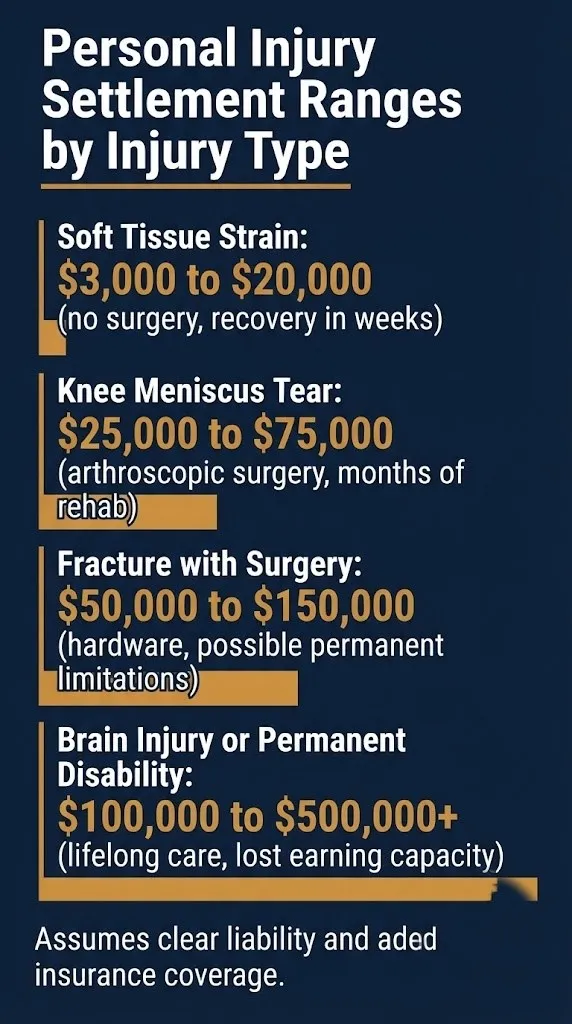
| Meniscus tear (arthroscopic surgery) | $25,000 to $75,000 | Surgery required; several months recovery; some permanent limitations |
| ACL or MCL tear (reconstruction) | $50,000 to $150,000 | Major surgery; extensive rehab; permanent instability risk |
| Knee fracture (non-displaced) | $30,000 to $80,000 | Immobilization; physical therapy; possible arthritis |
| Total knee replacement | $100,000 to $300,000+ | Permanent implant; lifelong limitations; multiple surgeries possible |
These ranges assume clear liability and adequate insurance coverage. A knee replacement caused by a driver with a $25,000 policy will settle for $25,000, not $150,000.
Key Takeaway: Knee injury settlement value is driven by the surgery requirement and permanence; a calculator can estimate the range, but policy limits and liability disputes set the ceiling.
Motorcycle Accident Settlement Calculator
Motorcycle accident claims are valued differently from car accident claims for reasons that have nothing to do with the injury itself. Motorcycle riders face bias in settlement negotiations and at trial. Insurance adjusters and jurors may assume the rider was speeding, lane-splitting, or otherwise at fault, even without evidence.
A motorcycle accident settlement calculator may apply a higher multiplier for the same injury because motorcycle crashes tend to produce more severe injuries. A broken leg in a car accident might get a multiplier of 3. The same broken leg from a motorcycle accident might get a 4 because the injury mechanism, typically ejection from the bike, is more violent and the recovery is often longer.
The bias factor means that liability evidence is even more important in motorcycle cases. The police report, witness statements, and accident reconstruction become critical. A calculator cannot weight evidence. If liability is contested, the settlement value drops, often by 50 percent or more, regardless of what the calculator says.
Motorcycle insurance policy limits are typically the same as auto policy limits. The rider’s own underinsured motorist coverage is important because at-fault drivers frequently carry low limits relative to the severity of motorcycle injuries. A calculator does not ask about underinsured motorist coverage, but a lawyer will.
Soft Tissue Injury Settlement Calculator
Soft tissue injuries, meaning sprains, strains, whiplash, and contusions without fractures or structural damage, are the most common injuries in car accidents and the hardest to value. There is no surgery. There is often no visible injury on imaging. The primary evidence is the patient’s report of pain.
Insurance companies aggressively challenge soft tissue claims. The adjuster’s valuation will be lower than the calculator’s estimate because the adjuster discounts damages that cannot be verified by objective medical evidence. A calculator might apply a multiplier of 2 to a whiplash claim with $5,000 in medical bills and produce an estimate of $10,000. The adjuster may offer $3,000, citing the lack of objective findings and the short treatment duration.
Soft tissue settlement values depend heavily on treatment consistency. A plaintiff who went to the emergency room, followed up with a primary care doctor, completed a course of physical therapy, and was discharged with no permanent restrictions has a stronger claim than someone who treated once and stopped. Gaps in treatment are used by adjusters to argue the injury was not serious.
A realistic settlement range for soft tissue injuries with $3,000 to $10,000 in medical bills is $3,000 to $20,000, depending on treatment duration, diagnostic testing, and the credibility of the pain complaints. The calculator’s estimate is often at the high end of that range.
How Much Is My Car Accident Settlement Worth?
The question behind every calculator search is straightforward: what is my car accident claim worth? The honest answer is that no calculator, no website, and no article can tell you. The value depends on factors that calculators cannot access.
The most important factor is the available insurance coverage. The at-fault driver’s bodily injury liability limit sets the maximum the insurer will pay per person. Your own underinsured motorist coverage can provide additional recovery if the at-fault driver’s limits are too low. Your health insurance subrogation rights may reduce your net recovery. None of these factors are captured by a settlement calculator.
The second factor is liability. If fault is disputed, the settlement value drops. If you share fault, the value drops by your percentage of fault in comparative negligence states. In contributory negligence states, any fault on your part bars recovery entirely. A calculator assumes 100 percent liability on the defendant.
The third factor is the venue. Jury verdicts vary by county. A personal injury lawyer who practices in your jurisdiction knows what cases settle for and what juries award. That local knowledge is not available in a national calculator.
A realistic approach to valuing your car accident claim involves getting the policy limits information, evaluating the liability evidence, and consulting a lawyer who practices in the county where the case would be filed. The calculator gives you a number to compare against the lawyer’s estimate and the adjuster’s offer. It is a reference point, not a decision.
Key Takeaway: Your car accident claim value is capped by the available insurance, reduced by any liability dispute, and shaped by your jurisdiction’s jury tendencies; a calculator gives you none of that information.
What Happens Next
Using a settlement calculator is step one. Step two is gathering the information the calculator cannot access. Here is a realistic timeline for moving from calculator estimate to settlement:
- Week 1: Use one or more calculators. Gather your medical bills, lost wage documentation, and out-of-pocket expense records. Write down the calculator results as a reference range.
- Week 2: Request the at-fault party’s insurance policy limits information. In many states, the insurer must disclose policy limits upon request. If the limits are low, ask about underinsured motorist coverage on your own policy.
- Week 2 to 4: Consult a personal injury attorney who practices in your county. Ask for their estimate of settlement value based on their knowledge of local juries and adjusters. Compare their estimate to the calculator range.
- Month 1 to 6: Medical treatment concludes or reaches maximum medical improvement. The claim cannot be valued until treatment is complete because future medical needs must be estimated.
- Month 6 to 12: Demand package submitted to the insurer. Settlement negotiations begin. The actual settlement number emerges from this process, not from the calculator.
Frequently Asked Questions
Are free settlement calculators accurate?
No free settlement calculator is accurate in predicting your actual settlement.
They provide a rough range based on averages and formulas.
Use them as a starting point for a conversation with a lawyer, not as a decision tool.
Do insurance companies use settlement calculators?
Insurance companies use proprietary claims valuation software, not consumer-facing calculators.
Their tools incorporate jurisdiction-specific jury verdict data and adjuster discretion ranges.
The adjuster’s valuation will differ from any consumer calculator.
What is the multiplier method in settlement calculations?
The multiplier method adds up your economic damages and multiplies by a number from 1.5 to 5.
The multiplier reflects injury severity, recovery duration, and permanence.
It is the most common formula used in online calculators and attorney demand letters.
Can I use a settlement calculator for a workers compensation claim?
Workers compensation claims are not valued using the multiplier method.
Workers comp pays specific benefits set by state law: medical care, a percentage of lost wages, and scheduled disability payments.
A personal injury calculator will produce misleading results for a workers comp claim.
What does a settlement calculator need to know about my case?
Most calculators ask for medical bills, lost wages, injury type, and whether the injury is permanent.
Some ask about your age, the accident type, and treatment duration.
More detailed inputs produce slightly better estimates, but no calculator captures policy limits or liability disputes.
Should I tell an insurance adjuster what the settlement calculator said?
No. The adjuster does not use consumer calculators and will not negotiate based on one.
Citing a calculator weakens your negotiating position by showing you lack legal representation.
Let your lawyer present the valuation, supported by medical evidence and legal argument.
How do I know if a settlement offer is fair?
A fair offer reflects the medical bills, lost wages, pain and suffering, and the strength of the liability case.
Compare the offer to what similar cases settle for in your jurisdiction.
A lawyer who practices locally can tell you whether the offer is in line with local norms.
Can I settle my claim without a lawyer?
You can, especially for small claims with clear liability and minimal injuries.
For any injury requiring surgery, causing permanent damage, or involving disputed liability, a lawyer typically recovers more even after fees.
Insurance adjusters negotiate differently with represented and unrepresented claimants.
What You Should Do Now
Take the estimate from the settlement calculator as a rough starting point. Then gather your medical records, your bills, and your wage documentation. Find out the at-fault party’s insurance policy limits. The calculator gave you a number. The adjuster will give you a different, almost certainly lower, number. The gap between them is what a personal injury lawyer negotiates.
If your injury required surgery, left you with permanent limitations, or if liability is contested, consult a lawyer. Most personal injury attorneys offer free consultations and work on contingency, meaning they are paid only if you recover. The calculator is free. The consultation is free. The information you get from both will tell you more than either one alone.