Workers Compensation Texas 2026: Rates, Rules, and the Opt-Out System Explained
Quick Answer
- Texas workers’ compensation insurance is not mandatory for most private employers, unlike every other state.
- The 2026 maximum weekly benefit is $1,271.05 and the minimum is $190.66, for injury dates between October 1, 2025 and September 30, 2026.
- You generally must file your claim with the DWC within 1 year of your injury date to preserve your right to benefits.
You got hurt on the job in Texas and now you’re trying to figure out what you’re actually owed. Here’s the direct answer: it depends entirely on whether your employer carries workers’ compensation insurance, because Texas is the only state that doesn’t require it.
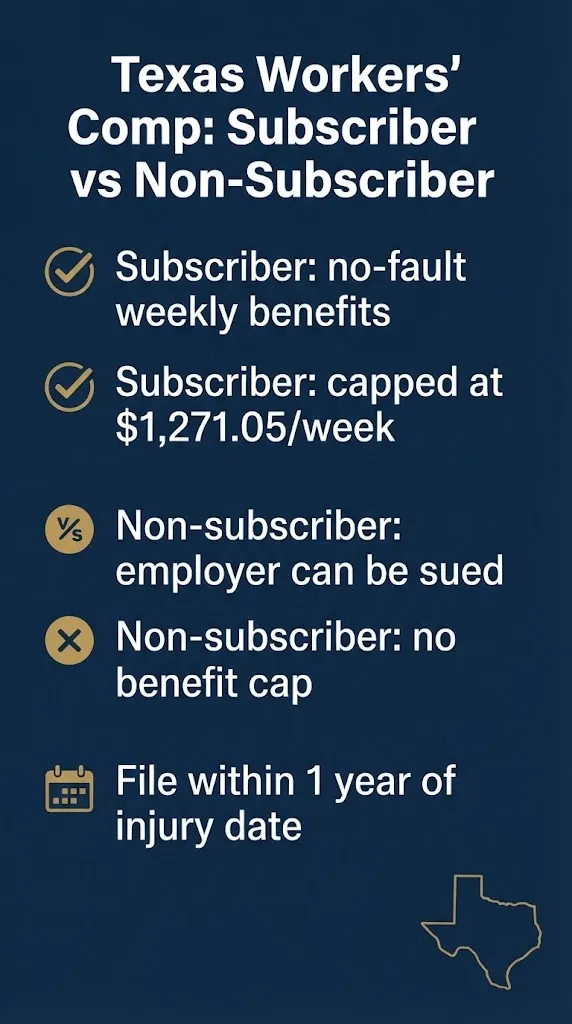
This matters because the two paths pay out completely differently. If your employer is a “subscriber,” you get no-fault weekly benefits capped at $1,271.05 for 2026. If your employer is a “non-subscriber,” you have to sue in civil court instead, and the payout ceiling disappears entirely.
This guide breaks down the current 2026 benefit rates, filing deadlines, and the opt-out system that catches so many Texas workers off guard. One detail worth knowing upfront: your employer is legally required to post a notice telling you which system applies to you, yet many workers never see it.
The Facts
| Category | What’s Verified for 2026 |
|---|---|
| System | Texas workers’ compensation, regulated by the Texas Department of Insurance, Division of Workers’ Compensation (DWC) |
| Coverage requirement | Optional for most private employers, Texas is the only state with this opt-out system |
| 2026 state average weekly wage | $1,271.05 |
| Maximum weekly income benefit | $1,271.05 |
| Minimum weekly income benefit | $190.66 |
| Rate window | Applies to injuries dated October 1, 2025 through September 30, 2026 |
| Filing deadline | 1 year from date of injury for a DWC claim |
| Report to employer | Within 30 days of the injury |
| Governing law | Texas Labor Code, Subtitle A, workers’ compensation provisions |
Not every number in Texas workers’ comp is fixed. Impairment income benefits, supplemental income benefits, and lump sum eligibility all depend on your specific medical rating and claim history.
Is workers’ compensation insurance required in Texas?
No, workers’ compensation insurance is not mandatory for most private Texas employers, making Texas the only state with this opt-out system. Every other state requires employers to carry coverage in some form.
Employers who choose not to carry coverage are called “non-subscribers.” Employers who do carry it are called “subscribers.” The distinction changes everything about how an injured worker gets compensated.
Two very different systems exist in Texas:
- Subscriber employers: Provide no-fault workers’ comp benefits through the DWC system, and are generally protected from being sued by injured employees.
- Non-subscriber employers: Provide no state-mandated coverage, but lose most common-law legal defenses if an injured employee sues them.
Government employers and some public entities are treated differently and often required to carry coverage, unlike private businesses.
What is Texas workers’ compensation insurance and who regulates it?
Texas workers’ compensation insurance is a no-fault benefit system regulated by the Texas Department of Insurance, Division of Workers’ Compensation, known as the DWC. The DWC sets benefit rates, oversees disputes, and enforces employer notice requirements.
The DWC recalculates the maximum and minimum weekly benefit amounts every year based on the state average weekly wage, and the new rates take effect October 1. For the current rate year, the 2026 SAWW of $1,271.05 sets both the benefit ceiling and the calculation basis for other benefit types.
Key Takeaway: Texas workers’ comp is administered by the DWC, but coverage itself remains optional for most private employers, which is the single fact that separates Texas from every other state.
How much does workers’ compensation pay in Texas?
Texas workers’ comp generally pays 70% of the difference between your average weekly wage and your post-injury earnings, or 75% for the first 26 weeks if you earn less than $10 an hour. This formula comes directly from Texas Labor Code Section 408.103.
Your average weekly wage, or AWW, is calculated using your wages from the 13 weeks before your injury, including regular pay, overtime, bonuses, and commissions.
| Benefit Component | Formula |
|---|---|
| Standard rate | 70% of (AWW minus post-injury earnings) |
| Reduced-wage worker rate (first 26 weeks) | 75% of the wage difference if you earn under $10/hour |
| 2026 maximum cap | $1,271.05 per week |
| 2026 minimum floor | $190.66 per week |
If your actual calculated benefit exceeds the weekly maximum, the cap applies regardless of your real wage loss. This is the same logic as an insurance policy limit: your coverage stops at the ceiling even if your actual loss runs higher.
What is the maximum weekly workers’ comp benefit in Texas for 2026?
The maximum weekly income benefit for 2026 is $1,271.05, set at 100% of the state average weekly wage for injuries dated October 1, 2025 through September 30, 2026. This figure applies across the main income benefit types, not just one category.
The minimum weekly benefit for the same period is $190.66, calculated at 15% of the SAWW. These figures reset every October based on updated wage data, so an injury dated in late 2026 could fall under a different rate year.
What the cap applies to:
- Temporary Income Benefits (TIBs)
- Impairment Income Benefits (IIBs)
- Supplemental Income Benefits (SIBs)
- Lifetime Income Benefits (LIBs)
Key Takeaway: The 2026 benefit ceiling of $1,271.05 a week applies no matter how high your actual pre-injury wages were, so higher earners lose a larger share of their real income under the cap.
How are impairment income benefits calculated in Texas?
Impairment Income Benefits pay 70% of your average weekly wage for 3 weeks per percentage point of your impairment rating, under Texas Labor Code Section 408.121. This benefit begins once your doctor determines you’ve reached Maximum Medical Improvement, known as MMI.
Your impairment rating comes from a doctor applying the AMA Guides to the Evaluation of Permanent Impairment, and you can request a Designated Doctor exam through the DWC if you dispute the rating assigned.
Example calculation:
- Impairment rating: 10%
- Weeks of IIB: 10% x 3 weeks = 30 weeks
- Weekly rate: 70% of your AWW, capped at $1,271.05
Not yet determined for your case: the exact impairment rating and resulting weeks, since that depends entirely on your doctor’s individual evaluation.
If your impairment rating reaches 15% or higher, you may also qualify for Supplemental Income Benefits once your IIB payments run out.
Reality Check: No legitimate DWC process requires you to pay an upfront fee to receive workers’ comp benefits you’re entitled to. Filing a claim with the DWC is free, and the insurance carrier, not you, pays the cost of your medical exams and impairment rating in a covered claim.
Can you get a lump sum workers’ comp settlement in Texas?
Generally no, Texas restricts lump sum payouts for ongoing income benefits, though a narrow commutation option exists for Impairment Income Benefits after you meet a return-to-work threshold. Lifetime Income Benefits specifically cannot be converted to a lump sum under any circumstances.
Disputed claims can sometimes be resolved through a negotiated settlement using DWC Form-025, but that process applies only to genuinely contested liability, not to benefits that aren’t in dispute.
What can and can’t be settled as a lump sum:
- IIBs: Limited commutation possible after meeting specific return-to-work criteria.
- SIBs and TIBs: Generally paid weekly, not as a lump sum.
- LIBs: Cannot be commuted or settled as a lump sum under any circumstances.
- Disputed liability: May be resolved through a negotiated settlement (DWC Form-025).
This is different from a personal injury lawsuit, where a lump sum settlement is the norm. Texas workers’ comp is built around weekly wage-replacement payments instead.
How do you file a workers’ compensation claim in Texas?
You file a Texas workers’ comp claim by reporting the injury to your employer, then submitting a claim to the DWC within the required deadline. Missing either step can jeopardize your benefits entirely.
Steps to file a Texas workers’ comp claim:
- Report the injury to your employer within 30 days of the incident.
- Seek medical treatment and inform the provider it’s work-related.
- Confirm whether your employer is a subscriber or non-subscriber.
- File your claim with the DWC within 1 year of the injury date.
- Cooperate with any required medical evaluations from the insurance carrier.
- Track your temporary income benefit eligibility, which begins by your 8th missed workday.
- Request a Designated Doctor exam if you dispute your impairment rating.
- Contact the DWC customer service line if a dispute arises during the process.
Your temporary income benefits generally begin once you’ve missed 7 days of work, not necessarily consecutive days, and become payable by the 8th missed day.
What’s the deadline to file a workers’ comp claim in Texas?
You generally have 1 year from the date of your injury to file a claim with the DWC if your employer is a subscriber. This deadline is separate from the 30-day window to notify your employer, and missing either one can put your claim at risk.
For workers whose employer is a non-subscriber, the relevant deadline shifts because you’re filing a civil lawsuit instead of a DWC claim. That deadline generally runs 2 years from the date of injury under general Texas negligence law.
Two deadlines, two systems:
- Subscriber employer: 1 year to file a DWC claim.
- Non-subscriber employer: 2 years to file a civil lawsuit.
Occupational disease claims can follow different timing rules, since the injury date may not be a single identifiable day. If your condition developed gradually, talk to the DWC about how the discovery rule applies to your specific situation.
How do you know if your employer carries TX workers’ compensation insurance?
Check the notice your employer is legally required to post at the worksite, called the “Notice to Employees Concerning Workers’ Compensation in Texas,” DWC Form No. 5. This single posting tells you which system applies to you.
Ways to confirm your employer’s coverage status:
- Look for the posted notice in a break room or common area.
- Ask your employer or HR department directly, they’re required to tell you.
- Search the Texas Department of Insurance Certificate of Coverage database.
- Call the DWC customer service line for a coverage lookup.
If the notice is missing or was never posted, that doesn’t necessarily mean your employer is a non-subscriber. Confirm through the DWC database or a direct request before assuming either way.
What happens if your Texas workers’ comp claim gets denied?
A denied claim can be appealed through the DWC dispute resolution process, starting with a Benefit Review Conference and potentially escalating to a Contested Case Hearing. This process exists specifically to resolve disagreements between injured workers and insurance carriers.
The general dispute path:
- Benefit Review Conference, an informal mediation session.
- Contested Case Hearing, a formal proceeding before a DWC hearing officer.
- Appeals Panel review, if either party disputes the hearing officer’s decision.
- Judicial review in state district court, as a final option.
Think of this the way you’d think of a denied insurance claim: the first denial isn’t necessarily the final word, and a structured appeals process exists specifically to challenge it.
What is a non-subscriber employer in Texas?
A non-subscriber employer is a private business that has chosen not to carry Texas workers’ compensation insurance, which is legal only in Texas among all 50 states. This choice fundamentally changes an injured employee’s legal options.
Non-subscriber status doesn’t mean an injured worker has no recourse. It means the recourse shifts from a no-fault benefits claim to a civil negligence lawsuit, with different rules entirely.
What changes under a non-subscriber employer:
- No no-fault DWC benefits available through the standard system.
- Injured employees can sue in civil court for negligence.
- Employers lose several traditional legal defenses in that lawsuit.
- Damages aren’t capped the way DWC weekly benefits are.
Key Takeaway: Whether your employer subscribes to workers’ comp determines your entire legal path after a workplace injury, and confirming that status early changes what deadlines and remedies actually apply to you.
Can you sue a non-subscriber employer in Texas?
Yes, if your employer is a non-subscriber, you can sue them in civil court for negligence, and Texas law strips away several defenses employers normally rely on. This is one of the more consumer-favorable parts of the non-subscriber system.
Under Texas Labor Code Section 406.033, a non-subscriber employer generally cannot use the defenses of contributory negligence, assumption of risk, or the fellow servant rule in this type of lawsuit. That makes it comparatively easier for an injured employee to establish liability, though you still must prove the employer was negligent.
What you generally must prove in a non-subscriber lawsuit:
- The employer had a duty of care toward you.
- The employer breached that duty through negligence.
- That breach caused your injury.
- You suffered actual damages as a result.
Unlike subscriber-system benefits, non-subscriber lawsuit damages aren’t capped at a fixed weekly maximum, which is why serious non-subscriber cases can resolve for significantly more than a comparable DWC claim.
What types of workers’ comp benefits are available in Texas?
Texas workers’ comp offers four main income benefit categories: Temporary Income Benefits, Impairment Income Benefits, Supplemental Income Benefits, and Lifetime Income Benefits. Medical benefits are also provided separately and cover reasonable, necessary treatment tied to the injury.
| Benefit Type | What It Covers | Duration |
|---|---|---|
| Temporary Income Benefits (TIBs) | Wage replacement while recovering | Until MMI or up to 104 weeks |
| Impairment Income Benefits (IIBs) | Compensation for permanent impairment rating | 3 weeks per 1% impairment |
| Supplemental Income Benefits (SIBs) | Continued wage support if impairment rating is 15% or higher | Up to 401 weeks total from injury date, with quarterly requalification |
| Lifetime Income Benefits (LIBs) | Catastrophic injuries: loss of both hands, feet, eyes, paralysis, severe brain injury | Paid for life, with a 3% annual cost-of-living increase |
Medical benefits under a covered claim generally include all reasonable and necessary treatment related to the injury, without a separate dollar cap tied to the income benefit maximum.
Do independent contractors get workers’ compensation in Texas?
Generally no, true independent contractors are not covered under Texas workers’ compensation, since coverage applies to employees, not contracted workers. Misclassification disputes are common in this area, so the label your employer uses isn’t always the final word.
Typically excluded from Texas workers’ comp:
- True independent contractors
- Sole proprietors, unless they specifically elect coverage
- Domestic servants in private homes
- Farm and ranch laborers, in some circumstances
Typically covered under a subscriber employer:
- Full-time and part-time employees
- Seasonal and temporary workers
- Undocumented workers, who receive full coverage under Texas law
If you believe you were misclassified as a contractor to avoid coverage, that’s a separate legal issue worth raising with an employment attorney or the DWC directly.
Are Texas workers’ comp benefits taxable?
No, Texas workers’ compensation benefits are not subject to federal income tax under IRC Section 104(a)(1), and this exclusion applies whether you receive weekly payments or a settlement. This is one of the clearer rules in the entire tax code around lawsuit and injury payments.
One narrow exception exists: if you also receive Social Security Disability Insurance and your workers’ comp benefits cause an SSDI offset, that specific offset amount can become taxable. This situation only applies to workers receiving both benefits simultaneously.
State income tax isn’t a factor either way, since Texas has no state income tax at all.
What’s changing with Texas workers’ compensation in 2026?
The most direct 2026 change is the annual benefit rate reset, with the maximum weekly benefit rising to $1,271.05 based on the updated state average weekly wage. This adjustment happens automatically every October under the DWC’s standard rate-setting process.
The DWC has also been actively proposing and adopting administrative rule updates in 2025 and 2026, including changes to Supplemental Income Benefits eligibility under Texas Labor Code Section 408.1415. These procedural updates affect how claims are administered rather than the core benefit structure itself.
Not yet confirmed: whether any broader legislative change to the opt-out system itself is under serious consideration for 2026, since no such change has passed as of this writing.
What happens next
October 1, 2025 through September 30, 2026 (current rate year): The $1,271.05 maximum and $190.66 minimum weekly benefit apply to injuries in this window.
Within 30 days of any new injury: Report the injury to your employer to preserve your claim.
Within 1 year of injury (subscriber) or 2 years (non-subscriber lawsuit): File your claim or lawsuit before the applicable deadline expires.
October 1, 2026 (expected): The DWC recalculates benefit rates again based on the updated state average weekly wage.
Frequently Asked Questions
Is workers’ compensation mandatory for employers in Texas?
No, Texas is the only state where most private employers can legally choose not to carry workers’ compensation insurance.
Employers who opt out are called non-subscribers and face civil lawsuits instead of DWC claims.
Government employers are generally treated differently and often required to carry coverage.
What is the maximum workers’ comp payment in Texas for 2026?
The 2026 maximum weekly income benefit is $1,271.05, based on the state average weekly wage.
This cap applies to Temporary, Impairment, Supplemental, and Lifetime Income Benefits alike.
The rate applies to injuries dated October 1, 2025 through September 30, 2026.
How long do I have to file a workers’ comp claim in Texas?
You generally have 1 year from your injury date to file a claim with the DWC if your employer is a subscriber.
You must also report the injury to your employer within 30 days.
Non-subscriber lawsuits generally follow a 2 year deadline instead.
Can I sue my employer for a workplace injury in Texas?
Only if your employer is a non-subscriber that has opted out of workers’ compensation coverage.
Subscriber employers are generally protected from lawsuits in exchange for providing no-fault benefits.
Non-subscriber lawsuits require proving employer negligence, but several employer defenses are stripped by law.
How much does Texas workers’ comp pay per week?
Generally 70% of your average weekly wage, or 75% for the first 26 weeks if you earn under $10 an hour.
The 2026 weekly cap is $1,271.05 and the floor is $190.66.
Your actual average weekly wage is calculated from your 13 weeks of pay before the injury.
Can I get a lump sum workers’ comp settlement in Texas?
Generally no for ongoing income benefits, though a narrow lump sum option exists for some Impairment Income Benefits.
Lifetime Income Benefits can never be converted into a lump sum under Texas law.
Disputed claims may sometimes be resolved through a negotiated settlement instead.
Are workers’ comp benefits taxed in Texas?
No, Texas workers’ compensation benefits are excluded from federal income tax under IRC Section 104(a)(1).
Texas also has no state income tax, so state taxation isn’t a factor either way.
An SSDI offset is the one narrow exception that can create a taxable portion.
Do part-time workers qualify for workers’ comp in Texas?
Yes, part-time employees generally qualify if their employer is a subscriber carrying coverage.
Your average weekly wage is calculated based on your actual part-time earnings.
Independent contractors and true sole proprietors are typically excluded from coverage.
Confirm your employer’s coverage status before you do anything else, since it determines your entire legal path forward. The number to remember for 2026: the maximum weekly benefit is $1,271.05, and you generally have 1 year from your injury date to file a DWC claim.