Exposure Compensation in 2026: Toxic Exposure Claims, Payouts, and What the Law Actually Covers
Quick Answer
- Exposure compensation means money paid for harm caused by toxic substances, radiation, or hazardous conditions.
- Claims may involve asbestos, PFAS, lead, mold, pesticides, or chemical spills, each with different rules.
- Payouts depend on diagnosed illness, exposure history, and the specific compensation program or lawsuit involved.
Exposure compensation is not one lawsuit. It is a category of legal claims built around a single idea: you were exposed to something dangerous, and that exposure caused harm.
The harm might be cancer from asbestos, lung damage from silica dust, or contaminated drinking water from PFAS chemicals. Each type of exposure has its own set of lawsuits, settlement funds, and government compensation programs.
In 2026, the biggest exposure cases involve PFAS water contamination, paraquat herbicide claims, and legacy asbestos trust funds. Some are class actions. Some are individual injury lawsuits. Some are no-fault administrative programs.
This article explains what exposure compensation means, what types of claims exist, how payouts work, and how to tell a real claim from a lawyer advertisement.
The Facts
| Item | Details |
|---|---|
| Legal Category | Toxic tort and environmental injury |
| Major Claim Types | Asbestos, PFAS, lead, silica, paraquat, mold |
| Primary Venues | Federal multidistrict litigation, state courts, trust funds |
| 2026 Open Funds | Multiple, claim-specific |
| National Settlement Fund | None exists |
| Claim Deadline | Varies by case and program |
What Is Exposure Compensation?
Exposure compensation is money paid to people who were harmed by contact with a toxic or hazardous substance.
The legal theory is simple. A company made, used, or dumped a dangerous substance. You were exposed. You got sick. The company pays.

The reality is more complicated. You need a diagnosed illness, a link between that illness and the exposure, and a responsible party with money to pay.
Exposure compensation comes from four main sources: lawsuit settlements, jury verdicts, bankruptcy trust funds, and government compensation programs.
What Types of Exposure Compensation Claims Exist in 2026?
The biggest exposure claims in 2026 fall into distinct categories. Each has its own legal history and payout structure.
Here are the major claim types:
| Claim Type | Typical Exposure Source | Common Illness |
|---|---|---|
| Asbestos | Insulation, construction, shipyards | Mesothelioma, lung cancer |
| PFAS | Drinking water, firefighting foam | Kidney cancer, thyroid disease |
| Paraquat | Herbicide spraying | Parkinson’s disease |
| Silica | Construction, mining | Silicosis, lung disease |
| Lead | Paint, water pipes | Neurological damage |
| Benzene | Industrial solvents | Leukemia |
Each category has its own set of active lawsuits, multidistrict litigation, or trust funds. None of them share a single national settlement fund.
How Much Is the Average Exposure Compensation Payout?
No official national average exists for exposure compensation. Payouts vary so widely that any average would be meaningless.
Asbestos trust funds pay anywhere from a few thousand dollars to over $1 million for mesothelioma, depending on the trust and the claim’s severity.
PFAS water contamination settlements have ranged from hundreds of dollars per exposed resident to millions for individual cancer claims.
Here is how published ranges compare:
| Claim Type | Reported Payout Range |
|---|---|
| Asbestos trust claim | $5,000 to $1 million plus |
| PFAS class member | $100 to $10,000 |
| PFAS individual cancer | $100,000 to $2 million plus |
| Paraquat Parkinson’s | Not yet settled |
| Silica trust claim | $5,000 to $200,000 |
These numbers come from court records and trust fund disclosures. They are not guarantees. Your claim value depends on diagnosis, age, exposure history, and jurisdiction.
Key Takeaway: Exposure payouts span from small class member checks to seven-figure individual awards. The disease and the defendant drive the number.
How Do I File an Exposure Compensation Claim?
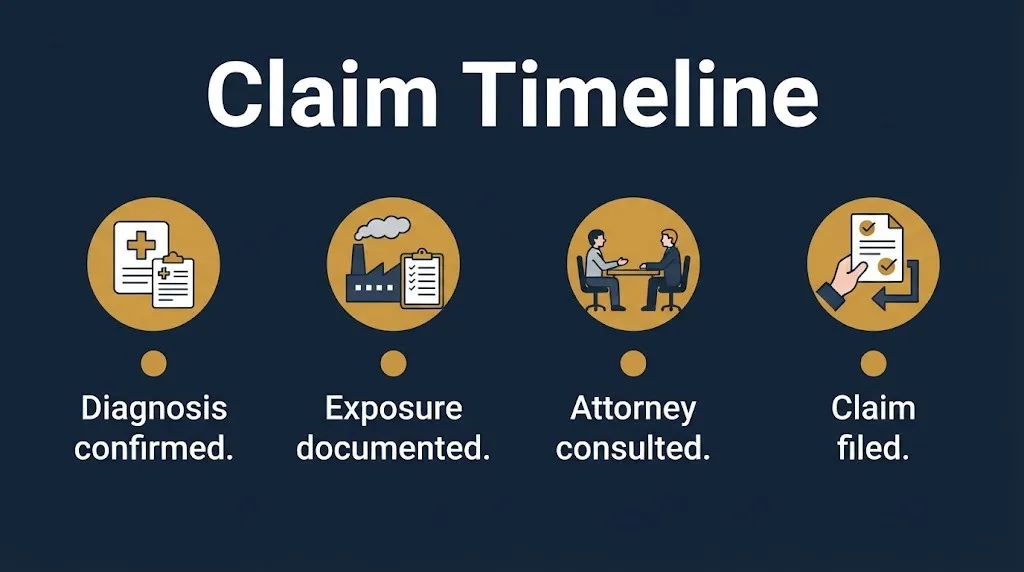
Filing starts with documentation. You need medical records showing a diagnosis, work or residence history showing exposure, and sometimes expert testimony linking the two.
The specific steps depend on the claim type. Here is the general path for a toxic tort lawsuit:
- Get a confirmed medical diagnosis from a specialist.
- Document your exposure history with dates, locations, and witnesses.
- Identify the product, employer, or company responsible for the exposure.
- Find an attorney experienced in that specific claim type.
- File within the statute of limitations for your state.
- Join an existing multidistrict litigation if one exists.
- Submit medical records and exposure evidence.
- Negotiate or wait for a settlement offer.
For trust fund claims, the process is similar but faster. You file directly with the trust, which has its own forms and deadlines.
Are Exposure Compensation Claims Legitimate or Scams?
Most exposure compensation claims are legitimate legal actions. But the advertising around them can be misleading.
Lawyer advertisements often make it sound like everyone exposed gets a check. That is not true. You need a diagnosed illness, not just exposure.
Scammers also use fake settlement notices to collect personal information. They may claim you are entitled to money from a case that does not exist.
Here is how to tell a real claim from a fake one:
- Real notices name a specific court and case number.
- Real settlement websites are run by court-appointed administrators.
- Real claims never ask for payment upfront.
- Real law firms do not guarantee a payout amount.
- Real cases show up in federal PACER or state court databases.
Reality Check: No legitimate exposure settlement asks you to pay a filing fee to receive compensation. If someone demands money or gift cards to process your claim, walk away.
What Is the Deadline to File an Exposure Compensation Claim?
The deadline depends on the claim type and your state’s statute of limitations.
For personal injury lawsuits, most states give you one to three years from the date you discovered the illness. For wrongful death claims, the clock starts at the date of death.
For bankruptcy trust claims, each trust sets its own filing deadline. Some trusts have been paying claims for decades and remain open.
For class action settlements, the claim deadline appears in the official notice. Missing it usually means you get nothing.
Here are the general rules:
| Claim Type | Typical Deadline |
|---|---|
| Personal injury lawsuit | 1 to 3 years from diagnosis |
| Wrongful death lawsuit | 1 to 3 years from death |
| Asbestos trust claim | Varies by trust, many open |
| Class action claim | Set by settlement notice |
| Government program | Set by program rules |
What Is Multidistrict Litigation and How Does It Affect Exposure Compensation?
Multidistrict litigation, or MDL, is how federal courts handle thousands of similar exposure claims at once.
The cases are consolidated before one judge for pretrial proceedings. The judge picks bellwether cases to test how juries respond.
MDLs often lead to global settlements. The defendant agrees to pay a set amount, and the money is divided among all qualifying claimants.
Here are the active exposure MDLs as of 2026:
| MDL Name | Exposure | Status |
|---|---|---|
| In re Paraquat | Paraquat herbicide | Active |
| In re PFAS | AFFF firefighting foam | Active |
| In re Zantac | Medication contaminant | Active |
| In re Asbestos | Asbestos products | Ongoing for decades |
Joining an MDL does not guarantee a payout. It means your case is part of the group, and any settlement must cover you too.
Key Takeaway: MDLs consolidate thousands of similar claims before one judge, which can speed settlement but also dilutes individual payouts.
What Government Programs Pay Exposure Compensation?
Several government programs pay compensation for specific exposure types without requiring a lawsuit.
The September 11th Victim Compensation Fund pays people exposed to toxic dust at Ground Zero, the Pentagon, and Shanksville.
The Radiation Exposure Compensation Act pays people exposed to radiation from nuclear testing or uranium mining.
The Black Lung Program pays coal miners with pneumoconiosis.
Here is how those programs compare:
| Program | Exposure Type | Administering Agency |
|---|---|---|
| 9/11 VCF | Toxic dust at attack sites | Department of Justice |
| RECA | Radiation | Department of Justice |
| Black Lung | Coal dust | Department of Labor |
| VA benefits | Agent Orange, burn pits | Department of Veterans Affairs |
Each program has its own eligibility rules, documentation requirements, and payment schedules.
Can I Get Workers’ Compensation for Toxic Exposure?
Yes, in many cases. If you were exposed to a toxic substance at work, workers’ compensation may cover your illness.
Workers’ comp pays medical bills and partial wage replacement for occupational diseases. It does not pay pain and suffering, which a lawsuit might.
The advantage of workers’ comp is that you do not need to prove the employer was negligent. The disadvantage is that payouts are often lower than lawsuit settlements.
Some workers file both a workers’ comp claim and a toxic tort lawsuit against a third party, such as the manufacturer of the chemical they were exposed to.
What Is a Tort Lawsuit for Exposure Compensation?
A tort lawsuit claims that someone else’s negligence or misconduct caused your exposure and your illness.
Unlike workers’ comp, a tort lawsuit can pay pain and suffering, emotional distress, and punitive damages.
The burden of proof is higher. You must show the defendant owed you a duty, breached that duty, and caused your illness.
These cases are harder to win but can pay much more than administrative programs. That is why the same exposure might produce both a workers’ comp claim and a tort lawsuit.
How Are Exposure Settlement Funds Divided?
Settlement funds are divided by a claims administrator using a formula or grid.
The formula considers factors like the severity of the illness, the claimant’s age, the length of exposure, and sometimes the claimant’s smoking history.
Here is a simplified version of how an asbestos trust might divide funds:
| Severity Tier | Illness Type | Typical Payout Multiple |
|---|---|---|
| Tier 1 | Mesothelioma | Highest |
| Tier 2 | Lung cancer | High |
| Tier 3 | Asbestosis | Moderate |
| Tier 4 | Pleural plaques | Lowest |
Class action settlements often divide money equally or by a simple formula. Individual lawsuits negotiate case by case.
Key Takeaway: Settlement funds are not divided equally. The formula rewards the sickest claimants with the strongest exposure histories.
What Happens Next
Expected 2026: PFAS litigation continues to expand as more water systems test positive for contamination.
Expected 2026: Paraquat bellwether trials continue, with settlement pressure building on manufacturers.
Ongoing: Asbestos trusts keep accepting claims decades after the original bankruptcies.
Your move: If you have a diagnosed illness and a documented exposure, consult an attorney who specializes in that exact claim type.
Exposure compensation is real, but it is not one-size-fits-all. The money comes from different sources, under different rules, with different deadlines.
Your claim value depends on what you were exposed to, what illness you have, and who is responsible. Document everything, find the right attorney, and move before your state’s deadline runs out.
The biggest mistake is waiting. Statutes of limitations do not pause while you think it over.