Defamation of Character Lawsuit: How to File, What You Can Recover, and 2026 Claim Deadlines
Quick Answer
- A defamation lawsuit is a real civil claim when someone makes a false statement of fact that harms your reputation, business, or livelihood.
- Settlement amounts vary widely based on provable damages, with most resolved cases falling between $10,000 and $75,000 when actual harm is documented.
- Most states impose a one-year statute of limitations from the date the defamatory statement was made, so acting quickly is essential.
If someone published a lie about you online, to your employer, or in a public forum, you may be wondering whether you can sue and what that actually looks like. This is not a mass tort or class action settlement you can join with a simple claim form. A defamation lawsuit is an individual civil claim you initiate yourself, and winning requires meeting specific legal standards that vary by who you are and who said what.
This article walks through every stage of a defamation of character lawsuit in 2026, from proving your claim to calculating what you might recover. It covers recent verdicts, the traps that sink most cases, and the deadlines you cannot afford to miss. One verified fact worth knowing now: roughly 70 to 80 percent of defamation cases that survive early dismissal motions settle out of court, often before any public trial record exists.
The Facts
| Case Type | Individual civil claim, not a class action |
| Legal Standard | False statement of fact, published to a third party, causing harm |
| Common Defenses | Truth, opinion, privilege, consent, statute of limitations |
| Statute of Limitations | Typically 1 year from publication date, varies by state |
| Average Settlement Range | $10,000 to $75,000 for documented harm cases |
| High-Profile Case Range | $100,000 to $5,000,000+ for public figures with provable damages |
| Filing Cost | $150 to $450 for court filing fees, plus attorney costs |
| Proof Required | The false statement itself, evidence of publication, proof of harm |
Is a Defamation of Character Lawsuit Legitimate?
Yes. A defamation of character lawsuit is a legitimate civil legal claim recognized in all 50 states. It allows a person to seek monetary damages when someone else makes a false statement of fact that causes reputational or financial harm. It is not a government program, a mass settlement, or something you sign up for online. It is a lawsuit you file in state or federal court.
The legal basis is well-established. Defamation falls under tort law, the same broad category as personal injury and negligence claims. Courts have recognized defamation claims for centuries, and the modern framework is built on state statutes and case law refined through decades of First Amendment rulings.
The confusion around legitimacy comes from two places. First, third-party services aggressively advertise “defamation settlement” help online, often implying you can join a class action. Those ads are misleading. There is no national defamation settlement fund. Every case is individual. Second, the internet has made it easier for people to believe they have a claim when they do not. Being insulted, embarrassed, or criticized online is not defamation under the law. The statement must be false, presented as fact, and cause measurable harm.
Key Takeaway: A defamation lawsuit is a real legal option, but only for false factual statements that cause concrete harm. Opinion, insults, and true statements do not qualify.
How Much Is a Lawsuit for Defamation of Character Worth?
There is no fixed payout for a defamation case. The value depends entirely on what you can prove you lost. Courts and insurance adjusters look at actual economic damages first, then consider non-economic harm like emotional distress, and in rare cases, punitive damages.
For cases where the plaintiff can document lost income, lost business opportunities, or specific financial harm, settlements typically fall between $10,000 and $75,000. These are the everyday defamation cases: a former employer gives a false negative reference, a competitor posts a knowingly false review that costs you clients, or a neighbor spreads a provably false accusation that gets you fired.
Cases involving public figures or widespread publication can reach much higher. In 2024, a defamation verdict in a high-profile election-worker case resulted in a $148 million judgment, though appeals and collection issues mean the final payout is often far below the headline verdict number. Settlement amounts in the $100,000 to $500,000 range are not uncommon when the defendant has assets or insurance coverage and the harm is well-documented.
Typical Settlement Ranges by Case Type
| Case Type | Typical Settlement Range | Key Factor |
|---|---|---|
| False negative employment reference | $15,000 to $50,000 | Lost job offer must be provable |
| Defamatory online review (business) | $10,000 to $35,000 | Requires showing lost revenue |
| Social media defamation (individual) | $5,000 to $25,000 | Harder to prove financial harm |
| False accusation of a crime | $50,000 to $250,000+ | Per se defamation, damages presumed in some states |
| Business disparagement | $75,000 to $500,000+ | Requires forensic accounting of losses |
| Public figure defamation | $100,000 to $5,000,000+ | Requires proving actual malice |
Reality Check: The headline verdicts you see in the news are rarely what the plaintiff collects. A jury may award $10 million, but if the defendant has no assets or files for bankruptcy, you may recover nothing. Before filing, your attorney should investigate whether the defendant has collectible assets or insurance that covers defamation claims. Homeowners and renters insurance policies sometimes include personal injury coverage that responds to defamation claims, but many exclude intentional acts. This is the single most overlooked factor in defamation case valuation.
Key Takeaway: The value of your case is what the defendant can pay, not what a jury might award. Asset and insurance checks happen before filing, not after.
What Are the Elements You Must Prove in a Defamation Case?
Every defamation claim requires proving specific legal elements. If any one element fails, the case fails. Courts do not guess or fill in gaps.
The four elements you must prove are:
- A false statement of fact was made. The statement must be objectively false, not an opinion, not hyperbolic, and not substantially true. Saying “I think he’s dishonest” is opinion. Saying “he stole $5,000 from the company account” when he did not is a false fact.
- The statement was published to a third party. Publication means the statement was communicated to at least one person other than you. A text sent only to you is not publication. A text sent to your boss, a post on social media, or an email copied to others is publication.
- The statement caused harm. You must show actual damages in most cases. Lost income, lost business, reputational injury that leads to financial loss. Some states recognize defamation per se, where certain statements are so damaging (false accusations of a crime, loathsome disease, professional incompetence, or sexual misconduct) that damages are presumed.
- The statement was made with the required level of fault. For private individuals, this typically means negligence: the person making the statement failed to exercise reasonable care in verifying the truth. For public figures, the standard is actual malice: the person knew the statement was false or acted with reckless disregard for the truth.
Public figures face a much higher burden. A celebrity, politician, or anyone who has voluntarily thrust themselves into a public controversy must prove the defendant acted with actual malice. This is the standard established by New York Times v. Sullivan, and it remains the law in 2026. Private individuals only need to prove negligence in most states.
Defamation Per Se: When Damages Are Presumed
In states that recognize defamation per se, certain categories of false statements are considered so inherently harmful that you do not need to prove specific financial loss. These categories are:
- False accusation of a crime involving moral turpitude
- False statement that you have a loathsome or contagious disease
- False statement that harms your business, trade, or profession
- False accusation of sexual misconduct or unchastity
If your case falls into one of these categories, the legal burden shifts. You still must prove the statement was false and published, but harm is presumed. This makes per se cases significantly easier to pursue.
Key Takeaway: The legal standard you must meet depends on who you are. Private individuals have a lower bar. Public figures must prove actual malice, a deliberately high standard.
How to File a Lawsuit for Defamation of Character
Filing a defamation lawsuit is not like filing a settlement claim online. It is a formal legal process with strict procedural rules. Every step matters, and mistakes in the early stages can get your case dismissed before it reaches discovery.
Step-by-Step Filing Process
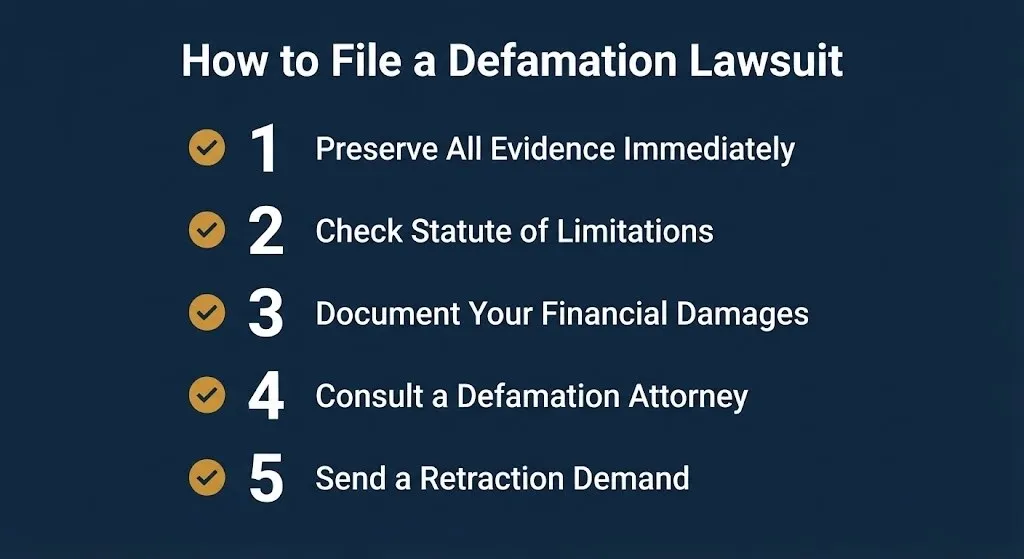
- Preserve all evidence immediately. Screenshot every post, save every email, download every message thread. Create a folder with date-stamped copies. Delete nothing. Courts expect you to preserve evidence the moment you contemplate legal action.
- Calculate your statute of limitations deadline. In most states, you have one year from the date of publication to file. Some states allow two years. A few states toll the deadline if you did not discover the statement right away. This deadline is rigid. Miss it by one day and your case is permanently barred.
- Document your damages. Compile pay stubs, termination letters, client correspondence, profit and loss statements, and any other records showing financial harm. If you lost a job, get the offer letter and the revocation notice. If you lost clients, document the timeline. The quality of your damage documentation directly determines your settlement value.
- Consult a defamation attorney. Defamation is a specialized area. A general practice lawyer may not know the procedural traps or the specific pleading standards. Look for an attorney who has handled defamation cases in your jurisdiction. Most offer free initial consultations.
- Send a retraction demand, if required. Some states require you to demand a retraction before filing suit, especially in cases against newspapers, broadcasters, or online publishers. Even when not required, a retraction demand can resolve the case without litigation or create evidence of the defendant’s refusal to correct the record.
- File the complaint. Your attorney will draft and file a complaint in the appropriate court, typically state civil court. The complaint must plead each element of defamation with specificity. Vague allegations get dismissed. The complaint must identify the exact statement, the date it was made, to whom it was published, and how it harmed you.
- Serve the defendant. The defendant must be formally served with the complaint and summons. Service rules vary by state. Improper service can delay the case or result in dismissal.
- Respond to early motions. Expect a motion to dismiss or an anti-SLAPP motion, especially if the statement involves a matter of public concern. Anti-SLAPP laws are designed to quickly dismiss lawsuits that target free speech. If the defendant files one, your attorney must show a probability of prevailing on the merits at an early stage.
The filing process can feel like preparing for a tax audit that never ends. Every document must be exact. Every deadline is firm. Unlike filing an insurance claim where you submit paperwork and wait, a defamation lawsuit is adversarial from day one. The other side is trying to get your case thrown out, not help you resolve it.
Key Takeaway: Defamation lawsuits are procedurally demanding. The evidence you preserve in the first 48 hours often determines whether your case survives the first motion to dismiss.
What Is the Statute of Limitations for a Defamation Lawsuit?
The statute of limitations is the deadline to file your lawsuit. It is the single most important date in your case. If you miss it, you lose the right to sue, permanently, no matter how strong your evidence is.
Most states set the defamation statute of limitations at one year from the date the defamatory statement was published. This is shorter than most other civil claims. A car accident might give you two or three years. A breach of contract might give you four or six. Defamation is typically one year because courts prioritize free speech concerns and want stale claims resolved quickly.
State-by-State Statute of Limitations Examples
| State | Statute of Limitations | Special Notes |
|---|---|---|
| California | 1 year | Single publication rule applies |
| New York | 1 year | From date of first publication |
| Texas | 1 year | Discovery rule may apply in limited cases |
| Florida | 2 years | Longer than most states |
| Illinois | 1 year | From date of publication |
| Pennsylvania | 1 year | From date of publication |
Do not rely on this chart alone. Confirm the deadline in your state with an attorney. Some states apply the discovery rule, which starts the clock when you discovered or reasonably should have discovered the defamatory statement. This matters when someone posts something about you online that you do not see for months.
The single publication rule applies in most jurisdictions. This means the clock starts when the statement is first published, not each time someone views it. A defamatory blog post published on January 1, 2025, must be sued upon by January 1, 2026, even if people are still reading it. Republishing the statement in a new context may reset the clock, but this is a fact-specific legal question.
Key Takeaway: If you are reading this and considering a defamation claim, write down the date the statement was made and count forward one year. That is your drop-dead deadline. Call an attorney well before that date.
Can You Sue for Defamation Without a Lawyer?
Technically, yes. You can file a lawsuit pro se, meaning you represent yourself. Practically, it is almost always a bad idea in defamation cases.
Defamation law is procedurally complex. Pleading standards are strict. Anti-SLAPP motions are common and can result in the defendant recovering their attorney fees from you if your case is dismissed. Discovery involves nuanced evidentiary rules. Trial requires understanding hearsay exceptions, witness examination, and jury instruction law.
The data on pro se defamation cases is clear. The overwhelming majority are dismissed at the pleading stage because the complaint fails to state a legally sufficient claim. Judges give pro se litigants some procedural leeway, but they cannot rewrite the substantive law. If your complaint does not plead a false statement of fact, publication, harm, and fault, it will be dismissed regardless of how sympathetically the court views your situation.
Most defamation attorneys work on a contingency fee or a hybrid arrangement. Contingency means the attorney takes a percentage of the recovery, typically 33 to 40 percent. Some attorneys require a retainer for defamation cases because they are labor-intensive and uncertain. A retainer of $5,000 to $15,000 is not unusual for a contested case.
If your damages are modest, below $10,000, the economics of hiring a lawyer may not work. In that situation, small claims court may be an option in some states, though the procedural rules and available remedies are limited.
Key Takeaway: You have the right to represent yourself, but defamation is one of the worst areas of law to exercise that right. The procedural traps are numerous, and the cost of losing can include paying the defendant’s legal fees.
Recent Defamation Verdicts and Settlements in 2024–2026
Recent years have produced several high-profile defamation outcomes that illustrate how courts are handling these claims. These cases show both the potential for large recoveries and the reality that collection is a separate battle.
The most notable recent case is the 2024 verdict in favor of two Georgia election workers against Rudy Giuliani, resulting in a $148 million judgment. The workers proved Giuliani made false statements accusing them of ballot fraud, which led to death threats and forced them from their homes. The judgment is historic, but as of mid-2026, collection efforts remain ongoing and the full amount is unlikely to be recovered.
The Dominion Voting Systems defamation case against Fox News settled in 2023 for $787.5 million, the largest known defamation settlement in U.S. history. While this involved corporate defamation, not individual, the settlement structure and the evidentiary standard applied, actual malice for public figures, are directly relevant to individual claims against media defendants.
Smaller but instructive cases from 2025 and 2026 include multiple six-figure settlements in online review defamation cases, where business owners proved that false reviews caused measurable revenue loss. A Florida case settled for $175,000 in early 2026 after a former employee posted false allegations about a restaurant’s health practices. A California tech founder recovered a $340,000 settlement in 2025 after proving a competitor created fake social media accounts to post false statements about the founder’s professional qualifications.
These cases share a common thread. The plaintiffs had documented evidence of the false statements and forensic accounting showing the financial harm. Emotionally compelling stories without documented financial harm rarely produce substantial settlements.
Notable Defamation Outcomes, 2023–2026
| Case | Outcome | Year |
|---|---|---|
| Georgia election workers v. Giuliani | $148M verdict, collection ongoing | 2024 |
| Dominion v. Fox News | $787.5M settlement | 2023 |
| Florida restaurant v. former employee | $175,000 settlement | 2026 |
| California tech founder v. competitor | $340,000 settlement | 2025 |
| Multiple online review defamation cases | $25,000 to $85,000 settlements | 2025–2026 |
Key Takeaway: Large verdicts make headlines, but most defamation cases settle for amounts that reflect the actual provable damages, and collection remains the hardest part.
What Damages Can You Recover in a Defamation Lawsuit?
Defamation damages fall into three categories. Understanding what each covers and how to prove it is essential to valuing your case accurately.
Actual Damages (Compensatory)
Actual damages are the measurable financial losses caused by the defamatory statement. This is the foundation of your claim. Without actual damages, your case is weak unless you qualify for defamation per se.
Documentable actual damages include:
- Lost wages or salary if you were terminated or forced to resign
- Lost business revenue if clients or contracts were canceled
- Lost job opportunities, including rescinded offers
- Costs incurred to repair your reputation, such as PR services or marketing campaigns
- Medical expenses for mental health treatment directly tied to the defamation
The standard of proof is preponderance of the evidence: more likely than not that the defamation caused the loss. Speculative losses are not compensable. You need receipts, invoices, correspondence, and financial records.
Non-Economic Damages
Non-economic damages compensate for harm that does not have a specific dollar value. These include emotional distress, mental anguish, humiliation, loss of enjoyment of life, and damage to personal relationships.
These damages are harder to quantify. Courts look at the severity of the defamation, how widely it was published, and the credibility of your testimony about its impact. Medical records from a therapist or psychiatrist strengthen non-economic damage claims. Testimony from family members, friends, or coworkers about observable changes in your behavior also helps.
Punitive Damages
Punitive damages are designed to punish the defendant and deter similar conduct. They are not available in every case. Most states require a showing of actual malice, willful misconduct, or reckless indifference to the truth. Negligent defamation alone is not enough for punitive damages in most jurisdictions.
Some states cap punitive damages. Others tie them to a ratio of compensatory damages. Your attorney can advise on the specific rules in your jurisdiction, but do not build a case around a punitive damages windfall. Most defamation settlements include little to no punitive component because defendants are unwilling to agree to them and insurance rarely covers punitive awards.
Key Takeaway: Build your case around actual documented losses. Emotional distress and punitive damages are secondary and harder to recover.
How Long Does a Defamation Lawsuit Take?
A defamation case moves through predictable stages. The timeline varies by jurisdiction, court congestion, and whether the case settles or goes to trial.
Typical Defamation Case Timeline
Pre-filing investigation and demand letter: 1 to 3 months. Your attorney investigates the facts, sends a retraction demand, and attempts pre-litigation resolution. Many cases settle at this stage if the defendant has insurance and the evidence is strong.
Filing and service: 1 to 2 months. The complaint is drafted, filed, and served on the defendant.
Motion to dismiss or anti-SLAPP motion: 2 to 6 months. The defendant typically files a motion challenging the legal sufficiency of your complaint. If the motion is granted, your case is over unless you appeal. If denied, the case proceeds to discovery.
Discovery: 6 to 12 months. Both sides exchange documents, answer interrogatories, and conduct depositions. This is the most expensive phase. Discovery costs in a contested defamation case can exceed $30,000 in legal fees alone.
Summary judgment motions: 2 to 4 months. After discovery, either side may ask the judge to decide the case without a trial. If material facts are disputed, the case proceeds.
Trial: 1 to 2 weeks. Defamation trials are typically short. The trial itself lasts days or weeks, not months. Jury selection, opening statements, witness testimony, and closing arguments move quickly.
Appeal: 6 to 18 months. The losing party may appeal. Appeals add significant time and cost.
From filing to trial, expect 12 to 24 months. If the case settles, which most do, resolution typically comes during discovery, 8 to 14 months after filing. Settlement often happens after depositions, when both sides have a clearer picture of the evidence and the risks.
Key Takeaway: A defamation lawsuit is a marathon, not a sprint. Expect at least a year from filing to resolution, and longer if the case is contested through trial.
What Happens Next After You File
The path forward after filing has clear stages. Knowing them reduces the uncertainty that makes litigation stressful.
Post-Filing Timeline
Within 30 days of filing: The defendant is served and must respond. The response is typically a motion to dismiss, an anti-SLAPP motion, or an answer to the complaint. Most defendants file a motion to dismiss, arguing that even if your allegations are true, they do not state a legal claim.
Within 60 to 90 days: Your attorney responds to the motion to dismiss. This is a critical stage. Your attorney must convince the judge that your complaint alleges enough facts to proceed. If the motion is granted with prejudice, the case is over. If granted without prejudice, you may amend the complaint.
If the motion is denied: Discovery begins. Expect interrogatories, requests for production of documents, and requests for admission. The defendant will demand your financial records, communications, and evidence of damages. You will demand the defendant’s communications, records of the defamatory statements, and evidence of their state of mind.
Depositions: You will be deposed. The defendant’s attorney will question you under oath about every aspect of your claim. Your attorney will depose the defendant and key witnesses. Depositions are the most revealing part of the case. They often drive settlement because both sides see how credible the witnesses are.
Mediation: Most courts require mediation before trial. A neutral third party facilitates settlement discussions. Cases that do not settle spontaneously often settle at mediation because the cost and risk of trial become concrete.
Trial or settlement: If mediation fails, the case proceeds to trial. Even then, settlement is possible at any point, including mid-trial.
Expected Q1 2027: If your case was filed in mid-2026 and survives early motions, discovery will be underway by early 2027.
Expected Q3 2027: Mediation and pre-trial motions.
Expected Q4 2027 to Q1 2028: Trial, if no settlement is reached.
These dates are estimates. Your case timeline depends on your specific court, the complexity of the facts, and the litigation strategy of both sides.
Frequently Asked Questions
What is the difference between libel and slander?
Libel is written or permanently recorded defamation, including online posts, articles, and videos.
Slander is spoken defamation, typically in person or over the phone.
Most modern defamation cases involve libel because online statements are permanent.
Can an opinion be defamation?
No, a pure opinion cannot be defamation.
However, a statement that implies undisclosed defamatory facts can be defamatory even if phrased as an opinion.
Example: “I think he stole money” may be opinion, but “I think he stole money because I saw the missing deposit records” may be actionable if the implication is false.
Do I need to prove financial loss to win a defamation case?
In most cases, yes, you must prove actual financial harm.
The exception is defamation per se, where damages are presumed for certain categories of false statements like accusations of a crime.
Even in per se cases, proving financial loss increases your settlement value substantially.
Can I sue for defamation over a Google review or Yelp post?
Yes, if the review contains false statements of fact, not just negative opinions.
A review saying “the food was terrible” is opinion and not actionable.
A review saying “I saw rats in the kitchen” when there were no rats is a false statement of fact and may be actionable.
You must prove the reviewer knew the statement was false or acted negligently.
How much does it cost to file a defamation lawsuit?
Court filing fees range from $150 to $450 depending on the jurisdiction.
Attorney fees are the primary cost.
Contingency arrangements mean the attorney takes 33 to 40 percent of any recovery.
Hourly arrangements mean you pay regardless of outcome, typically $300 to $600 per hour for an experienced defamation attorney.
Some attorneys use hybrid arrangements: a reduced hourly rate plus a lower contingency percentage.
Can I sue for defamation if the statement was true but misleading?
No, truth is an absolute defense to defamation.
A statement that is technically true but misleading may not be actionable as defamation.
You may have other claims, such as false light invasion of privacy, but defamation requires a false statement of fact.
Does homeowner’s insurance cover defamation lawsuits?
Sometimes.
Many homeowner’s and renter’s insurance policies include personal injury coverage that may cover defamation claims.
However, many policies exclude intentional acts, and defamation is often considered intentional.
If the defendant has insurance that covers defamation, your ability to collect a settlement increases substantially.
Your attorney will investigate available insurance early in the case.
What is an anti-SLAPP motion?
An anti-SLAPP motion is a special motion to dismiss designed to quickly end lawsuits that target free speech on matters of public concern.
SLAPP stands for Strategic Lawsuit Against Public Participation.
If the defendant files an anti-SLAPP motion and wins, your case is dismissed and you may be ordered to pay the defendant’s attorney fees.
Your attorney must show early in the case that your claim has legal merit to survive an anti-SLAPP motion.
If you believe you have a defamation claim, the most important step is the one you take today. Preserve every piece of evidence. Screenshot the statements, save the messages, and back them up in multiple places. Then calendar your statute of limitations deadline. For most people reading this, that deadline is one year from the date the statement was made, and missing it means losing your right to sue forever.
Contact a defamation attorney in your state for a case evaluation. The initial consultation is typically free, and it will tell you whether your case is worth pursuing or whether the legal standards, damages, and collectability make it an uphill battle not worth fighting. The attorney will be honest if the case is not viable. Listen to that honesty. A bad defamation case costs more than just money: it can result in you paying the other side’s legal fees.