What Is Civil Litigation? A 2026 Guide to Lawsuits, Process, and What to Expect
Quick Answer
- Civil litigation is the legal process for resolving non-criminal disputes between people, businesses, or organizations through courts.
- It covers contract disputes, personal injury, property claims, class actions, and consumer lawsuits, not criminal charges.
- Most civil cases settle before trial, with over 90 percent resolving through negotiation, mediation, or dismissal.
Civil litigation is the formal process of taking a non-criminal dispute to court. It is how one person, business, or organization sues another to recover money, enforce a contract, or stop harmful behavior. The person who sues is the plaintiff. The person being sued is the defendant. The case is decided by a judge or jury based on evidence, not by police or prosecutors.
This is the system behind every class action settlement, every personal injury claim, every contract dispute, and every consumer lawsuit you read about. If you got a notice about a data breach settlement or a defective product recall, that is civil litigation in action.
This article explains what civil litigation means in plain terms, how the process works from filing to appeal, how long it takes, and what it costs. One fact that surprises most people: the overwhelming majority of civil cases never reach a courtroom trial. They end in settlement, dismissal, or a judge’s ruling on legal technicalities.
The Facts
| Case | Civil litigation system, not a single case |
| Status | Active legal process governed by federal and state rules |
| Fund Size | Not applicable; each case has its own damages or settlement amount |
| Est. Per Person | Varies by case type and claim value |
| Claim Deadline | Varies by statute of limitations, typically 1 to 10 years depending on claim |
| Administrator | Court clerk and assigned judge manage each case |
| Proof Needed | Evidence: documents, testimony, records, and expert opinions |
Is civil litigation the same as a criminal case?
No. Civil litigation is completely separate from criminal law. Criminal cases are brought by the government against a person or company accused of breaking a criminal statute. The penalty is jail, probation, or fines paid to the state. The standard of proof is beyond a reasonable doubt.
Civil litigation is brought by a private party against another private party. The remedy is usually money or a court order. The standard of proof is lower. The plaintiff only has to prove the case by a preponderance of the evidence, which means more likely than not.
The same event can produce both criminal and civil cases. A company that commits fraud may face criminal charges from the Justice Department and civil lawsuits from harmed consumers. The O.J. Simpson case is the classic example. He was acquitted in criminal court but found liable in civil court because the burden of proof was lower.
This distinction matters because you do not need a prosecutor to pursue civil litigation. You can file a civil lawsuit on your own behalf. That is the entire point of the system.
Key Takeaway: Civil litigation is a private dispute resolved in court, not a government prosecution, and the lower burden of proof makes it easier to win than a criminal case.
What does civil litigation mean in plain terms?
Civil litigation means using the court system to settle a disagreement that is not a crime. It is the legal machinery for enforcing rights and resolving disputes between private parties. The word civil comes from civil law, which governs private rights rather than criminal conduct.
Think of it as a formal version of a store return dispute. When a store refuses a refund, you can negotiate, complain, or walk away. Civil litigation is what happens when the dispute is too large to walk away from and negotiation fails. You file a complaint. The court gets involved. A judge or jury decides who is right.
The most common types of civil litigation include contract disputes, personal injury claims, property disputes, employment discrimination, class action lawsuits, and consumer protection cases. Each follows the same basic procedural path.
Litigation is distinct from arbitration and mediation. Those are private dispute resolution methods. Litigation happens in a public court, with a public record, and a judge who has the power to enforce the outcome.
What is the civil litigation definition in law?
The legal definition of civil litigation is the process of resolving private legal disputes through the court system using formal rules of procedure and evidence. It begins with a complaint and ends with a judgment, settlement, or dismissal.
The Federal Rules of Civil Procedure govern cases in federal courts. Each state has its own rules for state courts. The rules cover how a case starts, how evidence is exchanged, how motions are filed, and how trials proceed.
The definition includes several distinct phases. Pleading is the initial exchange of claims and defenses. Discovery is the evidence-gathering phase. Pretrial motions can end the case before trial. Trial is the formal hearing. Appeal is the review of legal errors.
Not every civil dispute becomes litigation. Many are resolved through negotiation, mediation, or arbitration. Litigation is the last resort when private resolution fails.
Key Takeaway: Civil litigation is a court-supervised process with defined phases: pleading, discovery, pretrial, trial, and appeal, all governed by formal rules.
What are the types of civil litigation?
Civil litigation covers a wide range of case types. The most common categories are listed below.
| Case Type | What It Involves | Example |
|---|---|---|
| Contract disputes | Breach of agreement | Business fails to pay for services |
| Personal injury | Harm caused by negligence | Car accident, slip and fall |
| Property disputes | Ownership or use conflicts | Boundary disputes, landlord-tenant |
| Employment litigation | Wrongful termination, discrimination | Worker fired for reporting harassment |
| Class actions | Group claims against one defendant | Data breach, defective product |
| Consumer protection | Deceptive practices, false advertising | Hidden fees, false labeling |
| Medical malpractice | Harm from negligent healthcare | Surgical error, misdiagnosis |
| Product liability | Defective product causes injury | Faulty airbag, contaminated food |
Each type has its own substantive law. A contract case turns on the terms of the agreement. A personal injury case turns on negligence. A class action turns on common questions affecting many people.
The procedural path is the same. The evidence and legal arguments differ.
What is the difference between civil litigation and a class action?
A class action is a type of civil litigation, not a separate system. It is a procedural tool that lets one person or a small group sue on behalf of a much larger group with similar claims. Instead of thousands of individual lawsuits, one case represents everyone.
Civil litigation includes class actions, individual lawsuits, and multi-party cases. The difference is scale. An individual lawsuit has one plaintiff. A class action has named plaintiffs who represent a class of thousands or millions.
Class actions are common in consumer cases where individual damages are too small to justify separate lawsuits. No one sues over a five-dollar hidden fee. But a class action can aggregate millions of five-dollar claims into a meaningful case.
The settlement process differs too. In a class action settlement, the court must approve the settlement as fair to all class members. Notice goes out. Claim forms are processed. Payments are distributed. In individual litigation, the parties settle privately.
Key Takeaway: A class action is a type of civil litigation that bundles many similar claims, while civil litigation as a whole includes individual and multi-party cases.
How much does civil litigation cost?
Civil litigation is expensive. The cost depends on the case type, the complexity, and how far the case goes. Filing fees alone range from $50 to $500. Discovery costs can exceed $10,000. Expert witnesses cost thousands per report. A full trial can cost tens of thousands to hundreds of thousands of dollars.
Here is a rough breakdown of typical costs.
| Stage | Typical Cost Range |
|---|---|
| Filing and service | $100 to $1,000 |
| Discovery | $2,000 to $50,000 |
| Depositions | $1,000 to $5,000 per witness |
| Expert witnesses | $3,000 to $20,000 per expert |
| Trial | $10,000 to $200,000 or more |
Many plaintiffs do not pay upfront. Personal injury lawyers work on contingency, taking a percentage of the recovery. Class action lawyers are paid from the settlement fund. Business litigation is usually billed hourly.
The cost is the main reason most cases settle. Litigation is a war of attrition. The side with fewer resources often settles because it cannot afford to keep fighting.
The comparison is like a home renovation. The estimate never covers the full cost. Discovery finds more disputes. Motions add more hours. Trial preparation is a line item no one budgets for accurately.
How long does civil litigation take?
Civil litigation is slow. A simple contract case might resolve in 6 to 12 months. A complex class action can take 5 to 7 years. The average federal civil case takes about 2 years from filing to resolution, according to court statistics.
Here is a typical timeline for a civil lawsuit.
| Stage | Typical Duration |
|---|---|
| Filing and response | 1 to 3 months |
| Discovery | 6 to 18 months |
| Pretrial motions | 2 to 6 months |
| Trial | 1 to 4 weeks |
| Post-trial and appeal | 6 to 24 months |
The timeline is comparable to a delayed tax refund. You file. You wait. The government processes. You wait more. Civil litigation has the same stop-and-start rhythm.
Delays are common. Scheduling conflicts, discovery disputes, and motion practice all add time. The pandemic taught courts to use video hearings, but that has not shortened the overall timeline much.
What are the steps in a civil litigation case?
Civil litigation follows a predictable sequence. Each step has deadlines and procedural requirements.
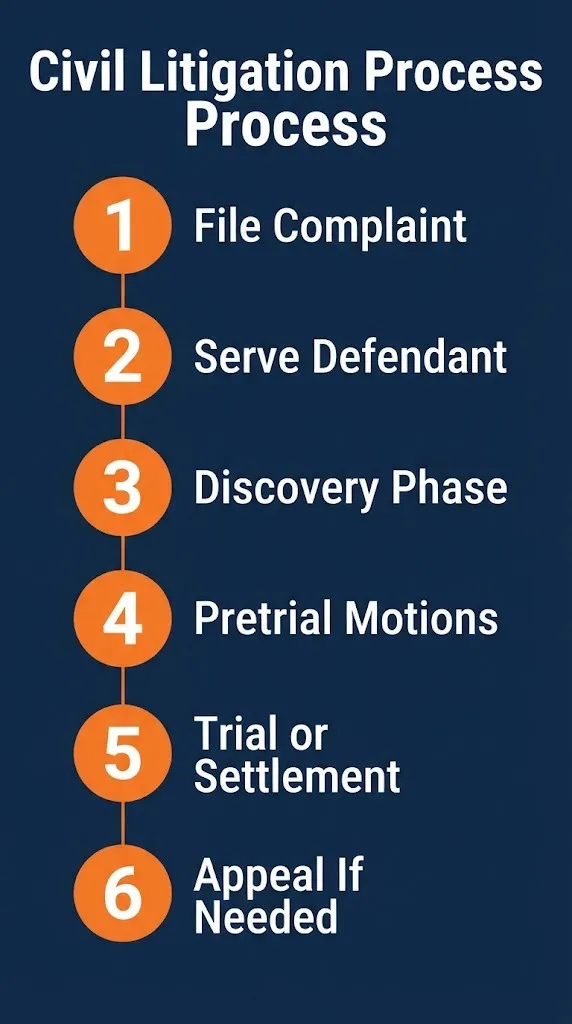
- Plaintiff files a complaint with the court.
- Defendant is served with the complaint and summons.
- Defendant files an answer or motion to dismiss.
- Discovery begins: documents, interrogatories, depositions.
- Either side may file a motion for summary judgment.
- If no settlement, the case goes to trial.
- A judge or jury issues a verdict.
- The losing side may appeal.
Each step is a filter. Many cases end at the motion to dismiss stage. More end at summary judgment. The ones that survive to trial are a small fraction of cases filed.
The process is more like a store return without a receipt than a quick transaction. You need documentation. You need patience. The outcome is never guaranteed.
Key Takeaway: Civil litigation moves through eight stages, and most cases end at the motion or settlement stage before ever reaching trial.
What is discovery in civil litigation?
Discovery is the evidence-gathering phase. It is what makes civil litigation different from a quick hearing. Both sides have the right to request documents, ask written questions, and take depositions. The goal is to eliminate surprise at trial.
The discovery tools include interrogatories, which are written questions answered under oath. Requests for production demand documents, emails, and records. Depositions are live testimony taken under oath before trial. Requests for admission ask a party to confirm or deny specific facts.
Discovery is often the most expensive and time-consuming part of the case. It is also where cases are won or lost. A damaging email found in discovery can force a settlement. A missing document can sink a claim.
The rules limit discovery to relevant information. But relevance is broad. Courts often resolve discovery disputes through motion practice, which adds more time and cost.
What percentage of civil cases go to trial?
Very few. The commonly cited figure is that over 90 percent of civil cases resolve before trial. Some studies put the number even higher. The vast majority end in settlement, dismissal, or summary judgment.
The reasons are practical. Trials are expensive and unpredictable. Settlement gives both sides control over the outcome. Trial gives the decision to a judge or jury.
Here is the breakdown.
| Outcome | Approximate Percentage |
|---|---|
| Settlement before trial | 60 to 70 percent |
| Dismissal or summary judgment | 20 to 30 percent |
| Trial verdict | 5 to 10 percent |
The numbers vary by case type. Personal injury cases settle at high rates. Civil rights cases go to trial more often. Class actions almost never go to trial after settlement negotiations begin in earnest.
Key Takeaway: Over 90 percent of civil cases never reach trial, ending instead in settlement, dismissal, or a judge’s ruling.
What is a statute of limitations in civil litigation?
A statute of limitations is the deadline for filing a lawsuit. Each type of claim has its own deadline. If you miss it, your case is barred, no matter how strong the evidence.
The deadlines vary by state and by claim type. Here are common ranges.
| Claim Type | Typical Statute of Limitations |
|---|---|
| Personal injury | 1 to 4 years |
| Contract breach | 3 to 6 years |
| Fraud | 2 to 6 years |
| Medical malpractice | 1 to 3 years |
| Property damage | 2 to 4 years |
| Class action claims | Varies by underlying claim |
The clock usually starts when the harm occurs. For hidden injuries, the discovery rule may start the clock when you knew or should have known about the harm. This is common in medical malpractice and toxic exposure cases.
Do not guess about deadlines. If you think you have a claim, the only safe move is to consult a lawyer immediately. Waiting is the single most common way people lose valid cases.
What is a settlement in civil litigation?
A settlement is an agreement to end the case without a trial. The plaintiff agrees to accept something of value, usually money, in exchange for dismissing the lawsuit. The defendant pays without admitting liability.
Settlements are private contracts. In individual cases, the terms are often confidential. In class actions, the settlement must be approved by the court and disclosed to class members.
Settlement can happen at any stage. Some cases settle before a complaint is filed. Others settle on the courthouse steps during trial. The terms depend on the strength of the evidence and the parties’ risk tolerance.
A settlement is not an admission of guilt. It is a business decision. Litigation is expensive and uncertain. Settlement buys certainty.
Key Takeaway: Settlement is a voluntary agreement to end the case, and it can happen at any point, from before filing to during trial.
What is the difference between civil litigation and arbitration?
Civil litigation happens in public courts with a judge or jury. Arbitration is a private process where a neutral third party decides the case. The rules are different. The timeline is different. The appeal rights are different.
Arbitration is often faster and cheaper than litigation. But it gives up the right to a jury and the right to appeal in most cases. Arbitration clauses are common in consumer contracts, employment agreements, and business deals.
Here is the comparison.
| Feature | Civil Litigation | Arbitration |
|---|---|---|
| Forum | Public court | Private proceeding |
| Decision-maker | Judge or jury | Arbitrator or panel |
| Public record | Yes | Usually confidential |
| Appeal rights | Broad | Very limited |
| Timeline | 1 to 5 years | 6 to 18 months |
| Cost | Higher | Usually lower |
Many consumer contracts force arbitration and waive class action rights. That means you may not be able to file a lawsuit or join a class action even if you have a valid claim. Courts have upheld many of these clauses.
What should you do if you are considering civil litigation?
Start with an honest assessment. Litigation is slow, expensive, and uncertain. It is not the right tool for every dispute. Sometimes a demand letter, mediation, or negotiation gets a faster result.
If litigation is the right path, take these steps.
- Gather all documents related to the dispute.
- Write a timeline of what happened and when.
- Identify potential witnesses and their contact information.
- Check the statute of limitations for your claim type.
- Consult a lawyer with experience in the relevant area.
- Discuss fee arrangements: hourly, contingency, or flat fee.
- Ask about the likely timeline and cost.
- Make a decision based on facts, not anger.
Litigation should be a strategic choice. The people who do best are the ones who document everything and act before deadlines pass.
What Happens Next
Before filing: Gather evidence and consult a lawyer.
At filing: The complaint starts the case and triggers the defendant’s response.
During discovery: Evidence exchange takes 6 to 18 months in most cases.
At the pretrial stage: Motions may end the case or narrow the issues.
At trial or settlement: Over 90 percent of cases resolve without a trial verdict.
The process rewards preparation and patience. It punishes delay and disorganization.
Frequently Asked Questions
What is the difference between civil and criminal litigation?
Civil litigation is a private dispute over money or rights. Criminal litigation is a government prosecution seeking jail or fines.
How long do I have to file a civil lawsuit?
It depends on the claim type and state law. Common deadlines range from 1 to 6 years, starting when the harm occurs.
Do most civil cases settle before trial?
Yes. Over 90 percent of civil cases end in settlement, dismissal, or summary judgment without a trial.
What is the burden of proof in civil litigation?
The plaintiff must prove the case by a preponderance of the evidence, meaning more likely than not.
Can I represent myself in civil litigation?
Yes, but it is usually a bad idea in complex cases. Courts hold self-represented parties to the same rules as lawyers.
What happens if I lose a civil case?
You may be ordered to pay damages and, in some cases, the other side’s costs. You may also appeal if there is a legal error.
What is a class action in civil litigation?
A class action is a civil lawsuit where one or more plaintiffs represent a larger group with similar claims.
How much does it cost to file a civil lawsuit?
Filing fees range from $50 to $500, but total litigation costs can reach tens of thousands or more.
Civil litigation is the backbone of the American legal system. It is how consumers recover from data breaches, how injured workers get compensation, how contract disputes get resolved. The process is slow and expensive, but it exists for a reason: it gives ordinary people a forum to hold others accountable without resorting to force. If you are considering a lawsuit, the most important thing is to check your deadline and consult a qualified lawyer. The second most important thing is to keep your records. The third is patience.