Ticketmaster Class Action Lawsuit 2026: Antitrust, Fees, and Data Breach Claims Explained
Quick Answer
- Multiple Ticketmaster class actions are real, covering the 2024 data breach, alleged monopolistic fees, and deceptive pricing.
- No unified settlement fund exists; payout amounts are not determined across any active Ticketmaster class action.
- No claim deadline applies because no class action settlement has received final approval in 2026.
The Ticketmaster class action lawsuit in 2026 is not one case. It is several. The most prominent is the data breach multidistrict litigation tied to the 2024 hacking incident that exposed roughly 560 million customer records. There are also antitrust and consumer deception class actions challenging Ticketmaster’s fee structure, dynamic pricing, and market dominance with Live Nation.
All of these cases are real. None of them have produced a settlement you can claim. If you saw an ad saying to sign up for a Ticketmaster settlement now, it is premature at best. The litigation is active, fragmented, and unresolved.
This article separates the verified cases from the noise. It explains which class actions exist, who they cover, what the money might look like if any settle, and how to preserve your position. One fact that surprises most consumers: the data breach case and the antitrust case are completely separate legal tracks, with different plaintiffs, different courts, and different timelines.
The Facts
| Case | Multiple proposed class actions against Ticketmaster and Live Nation |
| Status | Active litigation; no certified class settlement in any major case |
| Fund Size | Not applicable; no settlement fund approved |
| Est. Per Person | Not determined; varies by case and claim type |
| Claim Deadline | None; no settlement to claim |
| Administrator | None appointed |
| Proof Needed | Varies; likely purchase receipts, account records, or breach notice depending on case |
Are the Ticketmaster class action lawsuits real or a scam?
The Ticketmaster class action lawsuits are real. Multiple cases are pending in federal courts across the country. They are filed by consumers and investors, not by the government. The cases are public record. You can look them up on federal court dockets.
The most significant cases include the data breach multidistrict litigation in the Central District of California, the antitrust class action in the Southern District of New York, and several consumer protection cases challenging fee disclosures. Each is a real lawsuit with named plaintiffs and court-assigned judges.
What is a scam: any text, email, or website that asks you to pay a fee to join a Ticketmaster class action. You never pay to join a class action. You never pay to file a claim. If a settlement is approved, the claim form is free. The administrator is court-approved. No third party can speed up your payment for a fee.
Also be wary of sites claiming a Ticketmaster settlement is open now. No settlement has been approved. No claim window is open. Any site asking for your personal information to register you for a Ticketmaster payout is collecting data, not helping you.
Key Takeaway: Multiple Ticketmaster class actions are real and active, but no settlement exists yet, and no legitimate claim process ever charges a fee to file.
How much could Ticketmaster class action settlements pay?
No amount is determined. Each case has a different theory and a different potential recovery. The data breach case, the antitrust case, and the fee disclosure cases would produce different payouts if they settle.
Here is what similar cases have paid historically, not what Ticketmaster will pay.
| Case Type | Typical Per-Person Payout Without Proof | Typical Payout With Proof |
|---|---|---|
| Data breach (consumer) | $25 to $100 | $200 to $1,000 with documented fraud |
| Antitrust overcharge | $5 to $25 | $25 to $100 with purchase history |
| Fee disclosure / deceptive pricing | $1 to $10 | $10 to $50 with receipts |
These are historical ranges from comparable class actions. The Ticketmaster cases could settle for more or less. The data breach case has the largest potential fund because of the scale of the incident. The antitrust case has the largest potential per-person recovery because damages are tied to alleged overcharges.
If you bought tickets through Ticketmaster during the affected periods, keep your purchase confirmations. Digital receipts are acceptable. Even without receipts, most consumer settlements include a no-proof option.
Reality Check: No one will text you first about a Ticketmaster settlement payment. Filing a claim is always free. Third-party services that charge to file on your behalf add no value and may be phishing operations.
What is the Ticketmaster data breach class action?
The Ticketmaster data breach class action stems from the May 2024 disclosure that an unauthorized third party accessed a cloud database containing customer information. The breach affected roughly 560 million records globally, making it one of the largest data security incidents ever reported.
The case is consolidated as multidistrict litigation in the U.S. District Court for the Central District of California. The case name is In re: Ticketmaster Entertainment Inc. Customer Data Security Breach Litigation. The litigation alleges Ticketmaster failed to protect customer data and failed to notify affected customers in a timely manner.
The stolen data included names, addresses, email addresses, phone numbers, and partial payment card details. Full card numbers and CVV codes were not part of the compromised set, according to Ticketmaster’s public statements.
The case is in the settlement negotiation phase in 2026. A proposed settlement framework has been filed, but the judge has not granted preliminary approval. No claim deadline has been set. No administrator has been appointed.
What is the Ticketmaster antitrust class action?
The Ticketmaster antitrust class action challenges the company’s dominance in the live event ticketing market. The plaintiffs allege Ticketmaster and Live Nation illegally tied ticket sales to venue agreements, suppressed competition, and inflated fees through monopoly power.
The Department of Justice filed a separate antitrust lawsuit against Live Nation in May 2024. That government case is not a class action. It seeks to break up the company. The private antitrust class actions run in parallel and seek money damages for consumers.
The private antitrust case is pending in the Southern District of New York. It has survived initial motions to dismiss, according to the public docket. Discovery is underway. No class certification decision has been issued.
The antitrust case is the one most likely to produce a large settlement or judgment if the plaintiffs win. But it is also the slowest. Antitrust class actions frequently take five to seven years from filing to resolution.
Key Takeaway: The data breach case is closest to a settlement, while the antitrust case has the largest theoretical recovery but the longest timeline.
What are the Ticketmaster fee disclosure class actions?
Several smaller class actions target Ticketmaster’s fee practices. These cases allege the company fails to disclose all mandatory fees until the final checkout screen, making the advertised ticket price misleading.
The cases are filed under state consumer protection laws. Some are pending in California, New York, and Florida. They seek refunds of the difference between the advertised price and the final price with fees.
These cases are distinct from the antitrust litigation. They do not allege monopoly power. They allege deceptive pricing. The recoveries in these cases are typically smaller, often $10 to $50 per consumer with proof of purchase.
If any of these cases settle, the claim process would likely require proof of ticket purchases during the relevant period. Email confirmations are usually sufficient.
How do I join a Ticketmaster class action lawsuit?
You cannot join a class action. You are automatically included if you meet the class definition, unless you opt out. There is no sign-up form. There is no registration.
If you want to preserve your position, the practical steps are simple.
- Keep all Ticketmaster purchase confirmations and receipts.
- Keep any data breach notification email or letter you received in 2024.
- Document any fraudulent charges or identity theft tied to the breach.
- Keep records of fees charged on Ticketmaster purchases.
- Do not pay anyone to register you for a class action.
- Watch for official court notices if a settlement is approved.
The notice process in a class action settlement is designed to reach class members by email and publication. You do not need to do anything until that notice arrives.
What is the difference between the Ticketmaster data breach and antitrust cases?
These are entirely separate legal tracks. The data breach case is about the 2024 hacking incident. The antitrust case is about long-term market dominance and fee inflation. They have different plaintiffs, different legal theories, and different courts.
| Feature | Data Breach Case | Antitrust Case |
|---|---|---|
| Court | Central District of California | Southern District of New York |
| Legal theory | Failure to protect data, delayed notification | Monopolization, illegal tying, fee inflation |
| Proposed class | Customers whose data was exposed | Consumers who purchased tickets |
| Potential per-person payout | $25 to $1,000 | $5 to $100 |
| Timeline to resolution | 2027 to 2028 | 2028 or later |
The data breach case is closer to resolution. The antitrust case is earlier in the litigation process. Do not confuse news about one with progress in the other.
Key Takeaway: The data breach and antitrust cases are separate, with different courts, class definitions, timelines, and potential payouts.
When will Ticketmaster settlement checks be mailed?
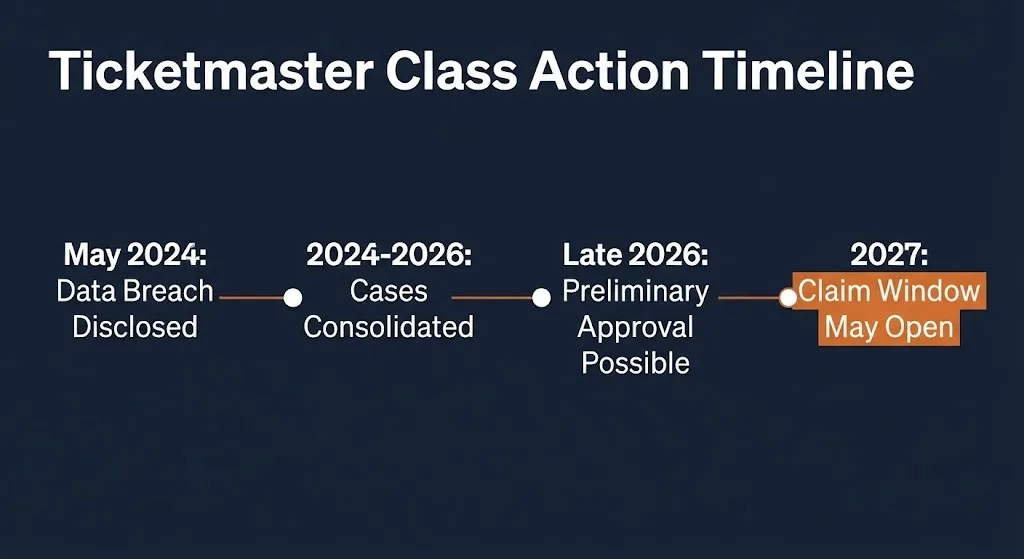
No checks have been mailed. No settlement has been approved. No date has been set. The earliest realistic payment window for the data breach case is late 2027 or 2028, assuming preliminary approval happens in late 2026 and final approval follows without appeals.
The antitrust case is further out. If it settles before trial, the earliest payment window is 2028 or later. If it goes to trial and appeals, it could be 2030 or beyond.
Payment method in any eventual settlement will likely include digital options and paper checks. Paper checks are slower and more vulnerable to mail fraud. If given a choice, opt for digital delivery.
What should I do if I got a Ticketmaster data breach notice?
Take these steps now.
- Save the notice email or letter in a permanent file.
- Check your credit card and bank statements for unauthorized charges.
- Consider placing a free fraud alert or credit freeze with the major credit bureaus.
- Change your Ticketmaster password and enable two-factor authentication.
- Be alert for phishing emails that use the breach to trick you into revealing more information.
- Keep records of any expenses related to identity theft or credit monitoring.
The breach notice matters later. If a settlement is approved, it may include a higher payment tier for people who received a notice and took protective action.
What is the Live Nation settlement?
There is no Live Nation settlement in 2026. The term appears in search results because the Department of Justice antitrust case against Live Nation is sometimes described as a settlement when it is not. The DOJ case is active litigation. No consent decree has been approved.
The private antitrust class actions against Live Nation and Ticketmaster are also unresolved. No class has been certified. No damages have been awarded.
Any news headline suggesting a Live Nation settlement exists is likely confusing the DOJ case with a resolution that has not happened. Check the actual court docket before believing it.
Key Takeaway: There is no Live Nation settlement in 2026, and headlines suggesting otherwise are confusing active litigation with a resolution that does not exist.
What proof do I need for a Ticketmaster class action claim?
No claim process exists yet, so no proof requirements are set. If a data breach settlement is approved, the likely proof requirements would follow this pattern.
- Tier 1: No proof required, small payment of $25 to $50.
- Tier 2: Proof of out-of-pocket expenses, such as credit monitoring receipts, with payment up to $250.
- Tier 3: Documentation of fraud or identity theft, such as police reports and bank statements, with payment up to $1,000.
For the antitrust or fee disclosure cases, proof of purchase would be the main requirement. Email confirmations, order numbers, and credit card statements showing Ticketmaster charges would be sufficient.
Keep everything. Digital records are fine. You do not need paper receipts.
What is the current status of the Ticketmaster class action in 2026?
The status is fragmented. No single case dominates. The data breach MDL is closest to settlement but still lacks preliminary approval. The antitrust case is in discovery. The fee disclosure cases are scattered across state and federal courts.
The most important date on the horizon is the expected preliminary approval decision in the data breach case. If the judge grants preliminary approval in late 2026, the notice program and claim window would open in early 2027. That would be the first Ticketmaster-related claim process to reach consumers.
The antitrust case has no projected resolution date. Antitrust litigation is slow. Even if the plaintiffs win at trial, appeals could add years.
What Happens Next
Late 2026: The judge may grant or deny preliminary approval in the data breach case.
Early 2027: If preliminary approval is granted, the notice program and claim window would open.
2027: The antitrust case continues discovery and may face a class certification decision.
2028 or later: The data breach case could issue payments if final approval occurs without appeals.
2030 or beyond: The antitrust case could resolve through settlement or trial, with appeals possible.
These dates are estimates based on the current dockets. They can change.
Frequently Asked Questions
Is there a Ticketmaster class action settlement in 2026?
No. No class action settlement has received final approval. The data breach case is closest, but no claim window is open.
Can I join the Ticketmaster class action?
You cannot join. You may be automatically included if you meet the class definition. There is no sign-up form.
How much will I get from Ticketmaster?
Nothing is determined. Data breach claims could range from $25 to $1,000 depending on proof. Antitrust claims would likely be smaller per person.
What did Ticketmaster do wrong?
The cases allege failure to protect customer data in 2024, monopolistic fee practices, and deceptive pricing disclosures. The companies deny the allegations.
Is the Live Nation lawsuit the same as the Ticketmaster class action?
No. The DOJ sued Live Nation separately. Private class actions are also pending. They are distinct legal proceedings.
What if I bought tickets years ago?
The class periods vary by case. The antitrust case may cover purchases over many years. Keep your records regardless of age.
Do I need a lawyer for a Ticketmaster settlement?
No. If a settlement is approved, you file a claim directly with the court-appointed administrator. Class counsel represents the class.
Will Ticketmaster notify me about a settlement?
If a settlement is approved and you are a class member, you should receive notice by email or publication. Ensure your email address is current with Ticketmaster.
The Ticketmaster class action landscape is real but not settled. Multiple cases are active. None have produced a claim form. The data breach case is closest. The antitrust case is largest. The fee disclosure cases are smallest. What matters now is keeping your records and ignoring anyone who asks for money to join. No legitimate class action charges a fee. No settlement is open. The only action is preparation.