Probate Litigation Attorneys 2026: What They Do, What It Costs, and When You Need One
Quick Answer
- Probate litigation attorneys handle disputes over wills, trusts, and estate administration in probate court.
- No class action or settlement fund exists. Each case is an individual dispute over estate assets.
- Deadlines to contest a will vary by state, often 30 to 120 days after probate opens.
If a family member died and someone is fighting over the estate, you may need a probate litigation attorney. These lawyers handle disputes that arise during the probate process: contested wills, trust disagreements, executor misconduct, and fights over asset distribution. They are different from estate planning attorneys, who draft documents. Litigation attorneys step in when those documents are challenged.
The process can be expensive and slow. Probate courts move at their own pace. Estate assets are often frozen during a dispute. Family relationships get strained. Knowing when to hire an attorney and what to expect can save you time, money, and grief.
Here is what’s verified for 2026: what probate litigation involves, the common types of disputes, the typical costs, the deadlines to watch, and how to find the right attorney.
The Facts
| Item | Detail |
|---|---|
| Practice Area | Probate and estate litigation |
| Governing Law | State probate codes |
| Court | State probate or surrogate’s court |
| Contested Will Deadline | Varies by state, often 30 to 120 days |
| Cost Structure | Hourly, retainer, or contingency in some cases |
| Average Cost | Varies widely, retainers often $5,000 to $25,000 |
| No Class Action | Each case resolves individually |
Is Probate Litigation a Legitimate Legal Practice?
Probate litigation is a legitimate legal practice, not a scam. It is a recognized area of law that deals with disputes over estates, trusts, and inheritance. Probate litigators are licensed attorneys who appear in probate court, which exists in every state.
The scam risk comes from people who target grieving families. Some pretend to be estate investigators or “heir finders” who demand upfront fees to locate assets. Legitimate probate attorneys do not cold-call grieving families. They are hired through referrals, research, or consultations.
If someone contacts you claiming you have an inheritance waiting and asks for a fee to release it, be careful. Legitimate estate administrators contact heirs through court notices, not unsolicited phone calls demanding money.
Key Takeaway: Probate litigation is a real legal field. Legitimate attorneys do not cold-call for fees or demand payment to release inheritances.
What Is Probate Litigation?
Probate litigation is the legal process of resolving disputes over a deceased person’s estate. It happens in probate court, which oversees the distribution of assets after death. When someone challenges a will, questions an executor’s actions, or disputes a trust, that dispute becomes probate litigation.
The process is different from other lawsuits. Probate courts have their own rules and procedures. Cases move through a specialized docket. Judges in probate court often have experience with estate and trust law, which differs from general civil litigation.
Probate litigation can involve will contests, trust disputes, breach of fiduciary duty claims, creditor claims, and fights over asset valuation. Each type of dispute has its own legal standards and procedures.
Key Takeaway: Probate litigation means fighting over an estate in probate court. It is a specialized process with its own rules.
What Do Probate Litigation Attorneys Do?
Probate litigation attorneys represent clients in estate disputes. They file court documents, conduct discovery, take depositions, negotiate settlements, and appear at trial. Their work is similar to other litigators but focused on estate and trust law.
A probate litigator might represent a beneficiary who believes the executor is stealing. Or a child who was cut out of a will. Or a trustee accused of mismanaging funds. The attorney investigates the facts, builds a legal case, and advocates for the client’s position in court.
Here are the core tasks:
- Reviewing estate documents for validity
- Investigating executor or trustee conduct
- Filing will contests or trust challenges
- Negotiating settlements between family members
- Representing clients at probate hearings
- Advising on settlement offers
- Preparing for trial if no settlement is reached
How Much Do Probate Litigation Attorneys Cost?
Probate litigation attorneys typically charge by the hour. Retainers often range from $5,000 to $25,000 to start. Hourly rates vary by location and experience, from $250 to $600 or more per hour. Complex cases can cost $50,000 to $100,000 or more if they go to trial.
Some probate litigation attorneys work on contingency. That is more common when the claim involves recovering a specific amount of money from an estate or trust. If the attorney wins, they take a percentage, often 30 to 40 percent. If they lose, you owe nothing.
Here is a cost comparison:
| Fee Structure | How It Works | Best For |
|---|---|---|
| Hourly | You pay for every hour worked | Complex disputes, high-asset estates |
| Contingency | Attorney takes a percentage of recovery | Clear financial claims |
| Hybrid | Reduced hourly plus percentage | Mid-sized disputes |
Key Takeaway: Probate litigation is expensive. Understand the fee structure before you hire anyone.
What Are the Most Common Probate Litigation Disputes?
The most common probate litigation disputes are will contests, trust disputes, executor misconduct, and fights over asset distribution. Each arises from different circumstances but shares a common thread: someone believes they were wronged in the estate process.
Will contests challenge the validity of a will. Grounds include lack of testamentary capacity, undue influence, fraud, or improper execution. Trust disputes involve disagreements over how a trust is managed or distributed. Executor misconduct claims allege that the person administering the estate is stealing, mismanaging, or failing to act.
Here are the main dispute types:
| Dispute Type | Common Allegation |
|---|---|
| Will contest | Undue influence, lack of capacity, fraud |
| Trust dispute | Breach of fiduciary duty, mismanagement |
| Executor misconduct | Self-dealing, failure to account |
| Asset distribution | Unequal treatment, hidden assets |
| Creditor claims | Disputed debts against the estate |
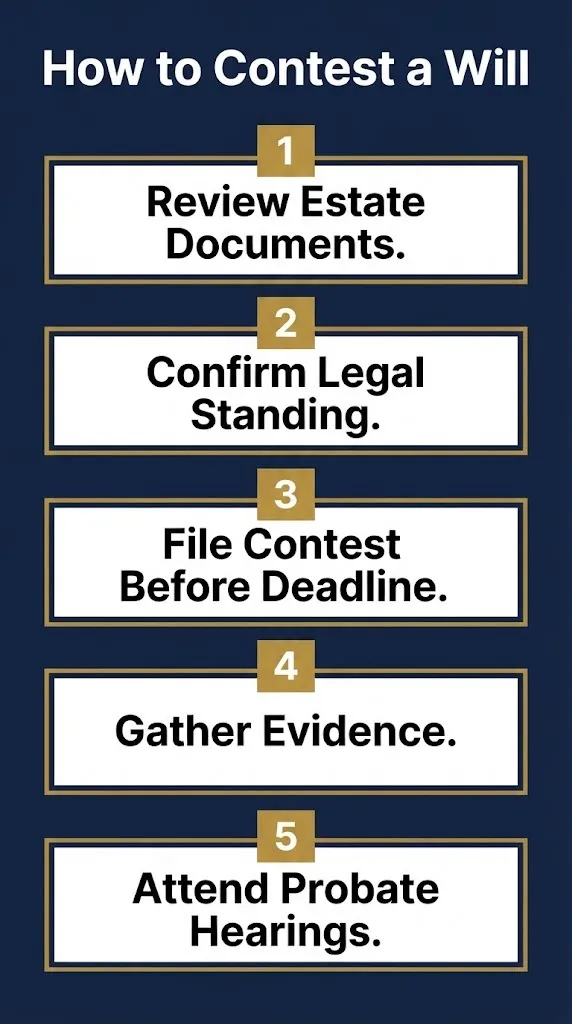
How Do You Contest a Will?
To contest a will, you must file a formal objection in probate court within the state’s deadline. That deadline varies by state, often 30 to 120 days after probate opens. You must have legal standing, meaning you are a beneficiary, heir, or someone who would inherit if the will were invalid.
The grounds for contesting a will are limited. You cannot challenge a will just because it seems unfair. You must prove lack of testamentary capacity, undue influence, fraud, or improper execution. Each ground has specific legal requirements.
Here are the steps:
- Review the will and estate documents.
- Determine your legal standing to object.
- File a contest within the state deadline.
- Gather evidence: medical records, witness statements, prior wills.
- Attend probate court hearings.
- Negotiate a settlement if possible.
- Proceed to trial if no settlement is reached.
Key Takeaway: Will contests have short deadlines and limited grounds. Act quickly if you believe a will is invalid.
What Is Undue Influence in Probate Litigation?
Undue influence in probate litigation means someone pressured the deceased to change their will or trust in a way that does not reflect their true wishes. It is one of the most common grounds for contesting a will. Proving it requires showing that the influencer had opportunity, motive, and the deceased was susceptible to pressure.
The classic case involves a caregiver who isolates an elderly person and convinces them to leave everything to the caregiver. Or a child who moves in near the end of life and suddenly appears in the will. These patterns raise red flags.
Evidence includes medical records showing cognitive decline, witness testimony about the relationship, and sudden changes to estate documents. An experienced probate litigation attorney knows how to build this case.
What Is a Breach of Fiduciary Duty in Probate Litigation?
A breach of fiduciary duty in probate litigation occurs when an executor or trustee fails to act in the best interests of the beneficiaries. Executors and trustees have legal obligations: to account for assets, to avoid self-dealing, to treat beneficiaries fairly, and to follow the terms of the will or trust.
When an executor takes estate funds for personal use, fails to file required documents, or distributes assets improperly, they breach those duties. Beneficiaries can sue to recover losses and remove the executor.
Here are common breaches:
- Self-dealing: using estate assets for personal benefit
- Failure to account: refusing to provide financial records
- Mismanagement: losing estate value through negligence
- Favoritism: treating beneficiaries unequally without legal basis
- Delay: failing to administer the estate in a timely manner
Key Takeaway: Executors and trustees have legal duties. Breaching those duties can lead to removal and money damages.
Reality Check: No legitimate probate attorney asks for money upfront to “release” an inheritance. Court-appointed executors and administrators are paid from the estate, not from your pocket. If someone calls claiming you owe fees to receive an inheritance, verify their identity through the probate court before paying anything.
How Long Does Probate Litigation Take?
Probate litigation typically takes 12 to 24 months to resolve. Straightforward disputes may settle in under a year. Complex will contests with multiple parties and significant assets can take three years or more.
The timeline depends on the court’s docket, the complexity of the dispute, and whether the parties are willing to negotiate. Probate courts often encourage settlement. Judges know that family disputes drain estates and prolong grief.
Here is a typical timeline:
| Stage | Timeframe |
|---|---|
| Filing the dispute | Month 1 |
| Discovery and document exchange | Months 2 to 8 |
| Mediation or settlement talks | Months 6 to 12 |
| Trial, if no settlement | Months 12 to 24 |
| Appeals, if filed | Months 24 to 36 |
How Do You Find a Probate Litigation Attorney?
You find a probate litigation attorney through referrals, bar association directories, or research. Start with your state bar association. Most states have a lawyer referral service that can connect you with qualified probate litigators.
Ask about experience, fee structure, and case approach during the initial consultation. Most probate litigation attorneys offer free or low-cost initial consultations. Use that time to evaluate whether the attorney understands your case and communicates clearly.
Here is a checklist:
- Ask for referrals from other attorneys or financial advisors.
- Check the state bar association directory.
- Read online reviews from past clients.
- Schedule consultations with two or three attorneys.
- Ask about experience with similar probate disputes.
- Confirm the fee structure in writing.
- Evaluate communication style and responsiveness.
Key Takeaway: Interview multiple attorneys before hiring. Fee structure and experience matter equally.
What Is the Difference Between Probate Litigation and Estate Planning?
Probate litigation and estate planning are different practice areas. Estate planning attorneys draft wills, trusts, and other documents to plan for death. Probate litigation attorneys handle disputes over those documents after death. One plans. The other fights.
Some attorneys do both, but many specialize. A litigation attorney may not be the best choice for drafting your will. An estate planner may not be the best choice for contesting a will. The skill sets are related but distinct.
Understanding this difference helps you hire the right person for the right job. If you need a will, hire an estate planner. If you need to fight over a will, hire a probate litigator.
What Happens Next?
If you are facing a probate dispute, time matters. Here is the expected path:
- Week 1: Gather estate documents and identify the dispute.
- Week 2: Consult a probate litigation attorney.
- Month 1: File the necessary court documents before deadlines expire.
- Months 2 to 8: Discovery and evidence gathering.
- Months 6 to 12: Settlement negotiations or mediation.
- Year 1 to 2: Trial, if no settlement is reached.
These timelines are estimates based on typical probate court schedules. Your state and specific dispute may differ.
Frequently Asked Questions
What is probate litigation?
Probate litigation is the legal process of resolving disputes over a deceased person’s estate in probate court. It includes will contests, trust disputes, and executor misconduct claims.
How much does a probate litigation attorney cost?
Hourly rates range from $250 to $600 or more. Retainers often start at $5,000 to $25,000. Contingency arrangements are available in some cases.
How long do you have to contest a will?
Deadlines vary by state, often 30 to 120 days after probate opens. Check your state probate code immediately if you are considering a contest.
Can you contest a will if you were cut out?
Yes, if you have legal standing and grounds such as undue influence or lack of capacity. Being unhappy with the will is not enough.
What happens if an executor steals from the estate?
The executor can be removed and sued for breach of fiduciary duty. The probate court can order repayment and impose penalties.
Do probate litigation attorneys work on contingency?
Some do, especially when the claim involves recovering a specific amount of money. Most charge hourly. Ask about fee structure upfront.
Can probate litigation be settled?
Yes. Most probate disputes settle before trial. Settlement saves time, money, and family relationships.
What is the difference between a will contest and a trust dispute?
A will contest challenges the validity of a will. A trust dispute involves disagreements over how a trust is managed or distributed. Both are probate litigation.