Litigation Funding in 2026: How Third-Party Funding Works, Costs, and Risks
Quick Answer
- Litigation funding is a non-recourse investment where a third party pays legal costs in exchange for a share of any recovery. If the case loses, the claimant owes nothing.
- Funders typically charge 2x to 3x their invested capital or 20% to 40% of damages, with pricing varying by case risk and duration.
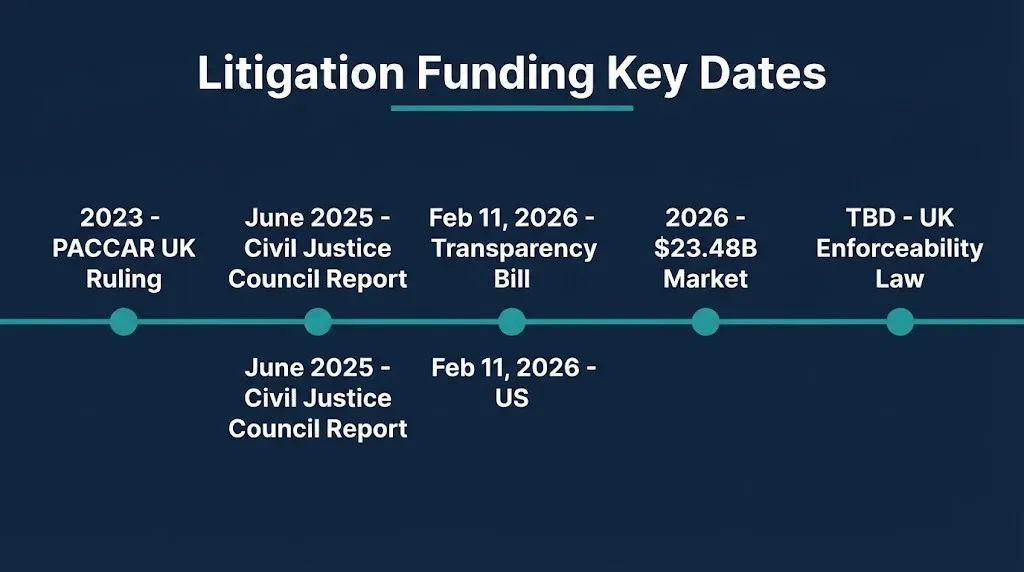
- The most significant 2026 regulatory development is S. 3826, introduced February 11, 2026, which would require disclosure of third-party funding in class actions and MDLs with 100+ cases.
What Is Litigation Funding?
Litigation funding is a financial arrangement where a third party unrelated to a lawsuit provides capital to cover legal costs in exchange for a portion of any financial recovery. It is also called third-party litigation funding or legal finance.
The arrangement is always non-recourse, meaning if the case is lost, the funded party owes nothing back . That distinguishes it from a traditional loan, where repayment is required regardless of outcome.
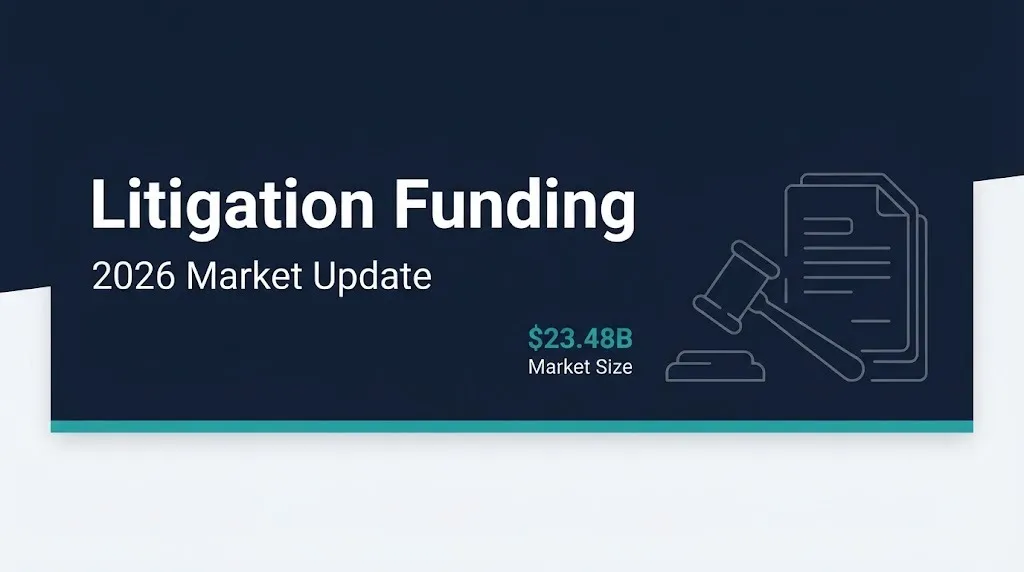
Litigation funding emerged from medieval English doctrines of maintenance and champerty, which once prohibited third-party involvement in lawsuits. Those prohibitions were gradually repealed in jurisdictions like the UK and Australia during the late 20th century, paving the way for the modern funding industry .
Today, litigation finance operates across two main markets. Consumer legal funding provides individuals with cash advances while personal injury claims are pending. Commercial litigation finance supplies corporations and law firms with capital for complex, high-value disputes like intellectual property, antitrust, and international arbitration .
Key Takeaway: Litigation funding is not a loan. It is a non-recourse investment where the funder shares in the risk and the reward of a legal claim.
How Does Litigation Funding Work?
Litigation funding works through a four-step process: preliminary discussions, indicative terms, due diligence, and a final funding agreement. The funder evaluates the case before committing capital.
Here is the typical sequence :
- Preliminary discussions on a no-names basis to gauge fit.
- Indicative terms outlining potential pricing and structure.
- Due diligence on legal merits, damages quantum, and enforcement prospects.
- Approval and funding agreement setting the terms of the investment.
Funders conduct extensive due diligence. They assess three core aspects: the legal merits of the case, the quantum of damages, and the enforcement prospects (whether the opposing party has attachable assets) .
The funder does not typically control litigation strategy. However, funding agreements may include provisions that give funders influence over settlement decisions or require reporting on case progress .
For the funded party, the primary appeal is risk transfer. If the case fails, the funder absorbs the loss. If it succeeds, the funder recovers its investment plus a return.
How Much Does Litigation Funding Cost?
Litigation funding costs are typically structured as either a multiple of invested capital or a percentage of recovery. Pricing is bespoke to each case and not publicly published .
| Pricing Model | Typical Range | How It Works |
|---|---|---|
| Multiple of Capital | 2x to 3x invested capital | Funder recovers a set multiple of what it spent |
| Percentage of Recovery | 20% to 40% of damages | Funder takes an agreed share of the award or settlement |
| Hybrid | Combination of both | Less common; combines fixed return with upside share |
The multiple typically builds up over time. A case that settles quickly might see a 1.5x return, while one that goes to trial could reach 3x .
Pricing is highly sensitive to risk. Higher-value claims likely to settle quickly attract more competitive terms. Complex cases with lengthy proceedings or uncertain enforcement require higher returns .
Funders often expect the legal budget to represent no more than one-tenth of the claim’s value. That means a case worth $10 million would typically attract no more than $1 million in funding .
Who Uses Litigation Funding?
Litigation funding serves three primary user groups: law firms, individual claimants, and institutional investors. Each uses funding for different reasons.
Law firms use funding to pursue high-merit claims without carrying the full financial burden internally. This allows smaller firms to compete with larger defense teams by expanding access to experts, technology, and discovery resources .
Individual claimants do not typically receive funding directly from commercial funders. Instead, funders provide capital to law firms representing consumers or small businesses. This enables representation for those who might otherwise be left without counsel .
Institutional investors access litigation funding as an alternative asset class. It offers returns uncorrelated with traditional markets, appealing to those seeking diversification with meaningful societal impact .
In the U.S., North America accounted for 58.6% of the litigation funding market share in 2025, making it the dominant region for deployment .
What Are the Different Types of Litigation Funding?
Litigation funding takes several forms depending on the case stage and the funded party’s needs. The most common structures are single-case, portfolio, and post-litigation funding.
| Funding Type | Description | Best For |
|---|---|---|
| Single-Case | Funder finances one specific dispute | High-value commercial claims |
| Portfolio | One funder finances multiple cases under a single facility | Law firms with a book of similar claims |
| Post-Litigation | Funding for enforcement or monetization after judgment | Claimants awaiting payment from a won case |
| Appeal Funding | Covers costs of appeals or enforcement actions | Cases with adverse rulings being challenged |
Portfolio funding spreads risk across multiple cases. A successful outcome in one case can offset losses in another, a mechanism called cross-collateralization. This diversification often translates into more attractive pricing than case-by-case funding .
Post-litigation funding is the fastest-growing segment, projected to deliver an 11.9% CAGR through 2031. Award monetization allows a funded party to sell part of a final or near-final award for immediate liquidity, useful when debtors resist payment or enforcement must proceed across borders .
What Are the Risks of Litigation Funding?
Litigation funding carries risks for both funders and funded parties. The most significant concerns involve ethical conflicts, confidentiality, and control over settlement decisions.
A central ethical issue is the divergence of interest between the funder and the claimant. A settlement offer might be sufficient to fully repay the funder but unacceptable to a client seeking greater damages. The funder may view trial as an unnecessary risk, while the client wants to proceed .
The American Bar Association has flagged concerns about attorney independence and attorney-client communications when funders are involved. Sharing sensitive case information with funders during due diligence may risk waiver arguments if not handled carefully .
Disclosure is another growing concern. Courts are paying closer attention to funding arrangements, especially when agreements could affect case control, settlement decisions, or potential bias. In some jurisdictions, failure to disclose funding relationships may lead to sanctions or discovery disputes .
Some jurisdictions still enforce champerty laws, which prohibit third parties from funding litigation in exchange for a stake in the proceeds. California never recognized the doctrine, while Minnesota abolished its restrictions in recent years. New York allows funding but prohibits funders from taking a contingent stake because it constitutes improper fee sharing under Rule 5.4 .
What Is the Litigation Funding Transparency Act of 2026?
The Litigation Funding Transparency Act of 2026 is a U.S. Senate bill that would require disclosure of third-party litigation funding in class actions and mass torts. It was introduced on February 11, 2026, by Senators Grassley, Tillis, Kennedy, and Cornyn .
The bill would amend Title 28 of the U.S. Code to require parties and counsel in covered civil actions to disclose funding agreements. Covered civil actions include MDL proceedings, class actions, and coordinated proceedings with 100 or more civil actions .
The disclosure requirement would not apply to nonprofit legal organizations funded by donors providing pro bono representation, as long as donations do not come from foreign states, foreign persons, or sovereign wealth funds .
The bill reflects growing congressional concern about foreign funding of U.S. litigation. The definition of third-party funder includes foreign states, foreign persons, and sovereign wealth funds .
The bill was referred to the Senate Judiciary Committee and has not yet received a vote. Its passage would represent the first comprehensive federal disclosure requirement for litigation funding in the United States.
How Is Litigation Funding Regulated in 2026?
Litigation funding regulation remains fragmented and jurisdiction-specific in 2026. There is no uniform federal framework in the United States, and approaches vary widely across states and countries.
In the U.S., disclosure obligations develop through local rules, standing orders, and case-specific decisions rather than comprehensive federal legislation. Some states have enacted consumer protection laws. Nevada requires funder registration. Maine governs consumer funding through its Legal Funding Practices Act .
New York has proposed legislation that would cap the amount a consumer could owe at 25% of the gross recovered amount plus the amount advanced. The bill would also require a 10-day cancellation right and mandate specific disclosures in funding contracts .
In the UK, the PACCAR Supreme Court decision in 2023 held that litigation funding agreements were unenforceable as damages-based agreements. The government has stated its intention to legislate to restore enforceability. The Civil Justice Council’s Final Report in June 2025 recommended a proportionate, light-touch approach to regulation .
In arbitration, the Chartered Institute of Arbitrators released its Guideline on Third-Party Funding in 2025. The guideline provides practical guidance on disclosure obligations, conflicts of interest, and cost recovery in funded arbitrations .
What Happens Next with Litigation Funding?
The litigation funding landscape will continue evolving through 2026 and beyond. Here are the key developments to watch:
Pending 2026: The Senate Judiciary Committee considers S. 3826, the Litigation Funding Transparency Act of 2026.
Ongoing 2026: State legislatures consider consumer protection bills, including New York’s proposed 25% cap on consumer funding repayments.
Expected 2027: UK legislation to restore enforceability of litigation funding agreements following PACCAR.
Ongoing: Post-litigation funding continues its rapid growth, projected at 11.9% CAGR through 2031.
Ongoing: Courts continue developing disclosure requirements through local rules and case-specific orders.
Frequently Asked Questions
What is litigation funding in simple terms?
Litigation funding is when a third party pays your legal costs in exchange for a share of any money you win. If you lose, you owe nothing back.
Is litigation funding legal?
Yes, it is legal in most U.S. states and many countries. Some jurisdictions still enforce champerty laws that restrict certain funding arrangements.
How much does litigation funding cost?
Funders typically charge 2x to 3x their invested capital, or 20% to 40% of the damages recovered. Pricing depends on case risk and duration.
What happens if I lose a funded case?
You owe nothing. Litigation funding is non-recourse, meaning the funder absorbs the loss if the case fails.
Do I need to disclose litigation funding to the court?
Disclosure requirements vary by jurisdiction and case type. Some courts require disclosure in class actions and MDLs. The Litigation Funding Transparency Act of 2026 would make disclosure mandatory in federal class actions if passed.
Can I get litigation funding for a personal injury case?
Commercial funders typically do not fund individuals directly. They provide capital to law firms representing consumers, including personal injury plaintiffs.
What is the difference between litigation funding and a loan?
Litigation funding is non-recourse: you repay only if you win. A loan requires repayment regardless of case outcome. Consumer funding companies may structure advances as loans with interest.
What is portfolio litigation funding?
Portfolio funding finances multiple cases under a single agreement, spreading risk across claims. This often results in lower pricing than single-case funding.