Personal Injury Settlement Amounts and Taxes: The Full 2026 Breakdown
Quick Answer
- Personal injury settlements compensating physical injury or sickness are generally not taxable under IRC Section 104(a)(2).
- Recent 2026 data puts the median personal injury settlement around $31,000, though case type changes this dramatically.
- Punitive damages and interest on a settlement are always taxable, reported as Other Income or Interest Income.
You searched “personal injury settlement” wanting two things: what a case like yours might be worth, and whether the IRS gets a cut. Both questions have real answers, and neither one is as simple as most search results make it sound.
The tax question affects almost everyone who settles a physical injury claim. The dollar question depends heavily on injury type, with broken bone car accident cases alone ranging from a few thousand dollars to well over $200,000 depending on which bone broke.
This guide covers both, using 2026 settlement data and the actual tax code language, not guesswork. One detail worth flagging up front: even a “tax-free” settlement can carry a taxable slice hidden inside it, and most people don’t find out until filing season.
The Facts
| Item | Detail |
|---|---|
| Governing tax statute | IRC Section 104(a)(2) |
| Physical injury compensation | Generally excluded from gross income |
| Punitive damages | Always taxable, reported as Other Income |
| Interest on a settlement | Always taxable, reported as Interest Income |
| National median settlement (2026) | Approximately $31,000 |
| Typical range, most cases | $10,000 to $100,000 |
| Broken bone, car accident (national average) | $89,688, ranging roughly $15,000 to $200,000+ |
| Where taxable proceeds get reported | Schedule 1, Form 1040 |
Is a Personal Injury Settlement Taxable?
A personal injury settlement is generally not taxable when it compensates you for a physical injury or physical sickness. Internal Revenue Code Section 104 explains that money a taxpayer receives as compensation for a physical injury or physical sickness isn’t taxable, whether that money comes from a settlement or a trial verdict.
That exclusion covers the core of most injury cases: medical bills, pain tied to a physical injury, and lost wages caused directly by that injury. Lost wages caused by the physical injury are confirmed tax-free under Revenue Ruling 85-97.

Punitive damages break that rule completely. Punitive damages are taxable and must be reported as Other Income, even when they arise from a physical injury case. A settlement can be split, tax-free for the injury portion and fully taxed on the punitive portion, in the same check.
Key Takeaway: The IRS taxes settlements based on what the money actually compensates, not what the lawsuit was labeled.
Do You Pay Taxes on a Lawsuit Settlement in General?
It depends entirely on what the settlement replaces, not the fact that a lawsuit produced it. Whether a settlement is taxable income comes down to what the money specifically compensated, not what label the lawsuit carried.
Lawsuit settlements outside the physical injury category, like employment disputes, contract breaches, or defamation claims, typically don’t get the Section 104 exclusion. The IRS continues to require that any taxable settlement proceeds be reported as ordinary income on Schedule 1 of Form 1040 for the 2026 tax year.
Courts have enforced this distinction directly. In cases where plaintiffs received settlements labeled as personal injury but couldn’t show an actual physical component, the U.S. Tax Court has repeatedly ruled the money taxable as ordinary income.
That’s the trap: calling something a “personal injury” settlement in a demand letter doesn’t make it tax-free if there was no physical injury behind it.
Do I Have to Pay Taxes on a Lawsuit Settlement? (Practical Breakdown)
You may owe taxes on part of a settlement even if the bulk of it stays tax-free. Here’s how to sort a typical injury settlement into taxable and non-taxable pieces:
| Settlement component | Typically taxable? |
|---|---|
| Medical expenses (physical injury) | No |
| Lost wages tied to a physical injury | No |
| Pain and suffering tied to a physical injury | No |
| Emotional distress, unrelated to physical injury | Yes |
| Punitive damages | Yes, always |
| Interest on the settlement or judgment | Yes, always |
| Reimbursement of previously deducted medical expenses | Yes, under the tax-benefit rule |
If you claimed a medical deduction in a prior year and later recovered those same costs through a settlement, that portion may become taxable under the tax-benefit rule. That’s a detail most settlement calculators skip entirely.
Is a Legal Settlement Taxable? (Beyond Personal Injury)
A legal settlement is taxable by default unless a specific exclusion applies. Under Internal Revenue Code Section 61, the government treats all income from whatever source derived as taxable, which is the broad starting point before any exclusion narrows it.
That default matters because personal injury is the exception, not the rule. Employment settlements, business dispute settlements, and most non-physical-injury claims fall back into ordinary taxable income unless they fit a separate carve-out.
Reality Check: No settlement, tax refund, or “compensation release” ever requires you to pay a fee upfront to receive your own money. If a caller, text, or email asks for a processing fee before releasing settlement funds, that’s a scam, not IRS or court procedure.
Personal Injury Settlement Amounts: What’s Average in 2026?
There’s no single national average, but 2026 data clusters around a fairly consistent middle. Recent data shows about half of all personal injury cases resolve for $24,000 or less, with the median payout closer to $31,000.
A separate July 2026 review of published firm data landed close to that figure. Four law firms reporting their average personal injury settlement amounts produced figures ranging from $24,000 to $55,100, with an estimated overall average of $40,500.
Broader industry ranges support the same picture. Most personal injury cases settle for somewhere between $10,000 and $100,000, though the exact amount varies case by case. Most personal injury settlements land between $10,000 and $75,000, though minor claims can be worth just a few thousand dollars while claims involving surgery or long-term disability can reach six figures.
Key Takeaway: Treat any single “average settlement” number as a starting reference, not a prediction, since case severity moves the real figure by a factor of ten or more.
Average Settlement for Personal Injury by Case Type
Case type changes the math more than any other single factor. Here’s how 2026 data breaks down by claim category:
| Case type | Typical 2026 range |
|---|---|
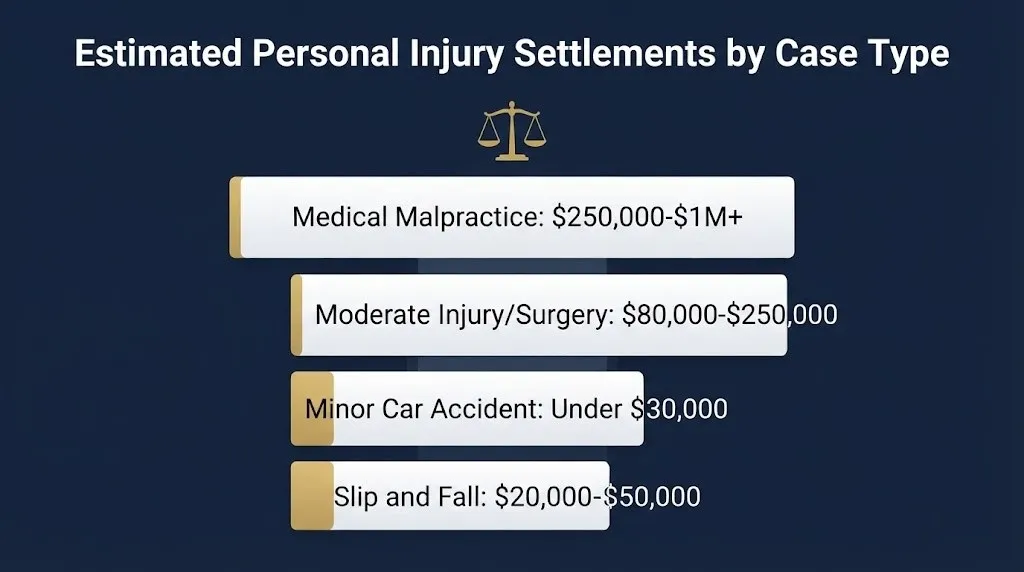
| Minor car accident (whiplash, soft tissue) | Under $30,000 |
| Car accident, moderate injury or surgery | $80,000 to $250,000 |
| Bodily injury claims, general average | Around $26,500 |
| Slip and fall, minor injury | $20,000 to $50,000 |
| Slip and fall, surgery required | Can exceed $100,000 |
| Medical malpractice | $250,000 to over $1 million |
Minor crashes involving whiplash or mild soft tissue injuries often settle under $30,000, while more serious accidents involving surgeries or long-term impairment commonly result in settlements between $80,000 and $250,000. According to the Insurance Information Institute, most bodily injury claim settlements average around $26,500, though higher settlements are possible when permanent harm is involved.
Malpractice settlements commonly range from $250,000 to over $1 million, since permanent disability and long-term care needs significantly increase case value.
Average Settlement for Broken Bone in Car Accident
The average car accident settlement for a broken bone lands near $89,688, but the range underneath that number is enormous. Based on April 2026 data, amounts vary by injury from $15,000 for ribs up to $200,000 for femurs.
The bone that breaks matters more than almost any other factor. The median national average verdict for a femur fracture, the most valuable type of broken leg injury, is $167,000.
| Broken bone | Typical settlement range |
|---|---|
| Ribs | $15,000 to $100,000 |
| Clavicle | $15,000 to $50,000 |
| Broken leg (general) | $55,000 to $150,000 |
| Tibia and fibula (both) | $125,000 to $200,000 |
| Femur | $130,000 to $200,000+ |
| Hip | $50,000 to $250,000 |
Not yet determined applies to any specific case: these are ranges pulled from aggregated 2026 firm data, not a guarantee for any individual claim.
Key Takeaway: A broken bone settlement can run anywhere from $15,000 to over $200,000, and the specific bone injured is the single biggest variable.
Accident Claims: How Much Compensation Can You Expect?
Compensation depends on four factors that show up in nearly every case: medical costs, lost income, liability strength, and available insurance coverage. No formula guarantees a number, but insurers and attorneys generally weigh these the same way.
Common inputs to a compensation estimate:
- Total medical bills, current and projected future treatment
- Lost wages during recovery, plus reduced future earning capacity
- Severity and permanence of the injury
- Strength of evidence proving the other party’s fault
- Policy limits on the at-fault party’s insurance
One common method multiplies total economic losses by a number between 1.5 and 5, depending on injury severity, so $40,000 in economic damages with a multiplier of 3 produces roughly a $120,000 pain and suffering estimate. That multiplier is a starting point for negotiation, not a locked formula.
Injury Lawsuit Settlement Payouts: What Pushes the Number Higher or Lower
Two claims with similar injuries can settle at wildly different amounts, and the gap usually traces back to a handful of factors. Insurance policy limits often set a hard ceiling regardless of how strong your case is.
Insurance policy limits often control the maximum payout available, since available coverage plays a major role in final settlement amounts.
Representation status changes outcomes too. Represented claimants recover 3.5 times more on average than those who negotiate on their own, according to data tracked from published 2026 settlements.
Think of an unrepresented claim like negotiating a used car trade-in without checking the market value first. You can still get a deal, but you’re negotiating blind.
Key Takeaway: Policy limits, evidence quality, and legal representation move settlement numbers more than the injury type alone.
How Personal Injury Settlements Get Paid Out
A settlement isn’t a single instant transfer in most cases. Here’s the typical sequence:
- You and the insurer or defendant agree on a settlement figure.
- You sign a release, waiving further claims tied to the injury.
- Any medical liens or outstanding bills tied to the case get identified.
- The insurer or defendant issues payment, often to your attorney’s trust account.
- Attorney fees and case costs get deducted per your fee agreement.
- Outstanding liens (medical providers, health insurers) get paid from the proceeds.
- The remaining balance gets released to you.
Once you agree on a settlement amount, you sign a claim release, which waives your right to pursue further legal claims against the other party in exchange for the payout. Read that document closely, since it typically closes the door on reopening the claim later, even if your injury turns out worse than expected.
Taxes on Settlement Money: What You Actually Report
Taxable settlement money gets reported as ordinary income, not as a special settlement category on your return. Taxable settlement proceeds must be reported as ordinary income on Schedule 1 of Form 1040.
State taxes typically follow the federal treatment, but not always. Most states follow the federal government’s lead and don’t tax most personal injury settlements, though state rules do vary.
Watch for these two commonly missed taxable items inside an otherwise tax-free settlement:
- Interest: Interest on settlements and judgments is taxable and should be reported as Interest Income, separate from the underlying injury compensation.
- Prior medical deductions: If you deducted medical costs on a past return and later got reimbursed for those same costs through the settlement, that reimbursed portion can become taxable.
How to Protect More of Your Settlement
A few practical steps reduce the odds of an unexpected tax bill or a smaller-than-expected check. None of these require a law degree to follow.
- Ask for a settlement agreement that itemizes what each dollar compensates.
- Separate punitive damages and interest from the physical injury portion in writing.
- Confirm any medical liens before you sign the release, not after.
- Keep records of any medical expenses you previously deducted on past returns.
- Talk with a tax professional before signing, not after the check arrives.
- Ask your attorney how fees and liens will be calculated against the gross settlement.
Reality Check: Structuring a settlement to minimize tax exposure is a legitimate legal and financial strategy discussed before signing, not a loophole. It has nothing to do with third-party “settlement funding” companies charging high fees for early cash advances, which come with their own steep costs.
What Happens Next
Before signing: Review the release language and confirm which portions of the settlement cover physical injury versus other categories.
At payout: Attorney fees, case costs, and any medical liens get deducted before you receive the remaining balance.
At tax filing: Taxable portions, if any, get reported on Schedule 1 of Form 1040 for the year you received payment.
Expected ongoing: The $2,000+ threshold changes and IRS reporting rules for 1099 forms tied to legal settlements continue to be reviewed periodically, so confirm current rules each filing season.
Frequently Asked Questions
Is a personal injury settlement taxable?
Generally no, if the money compensates you for a physical injury or physical sickness.
Punitive damages and interest within that same settlement are still fully taxable.
What is the average personal injury settlement amount in 2026?
Recent 2026 data puts the median around $31,000, with most cases falling between $10,000 and $100,000.
Serious injuries, surgery, or permanent disability push individual cases far higher.
Do you pay taxes on a lawsuit settlement that isn’t for an injury?
Usually yes, since the tax-free exclusion under Section 104 applies specifically to physical injury or sickness.
Employment, contract, and most other lawsuit settlements are typically taxed as ordinary income.
What is the average settlement for a broken bone in a car accident?
National 2026 data puts the average near $89,688, though it ranges from about $15,000 to over $200,000.
The specific bone fractured is the biggest factor in where a case lands.
How much compensation can I expect after an accident claim?
There’s no fixed number, since medical costs, lost wages, liability, and insurance limits all shape the final figure.
Represented claimants have recovered roughly 3.5 times more than unrepresented claimants in tracked 2026 data.
Do I have to pay taxes on a lawsuit settlement for lost wages?
If the lost wages are tied to a physical injury, that portion is typically tax-free under the same Section 104 exclusion.
Lost wages from a non-physical-injury claim, like an employment dispute, are usually taxable.
Is a legal settlement taxable if it includes interest?
The interest portion is taxable even when the underlying settlement is not.
Report that interest separately as Interest Income on your tax return.
How is settlement money actually paid out to me?
Payment typically goes to your attorney’s trust account first, where fees, costs, and any medical liens get deducted.
The remaining balance is then released to you, usually within weeks of signing the release.
Every personal injury settlement is different, and the range between a minor claim and a catastrophic one runs into the millions of dollars. Before signing anything, confirm in writing what each part of your settlement compensates, since that language decides your tax bill.