Probate Litigation Lawyer 2026: Costs, Deadlines and How These Cases Actually Work
Quick Answer
- Probate litigation lawyers handle contested estates: will contests, trust disputes, and fiduciary misconduct claims, not routine uncontested probate filing.
- Costs typically range from $300 to $600 per hour in 2026, with contested cases often running $15,000 to over $100,000 depending on complexity.
- Filing deadlines are short and unforgiving: many states allow only three to six months after a will enters probate to contest it.
You just found out a family member’s will changed right before they died. Or a sibling controlling a trust stopped answering your calls. Either way, you’re now searching for a probate litigation lawyer, and you need real numbers, not a sales pitch.
This matters because the clock is already running. Every state’s probate law includes a statute of limitations that sets the time limit for contesting a will, and missing that deadline means losing the right to contest it entirely. That window can be as short as a few weeks in some circumstances.
This guide covers what these lawyers actually do, what they cost in 2026, how long contested cases take, and which deadlines you cannot afford to miss. The detail that surprises most people: unlike almost any other type of lawsuit, probate litigation works on rules and timelines completely different from general civil claims like breach of contract or personal injury, which often allow years to file.
The Facts
| Category | Details |
|---|---|
| What it covers | Will contests, trust litigation, fiduciary duty breach, elder financial abuse in estates |
| Typical hourly rate (2026) | $300 to $600+ depending on state and experience |
| Typical case timeline | 9 to 18 months for contested probate; longer for trust disputes with discovery |
| Will contest deadline | Ranges 3 months to 2 years by state, not federal or uniform |
| Fee structure | Mostly hourly billing; some flat-fee uncontested work; contingency rare but exists |
| Who pays | Often the estate, but litigant may front costs until resolution |
| Proof needed to file | Standing (named heir or pecuniary interest) plus grounds: undue influence, lack of capacity, fraud, forgery, improper execution |
Nothing here is a guessed number. Every figure traces to state bar data, law firm fee disclosures, and court procedure guides checked for this article. Where a state’s specific deadline is not listed, check that state’s probate code directly, since local rules override any general estimate.
Is a Probate Litigation Lawyer the Right Type of Attorney for My Situation?
A probate litigation lawyer is the right attorney when an estate or trust becomes contested, not merely complicated. Contested means someone is challenging a will’s validity, disputing a trustee’s conduct, or fighting over who has authority to act.
This is different from a standard probate attorney, who helps an executor file paperwork, notify creditors, and close an estate with no disagreement among the parties. Probate lawyers generally serve as guides through the legal maze of estate administration, handling laws, procedures, filings, and obligations that must be followed whether someone died with a detailed estate plan or without one.
Litigation attorneys step in once that administration turns into a fight. Common trigger situations include:
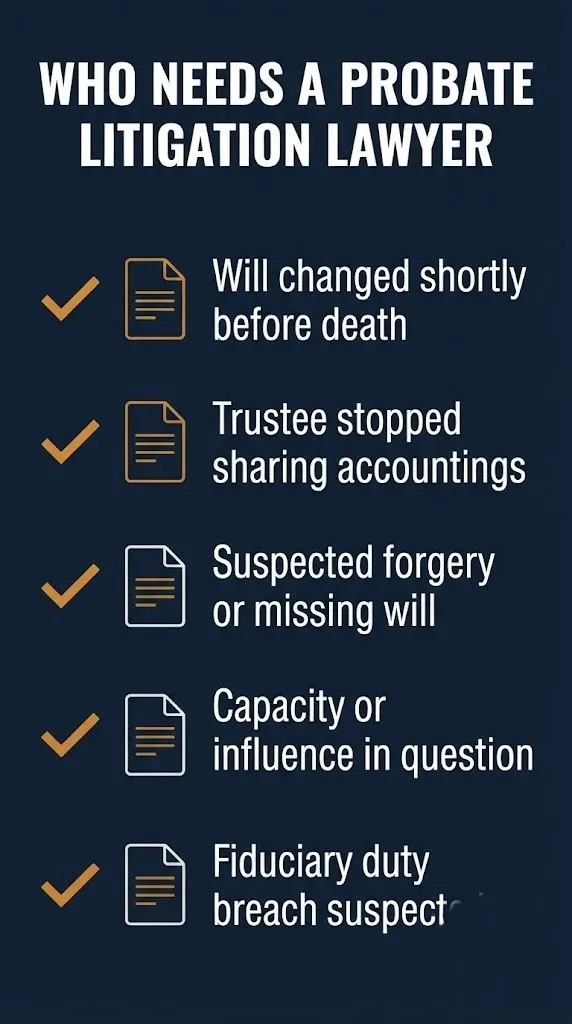
- A late-life will change that favors one heir over others
- A trustee who stops providing accountings or spends trust funds on themselves
- Suspected forgery or a missing original will
- Claims that the person who died lacked mental capacity when signing documents
- Allegations of undue influence by a caregiver, new spouse, or business partner
Key Takeaway: A probate litigation lawyer is for disputes, not paperwork. If everyone agrees on the will and the executor, you likely need a standard probate attorney instead, at a fraction of the cost.
What Does a Probate Litigation Attorney Actually Do?
A probate litigation attorney investigates the estate, builds the legal case, and represents one side in court, either the person contesting the will or the fiduciary defending it. The work looks much closer to civil litigation than to routine estate administration.
Typical tasks include:
- Reviewing the will, trust documents, and any prior versions for inconsistencies
- Interviewing witnesses to the signing, including the drafting attorney
- Requesting medical and financial records to establish capacity or influence
- Filing the formal petition or objection with the probate court
- Conducting depositions and written discovery
- Negotiating settlement between family members before trial
- Litigating the matter at a contested hearing or trial if no settlement is reached
Estate litigation almost always moves in phases. One California litigation firm describes the pattern as filing the petition, serving notice on all beneficiaries, then receiving the initial response or objection within the first one to three months before the case moves into discovery.
Think of it like a home renovation dispute with a contractor. The paperwork phase is simple if everyone agrees on the plan. Once someone disputes the work, it becomes a drawn-out process involving inspectors, experts, and sometimes court.
How Much Does a Probate Litigation Lawyer Cost in 2026?
A probate litigation lawyer in 2026 typically costs $300 to $600 or more per hour, with total contested case costs ranging from roughly $15,000 for a narrow, fast-resolving dispute to well over $100,000 for a multi-year trust fight involving real estate, business interests, or expert witnesses.
Billing structure matters as much as the rate itself.
Not yet determined for any individual reader: your exact total cost, since it depends entirely on how long the fight lasts and how much your relatives dig in. No lawyer or article can tell you that number before the case starts.
Here’s how the pricing typically breaks down by region and complexity in 2026:
| Market Type | Typical Hourly Rate | Notes |
|---|---|---|
| Small town / rural | $200 to $350 | Lower overhead, less specialization |
| Mid-size metro | $300 to $450 | Standard range for most contested matters |
| Major metro (NYC, LA, SF) | $350 to $600+ | Reflects firm overhead and specialization |
| Flat-fee uncontested probate | $3,500 to $8,000 | Only applies once a case is uncontested |
In Manhattan and the outer boroughs, 2026 rates for estate litigation and probate administration range from $350 to $600 or more per hour depending on the attorney’s experience and the firm’s overhead. A straightforward uncontested probate typically takes 20 to 50 attorney hours, which at $400 an hour runs $8,000 to $20,000 in fees alone, before any litigation begins.
Most contested probate and trust cases run on hourly billing rather than flat fees, because no one can predict in advance how many depositions or hearings a fight will require. This is the most common arrangement, especially for complex or contested probates, with the lawyer billing based on time worked in six or fifteen-minute increments.
Payment source is worth understanding too. In many cases, the estate ultimately pays legal fees, and in most situations nothing is paid up front. If the case is litigated and the executor’s side wins, the executor can ask the court to cover the lawyer’s fees from the estate. But if the estate has more debts than assets, that reimbursement path does not go as smoothly.
Key Takeaway: Expect hourly billing, not a flat fee, once a case becomes contested, and confirm in writing whether the estate or you personally will be billed as the case proceeds.
How Long Does Probate Litigation Take?
Probate litigation typically takes 9 to 18 months for a contested case to resolve at the trial court level, though disputes involving trusts, multiple properties, or appeals can stretch well beyond two years.
Timeline depends heavily on how many parties are fighting and how complex the estate is.
| Case Type | Typical Duration |
|---|---|
| Uncontested probate | 3 to 6 months |
| Contested will or trust dispute | 9 to 18 months |
| Multi-property or high-value estate dispute | 2 to 5 years |
| Appeal after trial court ruling | Add 6 to 18 months |
Most probate cases in 2026 take between 9 and 18 months to resolve, a timeline that allows the court to verify the will, notify creditors, and give people time to file claims. That’s the baseline even before a contest is filed. Once litigation starts, the process can be delayed by months or even years if a will is contested or a dispute arises among beneficiaries.
Value of the estate also drags out timing. Settling estates worth $2,000,000 or more tends to take about two-and-a-half to three times longer than smaller estates. One industry estimate puts the average time to fully settle any estate, contested or not, at around 16 months.
Compare it to a home insurance claim after storm damage. A clean, undisputed claim clears in weeks. Add a dispute over the payout amount, and it can take a year or more of back-and-forth before a check arrives.
What Are the Deadlines to Contest a Will or Trust?
Deadlines to contest a will or trust are set by state law, not federal law, and typically range from three months to two years after the will is admitted to probate, with many states landing on the shorter end.
This is the single most important fact in this entire article. Missing this window usually ends the case permanently, no matter how strong the evidence is.
Reality Check: No court extends a will contest deadline just because you were grieving, unaware of the process, or waiting on a lawyer’s schedule to open up. Filing a probate objection is always free of any third-party “expediting fee,” and anyone offering to unlock a faster court date for a payment outside official court costs is not legitimate.
Here’s how deadlines compare across several states checked for this article:
| State | Will Contest Deadline |
|---|---|
| New Jersey (resident) | 4 months from probate |
| New Jersey (non-resident) | 6 months from probate |
| Florida | Governed by strict statutory windows under §733.212 |
| Illinois | 6 months from the will entering or being denied probate |
| Oklahoma | 3 months from probate |
| Kansas | 4 months from creditor notice, or 30 days if all creditors known |
| Missouri | 6 months from probate or creditor notice, whichever is later |
| Nebraska | 3 years from death, or 1 year after distribution |
In Illinois, the statute of limitations for will contests is six months from the date the will enters or is denied probate. Oklahoma allows just three months from the date the will enters probate or is denied entry. Missouri gives six months from the will entering or being denied probate, or six months after creditor notice, whichever date lands later.
Florida imposes some of the most rigid limitation periods in the country for will and trust contests, and courts there have almost no discretion to extend a missed deadline, with only extraordinarily narrow exceptions available.
Fraud claims sometimes get more room. When a will contest involves fraud, the statute of limitations often begins running from the date the fraud was actually discovered rather than from the date of death or probate filing. Certain heirs also get special protection: if an interested party was a minor or incapacitated during the standard filing window, some states pause, or “toll,” the clock until that person reaches adulthood or regains capacity.
Key Takeaway: Confirm your specific state’s deadline within days of learning about a will or trust dispute, since some windows close in as little as three months.
What Grounds Can You Use to Contest a Will or Trust?
You can contest a will or trust only on specific legal grounds recognized by the court, not simply because you disagree with how an estate was divided.
Courts require standing plus a valid legal theory. To have standing to challenge a will’s validity, the person contesting it must either be named in the will or hold a direct financial interest in the estate.
Recognized grounds generally include:
- Lack of testamentary capacity: the person did not understand what they were signing or the extent of their property
- Undue influence: someone with power over the deceased pressured them into changes that don’t reflect their real wishes
- Fraud: the deceased was tricked about the contents or nature of the document
- Improper execution: the will wasn’t signed or witnessed correctly under state law
- Forgery: the signature or document itself is fake
- Revocation: a later, valid will replaced the one being probated
- Breach of fiduciary duty: for trusts, a trustee mismanaged assets, self-dealt, or failed to account to beneficiaries
Disagreeing with the outcome is not, on its own, a valid legal ground. Courts routinely dismiss contests filed purely because an heir feels an inheritance was unfair.
How Do Trust Litigation Cases Differ From Will Contests?
Trust litigation differs from will contests mainly in venue, ongoing obligations, and the types of claims available, since a trust operates continuously rather than triggering a single court filing at death.
A will contest challenges a document’s validity at one point in time, right after death, inside the probate court. Trust litigation can arise years after a trust was created, and often centers on ongoing trustee conduct rather than a single signing event.
Common trust litigation claims include:
- Breach of fiduciary duty by a trustee
- Failure to provide required accountings to beneficiaries
- Self-dealing or commingling trust assets with personal funds
- Improper trust amendments, especially those made shortly before death
- Disputes over trustee removal and replacement
- Claims that a trust was procured through undue influence, similar to a will contest
One estate litigation firm notes that pre-2020 trusts are increasingly vulnerable to challenge as laws and family circumstances shift, adding a new layer of dispute risk that families with older trust documents should watch closely.
Key Takeaway: If your dispute involves a trustee’s ongoing conduct rather than a single signing event, you’re likely looking at trust litigation, which can move on a different timeline than a probate court will contest.
How Do You Choose the Right Probate Litigation Law Firm?
Choosing the right probate litigation law firm comes down to matching the firm’s specific experience to your dispute type, confirming fee structure in writing, and checking their track record with cases similar to yours before signing anything.
Steps worth taking before you hire:
- Ask how many contested probate or trust cases the attorney handled in the past two years
- Request the fee agreement in writing before any work begins
- Ask directly whether the estate or you personally will be billed
- Confirm the attorney is barred and in good standing in the state where the estate is being probated
- Ask for a realistic timeline estimate based on your specific facts, not a generic average
- Get a written budget range for discovery, depositions, and possible trial
One litigation boutique frames the calculation this way: evaluation of a contested estate matter is critical, but hesitation carries its own cost, since statutes of limitations in probate matters are unforgivingly short. That’s a fair warning regardless of which firm you ultimately choose. Weigh the likely legal cost against what’s actually at stake in the estate before committing to a long fight.
What Happens Next
Immediately: Confirm your state’s specific will or trust contest deadline before doing anything else, since this window can close in weeks.
Within 30 days: Gather the will, any prior versions, medical records if capacity is at issue, and financial statements for the estate or trust.
1 to 3 months in: Expect initial pleadings, formal notice to all beneficiaries, and the first response or objection from the opposing side.
Months 3 to 12: Discovery phase, including depositions, document requests, and expert reports if capacity or forgery is disputed.
Expected resolution: Most contested cases settle or reach a hearing between 9 and 18 months after filing, though complex trust and multi-property disputes commonly run longer.
Frequently Asked Questions
How much does it cost to hire a probate litigation lawyer?
Most probate litigation lawyers in 2026 charge $300 to $600 per hour, depending on state and firm size.
Total case costs commonly range from $15,000 for a narrow dispute to over $100,000 for a lengthy trust fight.
Ask for a written fee agreement before signing with any firm.
Who pays for probate litigation, the estate or the family member?
In many cases the estate covers legal fees once a matter resolves, but the person filing suit often fronts costs during litigation.
If the losing side loses on the merits, courts don’t automatically shift fees to them in every state.
Confirm this specific point with your attorney before filing, since rules vary by jurisdiction.
How long do I have to contest a will?
Deadlines range from as little as three months to about two years after the will is admitted to probate, depending on your state.
Some states start the clock at death, others at the date of the probate filing or creditor notice.
Missing this deadline generally bars the contest permanently, with very few exceptions.
Can I contest a will just because I think it’s unfair?
No, disagreeing with how assets were divided is not, by itself, a legal ground for a contest.
Courts require a recognized legal theory such as lack of capacity, undue influence, fraud, forgery, or improper execution.
You also need legal standing, meaning you’re named in the will or hold a direct financial interest in the estate.
What’s the difference between a probate lawyer and a probate litigation lawyer?
A standard probate lawyer helps an executor file paperwork and close an estate when no one disputes it.
A probate litigation lawyer represents one side once a will or trust becomes contested in court.
The litigation route typically costs significantly more and takes longer than uncontested administration.
How long does a contested probate case take to resolve?
Most contested cases take 9 to 18 months to reach resolution at the trial court level.
Larger or more complex estates, especially those over $2 million, can take two to three times longer.
Appeals after a trial court ruling can add another 6 to 18 months.
Do I need a lawyer to contest a trust, or can I do it myself?
You are not legally required to hire a lawyer, but trust litigation involves fiduciary law, accounting disputes, and procedural rules that are difficult to navigate alone.
Self-represented parties face the same strict deadlines and evidentiary standards as represented ones.
Given the short filing windows involved, most people consult an attorney early even if they later decide not to retain one for the full case.
Is there a faster or cheaper way to resolve a probate or trust dispute?
Yes, many contested cases settle through mediation before reaching trial, which generally costs less and resolves faster.
Settlement mid-case remains common once both sides see the strength of evidence during discovery.
A lawyer can advise whether mediation makes sense for your specific dispute.
If you believe you may need to contest a will or trust, treat the deadline as your first priority, not your last. Confirm your state’s specific filing window this week, and gather documentation while memories and records are still fresh.
No two probate litigation cases cost or move the same way, so get a written estimate before committing to a fight.