Purpose Financial Settlement: 2026 Class Action Status, Eligibility, and What Borrowers Should Know
Quick Answer
- Purpose Financial class actions are real, targeting lending and collection practices at Advance America and related brands.
- No verified per-person payout or settlement fund total is confirmed for a current nationwide settlement.
- No claim deadline is confirmed; check the official settlement site or court docket before relying on any figure.
If you saw a headline or a text about a Purpose Financial settlement, you are probably asking whether it is real, whether you qualify, and how much you might get. The honest answer requires separating what is confirmed in court records from what is circulating on ads and forums.
Purpose Financial is a real company. It operates Advance America, one of the largest payday and installment loan chains in the country. The company has been sued repeatedly over how it markets loans, how it collects them, and what it discloses to borrowers.
This article breaks down the verified 2026 status of Purpose Financial litigation, the difference between active lawsuits and paid settlements, and the steps you should take if you believe you are part of an affected class.
The Facts
| Item | Verified Details |
|---|---|
| Case | Multiple class actions against Purpose Financial and Advance America |
| Status | Several settled; no single current nationwide settlement confirmed |
| Fund Size | Not yet confirmed for any active 2026 settlement |
| Est. Per Person | Not yet determined; varies by case and claim volume |
| Claim Deadline | Not yet confirmed |
| Administrator | Not yet confirmed for any current settlement |
| Proof Needed | Loan agreements, payment records, collection notices, or similar documents |
Is the Purpose Financial Settlement Real?
Yes, Purpose Financial has been involved in real class action settlements over the years. The company and its Advance America brand have paid money to resolve claims over lending practices, interest disclosures, and collection methods.
What is harder to verify is any single “Purpose Financial settlement” that is open for claims right now. Some search results and ads point to older settlements that have already closed. Others describe lawsuits that have not yet resulted in a claims process.
The pattern is familiar to anyone who follows consumer lending litigation. A company faces multiple suits in different states. Some settle quietly. Some go to arbitration. A few become class actions with a website, a notice, and a deadline.
As of August 29, 2026, no nationwide Purpose Financial settlement with an open claims window and a confirmed deadline has been posted on a centralized official settlement website. That does not mean one does not exist in some stage. It means you should verify before acting.
Key Takeaway: The company has settled real cases, but any site claiming you can file a Purpose Financial claim today is likely referencing an old or unverified matter.
What Is the Purpose Financial Settlement Com Website?
Some searches point to a domain like “purpose financial settlement com” or similar phrasing. That domain pattern is common for settlement administrators, but not every site using that pattern is legitimate.
A real settlement website will name the court, the case number, the claims administrator, and the deadline. It will have a privacy policy, a toll-free number, and a physical mailing address. It will never ask for a fee to file.
Sites that promise “check if you qualify” and then request your Social Security number, bank account, or an upfront payment are red flags. The claims process for a real class action is free.
If you land on a site with the phrase “purpose financial settlement” and it does not identify a court or a case number, treat it as unverified. Search the court docket directly or check the Consumer Financial Protection Bureau’s enforcement page for any related actions.
Key Takeaway: The website address alone tells you nothing about legitimacy. The court record does.
Why Is Purpose Financial Being Sued?
Purpose Financial and Advance America have faced lawsuits over several lending practices. The most common allegations include charging interest rates that violate state usury laws, failing to disclose the true cost of loans, and using collection tactics that cross legal lines.
Some suits target the company’s installment loan products. Others target lines of credit or title loans offered through related brands. The common thread in most consumer complaints is that the loan cost far more than the borrower understood at signing.
Regulators have also taken action. State attorneys general and the CFPB have examined payday and installment lending practices for years. Settlements in those enforcement actions sometimes create restitution funds that look like class action settlements but are administered differently.
What matters for you is which specific case you might fall under. A settlement involving a California borrower class is not the same as a CFPB action covering a different product in another state. The details control whether you qualify.
How Much Will the Purpose Financial Settlement Pay Per Person?
No verified per-person payout exists for any current Purpose Financial settlement. Any site quoting a specific dollar figure is guessing. Settlement amounts in lending cases depend on the size of the fund, the number of valid claims, and the tier structure.
In prior lending settlements involving similar companies, payouts have ranged from modest checks under $50 to several hundred dollars for borrowers with documented overpayments. The highest tiers usually go to people who can prove they paid specific illegal fees or interest.
A realistic expectation is that most consumer class actions pay less than the headline fund size suggests. A $10 million fund split among 500,000 class members produces an average of $20 per person before administrative costs and attorney fees.
That math is why documentation matters. Borrowers who kept loan agreements and payment records tend to receive more than those who file without proof.
| Claim Tier | Typical Proof Required | Likely Payout Range |
|---|---|---|
| Documented overpayment | Loan statements, payment history | Higher, varies |
| General class member | Basic identity verification | Low, often under $50 |
| No proof filed | Claim form only | Lowest or denied |
This table reflects typical structures, not any confirmed Purpose Financial case. Check the specific settlement notice before filing.
Reality Check: No settlement administrator will text you first and offer money. If someone contacts you claiming you have a Purpose Financial settlement waiting and asking for a fee to release it, that is a scam. Filing a legitimate claim is free, and the administrator never asks for your bank password or a prepaid card.
What Is Advance America and How Does It Relate to Purpose Financial?
Advance America is the retail lending brand owned by Purpose Financial. The company operates storefront and online lending locations across the United States, offering payday loans, installment loans, and lines of credit.
Purpose Financial is the corporate parent. When lawsuits name Advance America, the corporate entity behind the settlement is often Purpose Financial or one of its subsidiaries. That naming convention explains why some cases use the parent company name and others use the store brand.
If you borrowed from Advance America, an Advance America branded store, or an affiliated online platform, you may be part of a class that includes Purpose Financial as the defendant. Your loan documents will show the legal entity name, which matters when checking eligibility.
Do not assume every Purpose Financial case covers every Advance America borrower. Each case has a defined class, usually limited by state, product type, and time period.
What Loan Products Are Typically Involved in Purpose Financial Lawsuits?
The lawsuits against Purpose Financial and Advance America tend to involve specific products rather than every loan the company offers. The products most often at issue are payday loans, installment loans, and lines of credit.
Payday loans are short-term, single-payment loans tied to the borrower’s next payday. Installment loans are repaid over months or years. Lines of credit allow repeated borrowing up to a limit. Each product carries different fee structures and state law requirements.
The lawsuits often argue that the interest and fees charged on these products exceeded what state law allows. Some states cap interest rates for small loans. When a lender charges more, borrowers may be entitled to refunds.
If you had one of these products and you are not sure whether it is covered, your loan agreement will list the product name and the legal entity. That document is the starting point for any claim.
Key Takeaway: The product matters. A title loan claim is not interchangeable with a payday loan claim.
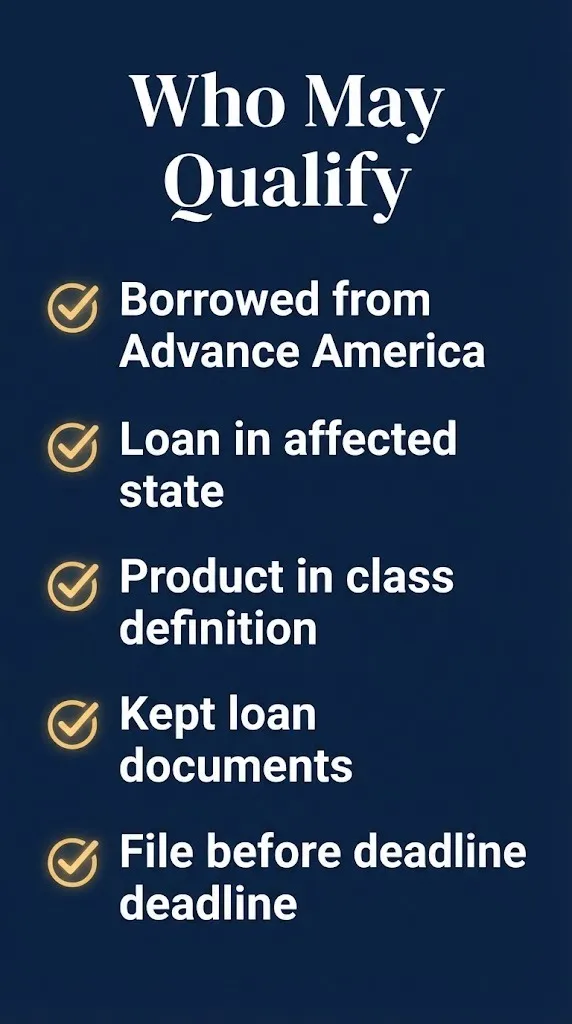
How Do I Check If I Qualify for a Purpose Financial Settlement?
Checking your eligibility starts with finding the specific case. No single database covers all class actions, but you can work through a few reliable steps.
- Find any loan documents from Advance America or Purpose Financial.
- Note the dates you borrowed and the state where you lived.
- Search the court docket for cases matching those details.
- Check the CFPB enforcement page for restitution actions.
- Look for an official settlement website tied to a specific case number.
- Verify the administrator’s name and the claim deadline before filing.
- Avoid any site that charges a fee to check eligibility.
The process is like checking a store return without a receipt. The more details you have about the transaction, the easier it is to confirm whether a policy applies to you.
What Is the Difference Between a Class Action and a Regulatory Settlement?
A class action is a lawsuit filed by private attorneys on behalf of a defined group. The settlement pays class members according to a court-approved plan. A regulatory settlement is an agreement between a company and a government agency, often with restitution paid to affected consumers.
Both can produce payments, but the rules differ. Class actions usually require you to file a claim. Regulatory settlements sometimes use the company’s own records to issue automatic payments, with no claim form needed.
Purpose Financial has faced both types. Some cases resolved through private class actions. Others involved state or federal regulators. The CFPB has ordered restitution in lending cases, and those payments often go out without a claim filing requirement.
If you receive an unexpected check from a Purpose Financial related matter, it may be from a regulatory restitution fund. That money is real and yours to keep. It does not require you to pay anything or provide additional information.
What Happens If I Already Received a Check From a Purpose Financial Settlement?
If you already received a check, the case that generated it has closed or is in distribution. You cannot file a new claim in that matter. The check is yours, and no one can validly ask you to return it unless the administrator made an error.
Some scammers follow settlement announcements and contact people who received checks, claiming an overpayment must be refunded. That is a known fraud pattern. Legitimate administrators do not operate that way.
If you receive a check and are unsure whether it is real, contact the administrator listed on the check or the court directly. Do not call a phone number from an unsolicited text or email about the check.
Key Takeaway: A real settlement check requires nothing from you. Any request for repayment or fees tied to it is fraud.
What Is the Current Status of Purpose Financial Litigation in 2026?
The current status is fragmented. Some older Purpose Financial and Advance America cases have settled and paid. Newer filings continue in various state and federal courts. No single master settlement covers all claims nationwide.
That fragmentation is common in consumer lending litigation. Companies face overlapping suits in different forums. Some claims go to arbitration because loan agreements often contain arbitration clauses that block class actions.
For borrowers, the practical takeaway is that no single deadline or website will cover every potential claim. You have to match your specific loan history to a specific case. That is more work than a single click, but it is also the only honest way to know where you stand.
What Should I Do Right Now If I Think I Am Affected?
Start with your own records. Pull any loan agreements, payment confirmations, and collection notices you still have. Organize them by lender name, date, and state.
Then set a monthly reminder to check the court docket and the CFPB enforcement page for new developments. Class action notices usually arrive by mail or email, but they can miss people who moved or changed addresses.
The single most important habit is documentation. Borrowers who keep records are the ones who receive the highest payouts when settlements do open. Even a simple screenshot of an online payment portal can support a claim later.
What Happens Next
- Expected late 2026: Any active Purpose Financial cases may move toward preliminary approval or dismissal.
- Expected early 2027: If a settlement is reached, a notice and official website will launch.
- Expected mid 2027: Claims window opens, typically for 60 to 120 days.
- Expected late 2027 or later: Payments distribute after final approval and any appeals.
The timeline is a projection, not a confirmed schedule. No dates are posted yet for any current nationwide Purpose Financial settlement. The honest answer is that you must watch the docket, not the ads.
Frequently Asked Questions
Is the Purpose Financial settlement a scam?
The company has faced real lawsuits, but some websites advertising a “Purpose Financial settlement” are not legitimate.
A real settlement will name a court, a case number, and an administrator.
Never pay a fee to file a claim.
How do I know if I qualify for an Advance America settlement?
Qualification depends on the specific case and class definition.
Your loan documents will show the product, dates, and legal entity.
Match those details to a specific court case before assuming you are covered.
How much money will I get from a Purpose Financial lawsuit?
No verified payout exists for any current case.
Prior lending settlements have paid anywhere from under $50 to several hundred dollars.
Documented overpayments usually receive the highest amounts.
Do I need a lawyer to file a claim?
No, you do not need your own lawyer to file a class action claim.
The class attorneys are paid from the settlement fund.
Filing is free and designed for individuals without legal training.
What if I no longer have my loan documents?
You may still file if you can verify your identity and loan details.
Contact the lender or check old bank statements for payment records.
A claim without proof typically receives a lower payout.
Can I get money from both a class action and a CFPB restitution fund?
Yes, in some cases a borrower may receive payments from separate actions covering different claims.
Each matter has its own eligibility rules and deadlines.
Receiving one payment does not automatically disqualify you from another.
When will Purpose Financial settlement checks be mailed?
No check mailing date is confirmed for any current nationwide settlement.
Payments typically go out 12 to 18 months after final approval.
Watch the official settlement website for distribution updates.
The Purpose Financial settlement landscape is real but fragmented. Some cases have paid. Others are still working through court. No single claim form, deadline, or payout applies to everyone who ever borrowed from Advance America.
Your next step is not to click an ad. It is to gather your loan records and check the court docket and the CFPB enforcement page every month. The borrowers who get paid are the ones who verify first and file fast when a real window opens.