Third Party Litigation Funding 2026: The $10 Billion Industry Facing a State-by-State Crackdown, Not a Federal Ban
Quick Answer
- Third party litigation funding is legal in most states, but North Carolina banned most commercial forms in June 2026 and at least 24 states now have some regulation on the books.
- There is no federal settlement fund, payout, or claim deadline for third party litigation funding. It is a financing arrangement, not a class action you join.
- The number that matters most: a funder’s recovery is often capped or negotiated as a share of proceeds, and New Jersey’s pending bill caps it at 25% of litigation proceeds.
Third party litigation funding is an arrangement where a non-party investor pays some or all of a lawsuit’s costs in exchange for a share of any settlement or judgment. It is not a settlement you claim. It is a financing deal between a funder and a party or law firm. The industry is estimated at $10 billion in the United States .
This matters to two groups: plaintiffs who cannot afford to litigate against a better-funded opponent, and defendants who want to know who is bankrolling the case against them. The 2026 regulatory fight is mostly about disclosure, not prohibition, with North Carolina as the loud exception.
This article covers what changed in 2026, the state-by-state rules, the federal disclosure push, how funder fees actually work, and the scam risk that comes with a lightly regulated market. One detail worth knowing upfront: North Carolina’s ban may have backfired on its supporters, because the statute’s narrow language left a carve-out for general working capital to law firms.
The Facts
| Item | Verified Detail |
|---|---|
| U.S. Industry Size | Approximately $10 billion |
| States With TPLF Regulation | At least 24 states, per the American Property Casualty Insurance Association |
| First Statewide Ban | North Carolina, enacted June 2026, with exceptions |
| Federal Bill | Litigation Funding Transparency Act of 2026, S. 3826, introduced February 11, 2026 |
| Federal Rule Status | No uniform federal disclosure rule. Advisory Committee studying a Rule 26 amendment |
| EU Position | No demonstrated need for EU-level legislation as of June 2026 |
| New Jersey Pending Cap | 25% of litigation proceeds, bill passed Assembly 70-4-2 |
Is third party litigation funding legal in 2026?
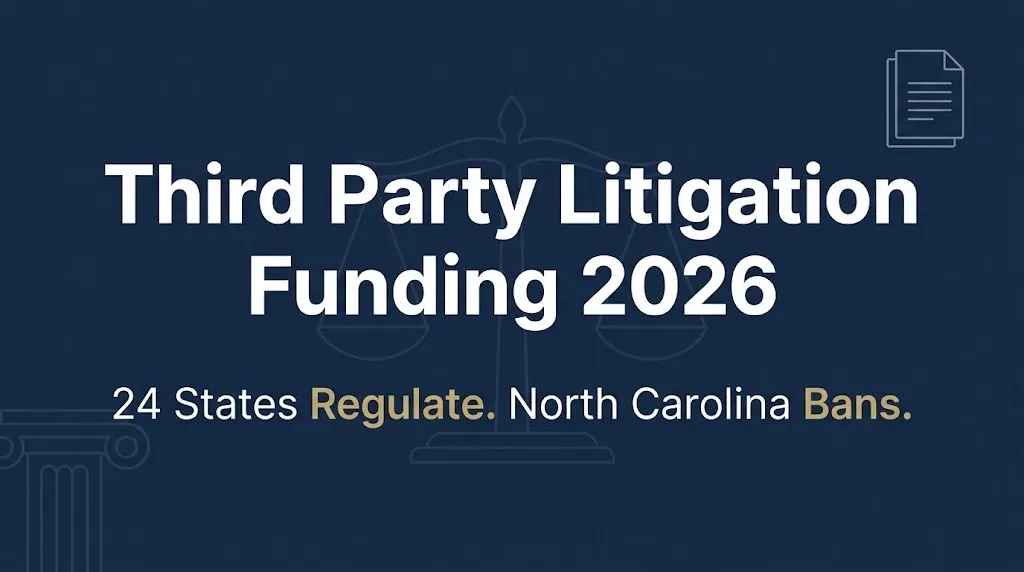
Third party litigation funding is legal in most U.S. states in 2026, but the list of states with restrictions is growing. At least 24 states have regulated some aspect of the practice, according to the American Property Casualty Insurance Association . North Carolina is the only state with a broad statutory ban.
The legal picture depends on where you are. Some states require disclosure of funding agreements. Some make them discoverable. A few, like North Carolina, prohibit the arrangement outright for commercial cases.
Here is the 2026 state split:
| Regulatory Approach | States | What It Means |
|---|---|---|
| Broad ban | North Carolina | Most commercial TPLF prohibited, with exceptions for contingency fees, insurance, and some nonprofits |
| Mandated disclosure | West Virginia, Wisconsin, Kansas, Arizona, Georgia (limited) | Parties must disclose funding arrangements to the court or opposing party |
| Discoverable | Louisiana, Oklahoma, Colorado, Indiana | Funding agreements can be requested in discovery, not automatically disclosed |
| Registration plus disclosure | Ohio, New Hampshire | Funders must register, with post-resolution disclosure or foreign-adversary limits |
North Carolina’s ban passed in June 2026 and voids prohibited funding agreements. Violators face civil penalties of up to $50,000 per violation, plus damages and potential treble damages . The law covers civil actions, arbitrations, mediations, and administrative proceedings, with carve-outs for contingency fee arrangements, insurers’ defense obligations, and certain nonprofit activities.
Key Takeaway: Third party litigation funding is not banned nationwide. It is legal in most states, but North Carolina’s ban and the spread of disclosure rules mean the compliance map changes by jurisdiction.
How much does third party litigation funding cost?
Third party litigation funding costs a share of whatever you recover, not an hourly fee or a fixed loan payment. The exact cost depends on the funder, the risk of the case, and the state’s rules on fee caps. There is no standard national rate.
The industry does not publish a single fee schedule. A funder might take 20% to 40% of a settlement, depending on how much capital was advanced and how long the case took. Some states cap the funder’s share. New Jersey’s pending legislation caps a funder’s recovery at 25% of the litigation proceeds . Montana’s law includes a 25% recovery cap as well .
Here is how the cost structure compares to ordinary financing:
| Feature | Third Party Litigation Funding | Ordinary Loan |
|---|---|---|
| Repayment trigger | Only if you win or settle | Due on a fixed schedule |
| If you lose | Funder may recover nothing (non-recourse) | You still owe the balance |
| Cost basis | Share of proceeds | Interest rate |
| Regulation | State-by-state, patchwork | Banking and lending laws |
The non-recourse feature is the key difference. Consumer legal funding, a subset of the industry, is defined in states like Kansas and California as a non-recourse transaction. If there is no recovery, the consumer owes nothing, absent fraud . That is not the same as a loan, and calling it a high-interest loan leaves out the part where you can owe nothing.
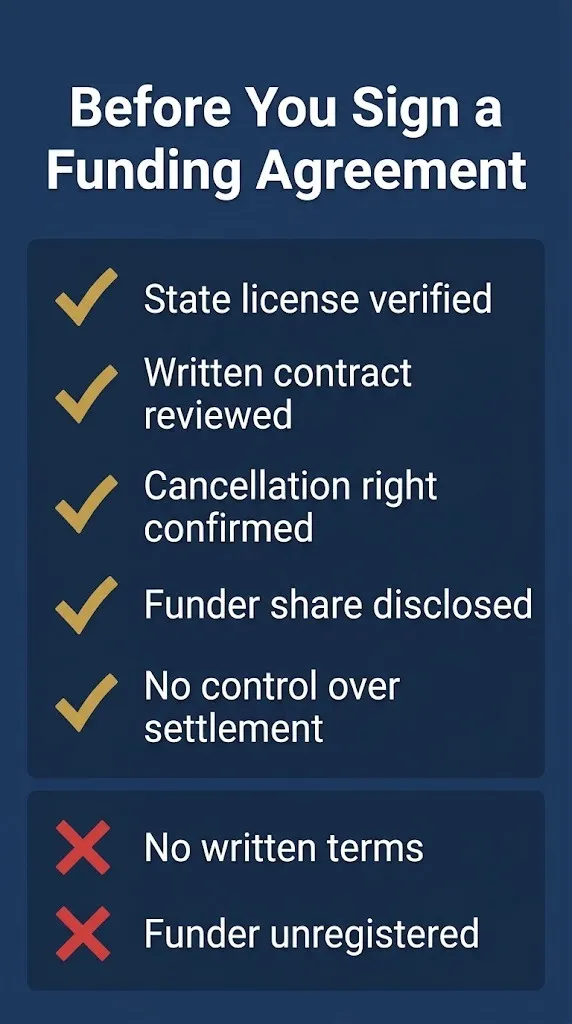
Reality Check: The most dangerous version of this market is not the funder with a published contract. It is the person who approaches you after an accident offering cash now for a share of your case, with no written terms and no state registration. Consumer legal funding is regulated in some states and not others. If someone offers you money against a lawsuit and cannot show you a state license or a compliant contract with a cancellation period, walk away.
Do you have to disclose a third party litigation funding agreement?
You have to disclose a third party litigation funding agreement if your state or court requires it. There is no uniform federal disclosure rule as of October 2026, but several states and individual federal courts have adopted their own requirements.
The federal picture is still a patchwork. The U.S. Chamber of Commerce and Lawyers for Civil Justice have asked the federal Advisory Committee on Civil Rules to amend Rule 26 to require automatic disclosure of funders and funding agreements . The committee is studying the issue. No rule has been adopted.
Some federal courts have moved on their own. The Western District of Louisiana issued Standing Order 1.75 in September 2026, requiring parties to identify funders and their addresses. The order does not require production of the agreement to the opposing party without a court order . The Delaware Superior Court adopted a limited disclosure framework that applies only where funders have contractual control rights .
On the state side, the disclosure models vary widely. Kansas passed a compromise in 2025 that requires plaintiffs to submit funding contracts to a judge for private, in-camera review. The court verifies the funder’s identity and whether it has control rights, but the agreement is not handed to the defendant . New Jersey’s pending bill goes further: it would make funding agreements expressly discoverable without waiting for a request .
Key Takeaway: Disclosure depends on your forum. Some states require it automatically. Some make it discoverable. Federal courts have no uniform rule, though individual districts are adopting their own.
What is the Litigation Funding Transparency Act of 2026?
The Litigation Funding Transparency Act of 2026 is a federal bill that would require disclosure of third party funders in class actions, multidistrict litigation, and certain consolidated proceedings. It was introduced in the Senate on February 11, 2026, as S. 3826 .
The bill would require parties and counsel to disclose in writing to the court and all named parties the identity of any third party funder. It covers class actions, MDL proceedings, and civil actions consolidated before a district court that include at least 100 civil actions .
The definition of third party funder is broad. It covers any commercial enterprise, foreign state, foreign person, or sovereign wealth fund that provides monetary support to a party or law firm in exchange for a right to receive proceeds from the action. It carves out ordinary loans, pro bono nonprofit funding, and counsel of record .
The bill has not passed. It was introduced and referred to committee. No vote is scheduled as of October 2026.
A separate federal bill, the proposed Litigation Funding Transparency Act, is not the same as the rule change the U.S. Chamber is seeking. The Chamber’s proposal would amend the Federal Rules of Civil Procedure, which would apply in all federal courts without congressional action. The bill would only apply to the covered categories of cases.
How does third party litigation funding work in practice?
Third party litigation funding works by transferring the financial risk of a lawsuit from the party to an investor. The funder pays litigation costs, often including attorney fees, expert fees, and court costs, in exchange for a contractual right to a portion of any recovery.
The typical structure has four parts:
- Due diligence: The funder reviews the legal merits, the damages model, the defendant’s ability to pay, and the expected timeline. Most cases are rejected.
- Funding agreement: The contract sets the amount advanced, the funder’s share of proceeds, and the conditions. Most agreements state that the funder cannot control settlement or litigation strategy.
- Advancement of costs: The funder pays as costs come due, often through the law firm.
- Repayment: If the case settles or wins, the funder is repaid from the proceeds according to the agreement. If the case loses, the funder may recover nothing.
The passivity claim is central to the industry’s defense. A group of practitioners told the federal Advisory Committee that passivity is “a central pillar” of the industry, and that control disclaimers are standard terms rarely negotiated . Critics argue that funders exert influence even without formal control rights, because a funder who can decline to advance more money has leverage over strategy.
Key Takeaway: A funder pays costs and gets repaid from proceeds if you win. The contract’s control terms matter more than the marketing language about passivity.
What is the scam risk in third party litigation funding?
The scam risk in third party litigation funding comes from unregulated consumer-facing advances, not from the institutional funders who finance commercial litigation. The consumer side of the market is where the regulatory gaps are widest.
The Solicitors Regulation Authority in the United Kingdom identified specific harms in 2026. Some funders may lack the expertise to assess consumer claims. Some made funding commitments without the capital to meet them. Some may be used by criminals to disguise proceeds of crime or evade sanctions . The SRA closed seven law firms and has 94 open investigations relating to 68 firms managing high-volume consumer claims .
Those are UK findings, not U.S. court rulings. But the structural risk is the same anywhere: a consumer who needs cash during a pending case is a vulnerable counterparty. The SRA’s response includes a proposal to require law firms to provide clients with a prominent funding information document before signing a funding agreement, and to notify the regulator when they use or arrange funding for consumer claims .
In the U.S., state regulation varies. Kansas requires contracts to clearly disclose the funded amount, all charges, how charges accrue, a payment schedule, and the maximum total the consumer may owe. It also provides a 10-business-day right to cancel . New York has similar disclosure and rescission requirements. States without those rules leave consumers with fewer protections.
What happens next in the third party litigation funding fight?
Here is the timeline of expected stages:
- October 2026: The federal Advisory Committee on Civil Rules continues studying the proposed Rule 26 amendment. No vote is scheduled.
- Expected late 2026 or 2027: The New Jersey Senate considers the Assembly-passed disclosure and cap bill. If enacted, New Jersey would join the disclosure states with a 25% recovery cap.
- Ongoing: At least 24 states have regulated TPLF. More state bills are expected in Florida, Missouri, Iowa, Michigan, and Washington .
- June 2028: The European Commission will evaluate the Representative Actions Directive, which contains provisions on TPLF in consumer collective redress. That review could reopen the EU-level debate .
- No date set: The U.S. Senate has not scheduled a vote on the Litigation Funding Transparency Act of 2026.
Frequently Asked Questions
Is third party litigation funding legal?
It is legal in most U.S. states, but at least 24 states regulate it and North Carolina broadly prohibits commercial forms. Check your state’s rules before signing a funding agreement.
How much does a litigation funder take from a settlement?
There is no standard national rate. Funders negotiate a share of proceeds, and some states cap the share. New Jersey’s pending bill would cap it at 25% of litigation proceeds. Read your contract for the specific number.
Do I have to tell the court I have a litigation funder?
It depends on your state and court. Some states require automatic disclosure. Some make the agreement discoverable. Federal courts have no uniform rule, though individual districts like the Western District of Louisiana have adopted their own requirements.
Is third party litigation funding the same as a lawsuit loan?
No. Consumer legal funding is non-recourse in states like Kansas and California, meaning you owe nothing if you lose. A lawsuit loan may be recourse, meaning you owe the balance regardless of outcome. Read the contract carefully.
What is the Litigation Funding Transparency Act of 2026?
It is a Senate bill, S. 3826, that would require disclosure of third party funders in class actions and multidistrict litigation. It was introduced in February 2026 and has not passed.
Can a litigation funder control my settlement?
Most funding agreements state that the funder cannot control settlement decisions or litigation strategy. But a funder who can decline to advance more money has leverage. Read the control terms in your contract, not the marketing language.
Is the EU going to regulate third party litigation funding?
Not at the EU level, as of June 2026. The European Commission said its 2025 study did not identify irregularities requiring legislative action, and the High-Level Forum on Justice for Growth agreed there is no demonstrated need for EU-level legislation .
What is the biggest risk of third party litigation funding?
For consumers, the biggest risk is signing an agreement with unclear terms, no cancellation right, or a funder who is not registered or capitalized. For defendants, the biggest risk is not knowing who is funding the case against them.
The regulatory map changes by state, not by headline. North Carolina banned most commercial funding, but the ban’s narrow language left room for working capital arrangements. At least 24 states regulate some aspect of the industry, and the federal rule remains unadopted. If you are considering a funding agreement, read the contract for the funder’s share, the control terms, and your cancellation right before you sign.