VA Special Monthly Compensation 2026: Rates, Eligibility, and How to Apply
Quick Answer:
- VA Special Monthly Compensation is a real, tax-free monthly VA benefit added on top of standard disability pay.
- Monthly amounts range from roughly $132 to more than $10,000 depending on the SMC category awarded.
- There is no claim deadline; veterans and eligible dependents can apply at any time through the VA.
If you searched “VA special monthly compensation” because you saw something online promising a payout, a class action check, or a new government program, know this right now: SMC is none of those things. It is a long-standing VA benefit. It has existed in some form for decades. It is not a lawsuit. It is not a one-time settlement. It is a monthly addition to your VA disability compensation, and many veterans who qualify are not receiving it.
That last fact is the one that matters most. The VA does not automatically add SMC when you become eligible. You or your representative must request it. This article covers how SMC works in 2026, what the current rates are, which conditions qualify, how to file, and why so many veterans leave this money unclaimed. One verified detail: roughly 15 to 20 percent of veterans rated 100 percent disabled are also eligible for at least one SMC level, according to VA data and veterans’ advocacy groups, but far fewer actually receive it.
The Facts
| Case | Not a lawsuit; an ongoing VA benefit program |
| Status | Active and paying monthly as of 2026 |
| Fund Size | No single fund; paid from annual VA appropriations |
| Est. Per Person | $132 to $10,000+ per month depending on SMC level |
| Claim Deadline | No deadline; applications accepted at any time |
| Administrator | U.S. Department of Veterans Affairs |
| Proof Needed | Medical records, VA rating decision, evidence of specific disabilities or loss of use |
Is VA Special Monthly Compensation Real or a Scam
VA Special Monthly Compensation is real. It is a statutory benefit codified in Title 38 of the U.S. Code. The VA pays it every month to veterans who meet specific disability thresholds beyond the standard rating schedule. It is not a scam, not a limited-time offer, and not something you need to pay a third party to file for.
The confusion comes from how SMC shows up online. Some websites and social media ads frame it as a “secret VA benefit” or a “little-known payout.” That language is marketing, not fact. SMC is not secret. It is listed on the VA’s own website, in the VA’s adjudication manual (M21-1), and in federal law. The real issue is that the VA does a poor job of notifying veterans when they qualify, especially for higher levels of SMC that depend on specific combinations of disabilities.

Scams around SMC are rare, but they exist. You will see ads from unaccredited claims consultants or companies offering to “unlock hidden VA payouts” for a fee. Some charge thousands of dollars to file paperwork you can file yourself or with a VA-accredited Veterans Service Officer at no cost. The VA accredits VSOs through its Office of General Counsel. You can verify any representative’s accreditation through the VA’s search tool. If someone asks for an upfront fee to get you SMC, walk away.
What Is VA Special Monthly Compensation (SMC)
VA Special Monthly Compensation is an additional tax-free payment the VA adds to a veteran’s monthly disability compensation when certain severe disabilities or combinations of disabilities exist. It is not a replacement for your standard VA rating. It sits on top of it. Think of SMC as the VA’s acknowledgment that some disabilities cost more than the rating schedule alone can account for, either because of lost anatomical function, the need for daily assistance, or the sheer severity of the impairment.
The statutory purpose of SMC is to compensate veterans for non-economic losses that the percentage rating system does not capture. The rating schedule compensates for lost earning capacity. SMC compensates for things like the loss of an eye, the loss of use of a limb, the need for another person to help you with daily activities, or being housebound due to service-connected conditions.
SMC is organized into categories identified by letters and sometimes numbers: SMC-K, SMC-S, SMC-L through SMC-N, SMC-O, SMC-P, SMC-R, and SMC-T. Each letter corresponds to a specific set of qualifying disabilities or circumstances. The amounts vary. SMC-K, the most common, adds a modest sum each month for loss of use of a creative organ, loss of a hand or foot, or loss of vision in one eye. SMC-R, the highest level, pays over $10,000 per month and requires such severe disability that the veteran needs regular aid and attendance from another person.
Key Takeaway: SMC is not a separate claim; it is additional compensation added to your monthly VA payment when your disabilities meet specific legal thresholds beyond your rating percentage.
What Qualifies for VA Special Monthly Compensation
Qualifying for VA Special Monthly Compensation depends on the specific SMC category. The VA awards SMC based on the medical evidence in your file, your VA rating decision, and sometimes a specific application. The VA is supposed to consider SMC whenever the evidence suggests you might qualify, even without a separate claim. In practice, the VA often misses this. That is why requesting it explicitly matters.
The most common SMC categories and their general requirements are listed below, based on the statutory criteria in 38 U.S.C. Section 1114 and the VA’s M21-1 adjudication manual.
| SMC Level | What It Requires | 2026 Approximate Monthly Add-On |
|---|---|---|
| SMC-K | Loss of use of one hand, one foot, one eye, or a creative organ; or deafness in both ears | $132 to $140 |
| SMC-S | One disability rated 100 percent, plus another separate disability rated 60 percent or more; or being housebound | $4,200 to $4,500 (replaces standard 100% rate) |
| SMC-L | Needing regular aid and attendance from another person; or being bedridden; or anatomical loss of both feet, one hand and one foot, or blindness in both eyes | $4,900 to $5,300 |
| SMC-L 1/2 | SMC-L plus an additional 50 percent disability from another condition | $5,500 to $5,900 |
| SMC-M | SMC-L plus an additional 100 percent disability from another condition; or specific anatomical losses | $6,000 to $6,500 |
| SMC-M 1/2 | SMC-M plus an additional 50 percent disability | $6,500 to $7,000 |
| SMC-N | SMC-L plus additional disabilities totaling 100 percent; or specific severe anatomical losses | $6,800 to $7,400 |
| SMC-N 1/2 | SMC-N plus an additional 50 percent disability | $7,400 to $7,900 |
| SMC-O | SMC-L plus additional disabilities totaling 100 percent under specific combinations; or triple amputee | $7,800 to $8,400 |
| SMC-P | Specific severe combinations, such as SMC-O with additional 50 percent disability | $8,400 to $9,000 |
| SMC-R | Requires regular aid and attendance plus specific extreme disability combinations | $10,000+ |
| SMC-T | Traumatic brain injury requiring regular aid and attendance for residuals of TBI | $10,000+ |
These amounts are monthly additions or replacements for the standard VA rate. They are adjusted annually for cost of living. The 2026 rates reflect the December 2025 COLA increase. Verify the exact dollar figure on the VA’s current compensation rate table because these numbers shift slightly each year.
Special Monthly Compensation Rates for 2026
The 2026 special monthly compensation rates increased from 2025 levels due to the annual cost-of-living adjustment, or COLA, which the Social Security Administration announces each October and the VA applies starting in December for the following year. The 2026 COLA increase was approximately 2.5 percent, matching the Social Security COLA announced in October 2025.
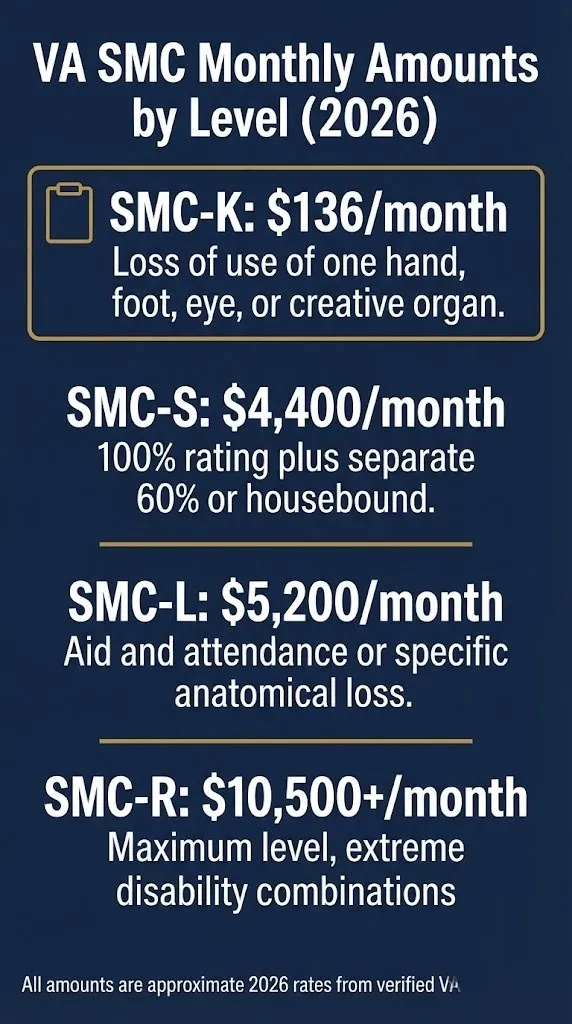
A veteran with no dependents at the SMC-L rate receives roughly $5,200 per month in 2026. A veteran at the SMC-S rate receives roughly $4,400 per month. A veteran who only qualifies for SMC-K, which is an add-on to whatever rating they already have, receives roughly $136 extra per month. Veterans with dependents, a spouse, children, or dependent parents, receive higher amounts at each SMC level. The difference can be several hundred dollars per month.
The VA publishes an official rate table each year. The table breaks down every SMC level by dependent status. If you are rated 100 percent and also receive SMC-S, you do not get your 100 percent rate plus SMC-S. SMC-S replaces the 100 percent rate at a higher amount. SMC-K is different. It adds to whatever you already receive. A veteran rated 70 percent who also qualifies for SMC-K gets the 70 percent rate plus the SMC-K add-on. Understanding which SMC levels replace versus add on is critical to knowing whether you are being paid correctly.
The highest possible SMC payment in 2026, SMC-R with dependents, exceeds $10,500 per month. This is reserved for veterans with the most catastrophic combinations of disabilities, such as loss of both arms and both legs, or blindness plus loss of a limb requiring regular aid and attendance.
Key Takeaway: SMC rates in 2026 range from about $136 for SMC-K to over $10,500 for SMC-R with dependents, with the exact figure depending on the SMC level, marital status, and number of dependents.
Reality Check: The VA Does Not Automatically Add SMC
The most expensive mistake a veteran can make is assuming the VA will catch SMC eligibility on its own. The VA has a legal duty to consider SMC when the evidence supports it. VA adjudicators are supposed to infer SMC claims from the medical record. In reality, the VA regularly misses SMC, especially SMC-S when a veteran has one condition rated 100 percent and a separate condition rated 60 percent or more. If you think you qualify, file the claim. Do not wait for the VA to figure it out.
What Is SMC-K and Who Gets It
SMC-K is the most common and most frequently overlooked level of special monthly compensation. It pays an additional monthly amount, roughly $136 in 2026, for the loss of use of a specific body part or function. The statute lists exactly what qualifies: loss of a hand, loss of a foot, loss of vision in one eye, loss of use of a creative organ, deafness in both ears, loss of use of one buttock, and a few other specific anatomical losses.
The key word is loss of use. You do not need to have the body part amputated. If you have a foot or hand that is so disabled from service-connected conditions that it is functionally useless, you may qualify for SMC-K. The VA defines loss of use of a hand as no effective function remaining beyond the ability to grasp and release. For a foot, it means no effective function beyond balance and propulsion. A creative organ means the physical inability to achieve an erection or, for female veterans, the loss of sexual function due to a service-connected condition.
SMC-K is an add-on. It does not replace your current rating. If you are rated 50 percent and qualify for SMC-K, you receive the 50 percent rate plus roughly $136. This is different from higher SMC levels that replace the standard rate.
Many veterans miss SMC-K because they do not realize their condition qualifies. Erectile dysfunction secondary to diabetes or PTSD medications is a common example. If you take SSRIs or blood pressure medications for service-connected conditions and develop erectile dysfunction as a result, you may qualify for SMC-K. The same goes for loss of sensation or function in a limb rated for radiculopathy. The VA will not add this payment unless the evidence clearly shows loss of use, and you or your representative may need to point that evidence out explicitly.
What Is Purple Heart Monthly Compensation
Purple Heart monthly compensation is a misconception. The Purple Heart medal itself does not carry a separate monthly payment. The VA pays disability compensation based on the disabling condition, not the medal. A veteran who received a Purple Heart and has a service-connected disability from the same incident receives standard VA compensation just like any other veteran with that disability rating.
What confuses people is that Purple Heart recipients receive certain priority benefits within the VA system. They get Priority Group 3 for VA healthcare, which means lower copays and easier access to care. They may also qualify for state-level benefits: property tax exemptions, vehicle registration fee waivers, free hunting and fishing licenses, and educational benefits for dependents. Those vary by state. There is no federal “Purple Heart check.”
If you see an ad or a post claiming that Purple Heart recipients get a monthly payment just for having the medal, it is wrong. The payment comes from the underlying service-connected condition. The Purple Heart is evidence that the condition was incurred in combat, which helps with service connection, but the money still comes from the disability rating and any applicable SMC.
Some states do offer a one-time bonus or annuity for combat-wounded veterans. Those are state programs, not VA programs. Check your state’s veterans affairs office to see if one exists where you live. Examples include the Alaska Veterans Bonus and certain annuity programs in states like New Jersey for veterans with specific combat-related disabilities.
How to Apply for VA Special Monthly Compensation
Applying for VA Special Monthly Compensation starts with identifying which SMC level you believe you qualify for, gathering the medical evidence that proves it, and submitting a claim to the VA. You do not need a lawyer, though many veterans use a VA-accredited Veterans Service Officer, claims agent, or attorney, especially for higher SMC levels that the VA is more likely to dispute.
- Review your current VA rating decision and medical records. Identify the specific disabilities that may qualify you for SMC.
- Determine which SMC level fits. SMC-K for loss of use, SMC-S for housebound or 100-percent-plus-60, SMC-L for aid and attendance, and so on.
- Gather the evidence. For SMC-K, you need a doctor’s statement or medical record showing loss of use. For SMC-L, you need evidence that you require regular aid and attendance from another person.
- Complete VA Form 21-526EZ, the application for disability compensation. You can file SMC as part of a new claim, an increased rating claim, or as a standalone claim if you already have the underlying rating.
- Write a short statement explaining which SMC you are seeking and why. Reference the specific body parts, conditions, and medical evidence.
- Submit the form through the VA’s online portal at VA.gov, by mail, or through a VSO.
- If the VA denies SMC, you can appeal through the Higher-Level Review, Supplemental Claim, or Board of Veterans’ Appeals process. Deadlines for appeals are typically one year from the date of the denial letter.
The VA’s average processing time for compensation claims as of mid-2026 is approximately 125 to 150 days, according to the VA’s own published workload data. SMC claims do not necessarily take longer than standard claims. But if the VA needs a compensation and pension exam to evaluate loss of use or aid and attendance needs, that adds time.
Key Takeaway: Apply for SMC through the same VA Form 21-526EZ used for standard compensation claims, and include specific medical evidence showing loss of use or need for aid and attendance.
Special Monthly Compensation for Aid and Attendance
SMC for aid and attendance, designated as SMC-L or higher, is the VA’s recognition that some veterans cannot manage daily life without help from another person. It pays a substantially higher monthly rate. In 2026, SMC-L starts at roughly $5,200 per month for a single veteran, compared to roughly $4,000 for a standard 100 percent rating.
Aid and attendance means you need help with activities of daily living: bathing, dressing, eating, toileting, or adjusting prosthetic devices. It can also mean you are bedridden, blind in both eyes, or have a severe cognitive impairment that requires supervision to prevent harm. The need does not have to be constant. If you need help at least some of the time with these tasks, you may still qualify.
The VA awards aid and attendance at two levels. The regular level, which triggers SMC-L, requires that you need the aid and attendance of another person. The higher level, which triggers SMC-R1 or SMC-R2, requires a higher degree of care, often described as needing skilled nursing-level care or constant supervision. The distinction matters because the payment difference is thousands of dollars per month.
Evidence for aid and attendance can come from your treating doctor, a VA compensation and pension examiner, or a caregiver statement. The VA looks for documentation that you cannot perform specific daily activities independently. A statement from a spouse or caregiver describing what they do for you each day, combined with a doctor’s note confirming the need, is persuasive.
Aid and attendance SMC is also available to veterans in nursing homes, assisted living facilities, or receiving in-home care through the VA’s Caregiver Support Program. If you pay for in-home care out of pocket, the SMC can help offset those costs. It is not income-restricted. Your other income does not affect eligibility, because SMC is compensation for disability, not a pension.
How to Check Your VA Special Monthly Compensation Status
Checking your VA special monthly compensation status uses the same tools as any other VA claim. The fastest method is the VA’s online portal at VA.gov. Log into your account, navigate to the “Claim Status” section, and find the claim that includes your SMC request. The portal shows the current stage, expected completion date, and any actions the VA is waiting on from you.
If you prefer phone, call the VA at 800-827-1000. Wait times vary, but the automated system can tell you claim status without speaking to a representative. For detailed questions, ask for a claims specialist.
If you already receive SMC and want to confirm you are being paid at the correct rate, check your VA benefits letter. VA.gov lets you download a current benefits summary letter showing your monthly payment, rating, and any SMC add-ons. Compare the amount on that letter to the VA’s published rate table for 2026. If the numbers do not match, or if you believe an SMC level is missing, file a claim or contact a VSO.
A VSO can also check your claim file directly through the VA’s electronic system. Accredited VSOs from organizations like Disabled American Veterans, the American Legion, and Veterans of Foreign Wars have read-only access to VA claim files and can tell you exactly what SMC, if any, is being paid and why.
What Happens Next
If you think you may qualify for SMC but have not yet applied, here is the expected path forward.
- Immediately: Download your current VA benefits letter from VA.gov and identify your rated conditions and percentages.
- Within 30 Days: Gather medical records that document loss of use, need for aid and attendance, or the specific anatomical losses that qualify for SMC-K through SMC-T.
- Within 60 Days: Meet with a VA-accredited VSO, claims agent, or attorney to review your file and determine which SMC level you should pursue.
- Within 90 Days: File VA Form 21-526EZ with the supporting evidence.
- 4 to 6 Months After Filing: Expect a VA decision. If denied, file an appeal within one year.
- If Approved: The VA pays retroactively to the date of claim, or in some cases to the date eligibility arose if the claim was filed within a year of that date.
Frequently Asked Questions
Is VA Special Monthly Compensation taxable
No, VA Special Monthly Compensation is completely tax-free at both federal and state levels.
This applies to all SMC levels, just like standard VA disability compensation.
You do not report SMC as income on your tax return.
Can I receive SMC and VA disability at the same time
Yes, SMC is paid in addition to or in place of your standard VA disability payment.
Some SMC levels, like SMC-K, are add-ons that stack on top of your rating.
Other levels, like SMC-S and SMC-L, replace your standard 100 percent rate with a higher amount.
Does SMC affect my Social Security or other benefits
No, SMC does not reduce Social Security Disability Insurance or Supplemental Security Income payments.
VA disability compensation and SMC are not counted as income for SSDI.
SMC also does not affect VA pension, but you generally cannot receive both SMC and pension for the same period.
Can I get SMC back pay if the VA grants it later
Yes, the VA typically pays SMC retroactively to the effective date of the claim.
If the VA should have awarded SMC earlier based on evidence already in your file, you may be entitled to an earlier effective date.
This is common in cases where the VA failed to consider SMC when it granted the underlying rating.
Do I need a doctor to certify loss of use for SMC-K
Yes, the VA requires medical evidence showing loss of use of the specific body part.
This can come from a VA compensation and pension exam, a private doctor’s statement, or hospital records.
The evidence must describe the functional loss, not just the diagnosis.
Is SMC-S automatic when one rating is 100 percent and another is 60 percent
No, SMC-S is not automatic even when the rating percentages mathematically qualify.
You must file a claim or the VA must explicitly consider it.
Many veterans with TDIU plus a separate 60 percent rating also qualify but are not paid SMC-S unless they request it.
Can my spouse receive SMC after I die
No, SMC stops upon the veteran’s death.
However, surviving spouses may be eligible for Dependency and Indemnity Compensation, or DIC, which is a separate monthly benefit.
Aid and attendance benefits are also available for surviving spouses who need daily care.
Does SMC-T for traumatic brain injury require permanent need for help
SMC-T requires that the veteran needs regular aid and attendance due to residuals of a service-connected traumatic brain injury.
The need does not have to be permanent, but it must be ongoing and documented.
Even if the veteran does not need help with physical tasks, the need for supervision due to cognitive impairment may qualify.
VA Special Monthly Compensation is not a secret, not a lawsuit payout, and not something anyone should charge you an upfront fee to access. It is money the law says you are owed if your disabilities reach certain thresholds. The VA will not go out of its way to put it in your pocket. Check your rating decision. Check your benefits letter. If you see a 100 percent rating plus a separate 60, or loss of use of a body part, or a need for help with daily living, call a VSO and ask whether SMC is already being paid. If it is not, file.
Download your VA benefits letter today. Compare your monthly payment to the 2026 SMC rate table. If the numbers do not add up, you may be owed money.