Harvard Pilgrim Data Incident Settlement: 2026 Claim Deadlines, Payout Amounts, and Case Status
Quick Answer
- The Harvard Pilgrim data incident settlement is real and has received final court approval.
- Eligible class members may claim up to $5,000 for documented out-of-pocket losses, with smaller flat payments available.
- The claim filing deadline is April 15, 2026.
The Harvard Pilgrim data incident settlement is not a rumor. It is a court-approved class action settlement resolving claims that Harvard Pilgrim Health Care failed to protect sensitive member data during a ransomware attack.
The case affects an estimated 2.5 million current and former Harvard Pilgrim members whose personal information, including Social Security numbers and health data, was exposed or stolen. The settlement fund totals $16 million, and the administrator is now accepting claims through April 15, 2026.
This article covers who qualifies, how much you may receive, what documentation you need, and how the payout process works. One verified detail that surprises most people: even without proof of financial loss, you can still file a claim for a flat cash payment.
The Facts
| Category | Details |
|---|---|
| Case | In re: Harvard Pilgrim Health Care Data Incident Litigation |
| Status | Final approval granted, claims open |
| Fund Size | $16,000,000 |
| Est. Per Person | $50 to $5,000 depending on claim type |
| Claim Deadline | April 15, 2026 |
| Administrator | Kroll Settlement Administration |
| Proof Needed | Varies by claim tier, see below |
Is the Harvard Pilgrim Data Incident Settlement Legitimate?
The Harvard Pilgrim data incident settlement is legitimate. It is a court-approved class action settlement, not a solicitation or a scam.
Final approval was granted by the U.S. District Court for the District of Massachusetts. The settlement resolves a consolidated class action lawsuit filed after a 2023 ransomware attack on Harvard Pilgrim Health Care’s systems.
The attack exposed or compromised data belonging to current and former members. The lawsuit claimed Harvard Pilgrim failed to implement reasonable security measures to protect that data.
The settlement administrator, Kroll Settlement Administration, is one of the largest and most established claims administrators in the country. Official notices are being sent by mail and email to identified class members.
If you received a notice with a unique claim ID, the notice is genuine. If you did not receive a notice but believe you are a class member, you can still file a claim through the official settlement website.
Key Takeaway: The Harvard Pilgrim settlement is real, court-approved, and managed by a major administrator. Filing is free and does not require a lawyer.
How Much Money Can You Get From the Harvard Pilgrim Settlement?
Payout amounts in the Harvard Pilgrim data incident settlement depend on which claim tier you file under and what documentation you provide.
The settlement divides claims into four main categories. The highest payouts go to people who can document actual financial losses caused by the data incident. The lowest go to people filing for the flat cash payment without documented losses.
| Claim Tier | Maximum Payout | Documentation Required |
|---|---|---|
| Documented out-of-pocket losses | Up to $5,000 | Receipts, bank statements, invoices |
| Lost time | Up to $500 | Written description, hours spent |
| California statutory damages | Up to $750 | California residency proof |
| Flat cash payment | $50 | No documentation required |
The $16 million fund is not unlimited. If approved claims exceed the fund, payments will be reduced pro rata. That means every claimant receives a proportional share rather than the full listed amount.
This is how class action settlements work. Think of it like a restaurant splitting one check among a large group. The total is fixed. The more people at the table, the smaller each share.
What Documentation Do You Need to File a Claim?
The documentation required depends on which claim type you select. The flat cash payment requires no documentation at all. The documented loss claim requires the most.
For the documented out-of-pocket loss claim, you need:
- Receipts for credit monitoring services you purchased after the incident.
- Bank or credit card statements showing fraudulent charges you incurred.
- Invoices from identity restoration services.
- Letters from financial institutions confirming account takeover.
- Receipts for notary fees, postage, or long-distance calls related to the incident.
For the lost time claim, you need a written description of the hours you spent dealing with the incident, including what you did and when.
For the California statutory damages claim, you need proof of California residency during the relevant period.
If you cannot find every receipt, file anyway with what you have. The administrator may contact you for missing information, and partial documentation can still support a partial award.
How Do You File a Harvard Pilgrim Settlement Claim?
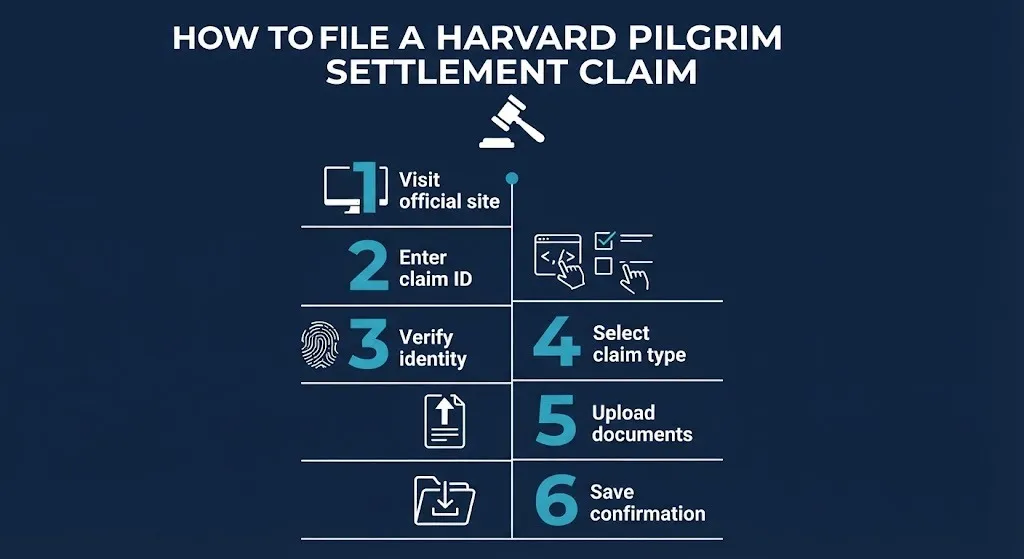
Filing a claim in the Harvard Pilgrim data incident settlement takes under 15 minutes if you have your notice and any supporting documents ready.
Here are the steps to file:
- Go to the official settlement website operated by Kroll Settlement Administration.
- Enter the unique claim ID from your notice, or click the option to file without a notice.
- Verify your identity by providing your name, address, and the last four digits of your Social Security number.
- Select your claim type: documented loss, lost time, California statutory, or flat payment.
- Upload any required supporting documentation as PDF or image files.
- Review your claim for accuracy before submitting.
- Save or print your confirmation page for your records.
- Note the confirmation number in case you need to contact the administrator.
The deadline to file online or postmark a mailed claim is April 15, 2026. Claims filed after that date will be rejected.
Key Takeaway: You can file the full claim online in 15 minutes. Gather your documents first, and do not wait until the deadline week when administrator sites get slow.
What Happened in the Harvard Pilgrim Data Incident?
The Harvard Pilgrim data incident traces back to a ransomware attack discovered in April 2023. The attack targeted the health insurer’s network and may have exposed sensitive member information.
Harvard Pilgrim Health Care confirmed the breach in May 2023. The compromised data potentially included names, addresses, dates of birth, Social Security numbers, health plan member IDs, and in some cases, clinical information.
The lawsuit that followed claimed Harvard Pilgrim failed to maintain adequate security controls. The complaint cited the absence of proper encryption, outdated systems, and insufficient monitoring.
Harvard Pilgrim denied any wrongdoing. The company said it responded promptly and offered free credit monitoring to affected members.
The settlement does not mean Harvard Pilgrim admitted fault. It means both sides agreed to resolve the case to avoid the cost and uncertainty of trial.
The incident affected members in Massachusetts, New Hampshire, Maine, and Connecticut, where Harvard Pilgrim operates.
Who Qualifies for the Harvard Pilgrim Settlement?
Class membership is defined by the settlement agreement, not by whether you received a notice.
You may qualify if you are a current or former Harvard Pilgrim Health Care member who was notified by the company that your personal information was potentially compromised in the April 2023 ransomware incident.
The class includes approximately 2.5 million people. Notices were sent to all identified class members using the most recent contact information Harvard Pilgrim had on file.
If you moved and did not update your address with Harvard Pilgrim, you may not have received a notice. You can still file a claim if you believe you are a class member.
To verify your eligibility, visit the official settlement website and search for your name or enter your notice ID. If you are not listed but believe you should be, contact the administrator directly.
Reality Check: No one from the settlement will call, text, or email you asking for payment to process your claim. Filing is free. Anyone who asks for money in exchange for settlement access is running a scam.
When Will Harvard Pilgrim Settlement Checks Be Mailed?
No checks have been mailed yet. The claim filing period remains open through April 15, 2026.
Here is the verified or expected payment timeline:
| Milestone | Date | Status |
|---|---|---|
| Final approval hearing | November 2025 | Complete |
| Claim filing deadline | April 15, 2026 | Open |
| Claim review period | April to September 2026 | Expected |
| Court approval of distributions | October 2026 | Expected |
| Checks mailed | November to December 2026 | Expected |
These later dates are estimates, not guarantees. The court must approve the final distribution plan after all claims are counted and verified.
If the number of claims is high, the review period could extend. If the number is low, payments could go out sooner.
The important point is that no payment will arrive before the claim deadline. Anyone promising early payment is not connected to the real settlement.
Can You Still File a Claim If You Missed the Deadline?
No. Claims filed after April 15, 2026, will be rejected. Class action settlement deadlines are strict.
The court sets deadlines in the final approval order. The administrator has no authority to accept late claims except in rare cases of documented mail failure or administrator error.
If you miss the deadline, you also lose your right to sue Harvard Pilgrim separately over the data incident. The settlement releases the company from all claims covered by the class definition.
This is the hard reality of class actions. It is like a store return without a receipt after 90 days. The policy is the policy.
The one exception: if you submitted a claim before the deadline and it was rejected for a fixable reason, you may have a short window to correct it. Watch for correspondence from Kroll Settlement Administration after the deadline.
What Is the Difference Between the Flat Payment and Documented Loss Claims?
The flat payment claim and the documented loss claim are different tiers with different requirements and different maximum payouts.
The flat payment is $50. It requires no documentation. You simply attest that you were a class member and select the flat payment option.
The documented loss claim pays up to $5,000. It requires receipts, bank statements, or other evidence showing actual financial harm from the data incident.
Most class members file the flat payment because it is simple and requires no proof. The tradeoff is a smaller payout.
The documented loss claim is worth filing if you spent money on credit monitoring, incurred fraudulent charges, or paid for identity restoration. Even partial documentation can support a partial award.
You cannot file both the flat payment and the documented loss claim. You must choose one. If you choose the documented loss claim and your documentation is rejected, you will not automatically receive the flat payment unless the administrator allows a correction.
How Does the Harvard Pilgrim Settlement Compare to Other Data Breach Settlements?
The Harvard Pilgrim settlement is mid-sized compared to other health data breach settlements in recent years.
The $16 million fund breaks down to roughly $6.40 per class member if everyone filed. That sounds small, but most people never file. Payouts are usually much higher per claimant because participation rates in data breach settlements rarely exceed 10 percent.
For comparison, the Anthem data breach settlement was $115 million. The Equifax settlement was $425 million. The Premera Blue Cross settlement was $74 million.
The Harvard Pilgrim fund is smaller because the company is smaller and the breach affected fewer people. The per-person economics are comparable to similar regional health insurer settlements.
The flat $50 payment is higher than the typical flat payment in data breach cases, which often ranges from $25 to $40.
Key Takeaway: The flat payment is straightforward and worth filing. The documented loss claim matters if you actually spent money. The deadlines are strict, and payment timing depends on claim volume.
What Are the Tax Implications of a Harvard Pilgrim Settlement Payment?
Settlement payments from a data breach case are generally not taxable as income if they reimburse actual financial losses.
The IRS treats compensation for lost or damaged property, or reimbursement for expenses you paid, as a return of your own money, not income. That means the documented loss portion of your settlement is typically not taxable.
The flat $50 payment is also unlikely to be taxable. It is compensation for a potential harm, not wages or business income.
Lost time payments occupy a gray area. If you claim lost time, the payment technically compensates for your labor. Some tax professionals treat it as taxable. The amount is small, and the IRS is unlikely to scrutinize a $50 to $500 payment from a class action.
You should not rely on this article for tax advice. If you receive a large documented loss payment, consult a tax preparer. The administrator may issue a Form 1099 for payments over $600, but that is not confirmed for this case.
What Happens Next in the Harvard Pilgrim Settlement?
The remaining steps in the Harvard Pilgrim data incident settlement follow a defined timeline. Here is what comes next.
February to April 2026: Claim filing continues. The administrator processes incoming claims and responds to requests for missing documentation.
April 15, 2026: Claim filing deadline. All online submissions must be complete and all mailed claims must be postmarked by this date.
May to September 2026: The administrator reviews all claims, verifies documentation, and calculates the total approved claim amounts.
October 2026: Expected court approval of the final distribution plan. The court confirms the pro rata allocation if claims exceed the fund.
November to December 2026: Expected check mailing window. Payments are distributed by check or electronic transfer based on the claim type and amount.
These dates are estimates after April 15. The court controls the final schedule, and delays are common in large class actions.
Frequently Asked Questions
Is the Harvard Pilgrim data incident settlement real?
Yes. The settlement received final court approval in November 2025 and is now accepting claims through Kroll Settlement Administration.
How much will I get from the Harvard Pilgrim settlement?
The flat payment is $50. Documented loss claims pay up to $5,000. Actual amounts depend on total claims filed.
Do I need a lawyer to file a Harvard Pilgrim settlement claim?
No. You can file directly through the official settlement website for free. A lawyer is not required.
What is the deadline to file a Harvard Pilgrim claim?
The deadline is April 15, 2026. Claims postmarked or submitted online after that date will not be accepted.
What documents do I need for a documented loss claim?
You need receipts, bank statements, or invoices showing expenses caused by the data incident, such as credit monitoring or fraudulent charge costs.
When will I receive my Harvard Pilgrim settlement check?
Checks are expected to mail in November or December 2026, after claim review and court approval of distributions.
Can I file if I did not receive a notice?
Yes. You can file through the official settlement website without a notice ID by verifying your identity as a class member.
What happens if claims exceed the $16 million fund?
Payments will be reduced pro rata, meaning all claimants receive a proportional share of the available fund.
The Harvard Pilgrim data incident settlement is open for claims now. The deadline is April 15, 2026. If you were a member during the 2023 breach, file the flat payment claim even if you have no documentation.
Gather your receipts if you had expenses. File online. Save your confirmation. The process is free, the deadline is fixed, and the flat payment is real money that most people leave on the table.