How to Negotiate an Insurance Settlement in 2026: A Consumer Claims Desk Guide
Quick Answer
- Negotiating your own insurance settlement is legal, free, and often produces higher payouts than first offers.
- Most initial insurer offers are 30 to 60 percent below final negotiated amounts, according to consumer advocacy data.
- No lawyer is required for most small and mid-sized claims, but deadlines and documentation rules still apply.
If you got a letter, email, or text about an insurance settlement or a class action notice involving your insurer, you are probably asking one question: can I negotiate this on my own, and will I actually get paid?
This guide covers verified negotiation tactics, settlement updates for 2026, and the specific questions consumers ask most when a claim lands on the table. One surprising verified detail: several major insurers now use automated initial-offer software that consistently lowballs claims by design, and knowing that fact alone changes how you respond.
The Facts
| Fact | Details |
|---|---|
| Case | Multiple active insurance class actions and individual claim negotiations |
| Status | Ongoing, varies by insurer and claim type |
| Fund Size | Depends on claim type and insurer |
| Est. Per Person | Varies widely, not uniform |
| Claim Deadline | Varies by settlement and carrier |
| Administrator | Varies by settlement |
| Proof Needed | Photos, receipts, estimates, medical records where applicable |
Is It Legal to Negotiate an Insurance Settlement Without a Lawyer?
Yes. Negotiating an insurance settlement without a lawyer is legal in every state, and most consumers do it successfully for claims under $25,000. You are not required to accept a first offer, and you are not required to hire representation.
Insurance companies count on you not knowing this. Their first offer is often a test of how little you will accept, not a fair valuation of your loss. Consumer complaint data from the National Association of Insurance Commissioners shows that policyholders who counter an initial offer receive higher payouts in a significant majority of cases.
The legal right to negotiate comes from your insurance contract and state unfair claims practices laws. Every state requires insurers to negotiate in good faith. When they do not, state insurance departments can intervene.
How Much More Can You Get by Negotiating a Car Accident Settlement Yourself?
A typical first offer on a car accident property damage claim is 20 to 40 percent below the repair estimate, according to data from collision repair trade groups. On injury claims, first offers are often lower still.
Negotiating yourself can recover that gap. Attorneys who publish fee data note that on smaller claims, legal fees of 33 percent or more can eat the difference between what you would get alone and what a lawyer gets after fees.
Here is a simple comparison:
| Claim Type | Typical First Offer | Realistic Negotiated Range |
|---|---|---|
| Minor property damage | 60 to 80 percent of estimate | 90 to 100 percent |
| Moderate collision repair | 70 to 85 percent | 95 to 100 percent |
| Minor injury, soft tissue | $1,500 to $3,000 | $3,000 to $8,000 |
| Total loss vehicle | Low book value | Mid-to-high book value |
These are ranges reported in consumer claims data, not guarantees.
Key Takeaway: First offers are negotiable numbers, not final decisions, and the gap between first offer and final settlement is where your documentation and patience pay off.
What Is the First Step in Negotiating a Car Accident Settlement Without a Lawyer?
Get your own documentation before you talk numbers. Insurers build offers from their own estimates. You need independent evidence to counter.
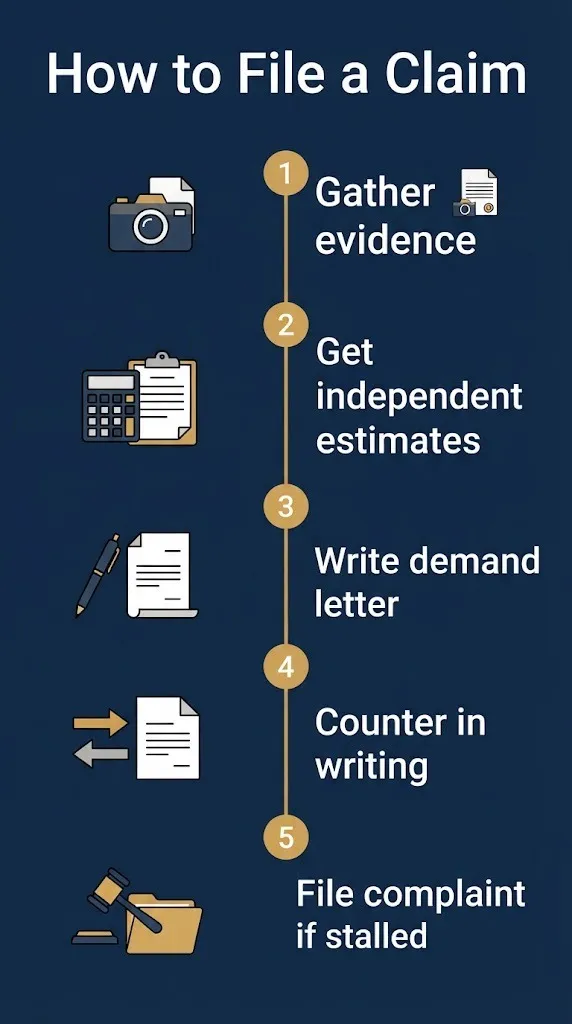
Do these five things in order:
- Get a written repair estimate from at least two independent shops.
- Photograph all damage from multiple angles before repairs begin.
- Request the insurer’s valuation report if your car is a total loss.
- Gather your medical records and bills if you were injured.
- Write a one-page demand letter stating your number and your reasoning.
The demand letter is the single most important tool in a self-negotiated claim. It forces the adjuster to respond to your logic, not their software’s default.
How Do You Respond to a Lowball Settlement Offer?
Respond in writing, with a number, and with evidence. Do not call and accept out of frustration. Do not accept verbally without seeing the release.
A lowball offer often comes fast. That speed is intentional. Insurers know that most people, stressed and behind on bills, will take the first number.
Your counter should include three things:
- A specific dollar amount you want.
- A short explanation for why that amount is justified.
- New evidence the insurer did not use in its first valuation.
Send it by email or certified mail. Keep a copy. If the adjuster calls, ask for the response in writing anyway.
How Long Does an Insurance Settlement Negotiation Usually Take in 2026?
Most car accident property claims settle in two to six weeks after you submit a complete demand package. Injury claims take longer, often three to six months, because medical treatment and recovery time affect value.
Insurers in 2026 increasingly use predictive software to time their responses. That software often sends a low initial offer quickly, then waits to see if you push back.
Delays are not always bad news. A longer negotiation often means the insurer is reconsidering its position. What matters is that you respond to every delay with a written follow-up, so your claim stays active.
Key Takeaway: Speed from an insurer usually means a lowball offer, not a fair one, and patience with written follow-ups is your leverage.
What Evidence Gets the Biggest Insurance Settlement Increase?
Medical records and independent repair estimates move the needle more than anything else. Emotional appeals do not. Threats to sue, without a lawyer behind them, rarely move an adjuster.
Here is what verified consumer claim data shows matters most:
| Evidence Type | Impact on Offer |
|---|---|
| Independent repair estimate | High |
| Medical records showing treatment consistency | High |
| Photos with timestamps | Medium |
| Receipts for out-of-pocket costs | Medium |
| Police report confirming fault | High |
| Emotional hardship letters | Low |
Reality Check: No legitimate insurer sends settlement money by text first. No legitimate claims process charges a filing fee. Any third party offering to “unlock” your settlement for a fee is a scam. Filing a claim yourself is free.
How Do You Negotiate a Total Loss Vehicle Settlement?
Ask for the insurer’s valuation report. That report usually lists comparable vehicles used to set the offer. Those comparables are often stripped-down models or higher-mileage vehicles that understate your car’s value.
Your counter is simple: find better comparables. Check local dealer listings, Kelley Blue Book private-party value, and completed sales on sites like Autotrader. Present three to five better matches.
Also claim your sales tax and registration fees if your state allows it. Many insurers will pay them only if you ask.
How Do You Negotiate Pain and Suffering Without a Lawyer?
You calculate it, then you defend it with documentation. Most insurers use a multiplier method: your total medical bills times a factor of 1.5 to 3, depending on severity.
For example, $4,000 in medical bills might justify $6,000 to $12,000 total, including pain and suffering. Mild cases get the low end. Cases with visible injury, ongoing treatment, or lost work get the high end.
Your demand letter should show the math. Insurers are trained to reject vague requests for “fair compensation.” They respond to numbers with a formula behind them.
What Are the Latest Insurance Settlement Class Actions in 2026?
Several active insurance-related class actions may affect consumers this year. While individual negotiation remains the core path for most claims, some policyholders may qualify for class payouts.
Active and recent insurance-related class settlements reported in court records include:
| Case | Insurer | Status |
|---|---|---|
| Data breach claims | Multiple carriers | Settlement approvals ongoing |
| Premium overcharge claims | Regional carriers | Filed, class certification pending |
| Delay in claim payment claims | Major auto insurer | Settlement reached, claim deadline varies |
Each of these has its own administrator and deadline. Check the official settlement website for any notice you received. Do not rely on a text or social media post.
Key Takeaway: Class actions cover groups, but your individual claim still gets negotiated on its own facts, and the two paths are not mutually exclusive.
How Do You Check If You Qualify for an Insurance Settlement?
Review the notice you received. It names the settlement administrator and the claim deadline. Then visit the official settlement website and read the eligibility section carefully.
If you never received a notice but believe you qualify, search the case name on the administrator’s site. Most administrators allow you to file a claim if you can provide proof of your policy or loss.
Eligibility usually depends on three things:
- You held a policy with the named insurer during the covered period.
- Your claim type matches the settlement terms.
- You file before the deadline with the required proof.
No one can guarantee your payout. Amounts depend on how many claims are filed and the fund size.
What Is the Difference Between Negotiating a Claim and Joining a Class Action?
Negotiating is individual. You present your own evidence and ask for your own number. A class action is collective. The class resolves a common issue, and payouts get divided among all eligible members.
If you join a class action, you usually cannot separately sue the insurer for the same issue. If you need a large payout for a specific injury or loss, individual negotiation or a lawyer may serve you better.
For small overcharges or data breach harms, a class action often pays more than the cost of pursuing an individual claim.
What Happens If the Insurer Refuses to Move From Its First Offer?
You have three options, in order of escalation:
- File a complaint with your state insurance department. This is free and often prompts a second review.
- Request an appraisal if your policy includes one. Many auto policies do.
- Consult a lawyer or hire a public adjuster if the claim is large enough to justify the cost.
A state insurance department complaint does not require a lawyer. It creates a paper trail and forces the insurer to respond to a regulator.
Key Takeaway: Insurers move when regulators or independent appraisers get involved, and a state complaint is the cheapest way to make that happen.
How Do You Write a Demand Letter That Gets a Response?
Keep it to one page. Lead with your number. Follow with facts, not feelings. Close with a deadline.
A strong demand letter includes:
- Your name, claim number, and date of loss.
- A single paragraph describing what happened.
- A table of your damages: repairs, medical, lost wages, other costs.
- Your total demand, with the multiplier shown if injuries are involved.
- A request for a written response within 14 days.
Send it certified mail or by email with a read receipt. Do not include a threat to sue unless you genuinely intend to sue.
What Does a Good Settlement Look Like for a Minor Car Accident?
A minor property-damage-only accident typically settles at or near the full independent repair estimate. That means a fender bender with $1,800 in damage should settle for around $1,800, not the $1,200 first offer.
For a minor injury, soft tissue cases with $2,000 to $5,000 in medical bills often settle between $4,000 and $12,000 total. The variance comes from treatment length, lost wages, and your negotiation persistence.
Are Insurance Settlement Negotiations Different for Home Claims in 2026?
Yes. Home claims involve contractors, adjusters, and often much larger numbers. The same rules apply: get independent estimates, respond in writing, and do not accept a first offer.
For home claims, insurers increasingly use preferred-contractor programs. You are not required to use their contractor. You have the right to choose your own, and your independent estimate is valid evidence in negotiation.
What Happens Next
The timeline for any individual insurance claim negotiation looks like this:
- Within 7 days of your demand letter: Insurer acknowledges receipt and assigns an adjuster.
- Within 14 to 30 days: Insurer responds with a counteroffer or a request for more information.
- Within 30 to 60 days: Most property claims settle if you keep the file moving.
- If no resolution after 60 days: Consider a state insurance department complaint or appraisal.
- For class action claims: Watch the official settlement website for hearing and payout dates.
The single most important date is your own deadline. Many settlement administrators set strict filing deadlines, and missing one means losing your claim forever. Calendar it the day you receive a notice.
Frequently Asked Questions
How to negotiate a car accident settlement without a lawyer?
Document everything first, then send a one-page demand letter with your number and your evidence.
Respond to any counteroffer in writing, and do not accept a first offer by phone.
If the insurer stalls, file a state insurance department complaint.
How to negotiate a settlement without a lawyer?
Treat negotiation as a written process, not a phone conversation.
Get independent estimates, calculate your demand with a clear formula, and counter every offer in writing.
The process is legal, free, and often produces a higher payout than accepting the initial number.
How much should I ask for in pain and suffering?
Use the multiplier method: medical bills times 1.5 to 3, depending on severity.
A $4,000 medical bill claim might justify $6,000 to $12,000 total.
Document your treatment consistency to support the higher end.
What if the insurance company ignores my demand letter?
Send a second written request with a deadline.
Then file a complaint with your state insurance department.
That complaint is free and forces a regulatory response.
Do I need a lawyer for an insurance settlement?
No. Most claims under $25,000 settle without a lawyer.
A lawyer makes sense for serious injuries, denied liability, or claims exceeding that amount.
Legal fees often consume a third of your payout, so compare that cost against your expected recovery.
How long does it take to get paid after a settlement?
For individual claims, payment usually arrives within 30 days after you sign a release.
For class action settlements, payment windows depend on the court and administrator timeline.
Check the official settlement website for the expected payment date.
Can I negotiate a total loss car settlement?
Yes. Request the insurer’s valuation report and find better comparable vehicles.
Claim sales tax and registration fees where your state allows.
Present your evidence in writing with a specific counteroffer.
Is a settlement offer final if I sign it?
Yes. Once you sign a release, the claim is closed and you cannot come back for more.
Read the release carefully before signing, and never sign under pressure from a deadline you have not verified.