USAA Late Fee Class Action Settlement 2026: Who Qualifies and When Checks Arrive
Quick Answer
- The USAA late fee class action settlement is real: a Maryland federal court approved it on April 28, 2026.
- Typical payments range from about $5.04 to $274.90, with a median payout of $14.77.
- No claim form is required. Payments are automatic and expected to go out in mid-summer 2026.
If you’re searching “USAA late fee class action settlement,” here’s the direct answer: it’s a real, court-approved $5 million settlement, and it just cleared its final hurdle. A federal judge in Maryland granted final approval on April 28, 2026.
This affects Maryland policyholders who were charged late fees by USAA before 2020 and got a refund of the fee itself, but never got the interest USAA earned while holding that money. No claim form is required, and payments are expected in the coming weeks if they haven’t already arrived.
This article breaks down eligibility, real payout numbers, the payment timeline, and how to fix a problem if your check never shows up. One detail worth knowing upfront: some class members will get as little as $5.04, while others could see over $270.
The Facts
| Category | Detail |
|---|---|
| Case | Black et al. v. USAA General Indemnity Co., et al. |
| Court | U.S. District Court for the District of Maryland |
| Case Number | 8:21-cv-01581-LKG |
| Status | Final approval granted April 28, 2026 |
| Fund Size | $5,000,000 |
| Est. Per Person | About $5.04 to $274.90, median $14.77 |
| Claim Deadline | None, payment is automatic |
| Administrator | JND Legal Administration |
| Proof Needed | None, based on USAA’s own refund records |
Is the USAA Late Fee Class Action Settlement Real?
Yes. This is a real, court-supervised settlement, not a scam or a rumor. It stems from an actual federal lawsuit filed in the U.S. District Court for the District of Maryland.
The case is formally titled Black et al. v. USAA General Indemnity Co., et al., case number 8:21-cv-01581-LKG. A judge granted preliminary approval on December 16, 2025, and final approval on April 28, 2026.
USAA has not admitted wrongdoing. Like most class settlements, this one resolves the claims without USAA conceding it did anything improper.
Is the USAA Late Fee Settlement a Scam?
No, but scams do sometimes piggyback on real settlement news like this one. The actual settlement never requires you to pay a fee to receive money.
You also never need to give out your Social Security number, bank login, or a credit card number to get paid. The official settlement website is usaalatefeelitigation.com, and USAA’s own records determine who qualifies.
If you get a text or call asking you to “verify” payment by sending money first, that’s not part of this settlement. Report it and ignore it.
How Much Is the USAA Late Fee Class Action Settlement Worth?
The total settlement fund is $5,000,000. That figure is confirmed in the settlement agreement and court filings.
Up to $2,000,000 of that fund may go toward attorneys’ fees and litigation costs, which leaves at least $3,000,000 for class members. Named plaintiffs may also receive service awards totaling up to $18,000, subtracted from the same pool.
Key Takeaway: The $5 million headline number is real, but the actual pool available for individual policyholders is smaller once fees and awards are subtracted.
How Much Will I Get From the USAA Late Fee Settlement?
Individual payments are not a flat amount. They’re calculated based on how much you were charged in late fees and how long USAA held that money.
Reported estimates put payments in this range:
| Payment Type | Estimated Amount |
|---|---|
| Minimum guaranteed payment | At least $5.00 per class member |
| Typical low-end payment | Around $5.04 |
| Median payment | $14.77 |
| High-end estimate | Up to $274.90 |
Your share is based on an 8 percent simple interest calculation applied to your original late fee charges. The more you were charged, and the longer ago it happened, the higher your estimated payment tends to be.
Current USAA policyholders will get a statement credit. Former policyholders will get a paper check mailed to their address on file.
Reality Check
No one from USAA or the settlement administrator will call, text, or email asking you to pay a processing fee to get your payment.
This settlement uses automatic distribution based on USAA’s own records. Filing is free, always, and any third party charging you to “unlock” your payment isn’t part of this case.
Do I Need to File a Claim for the USAA Settlement?
No. This settlement does not require a claim form. USAA already has records identifying every eligible class member.
That’s different from many class actions, where you have to submit paperwork or a sworn declaration. Here, if you meet the eligibility criteria, you’re automatically included and automatically paid.
Think of it like a store issuing an automatic refund to your card after a recalled product, instead of making you mail in a receipt. You don’t have to ask. It just happens.
The only action required is if you want to opt out or object, which involves a different process covered below.
How Do I Opt Out of the USAA Late Fee Settlement?
You can opt out only by mailing a signed written request, and that deadline has already passed. The opt-out and objection deadline was March 30, 2026.
To opt out, class members had to mail a signed letter including their name, address, phone number, the last four digits of their USAA policy number, and a clear statement of exclusion. Requests could not be submitted by phone, fax, or email.
Since that date has passed, class members who did not opt out are now bound by the settlement. That means they’ll receive an automatic payment and give up the right to sue USAA separately over the same late fee interest issue.
How Do I Update My Address With the Settlement Administrator?
You can update your mailing address by contacting JND Legal Administration directly. This matters most for former USAA policyholders getting a mailed check.
- Call the settlement administrator at 1-877-206-2306.
- Have your former USAA policy number ready.
- Confirm your current mailing address.
- Ask for written confirmation of the update.
- Watch your mail for a check in the coming weeks.
Key Takeaway: Since payments to former policyholders go out by mail, an outdated address is the single biggest reason a payment gets missed.
What Is the Status of the USAA Late Fee Class Action Settlement in 2026?
The settlement is fully approved and moving toward distribution. The court granted final approval on April 28, 2026, following a Zoom hearing that had been rescheduled to that date.
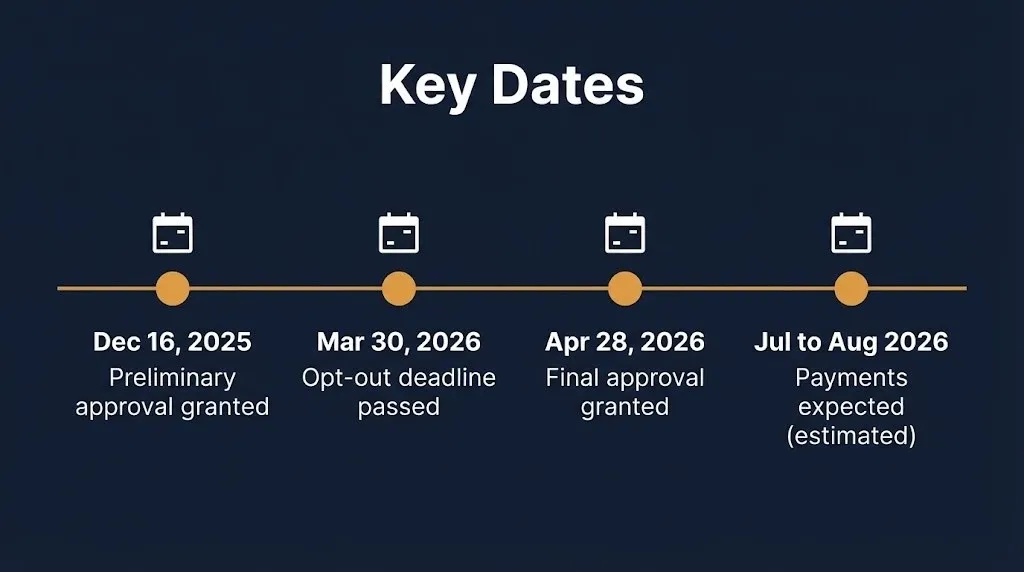
Preliminary approval came earlier, on December 16, 2025. That set the opt-out deadline, notice period, and final hearing date in motion.
As of mid-2026, no reported appeals are noted in available filings, though compensation only begins flowing once final approval is granted and any appeal period resolves.
When Will USAA Late Fee Settlement Checks Be Mailed?
Payments are expected to go out no later than 60 days after the settlement’s “Effective Date,” which follows final approval and any appeal period. Reporting from spring 2026 estimated distribution in mid-summer 2026, meaning July or August.
Current policyholders should see a statement credit within 30 days of the effective date. Former policyholders should receive a mailed check within roughly 60 days of that same date.
If you haven’t received anything by late summer 2026, that’s a signal to contact the settlement administrator directly rather than assume you were left out.
What Happened at the April 28, 2026 Final Approval Hearing?
The judge granted final approval to the $5 million settlement at this hearing. That approval is what triggers the countdown toward actual payments.
The hearing was held virtually via Zoom at 9:30 a.m. Eastern Time, after being rescheduled to that date. Final approval means the court found the settlement terms fair, reasonable, and adequate for the class.
Barring a successful appeal, this hearing effectively cleared the last legal obstacle standing between class members and payment.
Why Is USAA Facing a Late Fee Class Action Lawsuit?
The lawsuit traces back to a Maryland Insurance Administration market conduct exam. That exam found USAA had been improperly charging late fees to Maryland policyholders starting around August 27, 2011.
Key Takeaway: USAA already refunded the late fee principal back in 2020 under a state consent order, but this lawsuit argues that refund left out the interest USAA earned while holding the money.
USAA entered a Consent Order with Maryland regulators (MIA-2020-08-002) and refunded roughly $7.3 million in fee principal that year. Plaintiffs argued USAA should have also paid the interest or investment gains earned on those funds before returning them, and that USAA never disclosed the fees were unauthorized in the first place.
USAA has denied wrongdoing throughout the case. The settlement resolves the dispute without a trial or a court finding against the company.
Who Is Eligible for the USAA Late Fee Settlement?
You may be a class member if you meet three specific conditions tied to Maryland USAA insurance policies. All three generally need to apply.
- You were charged a late fee by USAA General Indemnity Co., Garrison Property and Casualty Insurance Co., United Services Automobile Association, or USAA Casualty Insurance Co.
- The fee was charged on a Maryland insurance policy before 2020.
- You received a refund of that late fee under the 2020 Maryland consent order, but not the interest or gains earned on it.
If all three apply to you, USAA’s own records should already reflect your eligibility. You don’t need to prove anything separately.
What Is Black v. USAA General Indemnity Co.?
Black et al. v. USAA General Indemnity Co., et al. is the formal federal case name behind this settlement. It carries case number 8:21-cv-01581-LKG in the U.S. District Court for the District of Maryland.
The case names four related USAA entities as defendants: USAA General Indemnity Company, Garrison Property and Casualty Insurance Company, United Services Automobile Association, and USAA Casualty Insurance Company.
This is a straightforward consumer finance dispute over unpaid interest, not a criminal or regulatory enforcement action, though it grew out of a prior regulatory exam.
Who Are the Settlement Administrator and Class Counsel?
JND Legal Administration is handling claims administration and payment distribution for this settlement. It’s a third-party firm courts commonly appoint for class action payouts.
You can reach the administrator at PO Box 91109, Seattle, WA 98111, by phone at 1-877-206-2306, or by email at [email protected].
Class counsel representing policyholders includes Andrea Gold and Gemma Seidita of Tycko & Zavareei LLP, Jonathan Kagan of Kagan Stern Marinello & Beard LLC, and Keith Vernon and Andrew Knox of Timoney Knox LLP. They will request up to $2 million in fees and costs, subject to court approval.
What Happens to Leftover Settlement Money?
Any funds left over after payments go to two military-focused charities rather than back to USAA. That’s a standard cy pres arrangement in class settlements.
If money remains in the fund nine months after checks are first issued, it will be donated to the Wounded Warrior Project and Face the Fight. USAA covers settlement administration costs separately, so those costs don’t reduce the $5 million fund itself.
Is This Connected to Other USAA Class Action Lawsuits?
This late fee case is separate from USAA’s larger, unrelated legal matters, though it fits a pattern of recent USAA settlements. USAA has faced several other class actions and regulatory penalties in recent years.
The largest is a separate $64.2 million settlement over allegations that USAA overcharged servicemembers on interest rates and fees. Other matters have touched on data security and bad faith claims handling.
Those cases involve different courts, different class definitions, and different eligibility rules. Being part of one USAA settlement doesn’t automatically make you eligible for another.
What Happens Next
April 28, 2026: Court granted final approval to the settlement (completed).
Following the Effective Date: Any appeal period runs its course before payments can begin.
Within 30 days of the Effective Date: Current USAA policyholders should see a statement credit.
Within 60 days of the Effective Date: Former USAA policyholders should receive a mailed check.
Nine months after checks issue: Any leftover funds go to the Wounded Warrior Project and Face the Fight.
Frequently Asked Questions
Is the USAA late fee class action settlement real?
Yes. It’s a court-approved $5 million settlement in the U.S. District Court for the District of Maryland.
Final approval was granted April 28, 2026.
Do I need to file a claim to get paid?
No. This settlement uses automatic distribution based on USAA’s own records.
There is no claim form to submit.
How much money will I get from the USAA settlement?
Estimated payments range from about $5.04 to $274.90, with a median of $14.77.
Your exact amount depends on how much you were charged in late fees and when.
When will USAA settlement payments arrive?
Payments are expected in mid-summer 2026, likely July or August.
Current policyholders get a statement credit; former policyholders get a mailed check.
Can I still opt out of the USAA settlement?
No. The opt-out and objection deadline was March 30, 2026, and it has passed.
Class members who didn’t opt out by that date are now bound by the settlement.
Who qualifies for the USAA late fee settlement?
Maryland USAA policyholders charged a late fee before 2020 who got a refund without interest may qualify.
The refund must trace back to the 2020 Maryland consent order.
What if I never got my original 2020 late fee refund?
Contact the settlement administrator directly at 877-206-2306 if you believe you’re missing a prior refund.
That situation may affect how this settlement applies to you.
Is there a risk of a scam tied to this settlement?
Yes, always be cautious of unofficial texts or calls asking for payment or personal banking details.
The real settlement never charges a fee and relies on USAA’s existing records.
Payments are expected to reach eligible USAA policyholders in Maryland sometime in July or August 2026. If you haven’t received a statement credit or check by then, contact JND Legal Administration directly rather than wait.
The single date that matters most now already happened: final approval on April 28, 2026. What’s left is the payment window playing out.