How Does Debt Settlement Work in 2026? The Real Process, Costs, and Risks
Quick Answer
- Debt settlement means negotiating with creditors to accept a lump sum that’s less than your full balance.
- Typical settlements land at 40% to 60% of the original debt, plus fees to the settlement company.
- The most important deadline is your last payment date, because debts become legally uncollectible after your state’s statute of limitations.
If you searched for “how does debt settlement work,” you’re likely staring at a stack of bills, wondering if a company that promises to cut your debt in half is legitimate or too good to be true.
This article explains the actual mechanics, the real costs, the tax consequences, and the alternatives nobody mentions. It’s based on CFPB enforcement data, FTC rules, and verified industry practices as of September 2026.
Here’s the part most articles skip: debt settlement companies are banned from charging upfront fees by federal law. Any company asking for money before it settles a debt is violating the FTC’s Telemarketing Sales Rule.
The Facts
| Item | Detail |
|---|---|
| Federal Regulation | FTC Telemarketing Sales Rule, CFPB oversight |
| Upfront Fees | Illegal before settlement under federal law |
| Typical Settlement Range | 40% to 60% of original debt |
| Typical Timeline | 24 to 48 months |
| Credit Score Impact | Severe during the program, recovery takes years |
| Tax Consequence | Forgiven debt over $600 may be taxable income |
Is Debt Settlement Legit or Just a Scam?
Debt settlement is legal, but the industry has a documented history of consumer harm. The CFPB has filed multiple enforcement actions against debt settlement companies for deceptive practices since 2020, including cases resolved in 2025 and 2026.
The difference between legit and scam comes down to one thing: when the company gets paid. Under the FTC’s Telemarketing Sales Rule, a debt settlement company cannot charge any fee until it actually settles or reduces at least one of your debts.
A legitimate company will explain the risks, including credit damage, collection lawsuits, and tax liability. A scam will promise specific results, guarantee settlements, or demand money upfront. The CFPB and FTC both publish consumer advisories warning about these red flags.
Legitimate debt settlement also has a success problem. Industry data and consumer complaints show that many people drop out before completing the program. Some end up with more debt than they started with, thanks to late fees and interest that accrue while they stop paying creditors.
How Does Debt Settlement Actually Work Step by Step?
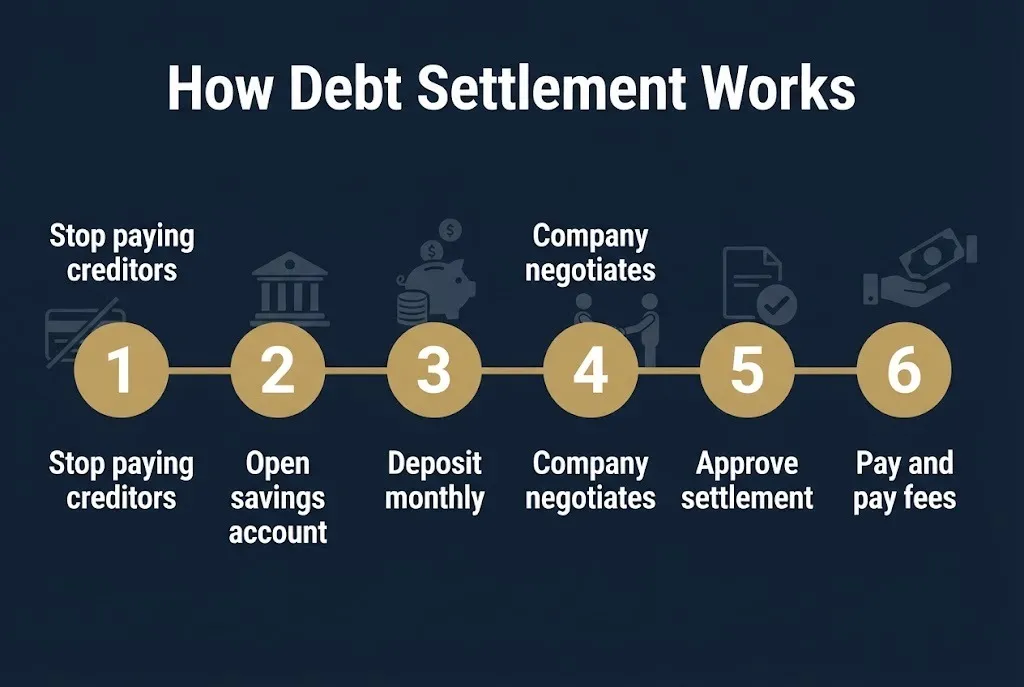
The process is straightforward to describe but hard to endure. Here’s what happens in order.
- You stop making payments to the creditors you want to settle.
- You open a dedicated savings account, often controlled by the settlement company.
- You deposit a fixed monthly amount into that account.
- Your creditors report late payments, then charge-offs, to credit bureaus.
- Once enough money accumulates, the settlement company contacts a creditor.
- The company negotiates a lump-sum payoff for less than the full balance.
- You approve the settlement and pay the creditor from your account.
- The company takes its fee, typically 15% to 25% of the enrolled debt.
- You repeat this with each creditor until all debts are settled or you quit.
The entire process takes 24 to 48 months on average. Some people finish faster. Many don’t finish at all.
Stopping payment is not optional. Creditors won’t negotiate with someone who’s current on their bills. That means your credit score drops, sometimes by 100 points or more, starting around month three and staying depressed for the duration of the program.
Key Takeaway: The core trade is simple: you wreck your credit now to pay less later, and the outcome is never guaranteed.
Is Debt Settlement Worth It in 2026?
Whether debt settlement is worth it depends on your total debt, your income, and whether you can tolerate collection lawsuits. For some people, the math works. For many, bankruptcy is faster and cheaper.
Here’s a comparison using verified 2026 figures:
| Factor | Debt Settlement | Chapter 7 Bankruptcy |
|---|---|---|
| Typical Cost | 15% to 25% of enrolled debt | $1,500 to $3,500 in attorney fees |
| Time to Complete | 24 to 48 months | 3 to 6 months |
| Credit Impact | Severe, lasts 3 to 7 years | Severe, lasts 7 to 10 years |
| Legal Protection | None from collection lawsuits | Automatic stay stops all collection |
| Tax on Forgiven Debt | Yes, over $600 | No, bankruptcy discharge is not taxable |
| Success Rate | 40% to 55% complete programs | Over 95% of filed cases discharge |
The success rate gap is the most important number. Debt settlement companies rarely advertise it, but industry data and academic studies consistently show that more than half of enrollees drop out. They drop out because they get sued, they can’t afford the monthly deposits, or they realize the fees aren’t worth it.
Bankruptcy, by contrast, has a completion rate above 95% for people who file and attend the required hearings. It’s not painless, but it’s predictable.
Reality Check: No legitimate debt settlement company guarantees results. No one can stop a creditor from suing you. No one can remove accurate negative items from your credit report. If a company promises any of these, it’s lying.
What Does Debt Settlement Cost?
Debt settlement companies charge fees based on the debt you enroll, not the amount you save. The typical range is 15% to 25% of the total enrolled debt, and under federal law, these fees can only be collected after a settlement is reached.
Here’s a concrete example:
- You enroll $30,000 in credit card debt.
- The settlement company’s fee is 20%, or $6,000.
- The company settles your debts for an average of 50%, or $15,000.
- Your total cost is $15,000 to creditors plus $6,000 in fees.
- Total paid: $21,000.
- Total saved: $9,000, before taxes.
That $9,000 in savings may be taxable. The IRS treats forgiven debt over $600 as income. If you’re in the 22% tax bracket, that’s another $1,980 owed at tax time.
The fee structure changed in 2010 when the FTC banned upfront fees. Before that, companies collected thousands before doing anything. Now they can only collect per settled debt, which aligns their incentive with actually settling.
But the fee is still calculated on the original debt amount, not the settled amount. That means the company’s fee doesn’t shrink if it negotiates a better deal for you. It gets paid the same either way.
How Much Debt Do You Need for Debt Settlement to Make Sense?
Most debt settlement companies require a minimum of $7,500 to $10,000 in unsecured debt before they’ll take your case. Below that, the fees eat up too much of the savings to justify the credit damage.
Unsecured debt means credit cards, personal loans, medical bills, and some private student loans in default. Secured debts like mortgages and auto loans don’t qualify. Neither do federal student loans, which have their own settlement and forgiveness rules.
The sweet spot for debt settlement is usually $15,000 to $50,000 in credit card debt, combined with a steady income that lets you make monthly deposits into the dedicated account. Without that income, the program stalls and creditors lose patience.
If your debt is under $10,000, a debt management plan through a nonprofit credit counseling agency is usually better. These plans don’t reduce your principal, but they cut interest rates and consolidate payments without the credit damage.
What Debts Can You Settle?
Not all debts are eligible. Here’s the verified list of what typically qualifies.
| Debt Type | Settlement Possible? |
|---|---|
| Credit card debt | Yes, most common |
| Personal loans | Yes |
| Medical bills | Yes, often easier |
| Collection accounts | Yes, often for 30% to 50% |
| Private student loans in default | Sometimes |
| Federal student loans | Rarely, separate programs exist |
| Mortgages | No, foreclosure rules apply |
| Auto loans | No, repossession rules apply |
| Secured debts | Generally no |
| Tax debt | Separate IRS programs apply |
Medical bills are often the easiest to settle because healthcare providers frequently accept reduced payments from uninsured patients. Collection accounts are also flexible, since the collection agency likely bought the debt for pennies on the dollar.
Credit card debt is the main target because banks are sophisticated, they know the alternatives, and they’d rather get something than nothing if you’re heading toward bankruptcy anyway.
Key Takeaway: Debt settlement works best for unsecured debts, especially credit cards and collection accounts, and it’s useless for secured debts.
What Happens to Your Credit Score During Debt Settlement?
Your credit score drops significantly, and the damage lasts for years. Most people see a 100 to 150 point drop within six months of stopping payments.
Here’s the timeline:
- Month 1 to 3: Late payments appear, score drops 50 to 100 points.
- Month 4 to 6: Accounts charge off, score drops another 50 to 100 points.
- Month 6 to 24: Collection accounts and charge-offs sit on your report.
- After settlement: Accounts show “settled for less than full balance.”
- 7 years after original delinquency: Negative items fall off your report.
The “settled for less than full balance” notation is itself a negative mark. Future lenders see that you didn’t pay what you owed. It’s better than an unpaid collection, but worse than “paid in full.”
The credit damage is the hidden cost of debt settlement. You might save $10,000 on your debts, but you’ll pay higher interest rates on any future loan for years. A car loan, a mortgage, even a rental application can cost more.
Can Creditors Sue You During Debt Settlement?
Yes, and they do. Debt settlement provides no legal protection from collection lawsuits. This is the biggest risk most people don’t understand.
When you stop paying, creditors have options. They can wait for your settlement offer, sell the debt to a collection agency, or file a lawsuit. If they sue and win a judgment, they can garnish wages, levy bank accounts, or place liens on property.
Some creditors are aggressive. Others rarely sue. The difference depends on the debt size, the creditor’s collection policies, and your state’s wage garnishment laws.
If you’re sued during a debt settlement program, the settlement company won’t represent you. You’ll need to respond yourself or hire an attorney. Ignoring the lawsuit guarantees a default judgment, which gives the creditor legal power to collect from you directly.
Bankruptcy, by contrast, triggers an automatic stay that legally stops all collection activity, including lawsuits. That’s the single biggest legal advantage bankruptcy has over debt settlement.
What Are the Alternatives to Debt Settlement?
Debt settlement is not your only option. In many cases, it’s not your best option.
| Option | What It Does | Best For |
|---|---|---|
| Debt management plan | Nonprofit agency negotiates lower interest rates | Debts under $10,000, steady income |
| Chapter 7 bankruptcy | Wipes out unsecured debts in months | Debt over $20,000, little income |
| Chapter 13 bankruptcy | Repayment plan over 3 to 5 years | Protecting assets like a home |
| DIY settlement | You negotiate directly with creditors | One or two debts, some cash saved |
| Debt consolidation loan | New loan pays off old debts | Good credit, manageable debt load |
| Doing nothing | Debts become uncollectible after statute of limitations | Very old debts, no assets, judgment-proof |
DIY settlement deserves more attention. If you have one or two old credit card debts and a lump sum saved, you can call the creditor yourself. Offer 30% to 50% in a single payment. Get the agreement in writing. Pay. Done. No fees, no middleman.
The statute of limitations angle is also underused. In most states, creditors have 3 to 6 years to sue you. After that, the debt still exists but it’s legally uncollectible. A debt settlement company won’t tell you this because settling a time-barred debt means paying something for nothing.
Key Takeaway: Debt settlement is one tool among several, and for many people, bankruptcy or DIY negotiation is faster, cheaper, and legally safer.
How Do You Choose a Debt Settlement Company?
If you’re considering a company, verify it first. The CFPB and FTC both maintain complaint databases, and your state attorney general’s office may have additional records.
Here’s the checklist:
- Verify the company is registered with your state, where required.
- Check the CFPB complaint database for unresolved complaints.
- Search the FTC’s legal actions for any enforcement history.
- Confirm no upfront fees will be charged.
- Get the fee percentage in writing before enrolling.
- Ask what happens if you’re sued during the program.
- Ask about the tax consequences of forgiven debt.
- Compare against a nonprofit credit counseling agency.
Nonprofit credit counseling agencies are a different animal entirely. They’re funded by creditors, not by you, and their debt management plans don’t reduce your principal but do cut interest rates substantially. The National Foundation for Credit Counseling certifies legitimate agencies.
A legitimate debt settlement company will answer every question without pressure. A bad one will rush you toward enrollment, downplay the risks, and promise outcomes it can’t deliver.
What Does the FTC Say About Debt Settlement?
The FTC’s Telemarketing Sales Rule governs debt settlement companies, and it’s specific about what’s legal.
- No fees before a settlement is reached.
- No misrepresenting the likelihood of success.
- No claiming debts will be settled for a specific percentage.
- No telling consumers to stop communicating with creditors.
- Clear disclosure of how long the program will take.
- Clear disclosure of how much money must accumulate before settlements begin.
Companies that violate these rules face FTC enforcement actions. Several major debt settlement firms have been ordered to pay millions in consumer redress over the past decade, with new actions still being filed as of 2025 and 2026.
The CFPB has also sued debt settlement companies for deceptive practices, including cases involving hidden fees, false promises, and failing to disclose that most customers don’t complete the program.
These enforcement actions are public record. Before hiring any company, search the CFPB and FTC websites for the company’s name. It’s free and takes five minutes.
What’s the Tax Hit on Forgiven Debt in 2026?
Forgiven debt over $600 is generally taxable income, unless you qualify for an insolvency exclusion.
The IRS rules haven’t changed in 2026. When a creditor forgives $10,000 of your debt, the creditor files a Form 1099-C and sends you a copy. That $10,000 becomes taxable income on your federal return.
There are exceptions:
- Insolvency: If your total debts exceed your total assets immediately before the settlement, you may exclude some or all of the forgiven amount.
- Bankruptcy: Debt discharged in bankruptcy is not taxable.
- Certain student loan forgiveness programs: Some are tax-exempt through 2025, with extensions pending.
The insolvency exclusion is the one most people miss. If your debts exceed your assets, you may owe no tax on the forgiven amount. But you’ll need documentation: balance sheets, account statements, property valuations.
This is where a tax professional earns their fee. Getting the exclusion wrong means an IRS notice and potentially thousands in unexpected tax debt.
What Happens After Debt Settlement?
Once your enrolled debts are settled, the recovery begins. But it’s slower than most people expect.
- Month 1 to 6 after settlement: Your credit score starts a slow climb from its low point.
- Year 1 after settlement: You can qualify for secured credit cards and credit-builder loans.
- Year 2 to 3: You may qualify for unsecured cards and some auto loans, at higher rates.
- Year 7 after original delinquency: The negative items fall off your credit report entirely.
The key to rebuilding is simple: pay every new bill on time, keep credit utilization under 30%, and don’t apply for too much credit at once. The passage of time does most of the heavy lifting.
One surprising detail: some people see their credit score improve within a year of completing settlement, simply because their debt-to-income ratio dropped. The settled accounts still show as negative, but the overall picture looks better to lenders.
What Happens Next in the Debt Settlement Industry
The regulatory landscape is tightening, not loosening.
- October 2026: The CFPB is expected to release updated debt collection and settlement examination procedures.
- January 2027: California’s new disclosure requirements for debt settlement companies take full effect.
- Early 2027: The FTC continues its enforcement sweep against companies charging illegal upfront fees.
- Ongoing: More states are requiring debt settlement companies to register and post bonds.
If you’re considering debt settlement, the industry will look different in 12 months. More disclosure, more state oversight, and more enforcement against bad actors.
The most important date is still your own. Your state’s statute of limitations on debt collection is the deadline that matters most. Once it passes, the debt becomes uncollectible.
Frequently Asked Questions
Is debt settlement better than bankruptcy?
It depends on your debt and income.
Bankruptcy is faster, cheaper, and legally protective.
Debt settlement is slower, more expensive, and offers no lawsuit protection.
Can I settle my debts myself?
Yes.
Call creditors directly and offer 30% to 50% in a lump sum.
Get the agreement in writing before paying anything.
How much can debt settlement save me?
Typically 40% to 60% of your enrolled debt.
Fees reduce your actual savings significantly.
Taxes on forgiven debt reduce it further.
Will debt settlement stop collection calls?
No.
Creditors can keep calling until a settlement is reached.
Lawsuits can still be filed during the program.
Does debt settlement hurt my credit?
Yes.
Late payments and charge-offs cause severe damage.
The negative marks last seven years from the original delinquency.
Are debt settlement fees tax deductible?
No.
Settlement fees are not tax deductible for individuals.
The forgiven debt itself may be taxable income.
How long does debt settlement take?
Typically 24 to 48 months.
The timeline depends on how fast you accumulate settlement funds.
Many people drop out before completing the program.
What happens if a creditor refuses to settle?
You either pay in full or face collection action.
The creditor may sue and obtain a judgment.
The settlement company cannot force a creditor to negotiate.
If you’re drowning in debt and considering settlement, start by checking your state’s statute of limitations and pulling your credit report. Then compare the real numbers: settlement fees, tax liability, and credit damage against the cost of bankruptcy or a nonprofit debt management plan.
The most important fact isn’t how much you might save. It’s whether the creditor can still sue you, and when that right expires.