False Advertising Lawsuit 2026: Open Settlements, Payouts, Deadlines and Who Qualifies
Quick Answer
- Yes, it’s real: Apple’s $250 million Siri case and Dr. Squatch’s $9 million case are open for claims.
- Apple may pay $25 to $95 per iPhone. Dr. Squatch may pay $0.50 per product, up to $12.50.
- Deadlines: Dr. Squatch claims close November 27, 2026. Apple claims close December 21, 2026.
A false advertising lawsuit pays ordinary buyers only after it settles as a class action with an open claim form. Right now, two of those exist. Neither company admits wrongdoing.
Dr. Squatch buyers have until November 27, 2026. Apple iPhone buyers have until December 21, 2026. Both claim forms are free to file.
This guide covers who qualifies, what each case pays, which proof counts, and when checks may land. One surprise sits in the math: Apple’s $95 headline only happens if relatively few people file.
| The Facts: Apple Siri Settlement | |
|---|---|
| Case | Landsheft v. Apple Inc., Case No. 5:25-cv-02668 (N.D. Cal.) |
| Status | Claims open; preliminary approval granted July 17, 2026 |
| Fund Size | $250 million |
| Est. Per Person | $25 per eligible device, adjustable up to $95 |
| Claim Deadline | December 21, 2026 |
| Administrator | Verita Global |
| Proof Needed | Device serial number and contact details; check the claim form |
Is a false advertising lawsuit settlement real or a scam?
A false advertising settlement is real when it carries a court case number and an administrator.
Both open cases pass that test. Apple’s is Landsheft v. Apple Inc., Case No. 5:25-cv-02668, in federal court in Northern California. Dr. Squatch’s is Guzman v. Dr. Squatch, LLC, Case No. 25STCV03523, in Los Angeles Superior Court.
Verita Global administers Apple’s claims. A separate administrator in Baton Rouge, Louisiana, handles Dr. Squatch. Those names matter, because scammers rarely cite a docket number.
Watch for these red flags:
- A text or call demanding a fee before you can file
- A claim link that doesn’t match the official settlement website
- A promise of a guaranteed dollar amount
Press language loves the phrase “up to.” The court documents say payments “may be adjusted.” Trust the court documents.
Which false advertising lawsuits are open for claims right now?
Two false advertising class actions are open for claims as of October 31, 2026. They are Apple’s iPhone Siri case and Dr. Squatch’s “natural” case.
| Case | Fund | Reported payout | Claim deadline | Final approval hearing |
|---|---|---|---|---|
| Landsheft v. Apple Inc. | $250 million | $25 per device, up to $95 | December 21, 2026 | February 24, 2027 |
| Guzman v. Dr. Squatch, LLC | $9 million | $0.50 per product, up to $12.50 | November 27, 2026 | March 2, 2027 |
Other recent cases have already closed. VSL#3’s claim deadline passed on October 20, 2026. A later section lists the closed ones.
Most trackers show only the headline number. We list the hearing dates too. A judge can still change terms before granting final approval, and that can change your payout.
How much money can you get from a false advertising lawsuit?
Most buyers collect a few dollars to a few hundred, depending on how many people file.
These settlements split the money pro rata. Picture slicing a pizza. The pie stays the same size, so more claimants mean thinner slices.
Attorney fees and administration costs come out first, so the pie is smaller than the headline. Your payment depends on the net fund and the number of valid claims.
| Case | Fund | Reported payout | Status |
|---|---|---|---|
| Apple (Landsheft) | $250 million | $25 to $95 per device | Claims open |
| Dr. Squatch (Guzman) | $9 million | $0.50 to $12.50 | Claims open |
| Joint Juice (Bland v. Premier Nutrition) | $70.84 million | $10 to $25 per unit | Payments began September 15, 2026 |
| VSL#3 | $20 million | $20 to $800 | Claims closed October 20, 2026 |
Key Takeaway: Payouts in a false advertising class action are pro rata, so your check depends on how many people file, not on the headline number.
How much will the Apple Siri settlement pay per iPhone?
Apple’s Siri settlement pays a presumptive $25 per device, adjustable up to $95.
The settlement covers roughly 36 million eligible devices. TidBITS reported just under $174 million left for awards after fees and costs. By that math, each claim would be worth under $5 if every device filed.
Here’s our own arithmetic, built on that reported $174 million. It’s an illustration, not an official estimate.
| Devices claimed | Rough payment per device |
|---|---|
| About 1.83 million or fewer | $95 cap |
| 5 million | About $34.80 |
| 10 million | About $17.40 |
| 36 million | About $4.83 |
The settlement says the $25 base can move up or down. Treat the table as a range finder.
A different Siri case offers a warning. Lopez v. Apple, a $95 million privacy settlement, reportedly paid about $8 per device after roughly 2.19 million claims. Apple has denied wrongdoing in the current case.
How much does the Dr. Squatch settlement pay?
The Dr. Squatch settlement pays $0.50 per eligible product, with a household maximum of $12.50.
You can claim up to five products with no receipt. That’s $2.50. You can claim up to 25 products with proof of purchase. That’s $12.50.
The notice says payments are calculated pro rata from valid claims. Your final check can differ from $0.50 per item. Payments go out only after the court grants final approval.
Reported payment options include paper check, PayPal, Zelle, and e-Mastercard. Dr. Squatch settled without admitting liability, and the court hasn’t ruled on the merits.
Is $2.50 worth five minutes? That’s your call. The form is short, and the deadline is November 27, 2026.
Reality Check: No one texts you settlement money first. Filing a claim is free, and official notices come from the court-approved administrator. Third-party “claim helpers” who charge fees aren’t needed, since the official form takes minutes.
Who qualifies for the Apple Intelligence settlement?
You may qualify if you’re the original U.S. purchaser of an eligible iPhone. The purchase must fall between June 10, 2024 and March 29, 2025.
Covered models include:
- iPhone 15 Pro
- iPhone 15 Pro Max
- iPhone 16
- iPhone 16 Plus
- iPhone 16e
- iPhone 16 Pro
- iPhone 16 Pro Max
Personal or business use counts. Resale doesn’t. The official site has separate filing options for organizations that bought devices for business use.
If you bought your phone secondhand, you likely don’t qualify. The settlement requires the original purchaser. Each eligible device is its own claim, with one payment per device.
Key Takeaway: Owning an eligible iPhone isn’t enough, because Apple’s settlement requires you to be the original U.S. purchaser within the class period.
Who qualifies for the Dr. Squatch settlement?
You may qualify if you bought a Dr. Squatch product labeled “natural” in the United States between November 1, 2018 and August 29, 2026.
Covered products include all sizes and scents of men’s natural bar soap, cologne, hand sanitizer, shampoo, shave butter, toothpaste, and wipes. Check the official product list before you file. It controls.
There’s no state residency requirement and no minimum purchase. You can buy from any retailer, online or in a store.
Current and former employees, officers, and directors of the company are excluded. If you’re unsure whether you’re a class member, ask the settlement administrator directly.
How do you file a claim in a false advertising class action?
You file by submitting the official claim form online, or by mailing a paper form postmarked by the deadline.
- Find your notice, or search the case name.
- Open the official settlement website for that case.
- Pick individual or business filing, if the site offers both.
- Enter your contact details and your serial number or product details.
- Choose a payment method, such as check or a digital option.
- Submit online before the deadline, or mail a postmarked paper form.
- Save your confirmation page or email.
Dr. Squatch online claims must arrive by 11:59:59 p.m. Pacific on November 27, 2026. Apple claims are due December 21, 2026, online or postmarked.
Apple’s notices are going out by email and mail. If you got one, use its claim details. If not, you can still file through the official site.
What proof do you need to claim a false advertising settlement?
Apple’s claim form asks for contact details and information that confirms purchase or ownership, typically the device serial number.
You’ll find the serial number in Settings, then General, then About. You can also check the original box barcode, or an old receipt. Apple Account email is part of the reported form.
Dr. Squatch uses a tier system. Five products need only a signed attestation. Up to 25 products need receipts or similar proof.
It works like a store return. Without a receipt, you get a small, capped credit. With one, you get the full amount.
Some outlets describe Dr. Squatch proof rules differently. The official claim form is the only version that counts. Read it before you sign.
Key Takeaway: Proof rules decide your ceiling, so a receipt can raise a Dr. Squatch claim from $2.50 to $12.50.
Should you file a claim, opt out, or object?
File a claim if you want money. Opt out only if you want to keep your own right to sue. Object only to tell the judge you dislike the terms.
For Apple, the claim, exclusion, and objection deadlines all fall on December 21, 2026. The first objection was reportedly docketed October 16, 2026, per Settlement Insight. We haven’t confirmed that on the docket.
Class counsel’s fee motion is reportedly due by November 16, 2026. That date is not yet confirmed. Watch the official site for it.
For Dr. Squatch, the opt-out and objection deadline was October 13, 2026. It has passed. You can still file a claim until November 27.
Opting out means you get no payment from that settlement. Ask a licensed attorney in your state before you choose that route.
When will false advertising settlement payments arrive?
Payments arrive after final approval, usually months after the claim deadline.
Think of a delayed tax refund. You file in January, but the check waits on processing. Settlements follow the same rhythm.
Apple’s final approval hearing is February 24, 2027. Payments are reportedly due within 90 days of final approval, or as soon as practicable after claim processing. By our arithmetic, that points to late May 2027 at the earliest.
Dr. Squatch’s final approval hearing is March 2, 2027. One tracker reports payment about 111 days after approval. That math points to roughly mid-June 2027. Neither date is guaranteed.
A real example helps. Joint Juice won final approval May 26, 2026, and payments began September 15, 2026. That’s about 16 weeks.
Which false advertising settlements have already closed or paid?
Several 2026 cases have closed their claim windows, and Joint Juice has started paying.
| Case | Fund | Reported payout | Key date |
|---|---|---|---|
| Joint Juice (Bland v. Premier Nutrition, RG19002714) | $70.84 million | $10 to $25 per unit | Payments began September 15, 2026 |
| VSL#3 probiotic | $20 million | $20 to $800 | Claims closed October 20, 2026; final hearing January 6, 2027 |
| Balance of Nature | $9.95 million | Varies | Claims closed March 11, 2026 |
| Sealy thread count bedding | $750,000 | Up to $40 | Claims closed May 12, 2026 |
| Hefty “Recycling” bags (Arizona) | $212,000 | Share of $30,000 restitution | Deadline October 1, 2026 |
A missed deadline usually ends your claim. Check the official site for any exception before giving up.
Closed cases still teach something. Most paid on a no-receipt tier. The payout per person stayed small, and the money took months.
Key Takeaway: Closed claim windows rarely reopen, so calendar your deadline the day you learn about a case.
What counts as false advertising under the law?
False advertising is a material, false or misleading claim that’s likely to sway a purchase.
Courts look at the effect on a reasonable consumer, not only literal truth. Leaving out a required fact can make an accurate statement deceptive. Vague boasts like “best ever” usually don’t count. Verifiable facts do.
Both open cases fit the pattern. Plaintiffs say Dr. Squatch labeled products “natural” while including synthetic ingredients. Plaintiffs say Apple promoted personalized Siri features that didn’t arrive on time.
Apple acknowledged in March 2025 that the personalized Siri features would be delayed. The class period ends March 29, 2025. That’s the date the delay became public.
Who can sue over false advertising: you, a competitor, or the FTC?
Consumers can sue under state consumer protection laws. Competitors can sue under federal law. The FTC and state attorneys general enforce the rules themselves.
| Who | Main law | Typical remedy |
|---|---|---|
| FTC | FTC Act Section 5 | Cease orders, monetary relief |
| Competitor | Lanham Act Section 43(a) | Injunction, damages |
| State attorney general | State consumer protection law | Penalties, restitution |
| Consumer | State consumer protection law | Damages, fees, class action |
There’s no private right of action under Section 5 of the FTC Act. Consumers also can’t sue under the Lanham Act. That’s why most buyer cases rely on state laws, sometimes called “little FTC Acts.”
Class actions often follow public enforcement. An FTC order or a state AG action can hand plaintiffs a ready factual record.
Can you file your own false advertising lawsuit?
Yes, you can sue individually under state consumer protection law, but most people join a class action instead.
Many state laws offer statutory damages and attorney fees. That can make a single-person claim worth pursuing. Small claims court handles low-dollar disputes, and limits vary by state.
Filing deadlines also vary by state and by claim type. We haven’t verified a single rule that applies everywhere. A licensed attorney in your state can tell you what applies.
If you opt out of a class settlement, you keep the right to sue. You also lose any payment from that settlement. Weigh a $25 check against months of litigation before deciding.
Key Takeaway: For most buyers, filing the free claim form beats suing alone, since the legal route costs time and offers no guaranteed payout.
What are the Apple and Dr. Squatch lawsuits actually about?
Both lawsuits accuse a company of selling a product on a promise that plaintiffs say wasn’t true.
In Apple’s case, plaintiffs say Apple advertised a more personalized, Apple Intelligence-powered Siri for iPhone 15 Pro and iPhone 16 models. The features didn’t ship on schedule. Several related suits were consolidated under the Landsheft docket. U.S. District Judge Noël Wise granted preliminary approval on July 17, 2026.
In the Dr. Squatch case, plaintiffs say products labeled “natural” contained synthetic ingredients. The court granted preliminary approval on July 15, 2026. A related federal case, Bruno v. Dr. Squatch, is named in the agreement.
Neither company admitted liability. Apple denies wrongdoing, and Dr. Squatch settled without admitting it. A settlement ends the fight without a verdict.
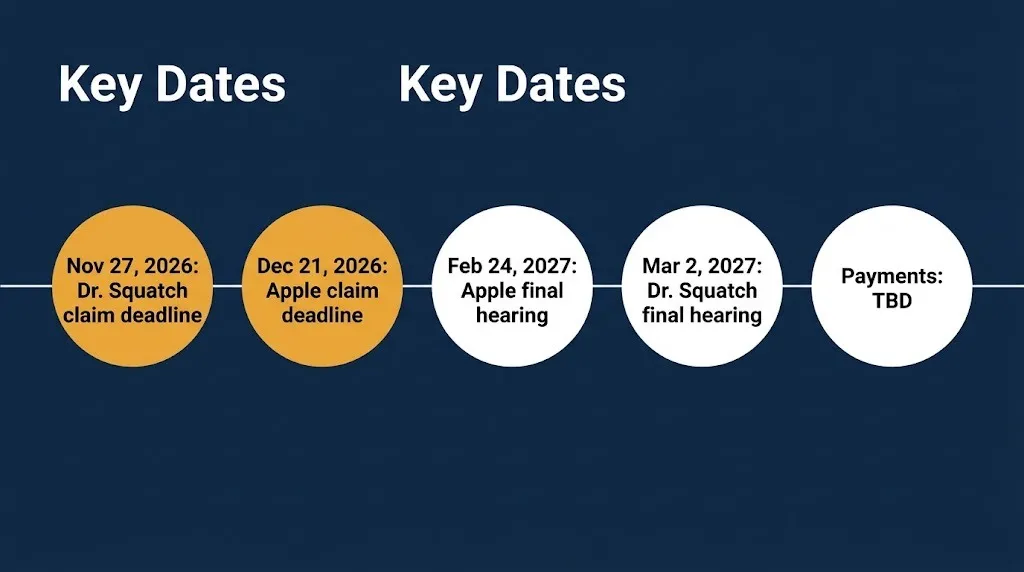
What Happens Next
- November 27, 2026: Dr. Squatch claim deadline, online by 11:59:59 p.m. Pacific or postmarked.
- December 21, 2026: Apple claim, exclusion, and objection deadline.
- February 24, 2027: Apple final approval hearing.
- March 2, 2027: Dr. Squatch final approval hearing.
- Expected spring to summer 2027: Payments, if final approval is granted, with timing set by each administrator.
Frequently Asked Questions
Is the Apple Siri false advertising settlement real?
Yes, it’s a court-supervised class action, Landsheft v. Apple Inc., Case No. 5:25-cv-02668.
Verita Global is the administrator.
Apple denies wrongdoing.
How much will I get from the Apple Siri settlement?
You may get $25 per eligible device, adjustable up to $95.
The final amount depends on how many valid claims are filed.
Nothing is guaranteed until final approval.
Do I need a receipt for the Dr. Squatch settlement?
You can claim up to five products with no receipt.
Claiming up to 25 products requires proof of purchase.
Check the official claim form for the exact rule.
What is the deadline to file a Dr. Squatch claim?
The deadline is November 27, 2026, at 11:59:59 p.m. Pacific for online claims.
Paper claims must be postmarked by that date.
The opt-out deadline of October 13, 2026 has passed.
Can I claim if I bought my iPhone used?
Probably not, because Apple’s settlement requires the original purchaser.
The purchase must be between June 10, 2024 and March 29, 2025.
Confirm on the official settlement website.
Can I file for more than one Apple device?
Yes, each eligible device is a separate claim.
The settlement allows one payment per device.
You’ll need each serial number.
Do I have to pay to file a settlement claim?
No, filing is free.
Anyone charging a fee to file for you isn’t the official administrator.
Use only the official settlement website.
Can I sue a company for false advertising on my own?
Yes, under state consumer protection laws, but rules and deadlines vary.
Opting out of a class settlement keeps that right alive.
Ask a licensed attorney in your state first.
Calendar both dates today: November 27 for Dr. Squatch and December 21 for Apple. Then gather your serial numbers and any receipts.
Open the official settlement website for each case and file the free form. The earliest deadline is November 27, 2026.