Compensation Benchmarking Software in 2026: Real Prices, AI Launches, and What Vendors Won’t Tell You
Quick Answer
- Compensation benchmarking software helps employers price jobs against market data; it is not a lawsuit or settlement.
- Verified 2026 prices run from $49 per user annually to $150,000+ for enterprise platforms.
- The key 2026 date is September 8, when Payscale launched its AI-first Ascent platform.
Compensation benchmarking software is a tool that compares your organization’s pay against market data to set competitive salaries. The market is real, crowded, and getting more expensive as AI features arrive.
This affects HR leaders, compensation analysts, and finance teams at companies of every size. The number that matters most is your total contract value, and Vendr’s 2026 transaction data puts mid-market OpenComp deals at $30,000 to $80,000 annually after negotiation .
This article covers verified 2026 pricing, the new AI platforms from Payscale and WTW, free trial options, and the hidden costs vendors don’t advertise. One detail most competitors miss: Payscale’s own survey of 3,400 HR leaders found fewer than two in three organizations are updating roles for AI skills .
The Facts
| Item | Verified Detail |
|---|---|
| Product category | HR software for salary benchmarking and pay structure design |
| Entry-level price | $49 per year per user (Compease) |
| Mid-market annual cost | $30,000 to $80,000 (OpenComp, 100 to 300 employees) |
| Enterprise annual cost | $60,000 to $150,000+ (OpenComp, 500+ employees) |
| Payscale Ascent launch | September 8, 2026 |
| WTW Rewards AI launch | February 2, 2026 |
| gradar entry price | 3,000 euros per year |
| Settlement fund | Not applicable; this is a software market, not a lawsuit |
Is compensation benchmarking software legit or a scam?
Compensation benchmarking software is legitimate, and the market includes established vendors with public pricing and named enterprise clients. Payscale has operated for more than 20 years and lists Cintas, Leidos, Chipotle, and TJX Companies as customers .
The scam risk sits with anyone who promises “guaranteed market data” without naming a source. Benchmarking data quality varies by vendor, and the underlying survey panels differ.
The real vendors publish their methodology. Payscale’s Ascent runs on its Peer network of more than 4,500 organizations and 10.2 million incumbents . WTW built Rewards AI on its proprietary compensation data . Those are verifiable claims.
A simple comparison: buying benchmarking software is like buying a scale for a kitchen. The scale is only useful if it’s calibrated. A tool with thin or stale data is just a spreadsheet with a logo.
How much does compensation benchmarking software cost in 2026?
Compensation benchmarking software costs between $49 per year per user at the low end and $150,000 or more annually for enterprise platforms. The range is that wide because the products serve very different buyers.
Here are verified 2026 price points:
| Vendor | Price | Notes |
|---|---|---|
| Compease | $49 per year per user | Entry-level salary administration |
| Payfederate | $500 per month | AI-powered compensation management |
| gradar SME Complete | 3,000 euros per year | Up to 250 employees, 100 jobs |
| gradar Enterprise | 10,000 euros per year | API access, 8 users |
| AcuGrade Core | $9,000 per year | Job families and salary bands |
| AcuGrade Professional | $20,000 per year | AI job evaluation, multi-department |
| AcuGrade Enterprise | $90,000 per year | Large enterprises, 1,000+ employees |
| OpenComp (small) | $12,000 to $30,000 per year | Under 100 employees, post-negotiation |
| OpenComp (mid-market) | $30,000 to $80,000 per year | 100 to 300 employees |
| OpenComp (enterprise) | $60,000 to $150,000+ per year | 500+ employees |
Not yet determined: Exact public list prices for Payscale, WTW, and Pave. All three use custom quotes and do not publish standard pricing.
What did Payscale launch in September 2026?
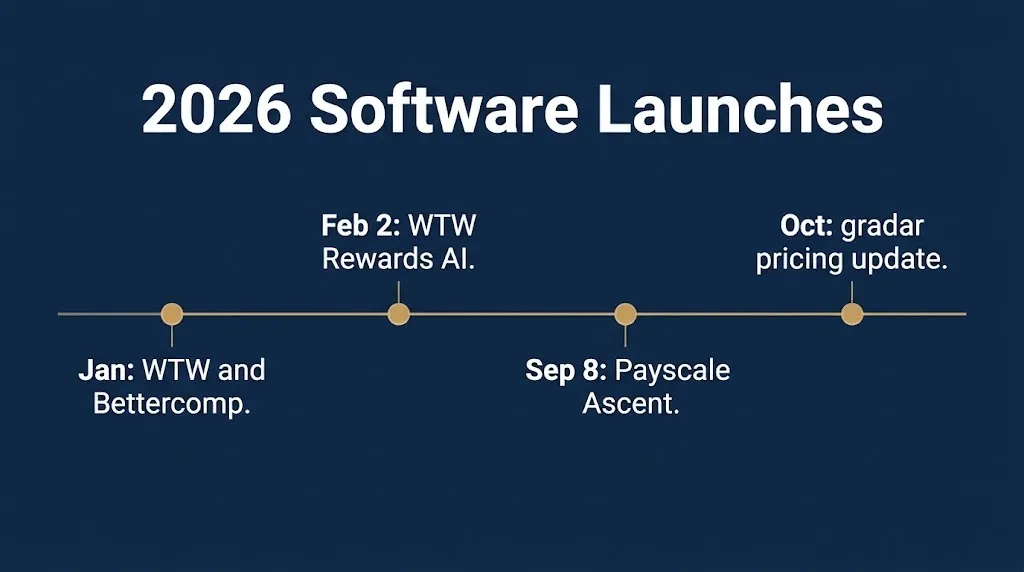
Payscale launched Ascent on September 8, 2026, an AI-first benchmarking platform inside its Payscale Intelligence Cloud . It combines market data, smart workflows, and contextual insights for pay decisions.
The key features are Smart Price, Smart Reporting, and Compass. Smart Price pairs skills-premium data with hiring demand signals. Smart Reporting lets you ask compensation questions in plain language and get a report back. Compass compares your compensation strategy against peers .
The platform runs on Payscale’s Peer network, which includes more than 4,500 organizations and 10.2 million incumbents . That data depth is the selling point.
The launch timing matters because Payscale’s own research shows the market is shifting. Its 2026 Compensation Best Practices Report found one in three organizations is replacing or reconsidering entire roles because of AI .
Key Takeaway: Payscale’s Ascent is the biggest 2026 launch in compensation benchmarking, and it bets that AI-driven workflows will replace annual survey snapshots.
What is WTW Rewards AI and how does it work?
WTW Rewards AI is a generative AI tool that lets compensation professionals ask questions in natural language about rewards data, launched February 2, 2026 . It runs on WTW’s proprietary compensation data.
The interface is conversational. You ask a question, and the tool returns an answer with every recommendation traceable to its source . That traceability is the trust feature, since AI-generated pay advice is only useful if you can defend it.
WTW also partnered with Bettercomp in January 2026 to integrate Bettercomp’s benchmarking software with WTW’s advisory data . That partnership expands what WTW can offer clients who want both advisory services and software.
The product is aimed at HR and compensation teams that already use WTW data. If you are a smaller company without a WTW relationship, the pricing and fit may not work for you.
Which compensation benchmarking tools offer free trials?
Several compensation benchmarking tools offer free trials, and the list is longer than most buyers expect. SourceForge tracks at least six tools with trial availability as of June 2026 .
Here is the verified trial list:
- Payfederate: Free trial available, $500 per month starting price
- Decusoft Compose: Free trial available
- Payfactors (Payscale): Free trial available
- Barley: Free trial available
- Salary.com: Free trial available
- Heartpace: Free trial available
A free trial does not mean a free product. Most trials run 14 to 30 days and require a sales conversation before activation. Treat the trial as a data-quality test, not a price test.
The better question is whether the trial data matches your industry and geography. A tool with excellent tech-industry data may have thin coverage for health care or public sector roles.
What hidden costs should you expect with benchmarking software?
Hidden costs with compensation benchmarking software include implementation fees, data integration charges, user seat overages, and equity data migration. Vendr’s 2026 data breaks down the real numbers .
The verified hidden costs for OpenComp specifically include:
- Data integration and API setup: $2,000 to $10,000 in one-time fees
- Equity data migration: $5,000 to $20,000 depending on complexity
- User seat overages: $500 to $2,000 per additional user annually
- Annual escalation: Contract renewal increases are common
Those add-ons can push a $30,000 contract to $45,000 or more in year one. The software price is the starting point, not the total.
Ask every vendor for a total cost of ownership estimate that includes implementation, integration, and the first renewal. If they won’t provide one, that’s a signal.
Reality Check: No one texts you about compensation benchmarking software or asks for a fee to “release” a benchmarking discount. This is a business software purchase, and legitimate vendors quote through sales teams, not cold calls. If a stranger contacts you offering a “guaranteed benchmarking license” at a steep discount, it is a scam. Verify the vendor through its official website before paying anything.
How do you choose the right compensation benchmarking software?
You choose compensation benchmarking software by matching data coverage to your industry and geography, then testing the workflow against your actual job catalog. Price comes third, after fit.
Here are the steps:
- List the job families and locations you need to benchmark.
- Ask each vendor for a data coverage report for your specific roles.
- Request a demo using your own job descriptions, not the vendor’s sample data.
- Get a written total cost of ownership estimate including implementation.
- Check the contract for auto-renewal terms and price escalation clauses.
- Ask for references from companies your size in your industry.
- Run a trial with your own data before signing.
The data coverage question is the one most buyers skip. A tool with great national data but thin local coverage will give you useless benchmarks for regional roles.
gradar’s pricing structure shows how vendors segment by company size. The SME Complete tier at 3,000 euros is capped at 250 employees, and the Starter Complete tier removes the company-size cap but still limits you to 100 jobs . If you grow past those limits, you pay more.
What happens next in compensation benchmarking software in 2026 and 2027?
The next stage in compensation benchmarking software is the AI feature race, with vendors adding generative interfaces and predictive modeling. No settlement or claim process exists, because this is a software market.
September 2026: Payscale Ascent launched and began onboarding customers .
Expected Q4 2026: Year-end compensation cycles drive adoption of planning and benchmarking tools.
Expected 2027: More vendors add generative AI interfaces, following WTW’s February 2026 launch .
Ongoing: The EU Pay Transparency Directive pushes European companies toward tools with pay gap analysis, which gradar and Syndio both address .
Frequently Asked Questions
How much does compensation benchmarking software cost?
Prices range from $49 per user per year to $150,000+ annually for enterprise platforms.
Mid-market OpenComp contracts run $30,000 to $80,000 after negotiation .
Entry-level tools like Compease start at $49 per user annually .
What is Payscale Ascent?
It is an AI-first benchmarking platform launched September 8, 2026.
It combines market data, smart workflows, and contextual insights in one platform .
It runs on Payscale’s Peer network of 4,500+ organizations.
Does WTW Rewards AI replace compensation analysts?
No, it is a tool for compensation professionals, not a replacement.
It lets users ask questions in natural language and returns traceable answers .
WTW describes it as “human-led, machine-powered.”
Which compensation benchmarking tools have free trials?
Payfederate, Decusoft Compose, Payfactors, Barley, Salary.com, and Heartpace all offer free trials .
Most require a sales conversation before activation.
Use the trial to test data coverage for your specific roles.
What hidden costs should I expect?
Data integration fees run $2,000 to $10,000.
Equity data migration can add $5,000 to $20,000.
User seat overages cost $500 to $2,000 per user annually .
Ask for a total cost of ownership estimate before signing.
Is compensation benchmarking software a scam?
No, the major vendors are established companies with public clients and verifiable data.
Payscale has operated for more than 20 years .
The risk is paying for data that does not cover your industry, so test coverage first.
What is the cheapest compensation benchmarking tool?
Compease lists $49 per year per user .
Payfederate starts at $500 per month .
Cheap tools may have limited data coverage, so compare features before choosing on price alone.
The number to check before you sign
Ask every vendor for a total cost of ownership estimate that includes implementation and the first renewal. Vendr’s data shows hidden costs can add $7,000 to $30,000 in year one on top of the software price . The sticker price is not the contract price, and the contract price is what you actually pay.