Compensation Structure 2026: The Complete Guide to Pay Components, Examples, and How Employers Build Them
Quick Answer
- A compensation structure is a company’s formal system for setting pay grades, salary ranges, and benefits for every role.
- Federal data shows benefits add about 30 percent on top of wages, with private employers spending $14.07 per hour on benefits versus $32.82 on wages.
- The structure usually includes base salary, bonuses, benefits, and sometimes equity, with each component serving a different purpose.
A compensation structure is the framework a company uses to decide what to pay people. It is not just a salary number. It is the whole system: pay grades, salary ranges, bonus targets, benefits packages, and the rules for how someone moves up. Without a structure, pay decisions become arbitrary, and that creates legal risk and employee resentment.
The U.S. Bureau of Labor Statistics tracks what employers actually spend. As of June 2026, total compensation costs averaged $46.89 per hour for private industry workers. Wages and salaries accounted for $32.82 of that. Benefits accounted for the remaining $14.07 . That split, roughly 70 percent wages and 30 percent benefits, is the structural reality of how American employers pay for labor.
If you are building a compensation structure, benchmarking your own pay, or trying to understand why your offer looks the way it does, this article breaks down the components, the dollar figures, and the examples that show how it all fits together.
The Facts
| Case | Compensation Structure (employment concept) |
|---|---|
| Status | Standard employment practice, not a legal case |
| Fund Size | Not applicable |
| Est. Per Person | Benefits average $14.07/hour in private industry |
| Claim Deadline | Not applicable |
| Administrator | Employer HR and compensation committee |
| Proof Needed | Total compensation statement from HR |
What Is a Compensation Structure?
A compensation structure is a formal system that defines how an employer pays its employees, including pay grades, salary ranges, bonus eligibility, and benefits. It answers the question: for this role, at this level, with this experience, what does the company pay? The structure removes guesswork and reduces the risk of discriminatory or inconsistent pay decisions.
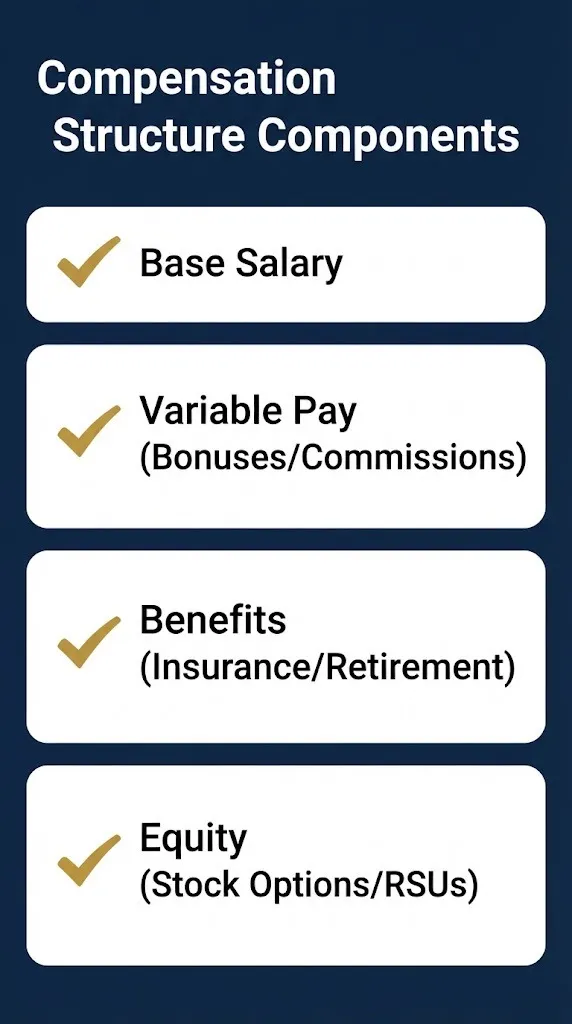
Most compensation structures have four main components. Base salary is the fixed annual amount. Variable pay includes bonuses, commissions, and profit-sharing. Benefits include health insurance, retirement contributions, and paid leave. Equity, when offered, includes stock options or restricted stock units.
The Bureau of Labor Statistics measures these components in its Employer Costs for Employee Compensation program. For private industry workers in June 2026, the breakdown was: wages and salaries at $32.82 per hour, paid leave at $3.54, supplemental pay at $1.71, insurance at $3.41, retirement and savings at $1.57, and legally required benefits at $3.38 .
That is the national average. Your employer’s structure may weight these components differently. A startup might offer lower base salary but more equity. A government agency might offer lower salary but a pension worth far more than a 401(k) match.
Key Takeaway: A compensation structure is a formal system, not a single number. It defines pay grades, salary ranges, and benefits for every role.
What Is a Compensation Structure Example?
A compensation structure example is a tech company with five pay grades, each with a defined salary range and bonus target. Here is how that looks in practice:
| Pay Grade | Role Level | Salary Range | Bonus Target | Equity |
|---|---|---|---|---|
| 1 | Entry Level | $50,000 – $65,000 | 5% | None |
| 2 | Associate | $65,000 – $85,000 | 10% | 0.01% |
| 3 | Mid-Level | $85,000 – $115,000 | 15% | 0.05% |
| 4 | Senior | $115,000 – $150,000 | 20% | 0.10% |
| 5 | Principal | $150,000 – $200,000 | 30% | 0.25% |
This structure tells you two things. First, where your role fits in the hierarchy. Second, what the employer is willing to pay for that level. The salary range is the band. The midpoint is usually the target for a fully qualified performer. The top of the range is reserved for exceptional performers or long-tenured employees.
A manufacturing company would have a different structure. Hourly production workers might have a narrow range with shift differentials. Skilled trades might have higher ranges and overtime eligibility. Management would have salary ranges with bonus targets tied to plant performance.
A nonprofit would have a flatter structure, with narrower salary bands and a heavier emphasis on benefits like paid leave and retirement contributions. The point is that the structure reflects the employer’s strategy and the labor market it competes in.
Key Takeaway: A compensation structure example shows pay grades, salary ranges, bonus targets, and equity tiers. The structure reflects what the employer values and what the market demands.
How Much Do Benefits Add to Total Compensation?
Benefits add about 30 percent on top of wages, according to Bureau of Labor Statistics data from June 2026. For private industry workers, benefits cost employers $14.07 per hour, compared to $32.82 per hour in wages and salaries . That means the real value of a job is roughly 43 percent higher than the salary alone.
That percentage varies by industry and employer type. State and local government employers spend $25.59 per hour on benefits, nearly double the private sector rate. Their retirement contributions alone average $8.83 per hour, more than five times the private sector average .
Here is the verified breakdown of benefit costs for private industry workers in June 2026:
| Benefit Category | Cost Per Hour |
|---|---|
| Paid leave | $3.54 |
| Supplemental pay | $1.71 |
| Insurance | $3.41 |
| Retirement and savings | $1.57 |
| Legally required benefits | $3.38 |
| Total benefits | $14.07 |
Legally required benefits include Social Security, Medicare, unemployment insurance, and workers’ compensation. Those are not optional. Every covered employer pays them. The discretionary benefits, like health insurance and retirement matches, are where employers compete for talent.
Key Takeaway: Benefits add roughly 30 percent to total compensation. Government employers spend nearly double the private sector rate on benefits.
What Is the Difference Between Compensation and Total Rewards?
Compensation is the measurable pay and benefit value an employer provides. Total rewards is a broader concept that includes compensation, benefits, and non-monetary elements like recognition, career development, flexible work, and mentorship. The distinction matters when you are comparing offers or designing a structure.
A total rewards strategy includes things that do not have a clean dollar figure. Flexible hours, remote work options, professional development budgets, and mentorship programs all have value. But they are harder to quantify than a salary number or a 401(k) match.
The Conference Board notes that total rewards strategies are shifting toward personalization and flexibility, with employers using data to offer benefits that match individual employee needs rather than a one-size-fits-all approach. That shift reflects a changing workforce with different priorities at different life stages.
When you evaluate a job offer, focus on compensation first. That is what you can calculate and negotiate most directly. Then factor in the total rewards elements. A flexible schedule might be worth thousands to a parent. A mentorship program might be worth more than a small salary bump to someone early in their career.
Key Takeaway: Compensation is the measurable value. Total rewards includes the harder-to-quantify extras. Compare offers using compensation numbers, then weigh the rest.
Reality Check: A compensation structure is not a guarantee of a specific salary. The range is a band, not a promise. Your offer depends on your experience, the employer’s budget, and the market at the time of hiring. The structure tells you what is possible, not what you will definitely get.
How Do Employers Build a Compensation Structure?
Employers build a compensation structure by benchmarking against the market, defining pay grades, and setting salary ranges for each grade. The process usually involves a compensation consultant, market data from surveys, and a job evaluation method that scores each role.
Here are the steps:
- Conduct a job analysis. Document the duties, requirements, and responsibilities of each role.
- Benchmark against market data. Use surveys from organizations like Mercer, Willis Towers Watson, or the Bureau of Labor Statistics.
- Define pay grades. Group similar roles into bands based on responsibility, skill, and market value.
- Set salary ranges. Establish minimum, midpoint, and maximum pay for each grade.
- Determine variable pay targets. Set bonus percentages, commission structures, and equity eligibility.
- Review benefits offerings. Compare health insurance, retirement, and leave against competitors.
- Document and communicate. Publish the structure internally so employees understand how pay is determined.
The structure is not static. Employers review it annually or whenever the market shifts significantly. A tight labor market pushes ranges up. A recession may freeze them.
What Factors Affect a Compensation Structure?
Several factors shape how an employer structures compensation. The most significant are industry, company size, geography, and the employer’s overall strategy.
Industry matters enormously. Technology companies often weight equity heavily. Financial services emphasize cash bonuses. Manufacturing focuses on hourly wages and shift differentials. Nonprofits emphasize benefits and mission.
Company size affects resources. Large employers can afford compensation consultants and sophisticated structures. Small employers often rely on simpler systems or ad hoc decisions.
Geography drives cost-of-living adjustments. A software engineer in San Francisco earns more than one in Austin, even for the same role. Employers use geographic differentials to adjust ranges by location.
Strategy determines the mix. A company that wants to attract top talent might pay at the 75th percentile of the market. A company focused on cost control might pay at the 25th percentile but offer more equity or flexibility.
Key Takeaway: Industry, company size, geography, and strategy all shape how an employer builds its compensation structure.
What Happens Next
Annually: Employers review and adjust their compensation structures based on market data and budget.
During hiring: Ask for the salary range for your grade and the total compensation breakdown before accepting an offer.
During performance reviews: Understand how your pay compares to the midpoint of your range. That tells you where you stand.
Ongoing: Request a total compensation statement from HR to see the full value of your package, not just your salary.
Frequently Asked Questions
What is a compensation structure?
A compensation structure is a formal system that defines how an employer pays employees, including pay grades, salary ranges, bonus targets, and benefits.
What is included in a compensation structure?
Base salary, variable pay (bonuses, commissions), benefits (health insurance, retirement, paid leave), and sometimes equity (stock options, RSUs).
How much do benefits add to total compensation?
Benefits add about 30 percent on top of wages. Private employers spent $14.07 per hour on benefits versus $32.82 on wages in June 2026.
What is a compensation structure example?
A tech company with five pay grades, each with a salary range, bonus target, and equity tier. Entry-level might be $50,000-$65,000 with 5% bonus. Principal might be $150,000-$200,000 with 30% bonus and 0.25% equity.
What is the difference between compensation and total rewards?
Compensation is the measurable pay and benefit value. Total rewards includes compensation plus non-monetary elements like recognition, development, and flexible work.
How do employers set salary ranges?
Employers benchmark against market data from surveys and the Bureau of Labor Statistics, then define pay grades and set minimum, midpoint, and maximum ranges.
What factors affect a compensation structure?
Industry, company size, geography, and the employer’s strategy all shape how compensation is structured.
Can I negotiate within a compensation structure?
Yes. The salary range is a band, not a fixed number. Your offer depends on your experience, the employer’s budget, and the market.