Lawsuit Loans Diamondback Funding 2026: What This Company Offers and What You Should Know Before Signing
Quick Answer
- Diamondback Funding offers non-recourse lawsuit advances, not traditional loans.
- You repay only if your case settles or you win at trial.
- Rates are high compared to bank loans, often 30 to 60 percent annually.
You have a pending lawsuit and need cash now. You search for lawsuit loans and find Diamondback Funding.
The first thing to understand: these are not loans in the traditional sense. They are non-recourse advances against your future settlement. If you lose your case, you owe nothing.
The second thing: the cost is steep. This article explains how Diamondback Funding works, what it costs, and the questions to ask before you sign anything.
| The Facts | |
|---|---|
| Company | Diamondback Funding |
| Product | Pre-settlement funding, lawsuit advance |
| Type | Non-recourse, in most cases |
| Repayment | Only if you win or settle |
| Rates | Not publicly disclosed, typically high |
| Attorney Involvement | Required in practice |
| Credit Check | None |
Is Diamondback Funding Legit?
Diamondback Funding appears to be a legitimate pre-settlement funding company operating in the lawsuit advance industry.
The company offers cash advances to plaintiffs with pending personal injury and other civil claims. This is a recognized industry with established players.
That said, legitimacy is not the same as affordability. The lawsuit funding industry charges rates far above traditional loans, and Diamondback Funding is not an exception.
| Legitimacy Factor | Status |
|---|---|
| Active business | Yes, appears operational |
| Industry recognition | Standard funding model |
| Regulatory actions | None confirmed |
| Consumer complaints | Varies, check state records |
No government enforcement action against Diamondback Funding is publicly confirmed as of September 2026.
How Do Lawsuit Loans From Diamondback Funding Work?
Diamondback Funding advances cash to plaintiffs based on the expected value of their pending lawsuit.
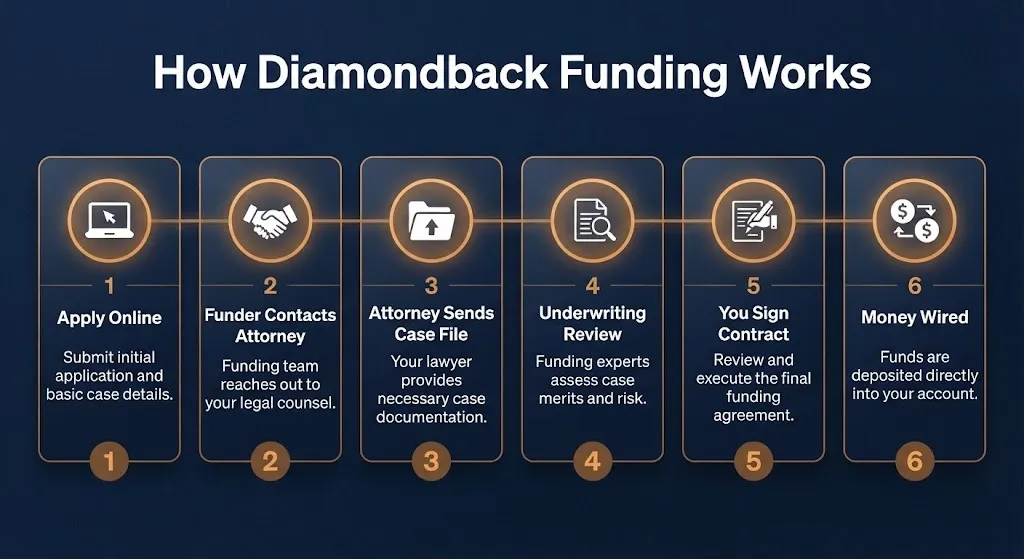
The process follows the standard pre-settlement funding model:
- You apply with details about your case.
- The company contacts your attorney for case documents.
- Underwriters evaluate liability, damages, and insurance limits.
- The company makes an offer if the case qualifies.
- You sign a funding agreement.
- The company wires the money.
- Repayment comes from your settlement or verdict.
The key requirement is attorney cooperation. The company cannot evaluate your case without your lawyer’s file.
How Much Does Diamondback Funding Cost?
Diamondback Funding does not publicly disclose standard rates, but the lawsuit funding industry typically charges 2.5 to 4.5 percent per month, compounded.
That translates to 30 to 54 percent annual interest before fees. Some cases run higher.
| Advance Amount | Monthly Rate | Owed After 12 Months |
|---|---|---|
| $5,000 | 3.0% | $7,100 |
| $10,000 | 3.5% | $15,100 |
| $25,000 | 4.0% | $40,000 |
These figures are illustrative based on industry norms, not confirmed Diamondback Funding rates. Get a written quote before signing.
Key Takeaway: Lawsuit advances from any funder, including Diamondback Funding, are expensive. The longer your case drags, the more you owe.
Is a Diamondback Funding Advance a Loan?
No, a Diamondback Funding advance is not a traditional loan. It is a non-recourse purchase of a portion of your potential settlement.
Non-recourse means the company can only collect if you win or settle. If you lose, you owe nothing.
This structure allows funding companies to avoid state usury laws in many jurisdictions. It also means the cost is not expressed as a simple APR, making comparison difficult.
| Feature | Lawsuit Advance | Traditional Loan |
|---|---|---|
| Credit check | None | Required |
| Repayment if you lose | No | Yes |
| Interest rate | 30% to 60% effective annual | 7% to 18% annual |
| Collateral | Your settlement | Income or assets |
The non-recourse feature is valuable. It is also the justification for the high cost.
What Types of Cases Does Diamondback Funding Cover?
Diamondback Funding typically covers personal injury cases with clear liability and insurance coverage.
The most common case types for lawsuit funding include:
- Car accident claims
- Slip and fall cases
- Medical malpractice
- Product liability
- Wrongful death
The company looks for cases with strong liability and sufficient insurance limits to repay the advance.
Does Diamondback Funding Require Attorney Cooperation?
Yes, Diamondback Funding requires attorney cooperation, even if it does not require an attorney signature on the funding agreement.
The company needs your attorney to provide case documents: medical records, police reports, insurance information, and liability evidence.
Your attorney must also agree to repay the funder from your settlement proceeds. Most funding companies require a written acknowledgment from the attorney.
| Attorney Role | Why It Matters |
|---|---|
| Provide case file | Underwriting cannot happen without it |
| Sign acknowledgment | Ensures funder gets paid from settlement |
| Confirm settlement amount | Prevents disputes at payout |
| Protect the lien | Attorney disburses funds to funder first |
Without attorney cooperation, no funding happens.
Key Takeaway: You can apply for Diamondback Funding without telling your lawyer, but the company will contact your lawyer before any money moves.
What Are the Risks of Using Diamondback Funding?
The main risks are the high cost, the potential to owe more than your settlement covers, and the loss of settlement flexibility.
Compounding interest is the biggest risk. A $10,000 advance can grow to $25,000 or more if your case takes two or three years.
If your settlement is smaller than expected, the funder still gets paid first. You may walk away with far less than you anticipated.
| Risk | What It Means |
|---|---|
| Compounding cost | Debt grows faster than you expect |
| Settlement shortfall | Funder paid first, you get less |
| Long case duration | More months means more interest |
| Pressure to settle | You may accept less to stop the clock |
Read the funding agreement carefully before signing.
Reality Check: No reputable lawsuit funder wires money without attorney verification. Anyone promising cash with no case review is either running a scam or charging rates that should terrify you.
What Are the Alternatives to Diamondback Funding?
Alternatives include personal loans, credit cards, medical payment plans, and negotiating directly with creditors.
If you can qualify for a personal loan from a bank or credit union, it will almost always be cheaper than a lawsuit advance.
| Alternative | Cost | Attorney Involvement |
|---|---|---|
| Personal loan | 7% to 18% annual | None |
| Credit card | 15% to 25% annual | None |
| Medical payment plan | Often zero interest | None |
| Family loan | Negotiable | None |
| Lawsuit advance | 30% to 60% annual | Required |
Exhaust cheaper options before signing with any lawsuit funding company.
What Should You Ask Before Signing With Diamondback Funding?
Ask for the total repayment amount at 6, 12, 18, and 24 months. Get the rate and fees in writing.
The right questions to ask include:
- What is the monthly rate and how is it compounded?
- What is the total owed if my case settles in 12 months?
- What fees are charged beyond the interest rate?
- Is the advance truly non-recourse?
- What happens if my settlement is less than the amount owed?
- Can I pay off the advance early without penalty?
- Will you contact my attorney directly?
Get every answer in writing before you sign.
What Happens Next With Your Lawsuit Funding Decision
If you move forward with Diamondback Funding, the process moves quickly once your attorney cooperates.
- Week 1: Application submitted
- Week 1 to 2: Attorney provides case documents
- Week 2: Underwriting decision
- Week 2 to 3: Offer and contract signing
- Week 3: Funds wired to your account
These timeframes are estimates. The process can move faster or slower depending on your attorney’s responsiveness.
Frequently Asked Questions
Is Diamondback Funding a scam?
No evidence suggests Diamondback Funding is a scam.
But the lawsuit funding industry charges rates far above traditional loans.
How much can I borrow from Diamondback Funding?
The amount depends on your case value.
Funding companies typically advance 10 to 20 percent of the expected settlement.
Do I need a lawyer to apply for Diamondback Funding?
You need an active lawsuit with an attorney.
The company requires attorney cooperation to evaluate your case.
What happens if I lose my case after taking a Diamondback advance?
You owe nothing in a non-recourse advance.
Confirm the non-recourse language in your contract before signing.
How fast can I get money from Diamondback Funding?
Funding can arrive in one to three weeks after approval.
Approval depends on how fast your attorney responds to document requests.
Are lawsuit advances regulated?
Regulation varies by state.
Some states cap rates; others treat advances as investments with few limits.
The Bottom Line
Diamondback Funding offers a real service for plaintiffs who cannot wait for their settlement. But the cost is high, and the risks are real.
Exhaust every cheaper option first. If you proceed, get the total repayment amount in writing for multiple timeframes. Know exactly what you owe before you sign.
The single most important fact is this: lawsuit advances are non-recourse, meaning you owe nothing if you lose, but the price of that protection is compounding interest that can consume a large share of your recovery.