Compensation Planning in 2026: What It Is, Why It Triggers Lawsuits, and How to Protect Your Pay
Quick Answer
- Compensation planning means designing pay structures, bonuses, and benefits for employees.
- Deferred compensation plans face lawsuits over forfeiture rules and ERISA compliance.
- The DOL’s September 2025 advisory opinion favored Morgan Stanley, but challenges continue.
If you searched for “compensation planning” expecting a simple definition, you’re in the right place. But you should know this: compensation planning isn’t just an HR buzzword anymore. It’s the center of a legal battle that could reshape how millions of workers get paid.
In 2026, courts and the Department of Labor are wrestling with a fundamental question. Are deferred compensation programs pension plans subject to federal protections, or discretionary bonuses that companies can cancel? The answer affects financial advisers, executives, and anyone with a pay package that includes delayed payouts.
This article breaks down what compensation planning actually means, why it’s triggering lawsuits, and what you need to know if your employer changes your pay structure.
The Facts
| Case Focus | Deferred compensation plan disputes, wrongful termination bonus claims, ERISA coverage questions |
| Key Litigation | Shafer v. Morgan Stanley, Merrill Lynch deferred pay appeal (4th Circuit) |
| Status | Active litigation; DOL advisory opinion issued September 2025 |
| Fund Size | No class settlement; individual claims seek hundreds of thousands each |
| Est. Per Person | Varies; one executive awarded $682,151 in wrongful dismissal case |
| Claim Deadline | Varies by case and arbitration agreement |
| Administrator | None; disputes proceed through arbitration or federal court |
| Proof Needed | Employment contracts, plan documents, compensation statements |
What Is Compensation Planning?
Compensation planning is the strategic process of designing, implementing, and managing how employees get paid . It covers base salaries, bonuses, commissions, equity, and benefits. The goal is to attract and keep talent while staying within budget.
Every company does it, even if they don’t call it that. When your boss decides how much to offer a new hire, that’s compensation planning. When HR sets salary bands for different job levels, that’s compensation planning too.
The process involves benchmarking roles against market data, defining salary ranges, and deciding how much to allocate for raises and promotions . Larger companies have dedicated compensation teams. Smaller businesses often handle it informally.
But informal or formal, the plan becomes a legal document the moment you accept a job offer. That’s where the lawsuits start.
Is Compensation Planning Legit or a Scam?
Compensation planning is entirely legitimate and standard business practice. But you should watch for one thing: when employers change the rules mid-game, that’s when legitimate planning turns into potential legal trouble.
The Morgan Stanley case shows exactly this. The company required financial advisers to contribute a portion of their revenue to deferred compensation plans . Those plans included a “cancellation rule” that caused advisers to forfeit money if they left for a competitor within four to eight years.
One adviser claimed he lost more than $500,000 under that rule . He argued it violated ERISA provisions governing how quickly retirement benefits vest.
Morgan Stanley says the plans are discretionary bonus arrangements, not pension plans . The Department of Labor agreed in a September 2025 advisory opinion. But former advisers are still fighting, arguing the DOL opinion was improperly obtained and legally wrong .
Reality Check: Your employer can change your compensation plan if the plan documents allow it. But they can’t break the law doing it. If your pay structure changes and you think it violates your contract, consult an employment attorney. Many offer free consultations.
How Much Could You Recover from a Compensation Lawsuit?
There’s no fixed payout for compensation lawsuits. It depends entirely on your documented losses and the specific facts of your case.
The Adelman v. IBM Canada case from January 2026 shows what courts can award . A 59-year-old executive received $682,151.18 total, including:
- $532,975.68 for 24 months of reasonable notice (base salary, pension, benefits)
- $269,508.27 for cancelled restricted stock units and stock options that would have vested during notice
His base salary at termination was $242,046 per year.
The court denied bonus entitlement during the notice period because the bonus wasn’t an integral part of compensation . But the judge found IBM’s decision to award a zero bonus for 2022 wasn’t exercised fairly. That ruling alone was worth significant money.
What Drives Compensation Lawsuit Values:
| Factor | Impact on Recovery |
|---|---|
| Length of service | Longer service typically means longer notice periods |
| Age | Older employees often receive longer notice under common law |
| Compensation complexity | Equity, bonuses, and deferred pay add value |
| Documentation quality | Clear records strengthen your claim |
| Contract language | Ambiguous terms often favor employees in court |
Who Qualifies for Compensation Plan Disputes?
You may qualify to pursue a claim if your employer changed your compensation plan without proper notice, failed to pay earned commissions or bonuses, or enforced forfeiture rules that violate your contract or federal law.
Common Scenarios That Trigger Claims:
- Your employer reduced your commission rate retroactively
- You were denied a bonus that was promised in writing
- Your deferred compensation was cancelled after you left
- Your employer misclassified your pay to avoid overtime or benefits
- Your compensation plan was changed without your consent
In the Office Depot case, a sales employee sued after the company unilaterally changed her compensation plan . The court found the company could change the plan without notice because the original plan allowed it. But the court also found the company violated the Illinois Wage Act by paying her commissions quarterly instead of monthly.
The lesson: contract language matters enormously. If your plan says the employer can change terms “at any time for any reason,” you have limited recourse on the change itself. But if they violate wage payment laws, you may still have a claim.
How Do You File a Compensation Lawsuit?
Filing a compensation lawsuit means documenting what you were promised, proving what you received, and showing the gap between the two. Most employment lawyers work on contingency.
Steps to Take:
- Gather your documents. Collect your employment contract, offer letter, compensation plan, and all pay statements.
- Document the change. Write down when you learned about the compensation change and who communicated it.
- Calculate your losses. Determine exactly how much money you should have received versus what you got.
- Check your arbitration agreement. Many employment contracts require arbitration instead of court.
- Consult an employment attorney. Most offer free initial consultations.
- File within the deadline. Employment claims have strict time limits, often 180 days to two years.
- Preserve evidence. Save emails, texts, and any written communications about your pay.
The Morgan Stanley advisers pursued arbitration after a federal judge sent their case there . Hundreds of former advisers have filed individual arbitration claims. The company has won some and lost others.
Why Is Morgan Stanley Facing Compensation Lawsuits?
Morgan Stanley faces lawsuits because former financial advisers claim the company’s deferred compensation program violates ERISA. The core dispute is whether the plan qualifies as a pension plan subject to federal vesting rules.
The plan requires advisers to contribute a portion of their revenue to deferred compensation accounts . The money pays out when advisers retire, become disabled, or are laid off. But if they leave for a competitor within four to eight years, they forfeit the money.
Advisers argue this “cancellation rule” violates ERISA provisions governing how quickly retirement benefits must vest . If the plans are ERISA-covered, the forfeiture rules would likely be illegal.
Morgan Stanley says the plans are discretionary bonus arrangements, not pension plans . The DOL agreed in September 2025, issuing an advisory opinion that the programs fall outside ERISA’s definition of a pension plan.
But a new lawsuit challenges that opinion, claiming Morgan Stanley improperly lobbied for it to use as a “sword” in arbitration . Three former employees allege the DOL violated its own procedures in issuing the letter.
Key Takeaway: The Morgan Stanley deferred compensation dispute is the biggest test of ERISA coverage for incentive pay since the 2008 financial crisis; its outcome will affect every company with similar plans.
What Does the DOL Advisory Opinion Mean for Your Pay?
The DOL’s September 2025 advisory opinion favors Morgan Stanley, but it doesn’t have the force of law. It’s persuasive authority that arbitrators and courts can consider, not binding precedent.
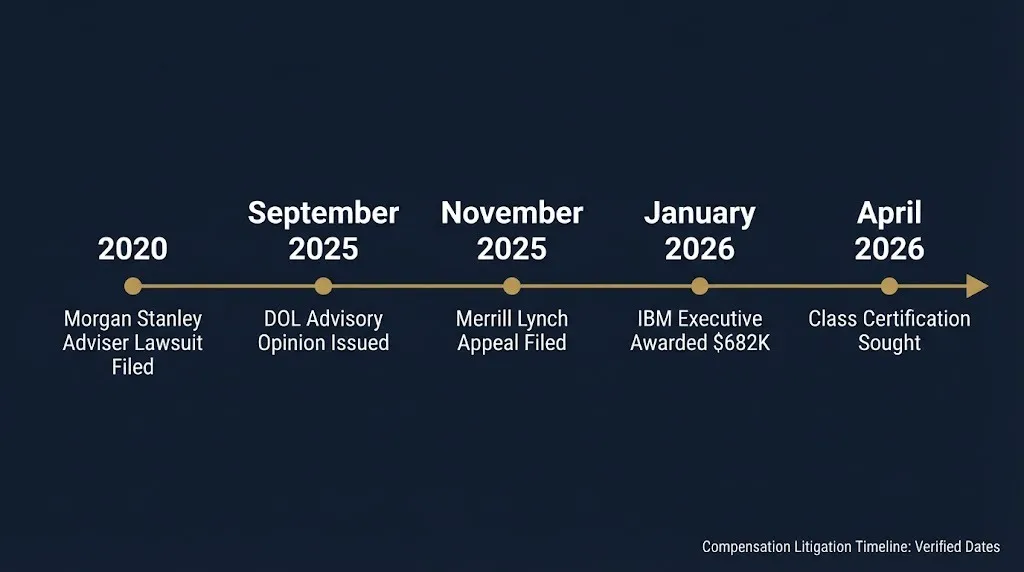
The opinion concluded that Morgan Stanley’s deferred compensation programs aren’t ERISA-covered pension plans because they incentivize performance and don’t systematically defer compensation beyond termination .
Government lawyers have since moved to dismiss a lawsuit challenging the opinion, arguing the former advisers lack standing and that the opinion itself has no binding legal effect .
For workers with deferred compensation, the opinion signals that the DOL currently favors employer-friendly interpretations. But the Merrill Lynch appeal in the Fourth Circuit could reach a different conclusion, creating a circuit split that might force Supreme Court review.
What Happens Next in Compensation Litigation
Pending: Former Morgan Stanley advisers seek class certification in their challenge to the DOL advisory opinion.
Expected late 2026: Fourth Circuit ruling on the Merrill Lynch deferred compensation appeal.
Ongoing: Hundreds of individual arbitration claims proceed against Morgan Stanley and Merrill Lynch.
Expected 2027: Potential Supreme Court review if circuit courts split on ERISA coverage for deferred pay.
Frequently Asked Questions
What is compensation planning in simple terms?
Compensation planning is how companies decide what to pay employees.
It covers salaries, bonuses, commissions, equity, and benefits.
The goal is to attract and keep talent while controlling costs.
Can my employer change my compensation plan without my consent?
It depends on your contract and plan documents.
If the plan allows changes without notice, courts often uphold them.
But employers still must comply with wage payment laws and anti-discrimination rules.
What is the Morgan Stanley deferred compensation lawsuit about?
Former advisers claim Morgan Stanley wrongfully forfeited their deferred pay.
They argue the plan violates ERISA vesting rules.
Morgan Stanley says the plan is a discretionary bonus, not a pension.
How much can I recover in a compensation lawsuit?
Recovery depends on your documented losses and contract terms.
One executive received $682,151 in a 2026 wrongful dismissal case.
Individual arbitration claims often seek hundreds of thousands of dollars.
Do I need a lawyer to sue over my compensation?
You can file on your own, but employment law is complex.
Most employment attorneys work on contingency, meaning no upfront cost.
A free consultation can tell you if your claim is worth pursuing.
What is the deadline to file a compensation lawsuit?
Deadlines vary by claim type and state.
Discrimination claims often require filing with the EEOC within 180 days.
Breach of contract claims typically have longer deadlines, often two to four years.
What You Should Do Now
If your employer changed your compensation plan, gather your documents immediately. Find your original offer letter, plan documents, and pay statements. Calculate exactly what you lost.
Consult an employment attorney before the deadline passes. Many claims have strict filing windows, and missing them means losing your right to recover. The Morgan Stanley arbitration claims show that even individual disputes can be worth hundreds of thousands of dollars.