Stock Based Compensation 2026: What It Is, How It Works, and the Legal Risks You Should Know
Quick Answer
- Stock based compensation means paying employees or executives with company stock instead of cash.
- It creates a non-cash expense on the company’s income statement under ASC 718.
- No consumer class action settlement related to stock compensation exists in 2026.
Stock based compensation is not a lawsuit. It is a way companies pay people with equity instead of cash.
Tech companies, startups, and public corporations use stock options, restricted stock units, and similar awards to attract and keep talent. The accounting rules for these awards are set by ASC 718.
But stock compensation does generate legal disputes. Shareholders sue over excessive dilution, improper accounting, and backdated options. Those cases are separate from the everyday accounting question.
This article explains what stock based compensation is, how the accounting works, what the legal risks are, and what to know in 2026.
The Facts
| Item | Details |
|---|---|
| Accounting Rule | ASC 718 |
| Governing Body | Financial Accounting Standards Board |
| Common Forms | Stock options, restricted stock units |
| Tax Treatment | Deductible when awards vest or are exercised |
| Legal Risk | Shareholder suits, SEC enforcement |
| 2026 Rule Change | None confirmed |
What Is Stock Based Compensation?
Stock based compensation is a form of payment where a company gives equity instead of cash.
Instead of paying an employee $50,000 in salary, a company might pay $40,000 in salary plus $10,000 worth of restricted stock units. The employee gets ownership, and the company preserves cash.
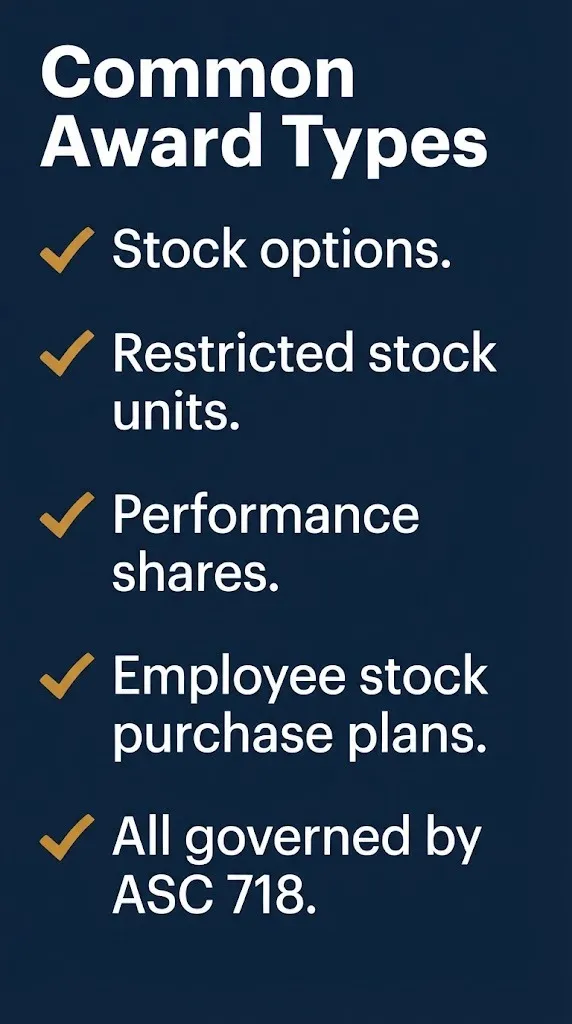
Here are the most common forms:
| Form | How It Works |
|---|---|
| Stock options | Right to buy shares at a set price |
| Restricted stock units | Shares delivered when vesting conditions are met |
| Performance shares | Shares earned when performance goals are hit |
| Employee stock purchase plans | Employees buy shares at a discount |
What Is a Stock Based Compensation Expense?
A stock based compensation expense is the accounting charge a company records when it grants equity awards.
Under ASC 718, companies must value the award on the grant date and expense that value over the vesting period. The expense is non-cash, meaning no money leaves the company’s bank account.
Here is how the expense works:
| Grant Element | Accounting Treatment |
|---|---|
| Award value on grant date | Total expense to recognize |
| Vesting period | Expense spread over this time |
| Non-cash nature | Reduces reported profit, not cash |
| Tax deduction | Recognized when award settles |
Key Takeaway: Stock compensation reduces reported earnings but does not reduce cash. That is why companies with heavy stock compensation often show non-GAAP profit metrics that add the expense back.
What Is ASC 718 Stock Compensation?
ASC 718 is the Financial Accounting Standards Board rule that governs stock compensation accounting.
It replaced the older APB 25 standard. Under ASC 718, companies must recognize the fair value of equity awards as an expense.
The fair value is usually calculated using an option pricing model like Black-Scholes for options or the market price for restricted stock.
Here is what ASC 718 requires:
| Requirement | What It Means |
|---|---|
| Fair value measurement | Award valued at grant date |
| Expense recognition | Spread over vesting period |
| Footnote disclosure | Companies must explain assumptions |
| Tax accounting | Deferred tax assets for future deductions |
Is Stock Compensation Taxable to the Employee?
Yes, stock compensation is taxable to the employee in most cases.
The timing depends on the award type. Restricted stock units are taxed when they vest. Stock options may be taxed at exercise or later, depending on the option type.
Here is the tax treatment:
| Award Type | Taxable Event |
|---|---|
| Restricted stock units | At vesting |
| Non-qualified stock options | At exercise |
| Incentive stock options | At sale, if holding periods met |
| Employee stock purchase plan | At sale, with special rules |
The company gets a tax deduction equal to the amount the employee includes in income.
What Legal Disputes Arise From Stock Compensation?
Legal disputes over stock compensation fall into several categories.
Shareholders sue when they believe awards are excessive or improperly approved. The SEC prosecutes cases involving backdated options or undisclosed compensation.
Here are the main dispute types:
| Dispute Type | Typical Claim |
|---|---|
| Shareholder derivative suit | Excessive executive pay |
| SEC enforcement | Backdated or undisclosed options |
| Employment dispute | Vesting or forfeiture conflicts |
| Securities fraud | Misleading disclosures about dilution |
These cases do not create consumer settlement funds. They are corporate governance matters.
Reality Check: No stock compensation lawsuit produces a public claim form for everyday consumers. If you see a post claiming you can file for a stock compensation payout, it is a scam.
How Does Stock Based Compensation Affect a Company’s Financial Statements?
Stock based compensation affects the income statement, balance sheet, and cash flow statement.
The expense reduces net income on the income statement. The balance sheet shows an increase in equity. The cash flow statement adds the expense back since it is non-cash.
Here is the impact:
| Statement | Effect |
|---|---|
| Income statement | Expense reduces net income |
| Balance sheet | Equity increases, no cash change |
| Cash flow statement | Expense added back to operating cash flow |
What Is the Difference Between Stock Options and Restricted Stock Units?
Stock options give you the right to buy shares at a set price. Restricted stock units give you shares outright when they vest.
Options have value only if the stock price rises above the exercise price. RSUs have value even if the stock stays flat.
Here is the comparison:
| Feature | Stock Options | Restricted Stock Units |
|---|---|---|
| Value if stock flat | Zero | Full share value |
| Value if stock rises | High | Full share value |
| Tax timing | At exercise | At vesting |
| Employee cost | May need to buy shares | No cost |
What Is Share Based Compensation Under ASC 718?
Share based compensation is the broader term that includes stock options, restricted stock, and other equity awards.
ASC 718 uses the term “share based payment” to cover all forms of equity compensation. The accounting is the same regardless of the specific award type.
Here is what falls under the ASC 718 umbrella:
| Award Type | Covered by ASC 718 |
|---|---|
| Stock options | Yes |
| Restricted stock | Yes |
| Restricted stock units | Yes |
| Performance awards | Yes |
| Employee stock purchase plans | Yes |
What Happens Next
Expected 2026: No major FASB changes to ASC 718 are pending.
Ongoing: Companies continue granting equity awards under existing rules.
Your move: If you receive stock compensation, understand your award type and tax timing.
If you are a shareholder: Watch proxy statements for dilution and award approvals.
Stock based compensation is a core part of how modern companies pay people. It is also a source of accounting complexity and legal risk.
The rules under ASC 718 are stable. No major changes are coming in 2026.
If you receive equity awards, know your vesting schedule and tax dates. If you are a shareholder, know how much dilution you are accepting.