What Happens to Deferred Compensation If I Quit? 2026 Tax and Payout Guide
Quick Answer
- Vested deferred compensation is usually paid out according to your plan’s distribution schedule, even if you quit.
- Unvested amounts are typically forfeited if you leave voluntarily before vesting requirements are met.
- Deferred compensation is taxed as ordinary income when it is paid or made available to you, not when you earned it.
What Happens to Deferred Compensation If I Quit?
What happens to your deferred compensation when you quit depends on whether your account is vested and what your plan document says about distribution timing.
If you are fully vested, you will receive the money according to the payout schedule you elected when you enrolled. That could mean a lump sum shortly after separation, or installment payments stretched over years.
If you are not fully vested, the unvested portion is usually forfeited. A typical plan clause states that if employment ends voluntarily before the account is fully vested, “any unvested portion of the Deferral Account shall be forfeited”.
Vesting schedules vary widely. Some plans vest after three to five years of service. Others tie vesting to reaching a certain age, like 55 with 10 years of service.
Key Takeaway: Your plan document is the only source that matters here. Read the vesting section before you make any decisions about leaving.
How Is Deferred Compensation Taxed When You Receive It?
Deferred compensation is taxed as ordinary income when it is paid or made available to you, not when you earned it.
This is the core tradeoff of a deferred comp plan. You defer income in high-earning years, then pay tax when the money comes out. If you are in a lower bracket at retirement, you may pay less tax overall.
The IRS is clear on this. “A payment of deferred compensation is not limited to a payment under a written plan that states that its objective is to defer compensation for retirement”. Any arrangement that results in a deferral of compensation falls under these rules.
Your payout will be reported on a Form W-2. Deferred compensation distributions are treated as wages and subject to income tax withholding. The withholding may not cover your full tax bill, especially if you receive a large lump sum.
Key Takeaway: A $200,000 payout is not $200,000 in your pocket. Withholding is just a down payment on your actual tax liability.
Reality Check
No one will call you about a “deferred compensation refund” or a “tax recovery program” for deferred comp. The money in your account is already yours if vested, and you do not need to pay a third party to access it. If someone claims they can unlock frozen deferred compensation for a fee, it is a scam.
Is Deferred Compensation Taxable When You Quit?
Deferred compensation is not automatically taxable just because you quit. The tax trigger is payment or availability, not separation from service.
That said, some plan designs create a taxable event at separation. Section 457(f) plans for government and tax-exempt employers are different. In those plans, “deferred compensation becomes taxable in the calendar year in which the substantial risk of forfeiture ends, regardless of whether the deferred amounts are actually paid in that year”.
If your plan has a vesting cliff that you hit on your last day, you may owe tax on the full vested amount even if the money is paid out later. That is rare in corporate 409A plans but common in 457(f) arrangements.
For most private-sector employees with a nonqualified deferred compensation plan, there is no tax at separation. The tax comes when the money hits your account.
Can I Take a Lump Sum If I Quit?
Whether you can take a lump sum depends on your plan’s distribution elections. Most plans require you to choose your payout form when you enroll.
Common payout options include a lump sum, five-year installments, or ten-year installments. You usually cannot change your election after the fact without meeting strict Section 409A rules.
Section 409A governs the timing of distributions from nonqualified deferred compensation plans. It limits when payments can be made and how elections can be changed. A payout triggered by separation from service is a permitted distribution event, but the form of payment is locked to your earlier election.
Some plans allow a “separation from service” lump sum only if you meet certain age or service thresholds. Others default to installments.
What About the 6-Month Delay Rule for Executives?
Certain specified employees of publicly traded companies face a six-month delay for payments triggered by separation from service.
This rule exists to prevent executives from getting a quick payout and leaving. If you are a “specified employee” as defined by the IRS, your deferred comp payments cannot start until six months after you separate.
The delay applies to separation-triggered payments only. If your plan allows distributions at a fixed date or upon a change in control, the six-month rule may not apply.
For planning purposes, this means you may need cash reserves to cover six months of expenses if you are relying on deferred comp to fund your transition.
How Does Deferred Compensation Affect Social Security and Medicare?
A deferred compensation payout can affect both Social Security taxation and Medicare premiums.
On the Social Security side, a payout increases your taxable income. That can push more of your Social Security benefits into the taxable category if you are already receiving them.
On the Medicare side, the impact can be sharper. A large payout can raise your modified adjusted gross income (MAGI) and trigger the Income-Related Monthly Adjustment Amount (IRMAA). For 2026, IRMAA applies to individuals with MAGI above $109,000 and married couples filing jointly above $218,000.
Medicare uses your tax return from two years earlier to set your premiums. A 2026 payout could raise your 2028 Medicare premiums.
What Should I Do Before Quitting With Deferred Compensation?
Before you resign, gather your plan documents and model the tax impact. You do not want to discover a six-month payment delay after you have already given notice.
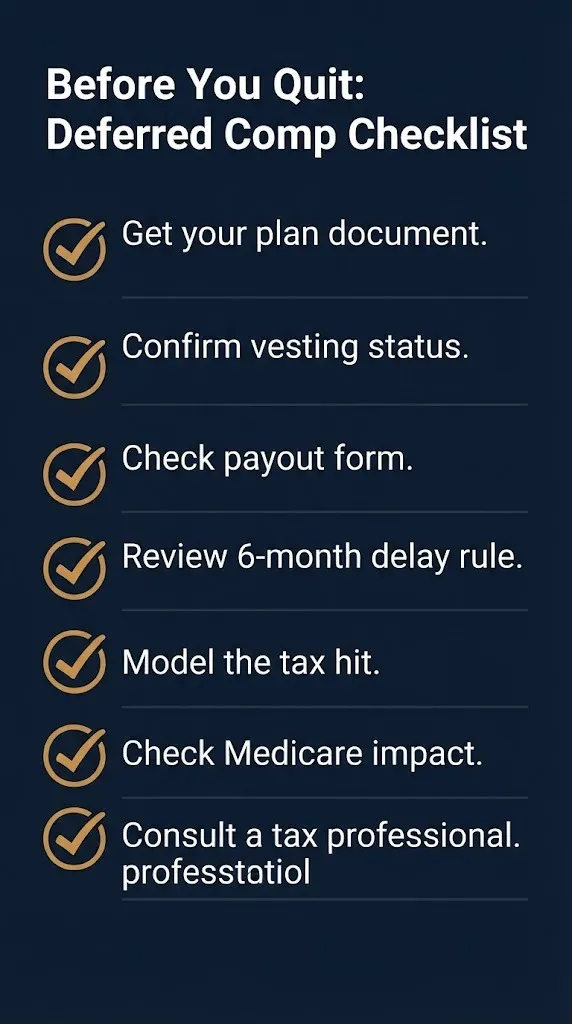
Here is a checklist to run before you quit:
- Get your plan document. Find the vesting schedule and distribution provisions.
- Confirm your vesting status. Know exactly how much is vested and how much would be forfeited.
- Check the payout form. Lump sum or installments? Can it be changed?
- Review the 6-month delay. Are you a specified employee of a public company?
- Model the tax hit. Estimate your income for the payout year and the next year.
- Check Medicare impact. If you are near 63 or older, a payout could raise future premiums.
- Consult a tax professional. Section 409A is dense, and the stakes are high.
What Happens Next With Your Deferred Compensation?
The timeline from resignation to payment depends on your plan’s terms and whether the six-month delay applies.
Here is the likely sequence:
- Immediately: Confirm your separation date and vesting status with HR or your plan administrator.
- Within 30 to 90 days: Most plans process the separation event and calculate your final vested balance.
- 6 months after separation (if applicable): If you are a specified employee of a public company, payments begin after the delay.
- Per your election: Lump sum or installments begin. Taxes are withheld at supplemental wage rates.
- January of the following year: You receive a Form W-2 reporting the distribution.
Frequently Asked Questions
Do I lose deferred compensation if I quit?
You only lose the unvested portion. Vested deferred compensation is yours and will be paid according to your plan’s distribution schedule.
Check your plan document for the vesting schedule. Voluntary termination often triggers forfeiture of unvested amounts.
Is deferred compensation taxed when I quit or when I get paid?
Deferred compensation is taxed when it is paid or made available to you, not when you quit.
The exception is 457(f) plans, where tax can trigger when vesting occurs even if payment is later.
Can I roll deferred compensation into an IRA?
No. Nonqualified deferred compensation generally cannot be rolled into an IRA or 401(k).
It is not a qualified plan, so the rollover rules do not apply. The payout is taxable income in the year received.
What is the 6-month delay rule for deferred compensation?
Certain executives at publicly traded companies must wait six months after separation before receiving deferred compensation payments.
This rule applies to “specified employees” and is designed to prevent quick payouts on the way out the door.
How is deferred compensation reported on my taxes?
Deferred compensation distributions are reported on Form W-2 as wages.
The amount is subject to federal income tax withholding. You may owe more when you file if the withholding rate does not match your bracket.
Does deferred compensation affect Medicare premiums?
Yes. A large payout can raise your modified adjusted gross income, which Medicare uses to set Part B and Part D premiums two years later.
For 2026, IRMAA starts at $109,000 for individuals and $218,000 for married couples filing jointly.
Can my employer take back vested deferred compensation?
Generally no, unless the plan has a clawback provision for specific misconduct or a “for cause” termination.
Read your plan document carefully. Some plans allow forfeiture for cause, but not for a standard voluntary resignation.
What happens to deferred compensation if I die?
Most plans pay the remaining vested balance to your designated beneficiary.
The payout is still taxable income to the beneficiary, usually reported on a Form 1099-MISC or W-2 depending on the plan structure.
Read your plan document before you resign. Confirm your vesting schedule, payout form, and the six-month delay rule if you are a public company executive. A payout can raise your taxable income, trigger Medicare IRMAA, and affect Social Security taxation. Model the numbers with a tax professional before you make a move.