Nebraska Workers’ Compensation Insurance 2026: Requirements, Rates, and Penalties
Quick Answer
- Nebraska requires workers’ comp coverage for nearly all employers with one or more employees, including part-time and seasonal workers.
- The maximum weekly income benefit for 2026 injuries is $1,166.00, with a minimum of $49.00 per week.
- Employers without coverage face civil fines up to $1,000 per violation, per day, plus possible criminal charges and stop-work orders.
Who Is Required to Carry Nebraska Workers’ Compensation Insurance?
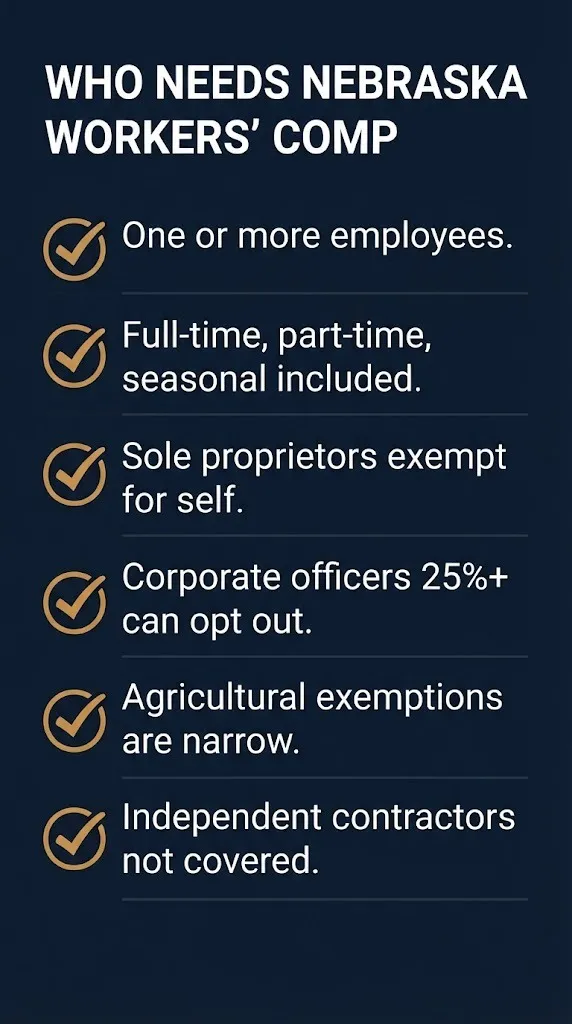
Nebraska workers’ compensation insurance is required for virtually every employer with one or more employees working in the state. There is no small-employer exemption based on headcount for most industries.
The Nebraska Workers’ Compensation Act applies to “every employer in the state employing one or more employees in the regular trade, business, profession, or vocation of the employer”. That includes full-time, part-time, seasonal, temporary, and minor employees.
The exemptions are narrow and specific. Sole proprietors and partners are not required to cover themselves, though they can opt in. Corporate officers who own 25% or more of a company’s stock can elect to opt out of coverage for themselves, but their employees remain covered.

Agricultural operations have a limited exemption. Employers with only related family members are exempt. Operations with unrelated employees are also exempt unless they employ 10 or more unrelated, full-time employees on each working day for 13 calendar weeks in a year.
Independent contractors are not covered. But misclassification is one of the most audited issues in Nebraska workers’ comp. If you control how, when, and where someone works, the state may treat them as an employee regardless of the label.
Key Takeaway: If you have one employee on payroll, you almost certainly need coverage. The “I’m too small” defense does not exist in Nebraska for most businesses.
How Much Does Nebraska Workers’ Compensation Insurance Cost?
Nebraska workers’ compensation insurance costs an average of $54 per month, or $646 annually, based on policy data from Insureon customers. But that average hides huge variation by industry.
Premium calculation follows a formula: Classification rate x Experience modification rate x (Annual payroll / $100).
The classification rate reflects the risk of each job type. Office workers pay far less than roofers. Nebraska relies on the National Council on Compensation Insurance (NCCI) database for classification codes.
Here are typical rate benchmarks for Nebraska employers:
| Industry | Rate per $100 Payroll |
|---|---|
| Clerical / Office | $0.12 to $0.50 |
| Retail Store Workers | $1.22 |
| Restaurant / Food Service | $0.92 to $1.50 |
| Landscapers | $4.62 |
| Trucking / Delivery | $4.00 to $8.00 |
| Construction (General) | $6.50 to $15.00 |
| Roofing Contractors | $8.70 to $12.00 |
The experience modification rate (EMR), or “Mod,” only applies once your annual premium reaches at least $5,000. A Mod of 1.0 is average. Below 1.0 means you pay less than competitors. Above 1.0 means you pay more because of claims history.
What Does Nebraska Workers’ Compensation Insurance Cover?
Nebraska workers’ comp covers medical expenses, lost wages, permanent disability, vocational rehabilitation, and death benefits. The system is no-fault, meaning injured employees do not have to prove the employer was negligent.
Coverage includes:
- Medical treatment: Doctor visits, emergency care, surgery, prescriptions, physical therapy, and all reasonable treatment related to the workplace injury
- Temporary total disability (TTD): Two-thirds of the employee’s average weekly wage, up to the state maximum
- Permanent disability: Calculated based on the body part affected and the degree of impairment
- Vocational rehabilitation: Retraining or job placement if the employee cannot return to their prior job
- Death benefits: Weekly benefits to surviving spouses and dependents, plus burial expenses up to $12,200.00 effective July 1, 2026
Workers’ comp does not cover injuries sustained outside of work, accidents involving intoxication, intentional self-inflicted injuries, or injuries occurring during a crime.
How Are Nebraska Workers’ Comp Benefits Calculated?
Nebraska workers’ comp pays 66.7% of your average weekly wage, with a maximum of $1,166.00 per week for 2026 injuries.
The minimum weekly benefit is $49.00. The state average weekly wage is $988.
The waiting period is 7 days before benefits begin. But Nebraska has one of the shortest retroactive triggers in the country: if disability lasts more than 6 days total, those 7 waiting days are paid retroactively.
TTD benefits can last up to 300 weeks (about 5.8 years), which is relatively favorable for injured workers.
Here is how a sample benefit calculation works:
| Employee Weekly Wage | Benefit Calculation | Weekly Benefit |
|---|---|---|
| $600 | $600 x 66.7% | $400 |
| $1,200 | $1,200 x 66.7% | $800 |
| $2,000 | $2,000 x 66.7% | $1,334 (capped at $1,166) |
The 2026 maximum of $1,166.00 applies to injuries and illnesses occurring on or after January 1, 2026. The previous maximum of $1,130.00 still applies to 2025 injuries.
What Happens If an Employer Does Not Carry Workers’ Comp in Nebraska?
Employers who fail to carry required workers’ comp coverage face severe penalties in Nebraska.
The Nebraska Workers’ Compensation Court can impose:
- A civil fine up to $1,000 for each violation. Each day of continued failure counts as a separate violation
- Criminal charges: Imprisonment for not more than one year, a $1,000 fine, or both
- Injunction: The employer can be prohibited from doing business in Nebraska until compliance is secured
- Loss of common law defenses: An injured employee can sue the employer in district court, and the employer loses its usual defenses
One serious injury to an uninsured employee can cost hundreds of thousands of dollars. No premium savings justify that exposure.
How Do You Verify That an Employer Has Workers’ Comp Coverage in Nebraska?
The Nebraska Workers’ Compensation Court provides a free Proof of Coverage Online Look-Up Application on its website.
Anyone can search for workers’ compensation insurance information for a particular employer on a particular date. This service is provided free of charge.
If you are a contractor hiring subcontractors, always collect certificates of insurance before they start work. Nebraska law allows workers’ comp liability to flow up to the general contractor if a subcontractor is uninsured and a worker is hurt on the job site.
How Do You File a Workers’ Compensation Claim in Nebraska?
Filing a Nebraska workers’ comp claim follows a specific sequence. The steps matter because deadlines are strict.
- Report the injury to your employer as soon as possible. Nebraska requires prompt notification.
- See a doctor. In Nebraska, employees can choose their own treating physician.
- Employer files a First Report of Injury with the Nebraska Workers’ Compensation Court. This must be completed within 10 days from notice of a work-related injury. Fatalities must be reported within 24 hours.
- The insurer accepts or denies the claim. Benefits start after the 7-day waiting period.
- If denied, file a Petition with the Nebraska Workers’ Compensation Court. The Petition is the initiating document that formally begins a claim.
- Consider Informal Dispute Resolution (IDR/Mediation) through the court if issues arise.
The filing deadline is 730 days (2 years) from the injury or illness date. Missing that deadline typically bars the claim entirely.
What Are the Most Common Workers’ Comp Injuries in Nebraska?
Workers in Nebraska experience about 20,400 on-the-job injuries and occupational illnesses per year.
The most hazardous industries in Nebraska are agriculture, forestry, fishing, and hunting; manufacturing; construction; healthcare and social assistance; and transportation and warehousing.
The top injuries leading to hospitalization are slip, trip, and fall injuries; motor vehicle accidents; machinery-related injuries; being struck by or against something; and fire or burn injuries.
Average compensation ranges based on Nebraska’s 2026 benefit rate include:
| Injury Type | Typical Total Compensation |
|---|---|
| Carpal Tunnel / Wrist | $12,276 |
| Fracture (Arm/Leg) | $15,869 |
| Neck / Whiplash | $18,802 |
| Knee Injury | $21,557 |
| Shoulder Injury | $25,628 |
| Head / Concussion | $28,204 |
| Back / Spine Injury | $33,413 |
These estimates are based on the 66.7% benefit rate and NCCI injury cost data. Actual amounts depend on injury severity and medical documentation.
What Happens Next for Nebraska Workers’ Comp in 2026?
The key dates and updates for Nebraska workers’ comp in 2026 are already in effect.
Here is the timeline:
- January 1, 2026: Maximum weekly income benefit increased to $1,166.00 for new injuries
- July 1, 2026: Mileage reimbursement rate increased to 76.0 cents per mile
- July 1, 2026: Burial benefit rate increased to $12,200.00
- Ongoing: The Nebraska Workers’ Compensation Court continues processing claims and enforcing coverage requirements
- TBD: No further rate changes have been announced for the remainder of 2026
Frequently Asked Questions
Is workers’ compensation insurance required in Nebraska?
Yes. Nebraska requires nearly every employer with one or more employees to carry workers’ compensation insurance.
There is no general small-business exemption based on employee count for most industries.
How much does workers’ comp cost in Nebraska?
Nebraska workers’ comp costs an average of $54 per month, or $646 annually, based on Insureon customer data.
Your actual premium depends on industry classification, payroll, claims history, and the experience modification rate.
What is the maximum weekly benefit in Nebraska for 2026?
The maximum weekly income benefit for 2026 injuries is $1,166.00.
The minimum weekly benefit is $49.00.
Who is exempt from workers’ comp in Nebraska?
Sole proprietors and partners can exclude themselves. Corporate officers owning 25% or more of company stock can opt out for themselves.
Certain agricultural operations with only related family members or fewer than 10 unrelated full-time employees are exempt.
What happens if an employer does not have workers’ comp in Nebraska?
Penalties include civil fines up to $1,000 per violation per day, criminal charges with up to one year imprisonment, and possible stop-work orders.
The employer also loses common law defenses if sued by an injured worker.
How long do I have to file a workers’ comp claim in Nebraska?
You have 2 years (730 days) from the injury or illness date to file a claim.
Missing that deadline typically bars the claim.
Can I choose my own doctor for a workers’ comp injury in Nebraska?
Yes. Nebraska allows employees to choose their own treating physician for workers’ compensation injuries.
Are workers’ comp benefits taxable in Nebraska?
No. Workers’ compensation benefits are not considered taxable income.
If you are an employer in Nebraska, verify your coverage is active before the next payroll cycle. The maximum weekly benefit is $1,166.00 for 2026 injuries, and the 2-year filing deadline is strict. If you are an injured worker, report your injury immediately and know that the clock is running.