Workers Compensation Lawyers in My Area 2026: What Massachusetts Cases Actually Pay and Cost
Quick Answer
- Is it legit? Yes. Workers’ comp lawyers in Massachusetts charge no upfront fees and get paid only from a recovery.
- How much? Attorney fees commonly run 15% to 20% of your settlement, subject to DIA approval.
- Key deadline: You have 4 years from the date you realize your injury is work-related to file a claim.
If you’re searching for workers compensation lawyers in my area, you’ve probably been hurt on the job and you’re weighing whether to hire someone. The honest answer is that most Massachusetts workers’ comp lawyers cost you nothing upfront.
Fees are regulated by statute, not negotiated in secret. In contested cases you win, the insurance company often pays your attorney’s fee on top of your benefits .
This article breaks down what lawyers actually charge, what recent Massachusetts settlements paid, how to check a lawyer’s credentials, and the deadlines that decide whether you have a case at all.
The Facts
| Item | Verified Detail |
|---|---|
| State Agency | Massachusetts Department of Industrial Accidents (DIA) |
| Typical Attorney Fee | 15% to 20% of recovery, subject to DIA approval |
| Upfront Cost | None in most cases; contingency basis |
| Filing Deadline | 4 years from date of injury or realization |
| Maximum Weekly Benefit (2026) | $1,922.48 for injuries between Oct 2025 and Sept 2026 |
| Recent Settlement Range | $11,000 (finger) to $625,000 (permanent total) |
| Fee Shifting | Insurer pays attorney fee in many contested wins |
| Proof Needed | Medical records linking injury to work |
How much do workers compensation lawyers in my area charge?
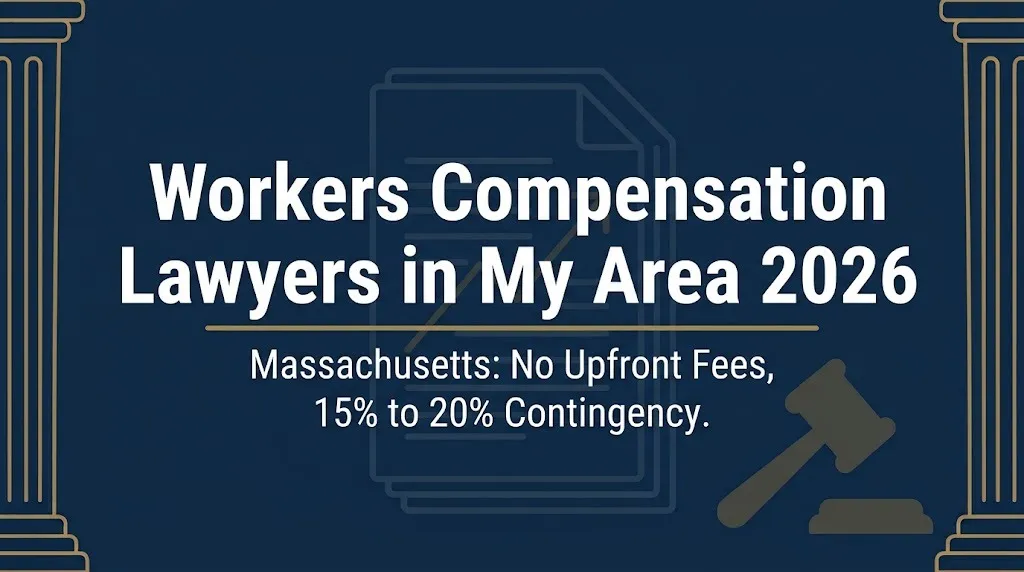
Massachusetts workers’ comp lawyers charge no upfront fees and typically take 15% to 20% of your recovery, with the exact amount subject to DIA approval.
That structure is set by statute, not by the market. Under Massachusetts General Laws chapter 152, attorney fees in workers’ comp cases require approval from the Department of Industrial Accidents . The DIA reviews the fee to make sure injured workers aren’t overcharged.
What this means for you: you won’t write a check to start your case. No retainer, no consultation fee, no filing costs out of pocket. If your claim is denied and no award is made, you owe no attorney fee .
Case expenses (medical records, deposition costs, expert fees) may be advanced by the firm and deducted from your recovery. Ask about that at your first meeting.
Do I have to pay a workers comp lawyer out of pocket in Massachusetts?
No. In most contested cases you win, the insurer pays the attorney’s fee on top of your benefits, so it doesn’t come out of your weekly check.
The statutory fee schedule works in stages. At an early conference, the fee might be around $1,965 plus expenses, paid by the insurer. If the case settles after liability is established, the fee cap is 20% of the settlement. If liability is still disputed at settlement, the cap drops to 15% .
This is different from a standard personal injury case. In a car crash claim, your lawyer’s contingency fee is negotiated privately. In workers’ comp, the fee is fixed by law and reviewed by a judge.
The practical result: an insurer’s decision to fight a valid claim doesn’t shift costs onto you. In some cases, it costs the insurer more.
Key Takeaway: Workers’ comp representation in Massachusetts is not just contingent, it’s largely paid by the other side when you win a contested case.
What is the average workers comp settlement in Massachusetts?
There is no single average. Recent DIA-approved settlements ranged from $11,000 for a finger injury to $625,000 for a permanent total disability claim .
The gap comes down almost entirely to documented medical evidence and the severity of your impairment. Here is what recent cases show:
| Settlement Amount | Year | Case Type |
|---|---|---|
| $625,000 | 2026 | Hand/forearm crush, complex regional pain syndrome, permanent total |
| $450,000 | 2026 | Ulnar nerve injury, union carpenter, 40% permanent disability |
| $24,000 | 2026 | Third-party negligence, burns (not a direct WC benefit) |
| $11,000 | 2025 | Finger injury, Section 36 specific-loss settlement |
Those are DIA-approved workers’ comp settlements. They are not the same as third-party tort settlements, which can reach much higher because they involve negligence claims against someone other than your employer .
A calculator site offers rough ranges: minor sprains settling for $10,000 to $30,000, herniated discs or surgical injuries reaching $50,000 to $200,000 or more . Treat those as modeling estimates, not guarantees.
What is the maximum weekly workers comp benefit in Massachusetts for 2026?
The maximum weekly benefit is $1,922.48 for injuries occurring between October 1, 2025, and September 30, 2026. That equals 100% of the state average weekly wage .
A new rate took effect October 1, 2026: $2,007.20 per week maximum, with a minimum of $401.44 . Your injury date determines which rate applies.
The minimum weekly benefit is $384.50 for the prior period, unless your own average weekly wage was already below that, in which case you receive your actual wage .
Benefits are calculated as a percentage of your average weekly wage, not a flat amount. Higher earners hit the cap and lose leverage above it.
Reality Check: No one texts you a workers’ comp settlement. No legitimate attorney charges you a consultation fee to review your case. And no one can promise you a specific payout before seeing your medical records. If any of those three things happen, walk away.
How do I find a good workers compensation lawyer in my area?
You find a good workers’ comp lawyer by checking three things: whether they practice before the DIA, whether they handle cases in your region, and whether their fee structure is transparent.
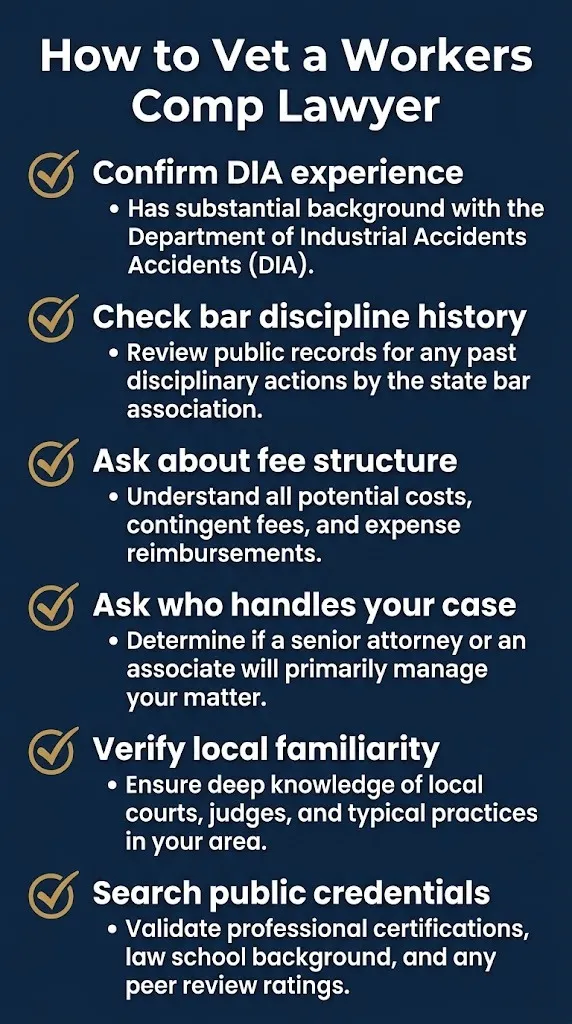
Here is a practical checklist:
- Confirm DIA experience. Workers’ comp is a niche practice with its own court, forms, and fee rules. A personal injury lawyer who doesn’t regularly file at the DIA may not know the local procedures.
- Check bar status and discipline history. The Massachusetts Board of Bar Overseers maintains public records.
- Ask about fee structure upfront. A legitimate lawyer will explain the statutory cap and confirm there’s no upfront cost.
- Ask who handles your case. Some firms hand cases to paralegals after the initial meeting. Ask directly.
- Look for local familiarity. If you were hurt in Boston, a Boston-based attorney knows the DIA office at Lafayette City Center and the administrative judges who hear cases there.
- Verify credentials through Super Lawyers or state bar listings. Robert S. Martin, a Boston workers’ comp attorney, has been selected to Rising Stars from 2018 through 2026 . That’s one data point, not a guarantee.
You can also search the DIA’s public resources for guidance on filing and appeals .
How do I file a workers compensation claim in Massachusetts?
You file by reporting the injury to your employer and, if you miss more than five days of work, filing a claim with the DIA. The process has specific steps and deadlines.
Here is the sequence:
- Report the injury to your employer immediately. Delay can give the insurer grounds to deny.
- Confirm your employer filed Form 101. They must file the Employer’s First Report of Injury within seven days if you miss five or more work days.
- File DIA Form 110 if needed. If your employer didn’t report the injury, you can file the employee claim form yourself.
- Attach medical documentation. A doctor’s report linking your incapacity to the work injury is required for weekly benefits.
- Watch for the insurer’s response. They have 14 days to investigate and either pay or deny.
- Appeal a denial within four years. If you receive a Form 104 denial, you have four years from receipt to appeal .
You must be disabled for five full or partial calendar days to file for lost wages. The days don’t need to be consecutive .
What is the deadline to file a workers comp claim in Massachusetts?
You have four years from the date you become aware of the connection between your injury or illness and your work. That’s the statute of limitations under Massachusetts law .
The clock starts when you realize the injury is work-related, not necessarily the day it happened. That distinction matters for occupational illnesses that develop over time.
If you receive a denial letter (Form 104), you have four years from the date you received it to appeal .
Missing the deadline usually bars your claim permanently. That’s the one date you cannot negotiate.
Why do workers compensation claims get denied in Massachusetts?
Claims get denied for three common reasons: late reporting, insufficient medical evidence, and paperwork errors.
Insurers deny when the injury wasn’t reported promptly. They deny when the medical records don’t clearly link the condition to work duties. And they deny when forms are incomplete or filed with the wrong entity .
A denial is not the end. Many claims are successfully appealed with better documentation and legal representation.
The insurer must send a Form 104 denial by certified mail, stating the reason and how to appeal. If you receive one, the four-year clock starts.
An experienced attorney can gather additional medical records, prepare the appeal, and negotiate with the insurer.
What happens next in a Massachusetts workers comp case?
The path from injury to resolution follows a predictable sequence, though timing varies by case.
Immediately: Report the injury to your employer. Get medical treatment. Document everything.
Within days to weeks: Your employer files Form 101. The insurer investigates and either pays, denies, or pays without prejudice for up to 180 days.
If denied: You file Form 110 at the DIA. A conciliation is scheduled, which is the first step in the dispute process.
If conciliation fails: The case moves to a conference before an administrative judge. The judge can order benefits.
If either side appeals: A hearing follows, then possibly a review by the DIA’s reviewing board.
At any point after liability is established: The case can settle by lump sum under Section 34A, subject to DIA approval.
Frequently Asked Questions
How much does a workers comp lawyer cost in Massachusetts?
Most charge no upfront fee and take 15% to 20% of your recovery, subject to DIA approval. In contested cases you win, the insurer often pays the fee on top of your benefits.
What is the average workers comp settlement in Massachusetts?
There is no reliable average. Recent DIA-approved settlements ranged from $11,000 for a finger injury to $625,000 for permanent total disability. The gap reflects medical evidence and severity.
How long do I have to file a workers comp claim in Massachusetts?
Four years from the date you become aware your injury or illness is work-related. If you receive a denial letter, you have four years from receipt to appeal.
Do I need a lawyer for a workers comp claim in Massachusetts?
Not always. Simple medical-only claims can be filed without one. But if your claim is denied, if you miss significant work, or if you face a disputed settlement, representation usually pays for itself.
Can I get fired for filing a workers comp claim in Massachusetts?
No. It is illegal for your employer to fire you for filing a workers comp claim. If it happens, you may have a separate retaliation claim.
How much is the maximum weekly workers comp benefit in 2026?
The maximum is $1,922.48 for injuries between October 2025 and September 2026. A new rate of $2,007.20 took effect October 1, 2026.
What if my employer didn’t have workers comp insurance?
You can file a claim against the Workers’ Compensation Trust Fund through the DIA. You’ll need a Certification of No Insurance and DIA Form 170.
How do I check a lawyer’s credentials in Massachusetts?
Use the Board of Bar Overseers for discipline history, Super Lawyers for peer recognition, and the DIA for confirmation that the attorney regularly practices before the agency.