Navient Lawsuit 2026: Are Settlement Checks Real, and Is a New Case Open
Quick Answer
- Yes, current Navient settlement checks are legitimate CFPB restitution, not a scam, and require no claim form.
- Individual payments are reported to range from roughly $100 to $2,000, drawn from a $100 million borrower fund.
- There is no new deadline to “join” a Navient lawsuit. No open class action is currently accepting new borrowers.
If you searched “Navient lawsuit,” you likely landed here because of a check in your mailbox, a headline, or a text claiming you can still sign up. The direct answer: Navient’s biggest legal battles are already settled, and what’s happening in 2026 is the payout phase of a case the Consumer Financial Protection Bureau finalized back in September 2024.
That $120 million enforcement action is separate from an earlier, much larger $1.85 billion multistate settlement from 2022 that already finished paying out in 2023. Confusing the two is the single biggest source of misinformation around this topic right now.
This article breaks down which Navient case is which, how much money is actually moving, who qualifies, and what’s still open in the courts. One detail most coverage buries: Navient is now permanently banned from servicing any federal student loans, a restriction with real consequences for how the company operates going forward.
The Facts
| Topic | Verified Detail |
|---|---|
| Case | CFPB v. Navient Corporation, Case No. 3:17-cv-00101-RDM, U.S. District Court for the Middle District of Pennsylvania |
| Status | Enforcement order finalized September 2024; restitution payments actively being distributed |
| Fund Size | $120 million total: $100 million in borrower restitution, $20 million civil penalty |
| Est. Per Person | Reported range of roughly $100 to $2,000; CFPB has not published a fixed formula |
| Claim Deadline | None required. Payments are automatic based on Navient’s servicing records |
| Administrator | Rust Consulting, contracted by the CFPB |
| Proof Needed | None for most borrowers. If a check doesn’t arrive, contact Rust Consulting to confirm your mailing address |
Is the Navient lawsuit real or a scam
The Navient CFPB settlement is a real, federally confirmed enforcement action, not a scam, and checks currently arriving in mailboxes are legitimate. The confusion comes from years of overlapping cases and copycat messages claiming you must “sign up now.”
The CFPB sued Navient in 2017 in the Middle District of Pennsylvania, alleging the company steered struggling borrowers into forbearance instead of income-driven repayment plans. That case resulted in a $120 million settlement finalized in September 2024.
How to know a Navient contact is legitimate:
- Real checks come from Rust Consulting, the CFPB’s named administrator
- The CFPB will never ask you to pay a fee or share banking details to cash a check
- No text message or robocall is a legitimate way to “join” this settlement
- There is no active sign-up window for a new Navient class action
How much money will I get from the Navient settlement
Payouts are not yet fixed at a set per-person amount; multiple outlets report a range of roughly $100 to $2,000 depending on the harm identified in your loan history. The CFPB has not published an exact formula.
What’s confirmed about the money:
| Detail | Amount |
|---|---|
| Total settlement | $120 million |
| Restitution to borrowers | $100 million |
| Civil penalty (not paid to borrowers) | $20 million |
| Reported individual check range | Roughly $100 to $2,000 |
| Number of eligible borrowers | Not publicly disclosed as a fixed total |
This is separate from the 2022 multistate settlement, which already paid closer to $260 to about 350,000 borrowers and finished distributing in 2023. If you received that earlier check, it does not disqualify you from this one, and this one does not disqualify you from any future action either.
Key Takeaway: Two different Navient settlements exist. The 2022 state case already paid and closed. The 2026 checks come from a separate, newer federal case, and mixing the two up is the top source of confusion online.
How do I know if I qualify for the current Navient payment
You may qualify if Navient serviced your federal student loans and the CFPB’s records show you were steered into repeated long-term forbearance instead of an income-driven repayment plan. Eligibility is determined automatically, not through an application.
Reported eligibility factors:
- Your federal loans were serviced by Navient, including if they later transferred to Aidvantage
- CFPB records show a pattern of forbearance steering on your account
- Some borrowers affected by inaccurate credit reporting tied to loans previously discharged in bankruptcy through Pioneer Credit Recovery may also qualify
You do not need to file anything. Rust Consulting identifies recipients directly from Navient’s own servicing records, then mails a check to the address on file.
How do I file a claim for the Navient settlement
You do not file a claim for the current CFPB payment, since it is a government enforcement action, not a class action requiring a claim form. If you believe you’re eligible but haven’t received a check, confirming your address is the only action required.
What to do if you think you qualify but nothing has arrived:
- Confirm your loans were serviced by Navient at any point before its federal servicing exit.
- Log into StudentAid.gov to review your current loan servicer history.
- Wait 4 to 6 weeks from the February 13, 2026 start date before assuming a check is missing.
- Contact Rust Consulting directly at 1-800-711-8418 to verify or update your mailing address.
- Do not respond to any third party asking for a fee to “release” your payment.
- Keep any check or notice you receive; do not discard mail from Rust Consulting.
Reality Check: No legitimate Navient settlement will ever ask you to pay money first, provide a gift card, or “verify” your bank login to release a check. If a message like that reaches you, it’s a scam trying to ride on real settlement news, not the CFPB or Rust Consulting.
Is this the same as the Sallie Mae lawsuit
No, Navient and Sallie Mae are related but not the same target of these settlements. Sallie Mae split into two companies in 2014: Sallie Mae kept private lending, while Navient took over servicing federal and older private loans.
What that split means for your search:
- If your loans are private and originated after 2014, “Sallie Mae” is likely your actual servicer, not Navient
- If your federal loans were serviced any time before Navient’s 2021 federal exit, Navient is the relevant company
- The current CFPB settlement targets Navient’s federal loan servicing conduct, not Sallie Mae directly
Think of it like a company that spun off a division years ago. The parent brand still gets confused with the spinoff, even though they’ve operated separately for over a decade.
When did the Navient settlement checks start going out
Checks began mailing on February 13, 2026, and distribution is rolling rather than all at once. Rust Consulting is processing hundreds of thousands of borrower records, so not everyone receives a check on the same day.
Timeline of the payout so far:
| Date | Event |
|---|---|
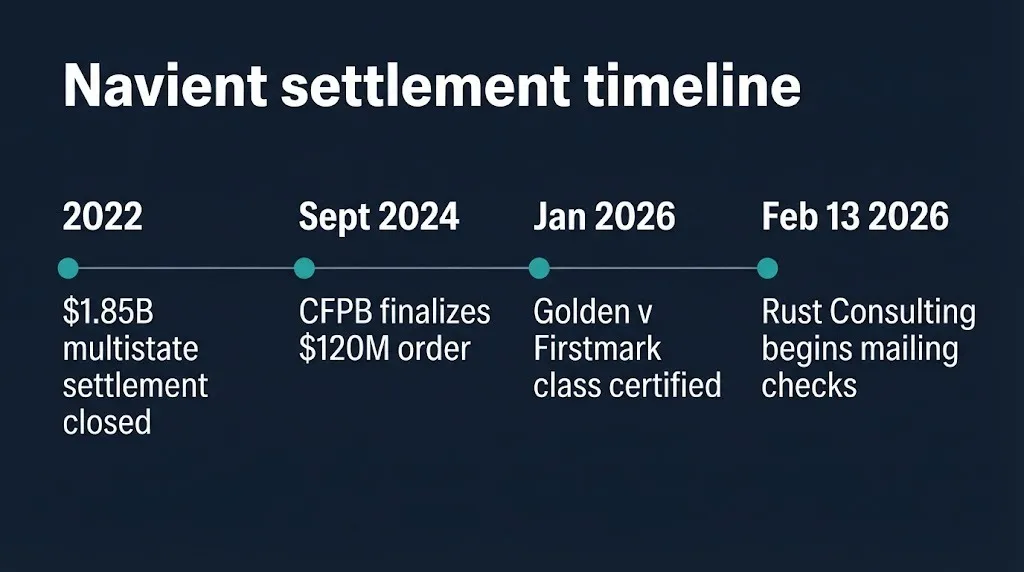
| September 2024 | CFPB finalizes $120 million enforcement order against Navient |
| February 13, 2026 | First checks mailed by Rust Consulting |
| Ongoing through 2026 | Rolling distribution continues in waves |
If it’s been more than six weeks since February 13 and you haven’t received anything, that’s the point to call Rust Consulting rather than assume you’re excluded.
Is there a new Navient class action lawsuit I can still join in 2026
No, there is currently no open Navient class action accepting new borrowers. Major federal and state enforcement cases against Navient are resolved, and any message claiming you can “sign up” for a new payout is not describing a real open case.
What is still active in court, separately:
- Golden v. Firstmark Services: a federal bankruptcy court certified nationwide injunctive and damages classes in January 2026 over specific private loan structures. This involves named defendants and particular loan types, not a general open-enrollment Navient lawsuit.
- Individual bankruptcy litigation tied to private student loan discharge continues in various federal courts.
These are narrow, specific cases, not broad class actions anyone with a Navient loan can join. If someone contacts you claiming otherwise, treat it as unverified until you confirm directly with a court record or attorney.
What happened in the 2022 Navient settlement
The 2022 settlement was a $1.85 billion agreement between Navient and 39 state attorneys general, resolving allegations of predatory private loan origination and forbearance steering. That case is fully closed.
What the 2022 deal delivered:
- $1.7 billion in private student loan debt cancellation for borrowers with specific defaulted loans, mostly from for-profit schools
- $95 million in nationwide restitution, paying roughly $260 each to about 350,000 borrowers
- Debt cancellation notices were mailed by Navient directly; restitution postcards came from the AG settlement administrator in spring 2022
If your debt was canceled or you received a $260 check years ago, that settlement has already run its course. It has no bearing on your eligibility for the 2026 CFPB payments.
Why was Navient sued in the first place
Navient was sued for allegedly steering financially struggling borrowers into repeated forbearance instead of income-driven repayment plans they likely qualified for. Forbearance pauses payments while interest keeps accruing, while income-driven plans can lower payments and lead to eventual forgiveness.
The core allegations across cases:
- Deceptively steering distressed federal borrowers into costly long-term forbearance
- Originating predatory private loans for borrowers attending schools with poor graduation and job placement outcomes
- Misapplying payments, damaging credit reports, and misleading cosigners about release options
- Inaccurate credit reporting tied to loans previously discharged in bankruptcy
Key Takeaway: The financial harm wasn’t from one bad decision. It was years of borrowers being pushed toward the option that made their debt grow, instead of the option that would have shrunk it.
Is Navient still servicing student loans
No, Navient is permanently banned from servicing federal student loans as part of the September 2024 CFPB settlement, and it has wound down that side of its business. If your loans were with Navient, they’ve likely transferred to a different servicer, such as Aidvantage.
What that means for you today:
- Log into StudentAid.gov to confirm your current federal loan servicer
- Contact your new servicer directly for payment plan or forgiveness questions
- Past Navient servicing issues do not need to be resolved with Navient itself anymore; they’re handled through your current servicer
What Happens Next
Ongoing through 2026: Rust Consulting continues rolling distribution of the $120 million CFPB settlement checks.
Ongoing: Golden v. Firstmark Services bankruptcy litigation over specific private loan structures continues in federal court.
If you haven’t received a check: Contact Rust Consulting to confirm eligibility and mailing address rather than waiting indefinitely.
Not yet confirmed: Whether additional CFPB or state actions against Navient will be filed; none are currently pending as of this writing.
Frequently Asked Questions
Is the Navient lawsuit settlement real?
Yes, the current $120 million CFPB settlement is a confirmed, federally finalized enforcement action.
Checks are mailed by Rust Consulting, the CFPB’s named administrator, and require no fee to cash.
How much is the Navient settlement per person?
The CFPB has not published a fixed formula, but reported individual checks range from roughly $100 to $2,000.
The exact amount depends on the type and duration of harm identified in your loan history.
Do I need to file a claim for the Navient settlement?
No, most borrowers do not need to file anything, since payments are issued automatically based on Navient’s servicing records.
If you believe you qualify but haven’t received a check, contact Rust Consulting directly to confirm your address.
Is this the same as the 2022 Navient settlement?
No, the 2022 multistate settlement already finished paying roughly $260 to about 350,000 borrowers and is closed.
The 2026 payments come from a separate $120 million CFPB enforcement action finalized in September 2024.
Can I still join a Navient class action lawsuit?
No, there is no open Navient class action currently accepting new borrowers.
Any message claiming otherwise should be treated as unverified until confirmed through an official court record.
Is Navient the same company as Sallie Mae?
No, Sallie Mae split into two companies in 2014, with Navient taking over servicing federal and older private loans.
If your loan is private and newer, Sallie Mae is likely your actual servicer, not Navient.
When did Navient settlement checks start arriving?
Checks began mailing on February 13, 2026, and distribution is happening in rolling waves, not all at once.
Allow 4 to 6 weeks from that date before assuming a check is missing.
Is Navient still allowed to service federal student loans?
No, Navient is permanently banned from servicing federal student loans under its September 2024 settlement with the CFPB.
Borrowers previously serviced by Navient have been transferred to a different servicer.
Bottom Line
If a Navient check shows up from Rust Consulting, it’s real and yours to deposit, no fee required. If a message asks you to “join” a new Navient lawsuit or pay to unlock a payment, that’s not how this settlement works.
Confirm your current federal loan servicer at StudentAid.gov, and call Rust Consulting at 1-800-711-8418 if a check hasn’t arrived within six weeks of February 13, 2026.