Nursing Home Abuse Lawsuit 2026: How Much You Could Recover and What Changed in Federal Rules
Quick Answer
- A nursing home abuse lawsuit is an individual civil claim against a specific facility, not a class action with one shared payout.
- Reported average settlements for nursing home abuse and neglect cases range from roughly $236,000 to $406,000, with some verdicts reaching into the millions.
- Most states give you 2 to 3 years to file, though some deadlines are as short as 1 year, so timing depends entirely on your state.
If you searched “nursing home abuse lawsuit,” you’re likely dealing with a real injury or loss right now, not a headline about a mass settlement. This isn’t one case with one deadline. It’s a category of lawsuits, each filed against the specific facility responsible for the harm.
That distinction matters because your timeline, evidence, and potential recovery depend entirely on your state’s laws and the facts of your loved one’s case. One number that should worry every family right now: as of February 2, 2026, a federal rule took effect that repealed the requirement for a registered nurse on-site 24 hours a day at Medicare and Medicaid certified facilities.
This article covers how nursing home abuse lawsuits actually work, what settlements have looked like in 2026, how state deadlines vary, and what the new federal staffing rollback means for your case. A surprising detail buried in advocacy research: experts estimate that for every reported case of nursing home abuse, as many as 24 cases go unreported.
The Facts
| Topic | Verified Detail |
|---|---|
| Type of case | Individual civil lawsuit against a specific nursing home or long-term care facility, not a class action |
| Status | Ongoing category of litigation nationwide; no single settlement fund exists |
| Fund Size | Not applicable. Each case is resolved separately, through settlement or verdict |
| Est. Per Person | Reported averages range from roughly $236,000 to $406,000; some verdicts exceed $1 million to tens of millions |
| Filing Deadline | Varies by state, generally 2 to 3 years from the date of harm, with some states as short as 1 year |
| Administrator | Not applicable. Cases proceed through the state or federal court where the facility is located |
| Proof Needed | Medical records, staffing records, incident reports, photos, and documented signs of injury or neglect |
Is a nursing home abuse lawsuit legit, or is this something else
Yes, nursing home abuse and neglect lawsuits are a well-established, legitimate category of civil litigation, filed by families or residents against specific care facilities. This is not a scam or a mass-tort payout waiting to be claimed automatically.
Unlike class action settlements you might see advertised with a claim form and deadline, nursing home cases work differently. Each family files its own lawsuit against the facility that caused harm.
What makes this category real and enforceable:
- Every state has laws defining nursing home negligence and elder abuse as grounds for a civil claim
- Facilities are regulated by the Centers for Medicare and Medicaid Services (CMS) and state health departments
- Courts across the country have issued verdicts and approved settlements in these cases throughout 2026
If you’ve been told you can “sign up” for a nursing home abuse settlement without naming a specific facility and incident, that’s not how this type of case works.
How much money can I get from a nursing home abuse lawsuit
Reported nursing home abuse settlements average $236,000 to $406,000, though this is not a guaranteed payout and depends entirely on the severity of harm, the facility’s liability, and your state’s laws. Some cases resolve far higher, others lower.
Verified 2026 verdict and settlement examples reported by legal outlets:
| Case Detail | Reported Amount |
|---|---|
| California jury verdict, preventable stage 3 bedsore during rehab stay | $15.8 million |
| California case, wrongful death after wandering resident died of hypothermia | $110 million |
| California case, wrongful death from unauthorized sedative use | $42.5 million |
| Rhode Island case, heart attack | $18.2 million |
| Massachusetts case, catheter infection death | $2 million |
| Minnesota case, stage 4 bedsores | $1.5 million |
These figures come from law firm case result reporting and should be read as examples, not predictions. Every case is different, and no outcome is guaranteed.
Key Takeaway: There’s no fixed payout for a nursing home abuse case, but reported averages cluster in the low-to-mid six figures, with severe injury or wrongful death cases sometimes reaching seven or eight figures.
How do I know if my loved one was abused or neglected
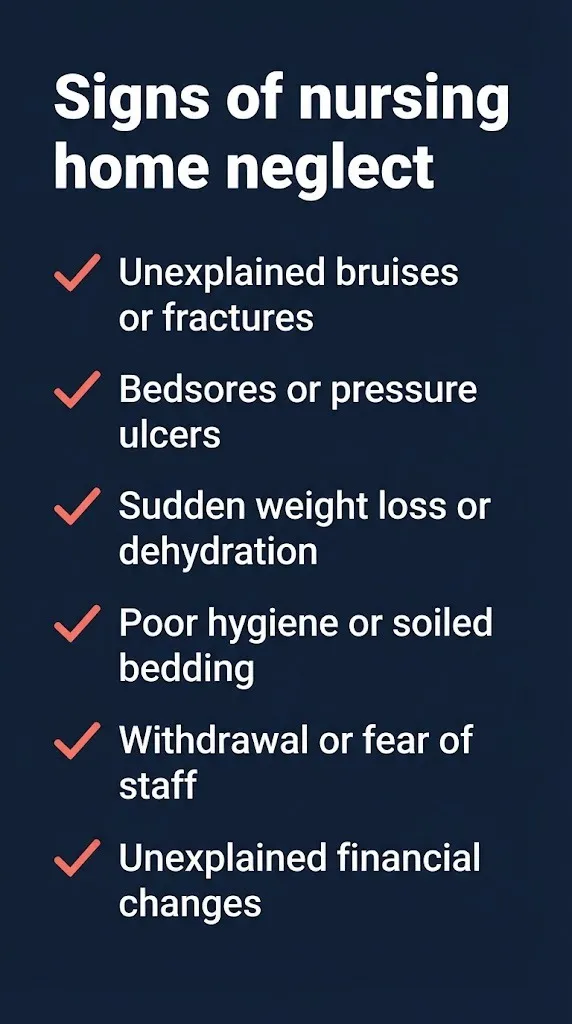
Common signs of nursing home abuse or neglect include unexplained bruising, bedsores, dehydration, malnutrition, repeated falls, and sudden changes in mood or hygiene. Documenting these signs early strengthens any future legal claim.
Warning signs to watch for:
- Unexplained bruises, cuts, or fractures
- Bedsores or pressure ulcers, especially stage 3 or higher
- Sudden weight loss, dehydration, or signs of malnutrition
- Poor hygiene, soiled bedding, or unclean living conditions
- Withdrawal, fear of staff, or unusual behavioral changes
- Overmedication or use of medications not prescribed for the resident
- Missing personal belongings or unexplained financial transactions
If you notice any of these signs, request the resident’s full medical records and staffing logs as soon as possible. Facilities are not required to volunteer this information, and records can be altered or lost if you wait.
How do I file a nursing home abuse lawsuit
You file a nursing home abuse lawsuit by working with an attorney to gather evidence, formally notify the facility, and file a civil complaint in the appropriate state court before your deadline expires. This is not a form you fill out online for a shared settlement.
General steps in the process:
- Document the signs of harm with photos, notes, and dates.
- Request complete medical and staffing records from the facility in writing.
- Consult an attorney who handles nursing home abuse or elder law cases.
- Have your attorney send a legal hold letter to preserve records and camera footage.
- File a formal complaint in the civil court where the facility is located.
- Go through discovery, where both sides exchange evidence.
- Negotiate a settlement, or proceed to trial if the facility won’t offer fair compensation.
Think of it less like joining a class action and more like filing an insurance claim after a car accident. It’s your case, tied to your facts, moving on its own track.
What is the deadline to file a nursing home abuse lawsuit in my state
Deadlines vary significantly by state, generally running 2 to 3 years from the date of the injury, though some states allow as little as 1 year and others extend further for wrongful death claims. There is no single nationwide deadline.
Examples of confirmed state-specific timelines:
| State | Reported Deadline |
|---|---|
| California | 2 years from date of abuse or neglect, or 2 years from discovery |
| California, wrongful death | 2 years from date of death |
| Missouri | 5 years from date of injury; 2 years if the claim is medical malpractice; 3 years for wrongful death |
| Most states generally | 2 to 3 years from date of injury |
| Shortest reported deadlines | As short as 1 year in some states |
Reality Check: Waiting to “see how bad it gets” before contacting an attorney is one of the most common mistakes families make. Evidence like staffing records and camera footage can be deleted or overwritten within weeks, not years, so acting early protects your case even if you haven’t decided whether to sue.
Should I sue for nursing home abuse or nursing home neglect
Abuse and neglect are related but legally distinct claims, and which one applies depends on whether harm resulted from an intentional act or a failure to provide adequate care. Many lawsuits include both types of claims together.
How the two differ:
- Abuse generally involves intentional harm: physical assault, verbal abuse, sexual abuse, or intentional financial exploitation.
- Neglect generally involves failure to provide basic care: understaffing, ignoring medical needs, failing to prevent falls, or failing to treat bedsores.
In practice, many cases involve neglect rather than intentional abuse, since understaffing and inadequate training are common root causes. Your attorney can determine which legal theory, or combination, fits your specific facts.
Does the new 2026 federal staffing rule affect my lawsuit
It may strengthen certain neglect claims, since a federal rule effective February 2, 2026 repealed the requirement that Medicare and Medicaid certified nursing homes keep a registered nurse on-site 24 hours a day. This is a significant, confirmed regulatory change.
What actually changed:
- The repealed rule had required 3.48 total nurse staffing hours per resident per day, including 0.55 registered nurse hours
- It also required 24/7 on-site registered nurse coverage, phased in with a May 11, 2026 deadline for non-rural facilities
- The rollback restores a prior standard requiring a nurse on-site for at least 8 consecutive hours per day
- The rule change followed federal court rulings, including one in the Northern District of Texas, that found CMS exceeded its authority in setting the original standard
What did not change: Facilities remain subject to the enhanced facility assessment requirement, ongoing inspections, complaint investigations, and Medicaid spending transparency provisions. The repeal loosened the specific hourly staffing mandate, not every federal obligation.
Key Takeaway: If understaffing contributed to your loved one’s injury, the timing of this rollback and your incident date both matter, and an attorney can assess whether the facility met even the reduced standard in effect at the time.
How long does a nursing home abuse lawsuit take to resolve
Most cases resolve through settlement rather than trial, and timelines vary widely depending on how quickly evidence is gathered and whether the facility disputes liability. There is no fixed, confirmed timeline that applies to every case.
What generally affects how long a case takes:
- How quickly medical and staffing records are obtained
- Whether the facility disputes fault or offers an early settlement
- Court scheduling in your state
- Whether the case proceeds to trial instead of settling
Settlements typically resolve faster than a full trial, since both sides avoid the cost and uncertainty of a jury verdict. If a facility refuses a fair settlement offer, cases can take considerably longer as they move through discovery and toward trial.
What evidence do I need for a nursing home abuse lawsuit
You’ll generally need medical records, staffing records, incident reports, and documentation of visible injuries to build a strong nursing home abuse or neglect case. The stronger your documentation, the harder it is for a facility’s legal team to dispute what happened.
Commonly needed evidence:
- Complete medical records from the facility and any outside hospital
- Facility staffing records and shift logs, where available
- Photographs of injuries, bedsores, or unsafe conditions
- Written incident reports filed by the facility
- State health department inspection and complaint history for the facility
- Witness statements from other residents, family members, or staff
Requesting these records immediately, ideally through an attorney’s formal legal hold letter, is the single most protective step you can take early in a case.
How do I report nursing home abuse separately from filing a lawsuit
Reporting suspected abuse to state authorities is separate from and does not replace filing a civil lawsuit, and both steps can strengthen protection for your loved one and any future case. Reporting can also trigger a state investigation that generates useful evidence.
Where reports typically go:
- Your state’s long-term care ombudsman program
- Your state health department’s nursing home complaint line
- Adult Protective Services, for suspected abuse or exploitation
- Local law enforcement, for suspected criminal abuse
A state investigation is not the same as a lawsuit and does not secure compensation on its own. Filing both a report and pursuing legal action gives your family the best combination of protection and potential recovery.
What Happens Next
If harm is ongoing: Contact the facility’s administration and, if necessary, Adult Protective Services or local law enforcement immediately.
Within days: Request complete medical and staffing records in writing before any records can be lost or altered.
Before your state deadline: Consult an attorney to evaluate whether your state’s statute of limitations, often 2 to 3 years, still allows you to file.
During the case: Expect a discovery period where records are exchanged, followed by settlement negotiation or trial.
Ongoing through 2026 and beyond: Watch for continued regulatory developments following the February 2, 2026 federal staffing rule repeal, which remains in effect as of this writing.
Frequently Asked Questions
Is there one big nursing home abuse settlement I can join?
No, nursing home abuse cases are filed individually against specific facilities, not through one shared class action fund.
Each family’s compensation depends on their own facts, evidence, and state’s laws.
How much does a nursing home abuse lawsuit typically settle for?
Reported averages range from roughly $236,000 to $406,000, though severe injury or wrongful death cases have settled or resulted in verdicts far higher.
No specific amount is guaranteed for any individual case.
How long do I have to file a nursing home abuse lawsuit?
Most states allow 2 to 3 years from the date of injury, though some deadlines are as short as 1 year.
Your exact deadline depends on your state and the type of claim, so confirm it as early as possible.
What’s the difference between abuse and neglect in a nursing home case?
Abuse generally involves intentional harm, while neglect generally involves a failure to provide adequate care, such as understaffing or ignoring medical needs.
Many lawsuits include claims covering both, depending on the facts.
Did the 2026 staffing rule change make nursing homes less safe?
The February 2, 2026 rule repealed the federal 24/7 registered nurse requirement and specific minimum staffing hours, restoring a prior 8-hour nurse presence standard.
Other federal oversight, including inspections and complaint investigations, remains in place.
Do I need a lawyer to file a nursing home abuse lawsuit?
You are not legally required to have one, but these cases involve complex medical records, facility legal teams, and strict deadlines that make an attorney’s involvement common practice.
Many nursing home abuse attorneys offer free initial case reviews.
What should I do first if I suspect my loved one is being neglected?
Document what you observe, request full medical and staffing records in writing, and consider a facility transfer if the resident is still living there.
Transferring the resident does not waive any legal claims related to past harm.
Can I still sue if my loved one already passed away?
Yes, most states allow a wrongful death claim in nursing home cases, generally with its own separate statute of limitations tied to the date of death.
Some states also allow a related survival action on behalf of the resident’s estate.
Bottom Line
If you’re seeing signs of abuse or neglect, documentation now matters more than a fast decision about whether to sue. Records, photos, and dates protect both your loved one and any future case.
Confirm your state’s specific filing deadline as soon as possible, since some states allow as little as 1 year to act. That clock starts at the date of harm, not the date you decide to pursue it.