Pregnancy Discrimination Lawsuit 2026: Settlement Amounts and Deadlines
Quick Answer
- Real and active: eight 2026 EEOC pregnancy resolutions with announced amounts ranged from $30,000 to $185,000 per case.
- Federal limit on compensatory and punitive damages: $50,000 to $300,000 per person, depending on employer size.
- Deadline: file an EEOC charge within 180 days, or 300 days where state or local law applies.
Pregnancy discrimination lawsuits are real and active. Eight 2026 EEOC announcements put case totals between $30,000 and $185,000.
Those are case totals, not guaranteed per-person payouts. They affect workers who were fired, demoted, or denied accommodations because of pregnancy. The deadline that matters most is 180 days, or 300 where state or local law applies.
Below, you’ll see what the numbers mean, the legal caps, and how to file. One surprise: a 2026 settlement announcement never disclosed its dollar amount.
The Facts
| Case | No single case. Federal claims under Title VII (as amended by the Pregnancy Discrimination Act) and the Pregnant Workers Fairness Act |
| Status | Active. EEOC announced multiple pregnancy settlements throughout 2026 |
| Fund Size | Not applicable. Amounts are set case by case |
| Est. Per Person | Not yet determined. Announced 2026 EEOC case totals: $30,000 to $185,000 |
| Claim Deadline | 180 calendar days, or 300 days with a state or local agency law |
| Administrator | The EEOC for charges. No single claims administrator |
| Proof Needed | Dates, documents, and details of the treatment. A filed charge |
| Damage Caps | $50,000 to $300,000 (compensatory and punitive combined), by employer size |
Is what happened to you pregnancy discrimination?
Pregnancy discrimination is unfavorable treatment at work because of pregnancy, childbirth, or a related medical condition. The EEOC also covers being denied a workplace change you need because of pregnancy or childbirth.
The Pregnancy Discrimination Act has been read to cover past, current, and potential pregnancy. It also reaches breastfeeding and abortion decisions, according to HR Dive’s summary of EEOC positions.
Here are patterns from 2026 EEOC announcements:
- A server fired the day after her employer learned she was pregnant (Cosmos Restaurant, Mississippi)
- A worker reassigned to X-ray equipment, then fired after giving a doctor’s note (Vital Systems, Reno)
- A worker left off the schedule after disclosing pregnancy (Condor Club, San Francisco)
- A patient services coordinator fired in a childbirth-related case (JAG Physical Therapy, New York)
Some of those are EEOC allegations. Others are EEOC findings from its investigation. Neither is a court ruling that you’d win a similar case.
Can you sue your employer for pregnancy discrimination?
Yes, you may be able to sue, but you generally must file a charge first. The EEOC says every law it enforces except the Equal Pay Act requires a Charge of Discrimination before a lawsuit.
You can file that charge with the EEOC. You can also file with a state or local fair-employment agency. A law firm guide notes that filing with either one stops the 300-day clock.
The EEOC itself also sues. Every 2026 pregnancy lawsuit settlement reviewed here followed the same pattern: the agency tried conciliation first, then filed suit.
Coverage depends on employer size and state law. The federal damage caps start at employers with 15 employees. Smaller employers may fall under state rules, so check yours.
You don’t need a lawyer to start a charge. The EEOC’s online portal lets you begin without one, per a law firm summary. A licensed attorney can explain your options.
Is there a pregnancy discrimination class settlement you can claim in 2026?
One 2026 EEOC settlement included a claims process: TEG Staffing, doing business as Eastridge Workforce Solutions. You may qualify to claim a share if you worked there since 2019 and believe you faced pregnancy discrimination.
The EEOC’s January 7, 2026 release announced a $185,000 consent decree. A California federal court case, EEOC v. TEG Staffing, Inc., Case No. 2:25-cv-09314, covers it. The decree was signed December 23, 2025 and runs three years.
The release lists an EEOC Los Angeles contact for claim instructions. It doesn’t state a claim deadline or whether the process is still open. Treat both as not yet confirmed and ask the EEOC directly.
If a different Fusion-style “claim site” asks you to pay, leave. Real EEOC claims don’t require fees.
| Detail | What the release says |
|---|---|
| Employer | TEG Staffing, Inc., d/b/a Eastridge Workforce Solutions |
| Fund | $185,000 |
| Who may claim | Workers since 2019 who believe they faced pregnancy discrimination |
| Deadline | Not stated |
Key Takeaway: Pregnancy discrimination lawsuits are real, but most start with an EEOC charge, and only one 2026 settlement reviewed offered a claims process.
How much are pregnancy discrimination settlement amounts in 2026?
Announced 2026 EEOC pregnancy resolutions with stated amounts ran from $30,000 to $185,000 per case. Amounts depend on the facts, the employer, and the law used.
| Announced | Employer | Amount | Law and court |
|---|---|---|---|
| Jan. 7 | TEG Staffing (Eastridge) | $185,000 | Title VII/PDA, C.D. Cal. |
| Feb. 2 | Feit Electric | $100,000 | Title VII (combined $285,000 with Eastridge) |
| Feb. 20 | Urologic Specialists of Oklahoma | $90,000 | PWFA and ADA, N.D. Okla. |
| Feb. 25 | Security Assurance Management | $45,000 | Title VII/PDA, D.D.C. |
| Mar. 31 | Cosmos Restaurant operators | Not disclosed | Title VII, S.D. Miss. |
| Apr. 7 | iPRO Dental Laboratory | $30,000 | Title VII, S.D. Fla. |
| Jun. 12 | JAG Physical Therapy | $125,000 | PWFA, E.D.N.Y. |
| Sept. 16 | Vital Systems | More than $57,000 | Title VII and PWFA (conciliation) |
| Sept. 16 | Condor Club | $40,000 | Title VII and PWFA (conciliation) |
Look at the Cosmos row. The EEOC said the operators will pay “significant monetary damages” and never named a figure. A press release isn’t a court record, so the number may sit in the consent decree.
What is the maximum payout in a pregnancy discrimination lawsuit?
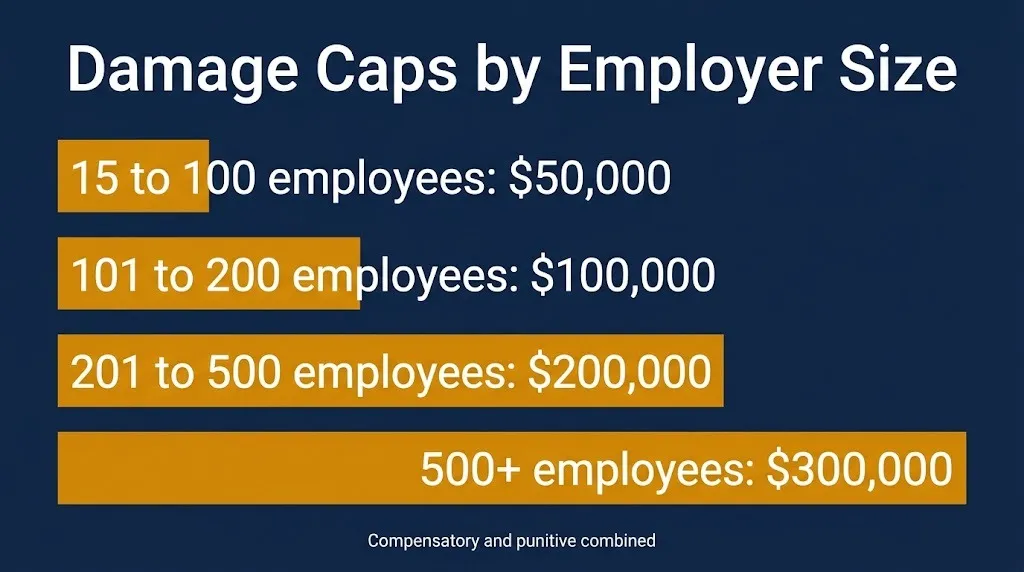
The federal cap on combined compensatory and punitive damages is $300,000, and it applies only to employers with more than 500 employees. Smaller employers face lower caps.
| Employer size | Cap on compensatory and punitive damages |
|---|---|
| 15 to 100 employees | $50,000 |
| 101 to 200 employees | $100,000 |
| 201 to 500 employees | $200,000 |
| More than 500 employees | $300,000 |
Those limits come from the EEOC’s remedies page. They apply to intentional discrimination based on sex, including pregnancy.
A legal glossary notes that back pay and front pay sit outside those caps. It also says a jury can award any figure, and the court then reduces it to the cap. One SHRM report described a jury award of $36 million in punitive damages cut to $300,000 combined.
State laws may offer different remedies. Check your state before assuming the federal cap is your ceiling.
What is the average pregnancy discrimination settlement?
No sourced average exists in the EEOC releases reviewed. The EEOC doesn’t publish one there, and the numbers online conflict.
| Source type | Claimed range | Dataset cited? |
|---|---|---|
| Los Angeles law firm page | $10,000 to $50,000 (California) | No |
| Legal forms site | $50,000 to $1,000,000 by case complexity (California) | No |
| Legal-help article | Average EEOC settlement about $40,000 | No |
The eight announced 2026 amounts above are a sample, not an average. They also come from cases the EEOC chose to announce. That’s like quoting average repair costs using only shops that advertise.
Most private settlements stay confidential. So no public number captures what workers who settle quietly receive.
Reality Check: No one owes you a pregnancy discrimination payout until a settlement, decree, or judgment says so. Anyone promising a guaranteed amount, or asking for an upfront fee to “release” funds, is a scam risk. Filing an EEOC charge is the real path, and you don’t need to pay anyone to start.
Key Takeaway: Announced 2026 EEOC amounts ran $30,000 to $185,000 per case, and federal caps limit compensatory and punitive damages to $50,000 to $300,000 per person.
What raises or lowers a pregnancy discrimination settlement?
Several factors move a settlement, and amounts depend on how they combine. Here are the main ones:
- Employer size: It sets the cap on compensatory and punitive damages.
- Lost pay: Back pay and front pay count outside the caps, per a legal glossary.
- Emotional harm: Compensatory damages can cover emotional harm and out-of-pocket costs.
- Employer conduct: Malicious or reckless acts can bring punitive damages.
- Retaliation: Retaliating after a complaint can turn a bounded case into a punitive one.
- Evidence: Timing and documents matter. A law firm guide lists dates and written records as key proof.
One legal-aid guide warns that compensatory and punitive damages are rare and shouldn’t be expected. That fits the 2026 amounts, where several cases landed well below the caps.
Non-money terms count too. Consent decrees often add training, policy reviews, and reporting duties, covered later in this article.
How do you file a pregnancy discrimination claim?
You file by submitting a Charge of Discrimination to the EEOC or a state or local agency. Here are the steps:
- Write down dates, names, and what happened.
- Save emails, texts, schedules, and doctor’s notes.
- Contact the EEOC online, at a field office, or at 1-800-669-4000.
- Submit a Charge of Discrimination.
- Or file with your state or local fair-employment agency.
- Keep copies of every form and message.
- Answer EEOC requests quickly.
- Talk to a licensed employment attorney about your options.
Pregnancy accommodation denials fit the same process. The EEOC lists being denied a needed workplace change because of pregnancy or childbirth as a basis for a charge.
How long do you have to file a pregnancy discrimination claim?
You generally have 180 calendar days from the discriminatory act to file a charge. That extends to 300 days if a state or local agency enforces a law banning the same discrimination.
The EEOC says the time limits are strict. It advises contacting the agency immediately.
Federal government employees follow a different, shorter path. A law firm summary cites 45 days to report. Confirm that with the EEOC.
Think of a store’s return window. On day 181, the answer can be no, even if your reason is good.
For a firing, the clock generally starts on the termination date, per a law firm guide. Count from the last discriminatory act, and check your state’s rules.
Key Takeaway: Count your days now: 180 is the federal floor, 300 applies in many states, and missing the window can end a claim.
What happens after you file an EEOC pregnancy charge?
After you file, the EEOC reviews the charge, and cases can end in mediation, conciliation, or an EEOC lawsuit. Every 2026 lawsuit release reviewed says the agency first tried a pre-litigation settlement through conciliation.
Two September 2026 resolutions show that path working. Vital Systems and Condor Club settled at conciliation, with no lawsuit.
Other employers settled after the EEOC sued. Cosmos, iPRO Dental, and Feit Electric all resolved that way. Federal courts entered consent decrees in those cases.
Ask the EEOC how a private lawsuit would work in your case. The charge process generally comes first.
| Stage | What 2026 releases show |
|---|---|
| Charge | Worker files with the EEOC |
| Conciliation | EEOC tries a pre-lawsuit settlement |
| Lawsuit | EEOC sues if conciliation fails |
| Consent decree | Court-approved terms, money, and oversight |
How long does a pregnancy discrimination settlement take?
EEOC pregnancy settlements in 2026 took roughly two to three years from the alleged act. Those figures come from the EEOC’s own release dates, not a law firm estimate.
| Case | Alleged act | Announced | Roughly |
|---|---|---|---|
| Cosmos Restaurant | November 2023 | March 31, 2026 | 28 months |
| Condor Club | November 2023 | September 16, 2026 | 34 months |
| Vital Systems | August 2024 | September 16, 2026 | 25 months |
A legal forms site says cases take one to four years. That’s a wide range with no data behind it. The EEOC dates are tighter and checkable.
Private settlements can move faster or slower. Evidence, employer response, and court schedules all play a part.
Is the EEOC still pursuing pregnancy discrimination cases in 2026?
Yes, the EEOC kept pursuing pregnancy cases through 2026. HR Dive reported in January that the agency’s focus stayed strong under both the Pregnancy Discrimination Act and the Pregnant Workers Fairness Act.
Seven settlements were announced between January and June. Two more resolutions followed on September 16. EEOC pages also list recent suits against Fred Meyer Stores, St. Louis Arc, Call 4 Health, and Family Dollar Stores of North Carolina.
Those suits aren’t settled, so they carry no payout. Allegations in a complaint aren’t findings.
The takeaway for you: a charge isn’t wasted effort. The agency has resolved pregnancy cases this year, from small employers to staffing agencies.
Key Takeaway: The EEOC resolved pregnancy cases in 2026 at every stage, from conciliation to consent decrees.
What laws cover pregnancy discrimination at work?
Three federal laws protect pregnant workers: Title VII (through the Pregnancy Discrimination Act), the Pregnant Workers Fairness Act, and the ADA. Each covers different ground.
| Law | What it covers |
|---|---|
| Pregnancy Discrimination Act (1978) | Bars sex discrimination based on pregnancy, childbirth, and related conditions |
| Pregnant Workers Fairness Act | Requires reasonable accommodations for known limitations, absent undue hardship |
| Americans with Disabilities Act | Covers some pregnancy-related conditions, such as gestational diabetes |
HR Dive notes pregnancy itself isn’t a disability under the ADA. Conditions such as gestational diabetes, nausea, or cervical insufficiency can qualify.
The PDA amended Title VII 14 years after the law took effect in 1964. Title VII claims also carry the damage caps shown earlier.
What does the Pregnant Workers Fairness Act add?
The Pregnant Workers Fairness Act requires employers to provide reasonable accommodations for known limitations related to pregnancy, childbirth, or related conditions. It also bars punishing workers for asking.
It took effect in June 2023. It closed a gap: under older rules, a pregnant worker sometimes had to find a comparable coworker who got an accommodation, per one legal summary.
Two 2026 cases show it in action. JAG Physical Therapy agreed to pay $125,000 in a PWFA case. Urologic Specialists of Oklahoma agreed to $90,000 in a PWFA and ADA case.
Vital Systems shows what a doctor’s note can mean. The EEOC found the company fired a worker after she said her doctor barred radiation exposure.
What non-money terms come with a pregnancy discrimination settlement?
Pregnancy discrimination settlements often include non-money terms, such as training, new policies, and reports to the EEOC. These terms can protect coworkers long after one case ends.
| Term | Example from 2026 releases |
|---|---|
| Training | Required at TEG Staffing, iPRO Dental, Condor Club |
| Hotline or reporting channel | TEG Staffing and iPRO Dental |
| Policy review | TEG Staffing, Condor Club, Vital Systems |
| Compliance reports to EEOC | Every six months for three years (Condor Club); four years (Vital Systems) |
| Record fixes | Expunged records and neutral references (TEG Staffing) |
| Reinstatement | Consideration for affected former employees (TEG Staffing) |
The decrees also require tracking accommodation requests. Several require posting a notice about employee rights.
Those terms cost the employer money and time. They don’t appear in the dollar figure, so compare settlements by the full package.
Key Takeaway: A settlement’s dollar amount is only part of the deal, since training, reporting, and policy changes often run for years.
What Happens Next
For you, the path starts with counting days. Here are the expected stages:
- Now: Write down dates and save evidence. Count 180 days, or 300 if state or local law applies.
- Before your deadline: File a charge with the EEOC or your state or local agency.
- Expected, no fixed date: The EEOC investigates and may offer mediation or conciliation.
- Expected, case by case: If conciliation fails, the EEOC may sue. Based on 2026 releases, resolution has taken about two to three years.
- Not yet confirmed: The TEG Staffing claim deadline. Contact the EEOC directly.
Frequently Asked Questions
How much is a pregnancy discrimination lawsuit worth?
It depends on the facts and employer size.
Announced 2026 EEOC case totals ran from $30,000 to $185,000.
What is the maximum you can get for pregnancy discrimination?
Compensatory and punitive damages cap at $300,000 for employers with over 500 employees.
Back pay and front pay sit outside that cap.
How long do I have to file a pregnancy discrimination claim?
Generally 180 calendar days from the discriminatory act.
That extends to 300 days where state or local law applies.
Do I need a lawyer to file with the EEOC?
No, you can start a charge without one.
A licensed employment attorney can explain your options.
Can I be fired for being pregnant?
Federal law bars firing someone because of pregnancy.
The EEOC sued or settled over such firings in 2026.
Is there an average pregnancy discrimination settlement?
No sourced average exists in the EEOC releases reviewed.
Online ranges conflict and cite no data.
Does the Pregnant Workers Fairness Act cover accommodations?
Yes, it requires reasonable accommodations for known pregnancy-related limitations.
Employers may refuse only when it creates undue hardship.
If you think pregnancy cost you a job, hours, or an accommodation, start counting. Gather your dates, messages, and doctor’s notes today.
Then file a charge before your window closes. The first deadline to protect is 180 days, or 300 where state or local law applies.