Minimum Hourly Compensation Requirement in 2026: What Federal Law Actually Says (And What It Doesn’t)
Quick Answer
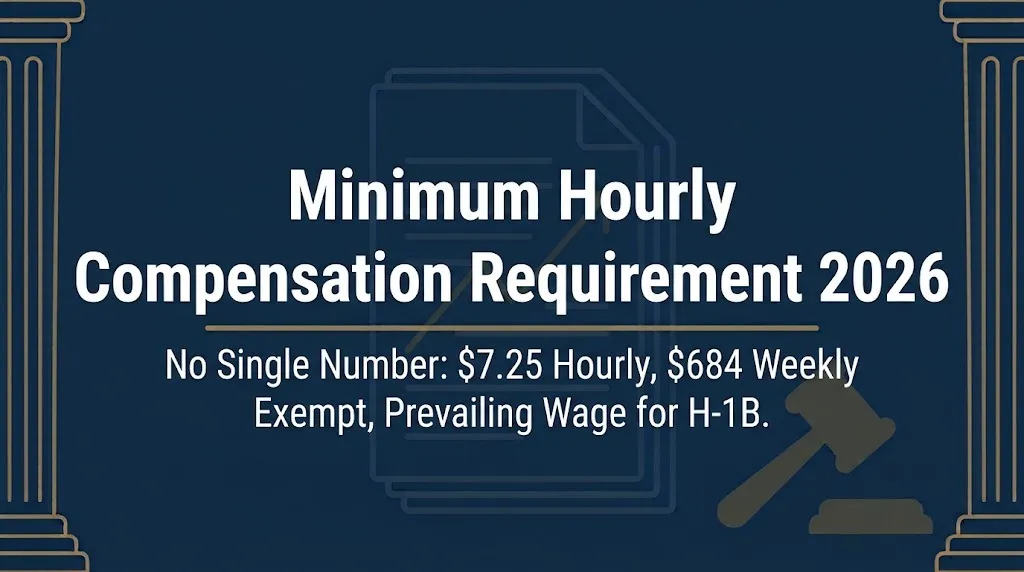
- Is there one number? No. The requirement depends on your status: hourly, salaried exempt, or visa worker.
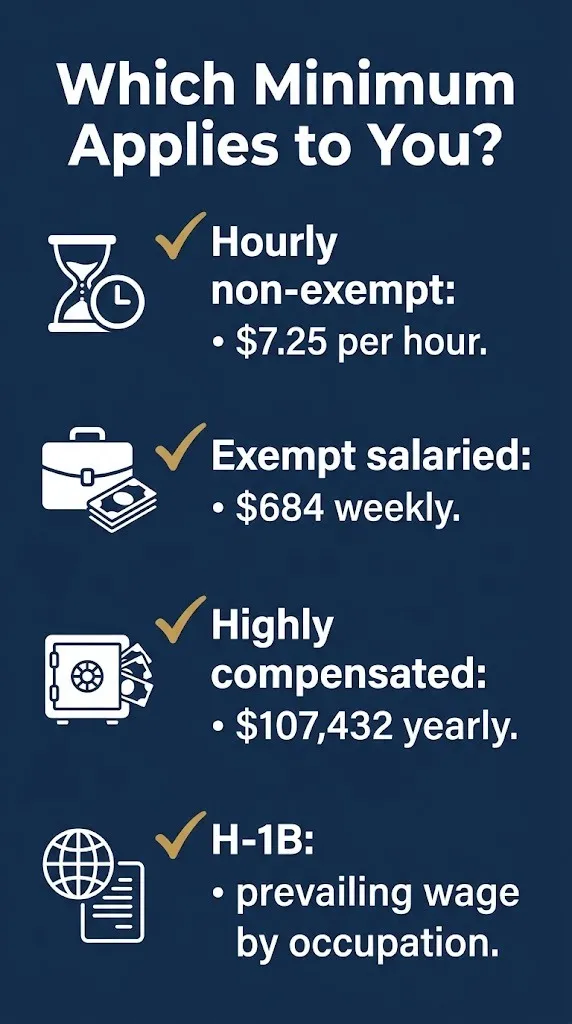
- What’s the baseline? The federal minimum wage remains $7.25 per hour for covered non-exempt employees.
- Key 2026 change: The DOL restored the $684 per week salary threshold for white-collar exemptions on May 14, 2026.
You searched for the minimum hourly compensation requirement, and the honest answer is that no single figure covers every worker. The rule that applies to you depends on how you’re classified.
A fast-food worker paid by the hour falls under the $7.25 federal minimum wage. A salaried manager classified as exempt must clear $684 per week. An H-1B software engineer faces a prevailing wage determination that varies by occupation and location.
This article breaks down each requirement, explains the May 2026 regulatory change that reset the salary threshold, and shows you where the real legal exposure sits in 2026.
The Facts
| Item | Verified Detail |
|---|---|
| Federal Minimum Wage | $7.25 per hour (non-exempt employees) |
| FLSA Exempt Salary Threshold | $684 per week ($35,568 annually) |
| Highly Compensated Employee Threshold | $107,432 annually |
| Effective Date of Restoration | May 14, 2026 |
| H-1B Exempt Wage Threshold | $60,000 annually (for dependent employer attestations) |
| Proposed H-1B Wage Change | Level I from 17th to 34th percentile (not final) |
| Lawsuit or Settlement Fund | None. This is a regulatory compliance topic. |
| Administrator | U.S. Department of Labor, Wage and Hour Division |
Is there a single minimum hourly compensation requirement in the US?
No. There is no universal hourly floor that applies to every worker in every classification. The Fair Labor Standards Act sets a minimum wage for non-exempt employees, but exempt employees are governed by a salary test, not an hourly rate.
The federal minimum wage has been $7.25 per hour since 2009. Many states and localities set higher rates, and employers must pay the higher of federal, state, or local minimum wage.
The confusion in your search likely comes from mixing three separate concepts: the minimum wage for hourly workers, the salary threshold for exempt employees, and the prevailing wage requirements for visa workers. They are different rules with different numbers.
What is the FLSA salary threshold for exempt employees in 2026?
The salary threshold for most exempt executive, administrative, and professional employees is $684 per week, which equals $35,568 annually. The Department of Labor restored this level on May 14, 2026 .
The change reversed a 2024 rule that would have raised the threshold to $844 per week ($43,888 annually). That 2024 rule was vacated by a federal court, and the DOL’s technical amendment formally republished the 2019 text .
The highly compensated employee threshold is $107,432 annually. Employees above that level may qualify for exemption with a less stringent duties test .
To be exempt, you must meet three tests: the salary basis test, the salary level test, and the duties test. Earning above $684 per week is necessary but not sufficient. Your job duties must also qualify.
| Exemption Category | Weekly Threshold | Annual Equivalent |
|---|---|---|
| Executive, Administrative, Professional | $684 | $35,568 |
| Highly Compensated Employee | Not applicable | $107,432 |
| Computer Employee (hourly option) | $27.63/hour | Not applicable |
How does the minimum wage work for hourly employees in 2026?
The federal minimum wage is $7.25 per hour for covered non-exempt employees. Your state may require more, and if it does, your employer must pay the higher rate.
There is no federal requirement that salaried employees be paid an hourly minimum. A salaried exempt employee can work 60 hours in a week and receive the same $684 minimum, with no overtime. That’s the tradeoff of exemption.
For non-exempt employees, overtime must be paid at 1.5 times the regular rate for hours over 40 in a workweek. The regular rate includes non-discretionary bonuses and other compensation, not just the hourly wage.
What is the H-1B minimum wage requirement in 2026?
H-1B workers have no single minimum wage. Employers must pay the higher of the actual wage paid to similar U.S. workers or the prevailing wage for the occupation and location .
The prevailing wage is set at four levels based on Bureau of Labor Statistics data. Under current rules, Level I (entry) is approximately the 17th percentile, and Level IV (fully competent) is approximately the 67th percentile .
A March 2026 Department of Labor proposed rule would raise those thresholds. Level I would move to the 34th percentile, a 33.4% increase. Level II would rise from the 34th to the 52nd percentile . That rule is not final. No changes are in effect until a final rule is published.
There is also a separate $60,000 annual wage threshold for determining whether an H-1B worker is “exempt” from certain attestation obligations at dependent employers. That figure includes cash bonuses but excludes benefits like health insurance .
Key Takeaway: The minimum hourly compensation requirement is not one number. It’s $7.25 for hourly workers, $684 per week for exempt salaried workers, and a prevailing wage for H-1B workers that depends on occupation and location.
Why did the salary threshold change in 2026?
The salary threshold changed because a federal court vacated the 2024 rule that raised it. The DOL then issued a technical amendment to formally restore the 2019 levels.
The 2024 rule would have raised the standard salary threshold to $844 per week and the highly compensated threshold to $132,964. A court struck it down, and the DOL had been applying the 2019 levels in enforcement since then .
The May 14, 2026 amendment removed the vacated 2024 language from the Code of Federal Regulations and republished the 2019 text. The practical effect for employers was clarity, not a change in enforcement posture .
If you were classified as exempt under the 2019 thresholds and your salary was between $684 and $844 per week, your classification is now on firmer regulatory ground. That doesn’t mean your employer handled it correctly during the transition period.
How do I know if my pay meets the minimum requirement?
You know your pay meets the requirement when you can identify which rule applies to you and confirm your compensation clears that threshold. The check depends on your classification.
Here is a practical checklist:
- Determine if you’re exempt or non-exempt. The job duties test matters more than the job title. Ask HR for your classification.
- If non-exempt: Confirm your hourly rate is at least $7.25 or your state’s higher minimum.
- If exempt: Confirm your salary is at least $684 per week on a salary basis, not subject to reduction for quality or quantity of work.
- If H-1B: Check your Labor Condition Application for the attested wage and compare it to the prevailing wage for your occupation and location.
- Review your pay stubs. Exempt employees should receive the full salary for any week worked, regardless of hours.
- Check state law. Some states set higher salary thresholds or stricter duties tests.
What happens next if your pay falls below the requirement?
The path depends on the violation. Unpaid minimum wages or overtime go to the DOL or your state labor agency. Misclassification as exempt can trigger back pay liability for the employer.
For minimum wage shortfalls: File a complaint with the Wage and Hour Division. The DOL can recover back wages and liquidated damages.
For overtime violations: The lookback period is generally two years, or three years for willful violations.
For misclassification: If you were treated as exempt but didn’t meet the salary or duties test, you may be owed overtime for hours over 40.
For H-1B violations: Report to the DOL’s Office of Foreign Labor Certification. Employers can face back wage liability and debarment.
Frequently Asked Questions
What is the minimum hourly compensation requirement in the US?
There is no single requirement. The federal minimum wage is $7.25 per hour for non-exempt workers. Exempt salaried employees must earn at least $684 per week.
Is the FLSA salary threshold $684 or $844 per week in 2026?
It is $684 per week. The DOL restored the 2019 level on May 14, 2026, after a court vacated the 2024 rule that would have raised it to $844.
Does the minimum wage apply to salaried employees?
No. Exempt salaried employees are not entitled to the hourly minimum wage or overtime. They must meet the salary basis and duties tests instead.
What is the minimum salary for an exempt employee in 2026?
$684 per week, or $35,568 annually, for most executive, administrative, and professional employees. The highly compensated threshold is $107,432.
Do H-1B workers have a minimum wage?
Yes, but it is not a flat hourly rate. Employers must pay the higher of the actual wage for similar U.S. workers or the prevailing wage for the occupation and location.
Did the H-1B prevailing wage increase in 2026?
Not yet. The DOL proposed raising the wage levels in March 2026, but the rule is not final and no changes are in effect.
What happens if my employer pays below the salary threshold?
If you were misclassified as exempt, you may be owed overtime and minimum wage back pay. The DOL can recover wages for up to three years in willful cases.
Is there a lawsuit or settlement for minimum wage violations?
No general settlement fund exists. Minimum wage claims are individual or collective actions, often under the FLSA or state law. You file a complaint or join a case, not a claim form.