You May Be Entitled to Compensation 2026: What That Phrase Really Means, Which Cases Pay, and How to Spot the Scam
Quick Answer
- The phrase is legitimate language from real lawsuits, but it is also a common scam hook. Context decides which one you are looking at.
- Real 2026 EEOC employment settlements verified here range from $26,000 to $600,000. Securities class actions have lead plaintiff deadlines in November 2026.
- The safest test: real settlements never ask you to pay an upfront fee to receive money. Any demand for payment before a payout is a scam.
“You may be entitled to compensation” is a standard legal notice phrase, not a promise of money. It means a lawsuit or agency action exists, a defined group of people may be covered, and those people have options. It does not mean you will be paid, and it does not tell you how much.
This phrase lands in your inbox most often through employment discrimination settlements and securities class action notices. The employment side has verified dollar figures attached to named employers. The securities side has verified court deadlines, but no settlement fund yet.
This article covers what the phrase means in each context, which 2026 cases have real money attached, the deadlines that are actually confirmed, and the warning signs that separate a court notice from a scam. One detail worth knowing upfront: some EEOC settlements in 2026 were resolved for less than the price of a used car, while others topped half a million dollars.
The Facts
| Item | Verified Detail |
|---|---|
| Phrase status | Standard notice language in lawsuits and agency actions, not a guarantee |
| Verified employment settlements in 2026 | $26,000 to $600,000 across named EEOC cases |
| Securities lead plaintiff deadlines | November 13, 16, and 23, 2026 in verified cases |
| EEOC filing route | Charge must be filed with the agency before a lawsuit |
| Scam red flag | Any demand for an upfront fee to release compensation |
Is “you may be entitled to compensation” legit or a scam?
The phrase is legitimate when it comes from a court-authorized notice, an EEOC press release, or a securities firm filing in an active case. It is a scam when it arrives unsolicited and demands payment, bank details, or identity documents before any money moves.
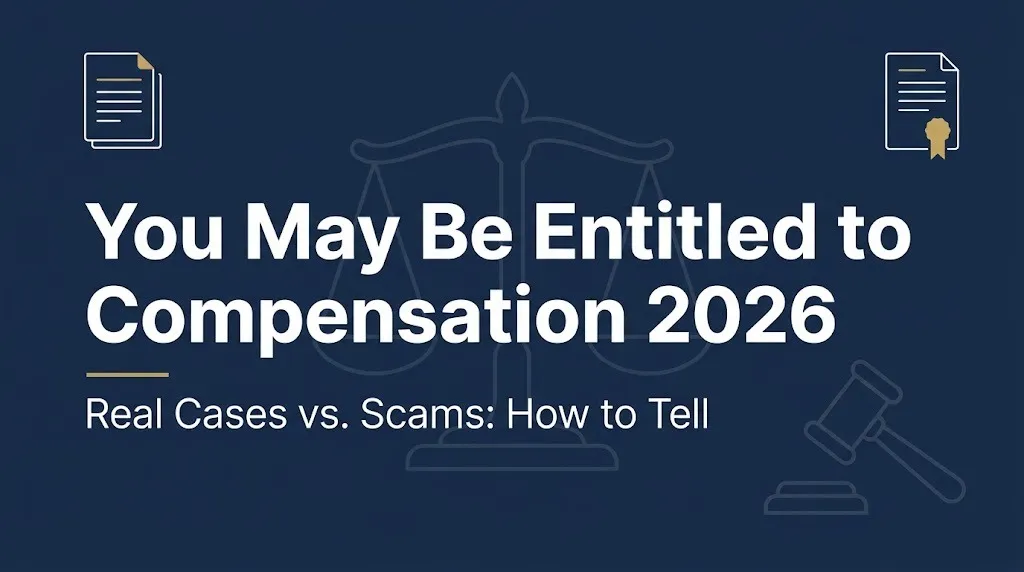
The scam version follows a predictable script. You get a text, email, or letter saying you are owed compensation. To release it, you must pay an administration fee, a tax, or a processing charge. Scamwatch and multiple government consumer agencies list this exact pattern as an advance-fee scam .
The legitimate version has verifiable anchors. You can find the case name, the court, the settlement administrator, and a deadline through public records. The EEOC publishes its settlements on its own website with case numbers and dollar amounts . Securities firms publish class period dates and lead plaintiff deadlines in press releases tied to filed cases .
A simple test separates them: real compensation never requires you to pay first. Court-authorized settlements deduct administration costs from the fund, not from your pocket.
Key Takeaway: The phrase itself is neutral. The scam is in the demand for upfront payment. Real settlements and agency actions never ask you to pay to receive money.
How much compensation is actually available in 2026?
The verified amounts in 2026 employment cases range from $26,000 to $600,000, depending on the employer and the number of workers affected. These are settlement totals, not per-person payouts, and individual amounts depend on the claims process.
Here are the verified 2026 EEOC employment settlements with published dollar figures:
| Employer | Amount | Allegation Type | Case Detail |
|---|---|---|---|
| Lori’s Gifts, Inc. | $600,000 | Disability discrimination, unlawful screening | Nationwide gift shop chain, Southern District of Ohio |
| HCL America | $495,000 | Age and national origin discrimination | Tech consulting, rejected 62-year-old applicant |
| Amer Sports Winter & Outdoor | $350,000 | Age discrimination and retaliation | Colorado employee, ADEA claims |
| Metro Eighteen, Inc. | $70,098 | Race harassment and retaliation | Black employee fired after complaining, Central District of California |
| South Valley Care Center | $75,000 | Age discrimination and retaliation | Albuquerque care facility, laundry department workers |
| Builders FirstSource | $26,000 | Disability and age discrimination | 67-year-old temp worker rejected, Western District of Washington |
These are agency-litigated cases, not class actions you join. The money goes to the specific workers named in the EEOC charge. If you were not part of the original complaint, you cannot claim a share of these particular funds.
Securities class actions follow a different model. The AST SpaceMobile, Tigo Energy, and AppLovin cases all use the phrase “you may be entitled to compensation” in Rosen Law Firm notices . Those cases have no settlement fund yet. They have lead plaintiff deadlines, which are procedural steps, not payout dates.
Key Takeaway: Verified employment settlements in 2026 range from $26,000 to $600,000, but these funds go to named workers in EEOC cases, not to anyone who sees a headline.
Do you have to file a claim to get compensation?
Whether you must file a claim depends entirely on the type of case. EEOC settlements do not have an open claim form for the public. Securities class actions require you to act only if you want to serve as lead plaintiff. Consumer class actions usually require a claim form by a deadline.
Here is the decision tree:
- EEOC employment case: No public claim form. If you were not named in the charge or the lawsuit, you cannot claim these funds. Your route is filing your own charge with the EEOC, not joining someone else’s settlement.
- Securities class action: You do not need to file anything to remain a potential class member. You must file a motion by the lead plaintiff deadline only if you want to direct the litigation . The deadline is typically 60 days after the notice.
- Consumer class action: You usually must submit a claim form by a stated deadline to receive a share. The 23andMe data breach settlement required a claim by February 17, 2026, and payments went out September 29 and 30, 2026 .
- Government agency settlement: The agency handles distribution to identified victims. You do not file a public claim.
For employment discrimination, the clock starts when the discrimination happens, not when you see a headline. You generally must file a charge with the EEOC within 180 days of the discriminatory act in most states, or up to 300 days in states with their own fair employment agencies.
Reality Check: No court or settlement administrator will ever text you a link and demand a fee to release your compensation. The Metro Eighteen case, the Builders FirstSource case, and every other verified settlement here paid workers through court-supervised processes. If someone asks you to pay first, you are not looking at a settlement. You are looking at a scam.
What are the November 2026 securities deadlines?
The securities lead plaintiff deadlines in November 2026 are procedural court dates, not claim payout deadlines. Missing them does not forfeit your right to a potential future recovery. It only forfeits your chance to ask the court to appoint you as lead plaintiff.
Here are the verified deadlines:
| Case | Lead Plaintiff Deadline | Class Period | Allegation |
|---|---|---|---|
| AST SpaceMobile | November 13, 2026 | March 4, 2025 to July 15, 2026 | Overstated capital position, slow user adoption |
| AppLovin | November 16, 2026 | February 12, 2026 to August 5, 2026 | AI feature delays, overstated model improvements |
| Tigo Energy | November 23, 2026 | February 24, 2026 to August 4, 2026 | EG4 partnership revenue projections lacked basis |
If you bought shares in any of these companies during the class period, you may be an absent class member. You do not need to do anything to preserve that status. If a settlement or judgment eventually produces a fund, you would be notified through a separate process.
No class has been certified in any of these cases as of the search date . That means no money is available now, and no payout amount can be estimated.
Key Takeaway: November 2026 securities deadlines are for lead plaintiff motions only. Doing nothing preserves your potential class membership. Filing is only for investors who want to direct the case.
How do you file an employment discrimination claim?
You file an employment discrimination claim by submitting a charge to the EEOC, not by responding to a settlement advertisement. The charge is free to file, and the agency investigates before any lawsuit happens.
Here are the steps:
- Confirm the deadline. File within 180 days of the discriminatory act in most states, or 300 days where a state or local agency has jurisdiction.
- Gather your evidence. Pay stubs, emails, texts, performance reviews, witness names, and dates of the incidents.
- Contact the EEOC. File in person, by mail, or through the agency’s online public portal.
- Attend the intake interview. An EEOC investigator will review your allegations and decide whether to open an investigation.
- Wait for the investigation. The agency may mediate, investigate, or issue a right-to-sue letter.
- Decide on a lawsuit. If the EEOC does not resolve the case, you may file your own lawsuit in federal court within 90 days of receiving a right-to-sue notice.
- Do not pay a claim helper. Filing a charge is free. Third parties charging fees to “process” your EEOC claim are unnecessary.
The verified 2026 cases show the range of outcomes. Metro Eighteen paid $70,098 to one worker who was harassed and fired for complaining . Lori’s Gifts paid $600,000 to resolve a pattern of unlawful screening that affected multiple applicants . The size of the fund depends on how many people were harmed and how strong the evidence is.
Key Takeaway: Employment discrimination claims start with a free EEOC charge, not a paid claim service. The 180-day filing window is the deadline that matters most, and it runs from the date of the discrimination.
What happens next if you think you have a claim?
Here is the timeline of steps to take, depending on what kind of notice you received:
- Now: Identify whether the notice names a court, case number, or agency. If it does not, treat it as unverified.
- Within one week: Search for the case name in public court records or the agency’s website. EEOC settlements appear on eeoc.gov. Securities cases appear on the filing firm’s case page.
- Before any deadline: If the notice is a securities lead plaintiff deadline, decide whether you want to serve as lead plaintiff or remain an absent class member.
- If it is an employment issue: Calculate your 180-day window from the date of the discriminatory act and file an EEOC charge if you are inside it.
- If it is a consumer settlement: Find the official settlement website, read the claim requirements, and note the claim deadline.
Frequently Asked Questions
Is “you may be entitled to compensation” a scam?
Not always. It is legitimate when it comes from a court-authorized notice, an EEOC release, or a securities filing. It is a scam when the sender demands an upfront fee or your bank details before any money moves.
How much money will I get?
No single amount exists. EEOC settlements in 2026 ranged from $26,000 to $600,000 in total, but those funds go to named workers. Securities class actions have no settlement fund yet. Consumer settlements set per-person amounts after claims are counted.
Do I need a lawyer to get compensation?
Not necessarily. EEOC charges are free to file and do not require a lawyer. Securities class actions have lead counsel appointed by the court. Consumer claims usually do not require a lawyer. A lawyer is most useful when you are considering your own lawsuit.
What is a lead plaintiff deadline?
A lead plaintiff deadline is the court date by which an investor must file a motion to serve as the representative party in a securities class action. Missing it does not forfeit your potential recovery. It only forfeits your chance to direct the case.
Can I join an EEOC settlement I saw in the news?
No. EEOC settlements resolve specific charges filed by specific workers. The money goes to those workers. If you experienced similar discrimination, you must file your own charge with the EEOC within the filing window.
How long do I have to file an employment discrimination claim?
In most states, you have 180 days from the date of the discriminatory act to file an EEOC charge. In states with their own fair employment agencies, the window can extend to 300 days. The deadline is strict.
What should I do if I get a compensation text or email?
Do not click, reply, or pay anything. Look up the case name or the sender’s identity through a public source. If no court, case number, or agency appears, treat it as a scam and report it.
Where can I verify a real settlement?
Check the EEOC website for employment cases, the federal court docket for the case number, or the official settlement website named in the notice. A real notice will always point to a verifiable public record.
The phrase is not the test. The source is. Check for a case name, a court, an agency, or an official settlement website before you act on any compensation notice. The verified EEOC settlements in this article all trace to public records. The scams do not.