Railroad Cancer Lawsuit Settlements 2026: Verdicts, Deadlines and FELA Claims
Quick Answer
- Railroad cancer suits are individual FELA cases. No global settlement fund or claims administrator exists.
- Not yet determined. One verified verdict reached $21.8 million, with 52% of fault assigned to the worker.
- FELA claims generally must be filed within three years of when you knew or should have known.
There is no single fund you can claim from in railroad cancer lawsuit settlements. Railroad workers sue one by one under the Federal Employers’ Liability Act, known as FELA.
The number that matters most is three years. FELA claims generally must be filed within three years of when you knew, or should have known, your cancer was work-related.
This guide covers verified verdicts, the 2026 filings, time limits, and what money figures really show. One surprise: a $21.8 million headline verdict came with 52% of fault assigned to the worker.
The Facts
| Case | Individual FELA suits by railroad workers and families. No class action found. Example: Hunter v. Norfolk Southern Railway Co., Philadelphia Court of Common Pleas, No. 260701694 |
| Status | New filings in July, September, and October 2026; no global settlement |
| Fund Size | Not yet confirmed. No settlement fund found |
| Est. Per Person | Not yet determined. Amounts vary by case |
| Claim Deadline | No claims deadline. FELA’s general limit is three years from when you knew or should have known |
| Administrator | None appointed |
| Proof Needed | No claim form. Cases rest on work history, exposure evidence, and diagnosis records |
Is there a railroad cancer lawsuit settlement you can join?
No, no railroad cancer settlement is open for workers to join. Railroad cancer claims are individual FELA suits, not a class action with a claims website.
We found no settlement administrator, no case-wide claim form, and no multidistrict litigation for these claims. Each worker or family files a separate case against a railroad employer.
That means “joining” is the wrong frame. You’d hire a lawyer, who files your case in court. Any site promising a settlement check you can claim online isn’t describing a verified program.
A separate case, the East Palestine derailment litigation against Norfolk Southern, involves residents, not worker cancer claims. Don’t confuse the two.
Is the railroad workers cancer lawsuit real in 2026?
Yes, railroad workers’ cancer suits are real, and filings picked up in 2026. Two law firms announced a first wave of FELA complaints against Norfolk Southern on July 20, 2026.
The first complaint, Hunter v. Norfolk Southern Railway Co., sits in the Philadelphia Court of Common Pleas as No. 260701694. On October 14, 2026, workers from a Roseville, California rail yard sued Union Pacific in San Francisco County Superior Court.
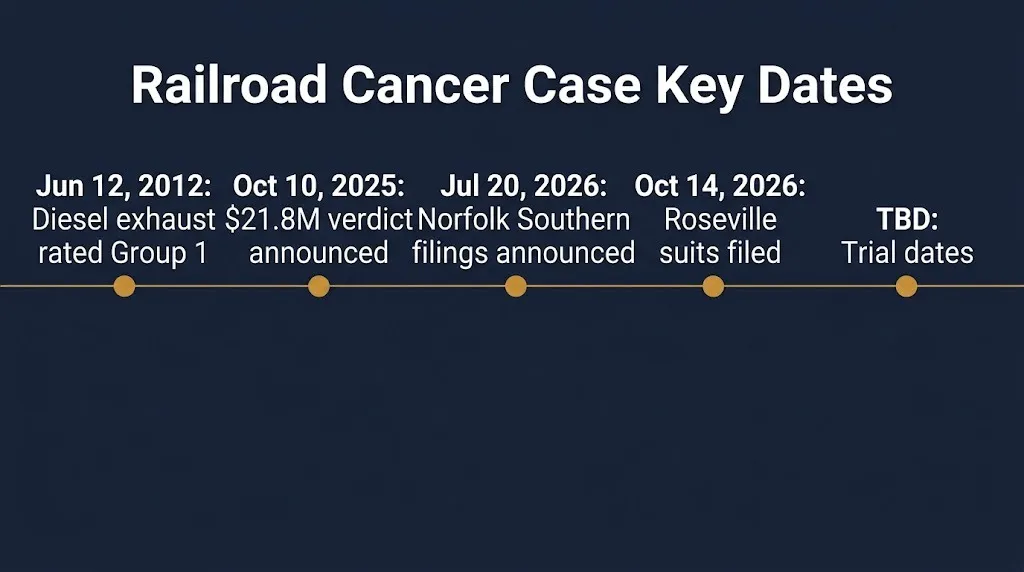
Verdicts exist too. A Virginia jury awarded $21.8 million in a Norfolk Southern leukemia case, announced October 10, 2025.
These are allegations and verdicts in separate cases. They don’t add up to one pool of money.
How much are railroad cancer lawsuit settlements worth?
The value of railroad cancer cases is not yet determined, because each case depends on its own facts. Verified public examples are mostly jury verdicts, since settlements are rarely published.
| Case | Venue | Award | Notes |
|---|---|---|---|
| Redford v. Norfolk Southern | Virginia state court, announced October 10, 2025 | $21.8 million | Leukemia; jury put 48% of fault on the railroad and 52% on the worker |
| Brown v. Union Pacific | Illinois jury, September 30, 2016 | $7.5 million | Cancer after a 31-year career; reported by a law firm |
| Howell v. Consolidated Rail | Cuyahoga County, Ohio, May 3, 2018 | $4,508,488 | Asbestos-related lung cancer; railroad found 60% liable |
| Two eve-of-trial settlements | Not named | $950,000 each | Attorney-reported, undated |
| Kidney cancer settlement | Not named | $700,000 | Attorney-reported, undated |
Payout for any individual worker: Not yet determined. Amounts depend on cancer type, exposure proof, medical costs, lost income, and fault shares.
Key Takeaway: Verified railroad cancer awards range from hundreds of thousands to millions, but no figure predicts your case.
What did the $21.8 million Norfolk Southern verdict actually award?
The $21.8 million Redford verdict is a gross jury award, and the jury assigned 52% of fault to the worker. Sources we checked don’t state the final judgment after that reduction.
The award broke down this way, per Missouri Lawyers Media:
- $10 million for pain and suffering
- $10 million for mental anguish
- $1.8 million for medical bills
Randall Redford was diagnosed with acute myeloid leukemia in 2019, and it recurred in 2024. The jury found Norfolk Southern 48% at fault for diesel exhaust and creosote exposure. It assigned 52% to his decades of heavy smoking.
A headline verdict works like a gross paycheck before deductions. Applying 48% to $21.8 million gives about $10.46 million. That’s our arithmetic, not a reported judgment.
Reality Check: No one will text you railroad cancer money. No claims website exists for these cases, and a “claim helper” charging a fee for a payout is selling nothing. Talk to a licensed attorney, and ask how fees work before you sign.
Who may qualify for a railroad workers cancer lawsuit?
You may qualify if you worked for a railroad, developed cancer, and can connect it to workplace exposure. A licensed attorney decides whether your case is viable, and no one qualifies automatically.
The usual building blocks are:
- You were employed by a railroad, such as a track laborer, engineer, machinist, or conductor
- You were diagnosed with a cancer named in these suits
- Records suggest exposure to diesel exhaust, benzene, creosote, asbestos, or similar substances
- The railroad’s negligence played a part, which you must prove
- You file within FELA’s time limit
Estates and widows have filed. In the Redford case, his wife managed his estate and sued after his death.
Long careers show up often. Charlie Hunter, 73, worked 40 years at Norfolk Southern, per his lawyers. Length of service alone doesn’t create a case, but it matters for exposure evidence.
How do you file a railroad cancer lawsuit?
You file through an attorney, who files a FELA complaint in state or federal court. Follow these steps:
- Gather your diagnosis and treatment records.
- List every railroad job, yard, and year you worked.
- Write down chemicals, fuels, and equipment you worked around.
- Note who first told you the cancer might be work-related, and when.
- Save pay stubs, union records, and retirement paperwork.
- Ask a FELA attorney to check your three-year deadline.
- Ask how fees work before you sign anything.
Step 4 matters because courts look at what you knew and when. The next section shows why.
How long do you have to file a railroad cancer lawsuit?
FELA claims generally must be filed within three years from when the cause of action accrued. Courts apply a discovery rule, so the clock can start when you knew or should have known of a work connection.
It works like a warranty clock that starts when you notice the defect, not when you read the fine print. Courts have still dismissed cases filed late:
| Case | Facts | Result |
|---|---|---|
| Anderson v. Union Pacific, D. Neb. (July 6, 2020) | Colon cancer diagnosed January 3, 2013; filed August 21, 2018 | Time-barred; clock began at diagnosis |
| Two BNSF cases, D. Neb. (reported 2022) | Diagnoses in 2012 and 2014; one suit filed November 30, 2020 after an attorney TV ad | Both time-barred |
| Stephans v. New York, Susquehanna & Western, N.J. App. Div. (January 2026) | Doctors linked bladder cancer to railroad work; complaint filed a year after the limit | Summary judgment affirmed |
| Loomis v. Delaware & Hudson, Lackawanna County (May 12, 2022) | Diagnosed 2007, died 2014; no one linked it to work until the year of filing | Summary judgment denied |
Deadlines depend on your facts. Ask an attorney to check yours now.
Key Takeaway: The three-year FELA clock can start at diagnosis, so waiting can cost you the case.
What is the latest news on railroad worker cancer lawsuits?
The newest verified filing is the Roseville suit against Union Pacific, filed October 14, 2026. It followed a wave against Norfolk Southern in Philadelphia.
| Date | Event |
|---|---|
| October 14, 2026 | Roseville rail yard workers and families sue Union Pacific in San Francisco County Superior Court |
| September 2026 (per one report) | More than 125 workers file comparable suits against Norfolk Southern in Philadelphia |
| July 20, 2026 | Law firms announce the first wave; Hunter case filed in Philadelphia |
| January 28, 2026 | New Jersey appeals court affirms a railroad’s limitations win |
| January 2, 2026 | Missouri Lawyers Media reports the $21.8 million verdict |
Reports differ on timing of the extra Philadelphia filings. One says the past month, and another says September. We found no scheduled trial dates.
What did the July 2026 Norfolk Southern filings allege?
The July 2026 complaints allege Norfolk Southern failed to protect workers from cancer-causing exposures. These are allegations, not findings, and the railroad’s response wasn’t found in sources we checked.
Hunter v. Norfolk Southern, No. 260701694, was filed in the Philadelphia Court of Common Pleas. Charlie Hunter, 73, worked from track laborer to foreman and received a lung cancer diagnosis, per his lawyers.
The complaint names diesel exhaust, benzene, creosote, silica dust, asbestos, herbicides, pesticides, and airborne heavy metals. It alleges the railroad knew or should have known of cancer risks for decades. It cites industry proceedings from the 1950s and 1960s.
Grant & Eisenhofer and Poolson|Oden represent the plaintiffs. They say the railroad failed to warn workers, monitor exposure, or provide respirators.
What are the Roseville railyard workers suing Union Pacific over?
The Roseville plaintiffs allege decades of unprotected exposure to diesel exhaust and other carcinogens at the J.R. Davis Yard. They filed on October 14, 2026, in San Francisco County Superior Court.
Reports differ on the count. One says 41 workers and family members, and another says more than 30 former workers. The plaintiffs worked as machinists, carmen, welders, trackmen, signal maintainers, conductors, engineers, and switchmen.
They requested jury trials. About six plaintiffs still work for the railroad, per their attorney. The lawyers say the railroad knew of some dangers since the 1930s.
A 2004 study cited in coverage looked at residents near the yard, not workers. It estimated added cancer risk above 500 cases per million over 70 years. Union Pacific’s response wasn’t found.
What is FELA, and why don’t railroad workers get workers’ comp?
FELA is a 1908 federal law that lets railroad employees sue their employers for injuries caused at least partly by negligence. Railroad workers are excluded from state workers’ compensation.
The Supreme Court described the law in Norfolk & Western Railway v. Ayers. It makes railroads liable for injuries caused “in whole or in part” by their negligence.
| FELA | State workers’ comp | |
|---|---|---|
| Fault | Railroad negligence required | No-fault |
| Time limit | Three years, with a discovery rule | Varies by state |
| Fault sharing | Worker’s share can reduce damages | Not applicable |
| Court | State or federal | Administrative system |
In Ayers, the Court also allowed fear-of-cancer damages for workers with asbestosis. It held railroads can be liable for full damages without apportionment among other exposures.
Which cancers and chemicals are named in railroad worker lawsuits?
Railroad suits name diesel exhaust, benzene, asbestos, creosote, and silica dust. The International Agency for Research on Cancer classified diesel exhaust as carcinogenic to humans (Group 1) on June 12, 2012.
IARC named railroad workers among those with potential exposure. The classification rested on evidence for lung cancer.
Cancers appearing in cases we found include:
- Acute myeloid leukemia (Redford)
- Chronic lymphocytic leukemia (Lewis, Florida)
- Lung cancer (Hunter, Howell)
- Bladder cancer (Stephans)
- Colon cancer (Anderson)
A classification isn’t proof in your case. Plaintiffs must still show exposure and railroad negligence.
How do railroads defend cancer lawsuits?
Railroads defend by blaming smoking, citing the three-year deadline, and challenging expert proof. Defense wins on timing are documented in several courts.
Common defenses:
- Other causes: Norfolk Southern argued Redford’s smoking was the sole cause. The jury disagreed and split fault 48% and 52%.
- Late filing: The cases above show limitations dismissals.
- Expert exclusion: In Lewis v. Norfolk Southern, a Florida trial court excluded the widow’s expert. The Fifth District Court of Appeal reinstated her suit in September 2025.
- Thin exposure proof: Defense lawyers publicize wins where plaintiffs couldn’t tie cancer to specific exposures.
The Lewis case involved chronic lymphocytic leukemia after a 39-year career. Her expert measured diesel exposure and the railroad’s industry knowledge.
Can smoking reduce a railroad cancer payout?
Yes, a worker’s smoking can reduce a FELA award through comparative negligence. In Redford, the jury assigned 52% of fault to the worker’s smoking.
In the Ayers asbestos cases, final judgments came to about $4.9 million after reductions for smoking and settlements. Reductions are real.
Attorney sources say strict-liability safety laws, such as the Locomotive Inspection Act, can block fault-based reductions. In a Tennessee case, Payne v. CSX, a jury awarded $8.6 million. The amount was later amended to $3.2 million, and the judgment was disputed.
Check the actual opinion before relying on any single result. Outcomes turn on the instructions the jury gets.
Key Takeaway: Smoking can cut a FELA award sharply, unless a court finds a safety-law violation that blocks the reduction.
Which railroads are being sued over worker cancer?
Norfolk Southern and Union Pacific face the newest 2026 suits. Other railroads appear in verdicts and rulings across the cases we found.
| Railroad | Example |
|---|---|
| Norfolk Southern | Philadelphia filings (2026); Virginia verdict; Florida appeal |
| Union Pacific | Roseville suits (October 2026); Brown verdict (2016) |
| BNSF | Nebraska limitations cases |
| CSX | Payne case in Tennessee |
| Consolidated Rail | Howell verdict (2018) |
| New York, Susquehanna & Western | Stephans (2026 appeal) |
| Delaware & Hudson | Loomis (2022 ruling) |
A named defendant isn’t a finding of liability. Many of these cases ended without a payout.
Are railroad cancer settlements public?
Most railroad cancer settlements aren’t public, which is why verified figures come mostly from verdicts. Law firm websites report some results, but no official database collects them.
Web guides disagree sharply on typical amounts:
- One says $100,000 to $1 million
- Another says $500,000 to $3 million
- Another says $200,000 to more than $10 million
We treat those as unverified marketing estimates. Checking them is like asking what homes sold for when sales aren’t recorded.
Use verified verdicts and court opinions instead. Ask any lawyer how they’d value your specific case, and what that figure rests on.
What happens next in the railroad cancer cases?
No trial date is scheduled in the cases we found:
Not scheduled: Norfolk Southern’s and Union Pacific’s responses to the 2026 complaints. We didn’t find them.
Expected, date not confirmed: More worker filings. The firms called the July complaint a first wave, and the Roseville suits followed.
Ongoing: Courts decide time-limit defenses case by case, as the 2026 New Jersey ruling shows.
Not scheduled: Any trial or settlement in the Philadelphia or Roseville cases.
Frequently Asked Questions
Is there a railroad cancer class action settlement?
No railroad cancer class action settlement turned up in our research.
Workers sue individually under FELA.
No claims administrator or case-wide deadline exists.
How much is a railroad cancer lawsuit worth?
The value is not yet determined, because each case differs.
Verified verdicts include $21.8 million, $7.5 million, and $4,508,488.
Fault shares and exposure proof change outcomes.
What is the deadline to file a railroad cancer lawsuit?
FELA claims generally must be filed within three years.
The clock can start when you knew or should have known of a work link.
An attorney must check your facts.
Can retired railroad workers file a cancer lawsuit?
Retirement doesn’t end a claim by itself.
The three-year clock runs from when you knew or should have known.
Several 2026 plaintiffs describe careers of four decades.
Can a family file after a railroad worker dies?
Yes, estates and widows have filed railroad cancer suits.
The Redford verdict went to his estate, managed by his wife.
Time limits still apply.
Do railroad workers get workers’ comp for cancer?
No, railroad workers are excluded from state workers’ comp.
FELA is the route, and it requires proving railroad negligence.
Fault sharing can reduce awards.
Which cancers are named in railroad lawsuits?
Cases name leukemia, lung, bladder, colon, and kidney cancers.
Diesel exhaust, benzene, asbestos, and creosote are the main exposures.
Plaintiffs must prove their own link.
If you or a family member worked on the railroad and developed cancer, gather your records now. Ask a FELA attorney to check your three-year deadline before it passes.
The one date to remember is three years from when you knew, or should have known.