Retaliation Lawsuit 2026: Deadlines, Proof, and Payouts
Quick Answer
- Real and common: retaliation is a legal claim when an employer punishes protected activity like reporting discrimination.
- Payout: not determined. Awards depend on facts; the EEOC recovered about $660 million across all cases in FY2025.
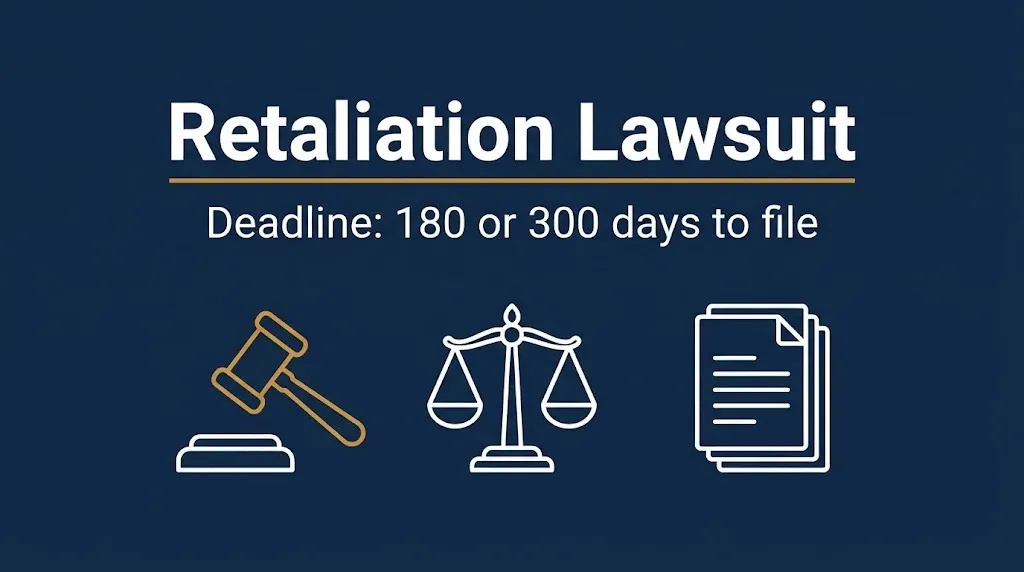
- Deadline: generally 180 days to file an EEOC charge, or 300 days where a state or local agency applies.
A retaliation lawsuit is a claim that an employer punished you for using a legal right. Retaliation made up 47.8 percent of EEOC charges in fiscal 2024, according to one analysis.
Most federal charges must be filed within 180 days of the act, or 300 days in many places. Missing that window can cost you the claim.
This guide covers proof, deadlines, payouts, and 2026 data. One surprising detail: a popular 55.8 percent statistic is tied to different years on different sites.
| The Facts | |
|---|---|
| Case | No single case. Retaliation claims under federal laws such as Title VII, the ADA, and the ADEA |
| Status | Active area of law. EEOC reported FY2025 results in April 2026 |
| Fund Size | Not applicable. EEOC recovered about $660 million across all discrimination cases in FY2025 |
| Est. Per Person | Not yet determined. Depends on facts, damages caps, and the employer |
| Claim Deadline | 180 days, or 300 days with a state or local agency |
| Administrator | EEOC for discrimination-related retaliation |
| Proof Needed | Protected activity, an adverse action, and a causal link |
Is workplace retaliation illegal?
Yes, federal law bars employers from punishing workers for using legal rights.
The EEOC enforces anti-retaliation rules under Title VII, the Americans with Disabilities Act, the Age Discrimination in Employment Act, and the Equal Pay Act. Guides also list the Genetic Information Nondiscrimination Act and the Pregnancy Discrimination Act. Employer coverage varies by law.
| Law | Covers | Employer size |
|---|---|---|
| Title VII | Race, sex, religion, national origin | 15 or more employees |
| ADA | Disability complaints and accommodation requests | 15 or more |
| ADEA | Age discrimination complaints (age 40 and over) | 20 or more |
| GINA | Genetic information complaints | 15 or more |
Retaliation is its own claim. You can lose the underlying discrimination complaint and still win on retaliation, because the law protects the act of complaining.
What counts as retaliation at work?
Retaliation is an adverse action taken because you engaged in protected activity.
Protected activity includes filing a discrimination complaint, reporting harassment, joining an investigation, or requesting an accommodation. The adverse action doesn’t have to be a firing. Guides describe demotions, schedule cuts, pay changes, and new discipline as possible examples.
Here’s the pattern the law looks for:
- Before: you complained, reported, or took part in a process
- After: your employer changed how it treated you
- Link: the change happened because of the complaint
One employment-law interview notes that retaliation claims often grow from routine decisions made after a complaint. Employers often don’t see the risk until the paperwork is read.
How much is a retaliation lawsuit worth?
Not yet determined. No fixed figure exists, because value depends on your facts, your employer’s size, and legal caps.
Federal caps limit compensatory and punitive damages under Title VII. A 2025 SkyWest Airlines case shows how that works. A Texas federal jury awarded $2.17 million, and the court reduced it to $300,000 under the statutory cap. That case involved sexual harassment, not retaliation, but the cap logic is the same.
Back pay and other remedies can sit outside those caps. That’s why verdicts and settlements vary so widely.
| Data point | Figure |
|---|---|
| EEOC total recovery, FY2025 | About $660 million |
| Paid to 17,680 victims | Roughly $37,000 average (simple division, all discrimination types) |
| Recovered through litigation | About $27 million for 2,505 people |
| Litigation average per person | Roughly $10,800 (simple division) |
Those averages cover all discrimination cases, not retaliation alone. They’re also averages: a few large awards pull the number up.
Key Takeaway: No standard retaliation payout exists, and damages caps can shrink even a large jury verdict.
What is the average settlement for a retaliation lawsuit?
No official average exists, and published ranges come from law firm estimates, not court data.
One firm lists typical ranges by claim type. Another guide gives a wider band. Neither cites a docket-level dataset, so treat them as rough marketing figures.
| Claim type | One firm’s estimate (unverified) |
|---|---|
| General retaliation, no termination | $20,000 to $80,000 |
| Wrongful termination retaliation | $50,000 to $150,000 |
| Whistleblower retaliation | $100,000 to $200,000 |
| EEOC-mediated settlements | Around $40,000 |
A competing page puts the range at $30,000 to $300,000. Those two ranges overlap but disagree on the edges.
Ask where any number came from before you rely on it. A figure with no named source is a guess dressed as data.
Reality Check: No one will text you retaliation settlement money first. Filing an EEOC charge is free, and no paid “claim helper” can improve your odds. Be wary of anyone promising a guaranteed payout before reviewing your facts.
How do you file a retaliation lawsuit?
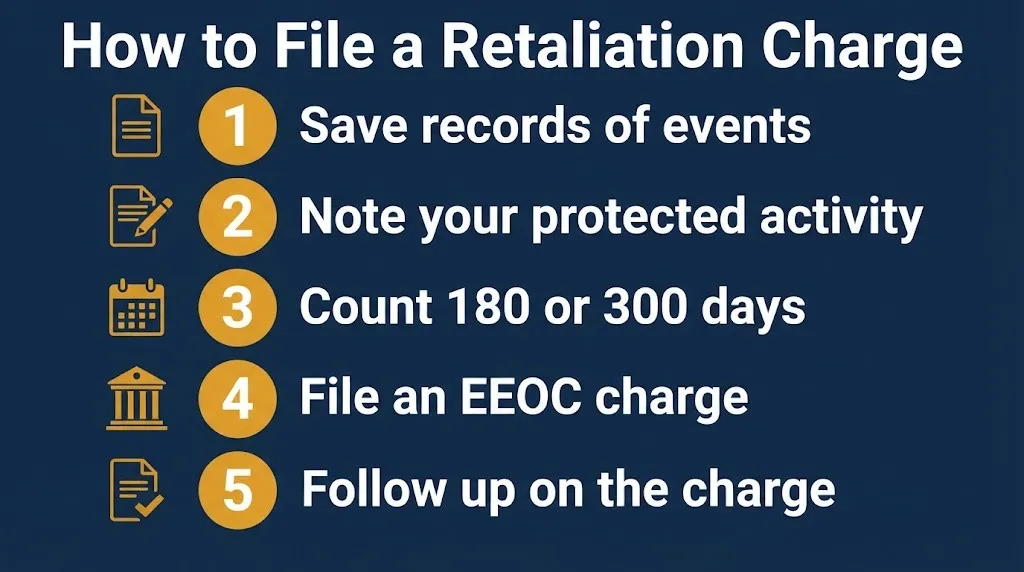
Most people start with an EEOC charge, and these seven steps outline the usual path.
- Write down what happened, with dates and names.
- Save emails, texts, reviews, and schedules.
- Note the protected activity you took part in.
- Count your 180 or 300 day deadline from the retaliatory act.
- File a charge with the EEOC, or its state partner agency.
- Respond to EEOC requests and keep copies.
- Ask an attorney about court options after the charge.
Generally, a federal discrimination-related claim goes through the EEOC before a lawsuit. Other laws send retaliation claims to different agencies, with different rules. An attorney can tell you which path fits your situation.
What is the deadline to file a retaliation claim?
You generally have 180 days to file an EEOC charge, extended to 300 days where a state or local agency enforces a similar law.
The clock runs from the retaliatory act, not from your original complaint. One guide notes most states have such an agency, so 300 days applies in many cases.
| Situation | Typical window |
|---|---|
| No state or local agency | 180 days |
| State or local agency exists | 300 days |
| Other laws (whistleblower, safety) | Different and sometimes shorter |
Missing a deadline is like a store refusing a return after the window closes. The product may be fine, but the window is not.
Count carefully, and count from the first adverse act if you can. An attorney or the EEOC can confirm your date.
Key Takeaway: The 180 or 300 day clock starts at the retaliatory act, so waiting can end a valid claim.
What do you need to prove in a retaliation lawsuit?
You generally must show protected activity, an adverse action, and a causal link between them.
Guides list those three elements consistently. The third is usually the hardest, because an employer can claim a separate reason.
Evidence that often matters includes:
- Timing: how close the action came to your complaint
- Records: emails, texts, reviews, and written warnings
- Comparisons: how similar workers were treated
- Witnesses: coworkers who saw what happened
- Change in pattern: strong reviews before, discipline after
You don’t have to win the original discrimination claim. That’s a feature of retaliation law, and it’s one reason these claims are so common.
What are the latest retaliation numbers for 2026?
The latest official data shows the EEOC recovered about $660 million in fiscal 2025 and filed 94 lawsuits.
The agency processed 88,201 new discrimination charges and resolved 90,743. It secured $528 million through pre-litigation enforcement, the highest in its 60-year history. Another source cites 91,503 charges received, so counts differ by definition.
Retaliation drove 31 of the 94 EEOC lawsuits in FY2025, or 33 percent. For FY2026, a law firm review published September 30, 2026 reports lawsuit filings rose from 94 to 99. It lists disability, sex, and retaliation among the most frequent allegations.
| Metric | FY2025 |
|---|---|
| New charges processed | 88,201 |
| Total recovered | About $660 million |
| Pre-litigation recovery | $528 million |
| Litigation recovery | About $27 million |
| EEOC lawsuits filed | 94 |
| Retaliation share of suits | 31 (33%) |
Is retaliation still the most common EEOC charge?
Yes, retaliation is historically the leading basis for EEOC charges, though sources disagree on the exact share.
One analysis puts it at 47.8 percent of 88,531 charges in fiscal 2024, or 42,301 charges. Many guides cite 55.8 percent and attach it to fiscal 2023. Another guide ties that number to fiscal 2020, which would make the 2023 label wrong.
That’s a good example of why you should check the year on any statistic. The EEOC counts charges that cite more than one basis, so percentages can add past 100.
Key Takeaway: Retaliation leads EEOC charges, but check the fiscal year, because the commonly cited 55.8 percent figure is attached to different years.
Which laws protect you from retaliation?
Several federal laws protect you, and each has its own rules and agency.
| Law | Protected activity | Agency |
|---|---|---|
| Title VII | Complaining about discrimination or harassment | EEOC |
| ADA | Disability complaints, accommodation requests | EEOC |
| ADEA | Age discrimination complaints | EEOC |
| Whistleblower laws | Reporting safety or fraud problems | Often OSHA or another agency |
States add their own protections, and many have their own agencies. Some claims can run under both federal and state law.
The path matters because deadlines and remedies differ. A safety complaint doesn’t follow the same route as a harassment complaint.
Should you go to the EEOC or straight to court?
For discrimination-related retaliation, the usual first step is an EEOC charge, not a lawsuit.
The EEOC can mediate, investigate, and attempt conciliation. In FY2025, it noted $52.5 million came through conciliation. Most matters resolve before litigation, which means most money moves outside a courtroom.
Litigation by the agency is rare. It filed 94 merits suits in FY2025 against 88,201 charges processed. Private suits are a separate path.
An attorney can explain whether you can sue after the EEOC process and how long that takes. This guide reports options and doesn’t make that call for you.
What do recent retaliation verdicts show?
Recent verdicts show juries can award large sums, and caps can cut them.
In December 2025, a federal jury in Colorado returned an $11.5 million verdict against the Society for Human Resource Management on race discrimination and retaliation claims. The employee said she was fired after complaining internally, including to HR and the CEO.
The SkyWest result shows the other side. A $2.17 million verdict dropped to $300,000 under Title VII caps. A big headline number isn’t always the final number.
| Case | Headline | Note |
|---|---|---|
| SHRM, D. Colo. | $11.5 million | Race discrimination and retaliation |
| SkyWest, N.D. Tex. | $2.17 million, cut to $300,000 | Statutory cap applied |
What mistakes weaken a retaliation claim?
Missed deadlines and thin records are the most common problems.
Employment guides point to a few patterns:
- Waiting past the 180 or 300 day window
- Keeping no written record of events
- Mixing work disputes with unrelated complaints
- Skipping the EEOC step when it applies
- Relying on an average settlement figure with no source
It’s like filing a warranty claim without the receipt. The product may be defective, but you’ll struggle to show it.
Keep copies of everything in a personal place, not only on work systems. An attorney can tell you what to preserve.
Key Takeaway: The strongest retaliation claims usually pair a timely filing with a clear paper trail.
What happens next in a retaliation claim?
Your own timeline starts at the retaliatory act, and agency dates follow it.
Day 0: The retaliatory act happens, starting your filing clock.
By day 180 or 300: You file an EEOC charge, depending on your location.
Expected after filing: The EEOC may offer mediation, request responses, or investigate. Timing is not confirmed and varies.
Expected, not confirmed: The EEOC publishes FY2026 results. FY2025 results came April 6, 2026.
Frequently Asked Questions
What is a retaliation lawsuit?
A retaliation lawsuit claims an employer punished you for using a legal right.
Examples include reporting harassment or joining an investigation.
You don’t have to win the original complaint.
How long do you have to file a retaliation claim?
You generally have 180 days to file an EEOC charge.
That extends to 300 days where a state or local agency applies.
The clock runs from the retaliatory act.
What is the average retaliation settlement?
No official average exists.
Published ranges come from law firms and vary widely.
Ask where any figure came from.
Is retaliation the most common EEOC charge?
Yes, it is historically the leading basis for EEOC charges.
One analysis reports 47.8 percent in fiscal 2024.
Percentages can add past 100 because charges cite multiple bases.
What do you have to prove?
You generally must show protected activity, an adverse action, and a causal link.
The causal link is often the hardest part.
Records and timing usually matter.
Do damages caps apply?
Yes, federal caps limit certain damages under Title VII.
A SkyWest jury award of $2.17 million fell to $300,000 under the cap.
Back pay and other remedies can be treated differently.
Does filing an EEOC charge cost money?
Filing an EEOC charge is free.
Be wary of anyone charging fees for a “claim service.”
An attorney can explain fees for any later lawsuit.
Write down what happened, with dates, while memory is fresh. Count your 180 or 300 days now, and confirm the date with the EEOC or an attorney.
The number that matters most is the deadline: generally 180 days, or 300 where a state or local agency applies.