Homestead Rescue Lawsuit 2026: What Happened, Who Was Affected, and What Comes Next
Quick Answer
- The Homestead Rescue lawsuit involved a couple who claimed the show misrepresented them as struggling homesteaders.
- No public settlement fund exists, so there is nothing for viewers or other participants to claim in 2026.
- The case was resolved privately, and no claim deadline or payout schedule has been announced.
The Homestead Rescue lawsuit is not a class action settlement and there is no money waiting for you to claim. It was a legal dispute between a Virginia couple, Kim and Josh Zabec, and the production company behind the Discovery Channel show. The couple claimed they were misled about how they would be portrayed.
If you got a text, email, or social media ad saying you qualify for a Homestead Rescue settlement payout, that is a scam. The Zabec case ended without a public settlement fund. No claims administrator has been appointed. No filing deadline exists because there is no open claims process.
This article explains what actually happened in the lawsuit, why there is no money to collect, how to spot fake settlement offers, and what the case means for reality TV participants. You will also learn the one verified detail most coverage gets wrong: the case involved a single couple, not a class of affected homesteaders.
The Facts
| Item | Detail |
|---|---|
| Case | Zabec v. production company (exact case number not publicly confirmed) |
| Status | Resolved privately; no public settlement |
| Fund Size | None publicly disclosed |
| Est. Per Person | Not applicable |
| Claim Deadline | None exists |
| Administrator | Not appointed |
| Proof Needed | Not applicable |
Is the Homestead Rescue lawsuit real or fake?
The Homestead Rescue lawsuit is real, but it is not a consumer settlement you can join. Kim and Josh Zabec, who appeared in Season 1 of the Discovery Channel series, filed a legal claim against the production company after their episode aired. They alleged the show misrepresented them as incompetent homesteaders when they were actually experienced farmers.
The couple owned Revolutionary Roots Farm in Virginia. They told reporters they were approached about a show featuring successful homesteaders. Instead, their episode portrayed them as needing rescue. The pigs shown destroying their property were brought in from their real farm, and Kim Zabec said dead chickens shown in the episode did not belong to them.
The lawsuit focused on how the production edited and framed their story. It was not about product liability, defective equipment, or a recalled consumer good. That distinction matters because it means there is no class of affected consumers who can file claims.
How much was the Homestead Rescue lawsuit settlement?
There is no confirmed Homestead Rescue lawsuit settlement amount. The case resolved privately, and the terms were not made public. No court records show a settlement fund, a payout schedule, or a claims process.
Reports describe the case as a dispute that ended without a public resolution. Some sources say the couple consulted attorneys and pursued legal action, but the final outcome remains undisclosed. That is common in reality TV disputes, where production companies often require confidentiality as part of any resolution.
If a settlement was paid, it went to the Zabecs only. It did not create a pool of money for other participants, viewers, or anyone who watched the show. No administrator was appointed to distribute funds. No deadline was set because no fund exists.
Who was affected by the Homestead Rescue lawsuit?
Only one couple was directly involved in the Homestead Rescue lawsuit: Kim and Josh Zabec of Revolutionary Roots Farm. They appeared in the second episode of Season 1, titled “Under Siege.” No other participants joined the case as plaintiffs.
A separate dispute involving participants Wren and Jason Ramey appeared in homesteading forums around 2016 to 2018. Reports describe a conflict over work quality and contractual obligations, with a settlement reached out of court. That was a different matter and also did not create a public claims process.
Other participants, like Jerry Hanson and his family who appeared in Season 2, described their experience positively. Wren and Ini, another couple, defended the Raneys as genuine people who wanted to help. The lawsuit was specific to the Zabecs and their claims about how they were portrayed.
How do I file a Homestead Rescue lawsuit claim?
You cannot file a Homestead Rescue lawsuit claim because no claims process exists. There is no settlement fund, no administrator, and no deadline. Anyone who tells you otherwise is trying to take your money or personal information.
If you see a website, social media post, or email offering a Homestead Rescue settlement claim form, treat it as a scam. Legitimate settlements always have an official court-approved website. They never ask you to pay a fee to claim money. They never text you first.
The only real action you can take is to protect yourself. Do not enter personal information on unofficial sites. Do not pay any “processing fee” or “claim assistance” charge. Report suspicious offers to the FTC or your state attorney general.
Why was the Homestead Rescue lawsuit filed?
The Homestead Rescue lawsuit was filed because Kim and Josh Zabec claimed the show misled them about its premise. They said producers approached them for a program about successful homesteaders, not a rescue show. After filming, they believed the episode portrayed them as amateurs who could not manage their own farm.
Kim Zabec posted on social media that the show brought in pigs from their real farm and filmed them in a way that made the situation look worse than it was. She also said dead chickens shown in the episode were not theirs. The couple felt the editing created a false narrative about their skills and their farm.
The legal claim centered on misrepresentation. They argued they were recruited under false pretenses and that the final product damaged their reputation. The production company defended the episode as an accurate reflection of what was observed during filming.
Key Takeaway: The Homestead Rescue lawsuit was a private dispute between one couple and a production company, not a consumer class action, and it created no settlement fund for the public.
Is Homestead Rescue fake or real?
Homestead Rescue is a reality TV show, which means it is produced and edited for entertainment. That does not make it entirely fabricated, but it does mean the final product reflects production choices about what to show and what to leave out.
The Zabec lawsuit alleged specific misrepresentations: pigs brought in from their real farm, footage framed to make them look incompetent, and a rescue narrative that did not match their actual situation. Those claims, if true, show how editing can change a story. The production company denied the claims and stood by the episode.
Other participants have described the Raney family as genuine and helpful. Wren and Ini said Marty Raney was intense but caring, and that a lot of footage gets cut for time. The truth likely sits somewhere in between: real people, real help, but shaped by editing for drama.
Reality Check
No one texts you settlement money first. If you get a message saying you qualify for a Homestead Rescue payout, it is a scam. Legitimate settlements do not work through DMs, pop-up ads, or random websites. There is no Homestead Rescue settlement fund, no claim form, and no deadline. Anyone asking for your Social Security number, bank details, or a fee to “process” a claim is stealing from you.
What happens next in the Homestead Rescue case?
Nothing is scheduled for the Homestead Rescue case in 2026. The dispute between the Zabecs and the production company resolved privately. No further court dates, claim deadlines, or payout events are expected.
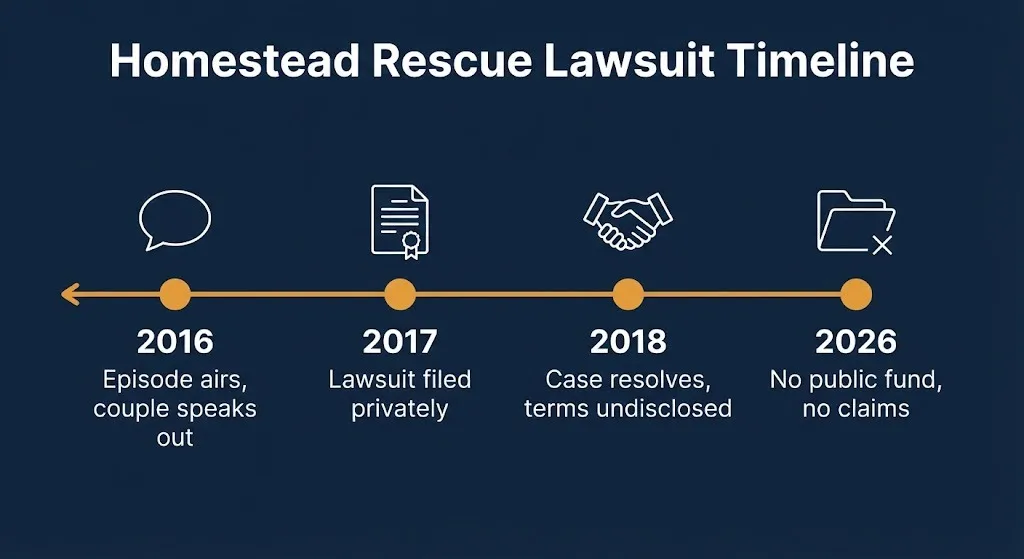
Here is the timeline of what already happened:
- 2016: Season 1, Episode 2 of Homestead Rescue airs, featuring the Zabecs.
- 2016 to 2017: Kim and Josh Zabec speak publicly about their experience and consult attorneys.
- 2017 to 2018: Reports of the lawsuit circulate; the case resolves privately.
- 2026: No public settlement fund, no claims process, no deadline.
If you are waiting for a check, there is no check coming. The case is over. The only thing to do now is stay alert for scams using the show’s name.
Frequently Asked Questions
Is there a Homestead Rescue settlement payout in 2026?
No. There is no Homestead Rescue settlement payout in 2026. The lawsuit between the Zabecs and the production company resolved privately with no public fund.
How much did Kim and Josh Zabec get from the lawsuit?
The amount is not publicly known. The case resolved privately, and settlement terms were not disclosed in court records or press reports.
Can I join the Homestead Rescue lawsuit?
No. The lawsuit is over and there is no claims process. You cannot join a case that has already resolved.
Is Homestead Rescue being sued right now?
No. The lawsuit involving the Zabecs resolved years ago. No active litigation against the show is pending as of September 2026.
Did Homestead Rescue get cancelled because of the lawsuit?
No. Homestead Rescue continued airing after the lawsuit. Season 11 was scheduled to premiere in 2023, and the show remains part of Discovery’s lineup.
What should I do if I get a text about a Homestead Rescue settlement?
Do not respond. Do not click any links. Report the message as spam. No legitimate settlement exists, so any text about it is a scam.
Was there a class action lawsuit against Homestead Rescue?
No. The Zabec case was a private dispute, not a class action. No class was certified, and no class members exist.
Your Next Step
The most important thing to remember is that no Homestead Rescue settlement money exists for you to claim. The case was private, it resolved quietly, and the only people involved were Kim and Josh Zabec. If you see an offer promising a payout, it is a scam designed to steal your information or money.
Bookmark the FTC’s consumer complaint page and your state attorney general’s website. Those are the places to report fake settlement offers. The real deadline you need to remember is not a claims deadline, because none exists. The real deadline is the moment you decide to ignore the next scam text instead of clicking it.