Car Accident Settlement California 2026: How Much to Expect
Quick Answer
- No fixed “average” settlement exists in California. Verified 2026 data shows typical payouts of $15,000 to $80,000.
- Serious injuries involving surgery, brain trauma, or spinal damage can push settlements toward $150,000 or more.
- You generally have two years from the crash date to file a personal injury lawsuit in California.
You got hurt in a crash and now you want a real number, not a lawyer’s ad. Here is the honest answer. Verified 2026 data puts most California car accident settlements between $15,000 and $80,000, with a median closer to $20,000 to $30,000 for cases resolved without a lawsuit.
That range covers everyday claims: rear-end collisions, whiplash, a few weeks of physical therapy. It does not cover every case you’ll read about online, and it shouldn’t. A settlement for a broken wrist looks nothing like one for a spinal fusion.
This article breaks down real 2026 settlement ranges by injury type, the California laws that quietly shrink or grow your number, and the deadlines that can end your claim before it starts. One detail most sites skip: California’s minimum insurance limits just doubled in 2025, and that change is already reshaping payouts.
The Facts: Settlement Ranges at a Glance
| Category | Verified Figure |
|---|---|
| Typical settlement range (all injury levels) | $15,000 to $80,000 |
| Moderate-injury average (NAIC-based data) | Roughly $20,000 to $30,000 |
| Minor soft tissue injuries | $5,000 to $25,000 |
| Serious injury (surgery, permanent impairment) | $150,000 to $1,000,000+ |
| Filing deadline, personal injury | 2 years from the crash date (CCP 335.1) |
| Filing deadline, property damage only | 3 years from the crash date |
| Claims against a government entity | 6 months |
| Minimum liability insurance since Jan. 1, 2025 | $30,000 per person / $60,000 per accident / $15,000 property (30/60/15) |
| Fault rule | Pure comparative negligence |
Not every number in your case will match this table. Your case is your case. But this is the verified starting point most competing sites won’t give you straight.
Is There One Average Car Accident Settlement in California?
No single average exists, and any site that gives you one flat number is oversimplifying. California car accident settlements depend on injury severity, fault, insurance limits, and how well the claim is documented.
What does exist is a verified range. Multiple 2026 analyses of California claims put typical settlements between $15,000 and $80,000. A widely cited National Association of Insurance Commissioners figure pegged average California bodily injury claim severity near $51,635 in the most recent year that data was published.
That NAIC number blends minor and moderate cases together, which is why it sits above the median. Most claims that settle without a lawsuit land closer to $20,000 to $30,000.
Severe cases pull the average up without representing the typical driver. A spinal injury or traumatic brain injury case can settle for $150,000 to well over $1,000,000. Those cases are real, but they’re not the norm.
Key Takeaway: There is no fixed California average. Verified 2026 data shows a $15,000 to $80,000 range for most claims, with severe injuries settling far higher.
How Much Can You Expect From a Car Accident Settlement in California?
You can expect a number that scales with your medical bills, not a flat payout. Insurance adjusters build settlement offers around documented losses first, then add a multiplier for pain and suffering.
For a minor injury with a few weeks of treatment, expect a range closer to $5,000 to $25,000. For a moderate injury involving imaging, physical therapy, or a short course of specialist care, expect somewhere in the $20,000 to $80,000 band, based on current 2026 claims data.
For anything requiring surgery, hospitalization, or long-term care, the range widens dramatically. Adjusters weigh future medical needs and lost earning capacity, which is exactly where unrepresented claimants tend to get shortchanged.
Three things move your number the most:
- How well your medical treatment is documented from day one
- Whether liability is contested or clear
- Whether the at-fault driver’s insurance policy has enough coverage to pay it
Car Accident Settlement Amounts by Injury Type
Injury type is the single biggest driver of settlement value. Here’s the verified breakdown reported across 2026 California case data.
| Injury Type | Typical 2026 Settlement Range |
|---|---|
| Whiplash / soft tissue | $5,000 to $25,000 |
| Mild concussion | $20,000 to $30,000 |
| Broken bones | $30,000 to $100,000 |
| Herniated disc | $50,000 to $100,000+ |
| Surgery-required injuries | $150,000 to $1,000,000+ |
| Spinal cord injury or wrongful death | $1,000,000+ |
A broken bone that needs surgery settles differently than one treated with a cast and rest. The same injury label can produce wildly different numbers depending on recovery time and whether it leaves lasting impairment.
Think of it like a home warranty claim. A cracked window costs little to fix. A collapsed roof costs a fortune, even though “roof damage” was the category both times.
What Factors Actually Increase or Decrease Your Settlement Value
Your settlement is not decided by injury type alone. Insurance adjusters weigh a specific set of factors, and knowing them helps you understand any offer you receive.
Factors that typically increase value:
- Clear, undisputed fault by the other driver
- Complete, consistent medical records with no treatment gaps
- Documented lost wages or reduced earning capacity
- Available insurance limits high enough to cover the claim
- Visible, well-photographed vehicle damage supporting the injury claim
Factors that typically decrease value:
- Gaps in medical treatment that let insurers argue the injury wasn’t serious
- Pre-existing conditions in the same body area without clear medical separation
- Shared fault under California’s comparative negligence rule
- Low insurance policy limits on the at-fault driver’s policy
Key Takeaway: Documentation, not injury severity alone, is what convinces an adjuster to raise an offer.
How California’s Comparative Negligence Law Affects Your Payout
California uses a pure comparative negligence rule, meaning you can still recover money even if you were partly at fault for the crash. Your settlement is simply reduced by your percentage of fault.
If a jury or adjuster decides you were 20 percent at fault for a crash worth $100,000 in damages, your recoverable amount drops to $80,000. There’s no cutoff percentage that bars you from recovering, unlike some other states.
This rule matters because insurance companies routinely try to shift partial blame onto the injured driver to shrink the payout. Every percentage point they assign to you comes directly out of your check.
Reality Check: No insurance company calls or texts you first with a settlement offer out of goodwill. Filing a claim is always free, and any third party charging an upfront fee to “help you file” is not something the process requires.
How Insurance Policy Limits Cap What You Can Recover
Your settlement can never exceed the at-fault driver’s available insurance coverage, no matter how serious your injury is. This is the ceiling most injured drivers don’t find out about until it’s too late.
As of January 1, 2025, California raised its minimum liability requirements from 15/30/5 to 30/60/15 under Senate Bill 1107, the Protect California Drivers Act. That means every insured driver must now carry at least:
- $30,000 per person for bodily injury
- $60,000 per accident for bodily injury
- $15,000 for property damage
That’s double the old minimum, but it’s still low relative to serious medical bills. A single hospital stay after a moderate collision can exceed $30,000 on its own.
If your damages exceed the at-fault driver’s policy limit, your own uninsured/underinsured motorist (UM/UIM) coverage becomes the next source of recovery. Without it, you may be left absorbing costs the at-fault driver’s insurer simply won’t pay.
Key Takeaway: California’s 2025 insurance minimum increase doubled available coverage, but serious injury costs can still exceed even the new 30/60/15 limits.
How to File a Car Accident Claim in California
Filing correctly protects the value of your claim from the start. Here’s the general process reported across California claims resources.
- Call police and get an official accident report
- Seek medical care immediately, even for minor symptoms
- Photograph the scene, vehicle damage, and any visible injuries
- Notify your own insurer of the accident, even if you weren’t at fault
- File a claim with the at-fault driver’s insurance company
- Keep every medical bill, receipt, and record of missed work
- Wait until treatment is substantially complete before accepting any offer
- Consider a written demand letter if the insurer’s offer is low
Skipping steps early, especially medical documentation, is the single most common reason a strong claim turns into a weak one.
How Long Does a California Car Accident Settlement Take?
Simple claims with clear fault and minor injuries can settle in 3 to 6 months. Cases involving surgery, disputed fault, or high-dollar damages often take a year or longer.
Most attorneys recommend waiting until you reach “maximum medical improvement,” meaning your treatment has plateaued, before finalizing a settlement. Settling too early can leave future medical costs uncovered.
If a lawsuit becomes necessary because the insurer won’t offer a fair number, timelines extend further to account for discovery, depositions, and possibly trial.
What Is the Deadline to File a Car Accident Claim in California?
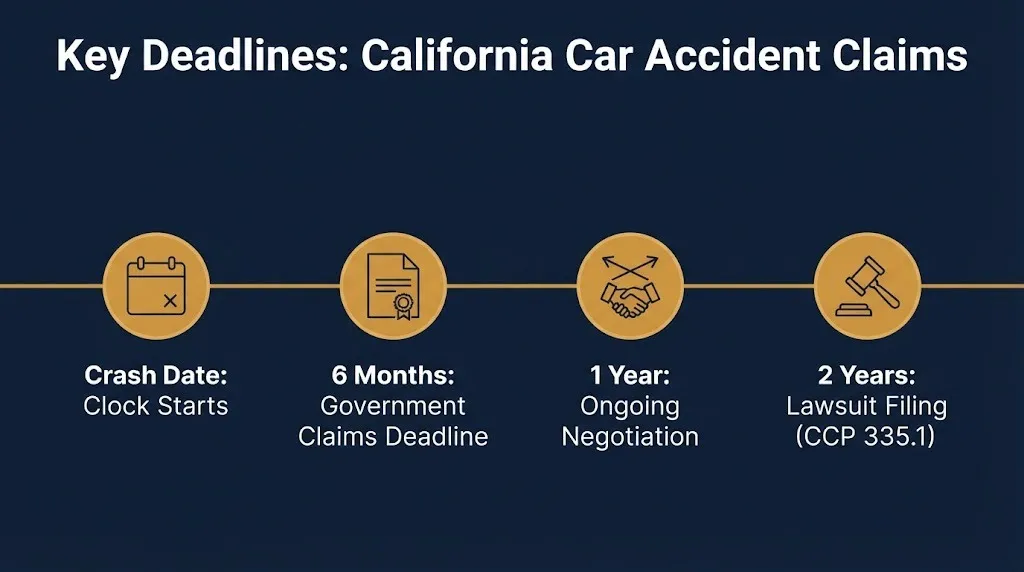
California gives you two years from the date of the crash to file a personal injury lawsuit, under California Code of Civil Procedure Section 335.1. Miss it, and the court will almost certainly dismiss your case, no matter how strong the evidence.
Exceptions and different deadlines apply:
- Property damage only: 3 years from the crash date
- Claims against a government entity (a city vehicle, for example): 6 months
- Wrongful death: 2 years from the date of death, not the crash date
- Minors or those without mental capacity: the clock can pause until the disability ends
Filing a claim with the insurance company is not the same as filing a lawsuit. You can negotiate with an adjuster right up against the deadline, but if talks stall, you need the lawsuit filed before the clock runs out.
Key Takeaway: The two-year statute of limitations is the single deadline that can end your entire claim, regardless of how strong your case is.
Should You Accept the Insurance Company’s First Offer?
Generally, no. First offers are calculated to close the claim quickly and cheaply, often before your full medical picture is known.
Once you sign a release accepting a settlement, you typically give up the right to ask for more, even if new symptoms appear later. That’s why most guidance recommends waiting until treatment stabilizes before accepting anything.
If an early offer seems reasonable for a genuinely minor, fully resolved injury, it may be fine to accept. For anything involving ongoing treatment, a counteroffer backed by documented bills and records is the standard next step.
Do You Need a Lawyer to Get a Fair Settlement?
Not every case needs one, but attorney-represented claims tend to settle for meaningfully more than unrepresented ones, according to multiple 2026 California claims reports. Attorneys typically work on contingency, meaning no upfront fee and a percentage taken only if you recover money.
A lawyer becomes more important when fault is disputed, injuries are serious, or the insurer’s offer doesn’t cover your actual medical bills and lost income. For a minor fender-bender with clear fault and modest bills, many people negotiate directly with the adjuster.
What Happens After You Settle: Liens, Fees, and Taxes
This is the part most sites leave out entirely. A settlement check is rarely the full amount you see in the total.
Before you get paid, expect these typical deductions:
- Attorney contingency fees, commonly 33 to 40 percent if a lawsuit was filed
- Medical liens from health insurers or hospitals that treated you
- Outstanding balances owed to any medical provider who treated you on a lien basis
Compensation for physical injury is generally not taxable at the federal level, but any portion allocated to lost wages or punitive damages can be. Confirm your specific situation with a tax professional before spending settlement funds.
Key Takeaway: The number in a settlement demand letter and the number that lands in your bank account are rarely the same figure.
What Happens Next: Typical Claim Timeline
Every case moves at its own pace, but this is the general sequence reported across current California claims resources.
Days 1 to 14: Police report filed, medical treatment begins, insurance claim opened.
Weeks 2 to 12: Ongoing treatment, documentation of bills and lost wages, initial adjuster contact.
Months 3 to 6: Treatment stabilizes, demand letter sent if negotiating directly or through counsel.
Months 6 to 12: Negotiation or, if stalled, lawsuit filed before the 2-year deadline.
12+ months: Complex or disputed cases proceed through discovery, mediation, or trial if no settlement is reached.
Frequently Asked Questions
What is a fair settlement for a car accident in California?
A fair settlement covers your medical bills, lost wages, and pain and suffering based on your actual documented losses.
For minor injuries, that typically falls between $5,000 and $25,000.
For moderate to serious injuries, verified 2026 ranges run from $30,000 to well over $150,000.
How is pain and suffering calculated in California?
Insurers commonly apply a multiplier, often 1.5 to 5 times your medical expenses, based on injury severity.
There is no fixed legal formula, so the multiplier varies by adjuster and by the strength of your documentation.
Serious, permanent injuries generally draw a higher multiplier than short-term soft tissue injuries.
Can I still get a settlement if I was partly at fault?
Yes. California’s pure comparative negligence rule allows recovery even if you share blame for the crash.
Your settlement is simply reduced by your percentage of fault.
There is no cutoff percentage that bars you from recovering entirely.
How long do I have to file a car accident claim in California?
You generally have two years from the crash date to file a personal injury lawsuit under CCP Section 335.1.
Property damage claims get three years.
Claims against a government entity require notice within six months.
Will my case settle without going to court?
Most California car accident claims settle without a lawsuit being filed.
Cases go to court mainly when liability is disputed or the insurer’s offer doesn’t reflect the actual damages.
Even filed lawsuits frequently settle before reaching trial.
Does California’s new insurance minimum affect my settlement?
Yes. Since January 1, 2025, California requires 30/60/15 minimum liability coverage, up from 15/30/5.
That gives injured drivers a larger baseline of available insurance to draw from.
Serious injury costs can still exceed even these higher limits, which is where uninsured/underinsured motorist coverage matters.
Do I need a lawyer for a minor accident claim?
Not necessarily. Many people successfully negotiate minor, clear-fault claims directly with an adjuster.
Legal representation becomes more valuable when injuries are significant, fault is contested, or the offer doesn’t cover documented losses.
Is settlement money from a car accident taxable?
Compensation for physical injuries is generally not taxable at the federal level.
Portions allocated to lost wages or punitive damages may be treated differently.
Check with a tax professional about your specific settlement breakdown.
Your settlement depends on documentation, timing, and the deadlines above, not luck. Calendar the two-year filing deadline the moment you’re able to, and keep every medical record from day one.
If you’re currently negotiating a claim, verify current insurance requirements and legal deadlines directly through California’s official resources before signing anything.