Workmans Comp Compensation 2026: How the System Works, What It Covers, and How to File a Claim
Quick Answer
- Workers’ comp pays medical bills and a portion of lost wages for work-related injuries or illnesses.
- Most states replace about two-thirds of your average weekly wage, subject to a state maximum.
- The most important deadline is reporting the injury to your employer, often within 30 to 120 days depending on your state.
You got hurt at work. You have heard the term workers’ comp but do not know how it works or what it covers.
Here is the direct answer: workers’ compensation is a state-run insurance system that pays medical bills and partial wage replacement when you are injured or become ill because of your job. You do not have to prove your employer was at fault.
This article explains how the system works, what is covered, how much you may receive, and what deadlines you cannot miss.
The Facts
| Topic | Workmans Comp Compensation |
| Status | State-run system, no federal standard |
| Wage Replacement | Usually 66.67% of average weekly wage |
| Medical Coverage | 100% of reasonable and necessary treatment |
| Reporting Deadline | 30 to 120 days depending on state |
| Claim Filing Deadline | 1 to 3 years depending on state |
| Fault Required | No, it is a no-fault system |
Is workers’ compensation real?
Yes. Workers’ compensation is a legally mandated insurance system in every state except Texas, where it is optional for some employers.
The system has existed for over a century. It was created as a trade-off. Workers gave up the right to sue their employers for negligence. In exchange, employers agreed to pay medical bills and wage replacement regardless of fault.

The money is real and the system is real. But the rules vary by state, and the process is not always simple.
How does workers’ compensation work?
Workers’ compensation works like a no-fault insurance claim. You report an injury, see an approved doctor, and the insurance pays your medical bills and a portion of your lost wages.
The process is designed to be faster than a lawsuit. You do not have to prove your employer did something wrong. You only have to show the injury arose out of your employment.
Here is the basic flow.
- You are injured at work.
- You report the injury to your employer.
- Your employer files a claim with its workers’ comp insurer.
- The insurer approves or denies the claim.
- If approved, the insurer pays medical bills and wage benefits.
- If denied, you can appeal to a state workers’ comp board.
What is covered under workers’ compensation insurance?
Workers’ compensation covers injuries and illnesses that arise out of and in the course of your employment.
Covered items typically include:
- Emergency room visits and hospital stays
- Doctor appointments and specialist care
- Surgery and physical therapy
- Prescription medications
- Medical equipment like crutches or braces
- A portion of lost wages
- Vocational rehabilitation if you cannot return to your old job
- Death benefits for families of workers killed on the job
The medical coverage is usually 100%. You do not pay a copay or deductible for approved treatment.
What is not covered by workers’ compensation?
Not every injury is covered. The system excludes certain situations.
- Injuries from intoxication or drug use
- Self-inflicted injuries
- Injuries from horseplay or fighting
- Injuries that happen off the job
- Purely emotional injuries without a physical cause in most states
- Independent contractor injuries in many cases
The exclusions vary by state. But the general rule is the injury must be work-related.
Key Takeaway: Workers’ comp covers most work injuries, but it is not a universal safety net. Exclusions apply, and the burden is on you to show the injury was work-related.
How much does workers’ compensation pay?
Most states pay about two-thirds of your average weekly wage, subject to a state maximum.
The exact percentage varies. Some states pay 60%. Others pay 66.67%. The maximum weekly benefit also varies, ranging from about $800 to over $1,500 per week depending on the state.
Medical benefits are paid in full. There is no cap on medical treatment for an accepted claim.
How are workers’ compensation benefits calculated?
Your wage replacement is based on your average weekly wage before the injury.
The formula is usually your gross earnings over a set period, often 13 or 52 weeks, divided by the number of weeks. The result is your average weekly wage. Your benefit is a percentage of that number, subject to the state maximum.
If you earned $900 per week and your state pays 66.67%, your weekly benefit would be about $600, assuming that is below the state cap.
What is the difference between workers’ comp and a lawsuit?
Workers’ comp is a no-fault insurance claim. You do not sue your employer.
A lawsuit is a fault-based legal case. You must prove someone was negligent. Workers’ comp was designed to replace lawsuits for most workplace injuries.
There are exceptions. If a third party, not your employer, caused your injury, you may have a separate lawsuit. For example, if a defective machine injured you, you might have a product liability claim against the manufacturer.
Reality Check: Workers’ comp does not pay for pain and suffering. It pays medical bills and partial wages only. If you want pain and suffering damages, you need a third-party lawsuit, which is rare in workplace injury cases.
What should you do immediately after a work injury?
The first steps after a work injury shape your entire claim.
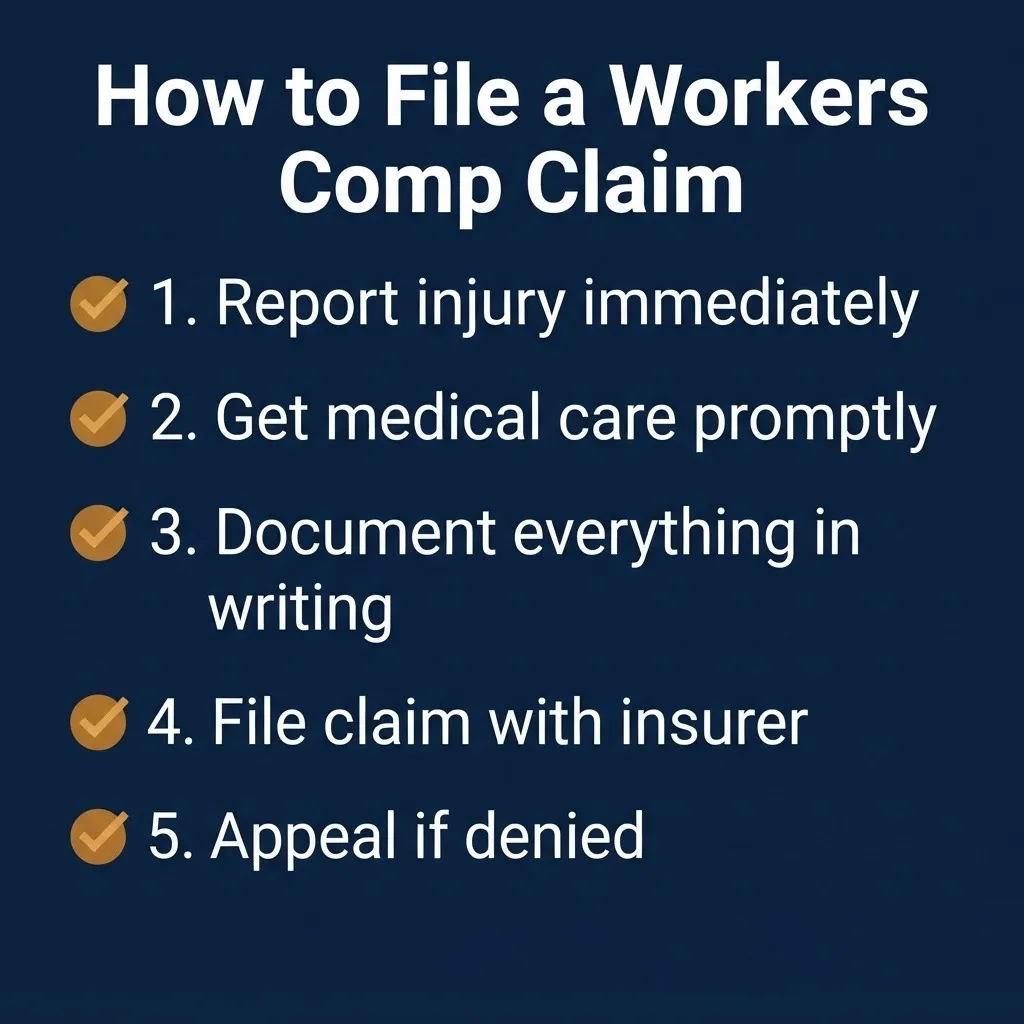
- Report the injury to your supervisor immediately.
- Get medical care from an approved provider if your employer designates one.
- Write down what happened, including witnesses and timeline.
- Take photos of the injury and the accident scene.
- Keep every medical record, bill, and work note.
- File a written report within your state’s deadline.
- Contact a workers’ comp attorney if the claim is denied.
The more you document, the harder it is for the insurer to dispute what happened.
How long do you have to report a work injury?
The reporting deadline varies by state. Most states require notice within 30 to 120 days.
Some states allow longer for occupational diseases that develop over time. The clock starts on the date of injury or the date you knew the injury was work-related.
Missing the reporting deadline can bar your claim. Do not wait.
How long do you have to file a workers’ compensation claim?
The claim filing deadline varies by state, usually one to three years from the injury date.
The reporting deadline and the filing deadline are different. Reporting means telling your employer. Filing means submitting a formal claim to the state workers’ comp board or the insurer.
Both deadlines matter. Missing either one can kill your claim.
Key Takeaway: The reporting deadline and the filing deadline are separate. Know both. The filing deadline is usually one to three years, but the reporting deadline is often much shorter.
What happens if your workers’ comp claim is denied?
A denial is not the end. You have the right to appeal.
The appeal process varies by state but generally follows this path.
- You receive a denial letter from the insurer.
- You file an appeal with the state workers’ comp board.
- A hearing is scheduled before an administrative judge.
- Both sides present evidence and testimony.
- The judge issues a decision.
- Either side may appeal the decision.
Many denials are overturned on appeal. But the process takes time.
What happens next after you file a workers’ comp claim?
Once you file, the insurer investigates and issues a decision.
| Timing | Expected Stage |
|---|---|
| Week 1 | Report the injury and file the claim |
| Week 2 to 4 | Insurer reviews medical records and wage data |
| Month 1 to 2 | Insurer approves or denies the claim |
| Month 2 to 6 | Medical treatment and wage payments begin |
| Month 6 and beyond | Claim continues until maximum medical improvement |
The timeline varies by state and by claim complexity.
Frequently Asked Questions
How does workers’ compensation work?
It is a no-fault insurance system.
Your employer’s insurer pays medical bills and partial wages for work injuries.
What is covered under workers’ compensation insurance?
Medical treatment, a portion of lost wages, and vocational rehabilitation.
Death benefits are also available for families of workers killed on the job.
How much does workers’ comp pay?
Most states pay about two-thirds of your average weekly wage.
The exact amount depends on your state and your pre-injury earnings.
Do I have to prove my employer was at fault?
No, workers’ comp is a no-fault system.
You only need to show the injury was work-related.
What is not covered by workers’ comp?
Injuries from intoxication, self-harm, horseplay, or off-the-job activity.
Purely emotional injuries without a physical cause are also often excluded.
How long do I have to report a work injury?
Most states require notice within 30 to 120 days.
Report immediately to protect your claim.
Can I sue my employer instead of filing workers’ comp?
Usually no.
Workers’ comp is the exclusive remedy for most workplace injuries, with limited exceptions.
Workers’ comp is a real, functioning system that pays medical bills and partial wages for work injuries. It is not perfect, but it is the safety net most American workers rely on.
The most important thing you can do after a work injury is report it immediately. The deadline is short. If you miss it, you lose everything. Know your state’s rules, document everything, and file the claim.