Workers Compensation Insurance Texas in 2026: What Employers and Workers Need to Know
Quick Answer
- Texas workers compensation insurance is optional for most private employers, unlike every other state.
- Employers who opt out lose legal protections and can be sued directly by injured workers.
- The most important deadline for injured workers is one year from the injury date to file a claim if covered, or two years for negligence lawsuits.
If you searched for “workers compensation insurance Texas,” you’re likely an employer deciding whether to buy coverage, or a worker who got hurt and wants to know your options. Texas is different from every other state, and that difference matters.
This article gives you the verified facts as of September 9, 2026. It explains the unique Texas system, what opting out means, and what workers can do if their employer doesn’t have coverage.
Here’s the part most articles skip: in Texas, not having workers compensation doesn’t mean an injured worker gets nothing. It means the employer faces personal injury lawsuits with no damage caps. That’s the tradeoff.
The Facts
| Item | Detail |
|---|---|
| Coverage Requirement | Optional for private employers |
| Public Employers | Generally required to have coverage |
| Regulatory Agency | Texas Department of Insurance, Division of Workers Compensation |
| Injury Claim Deadline | One year from injury date if covered |
| Negligence Lawsuit Deadline | Two years from injury date |
| Nonsubscriber Status | Employers without coverage lose legal defenses |
| 2026 Rate Trend | Rates stable, slightly down from 2025 |
Is Workers Compensation Required in Texas?
No, for most private employers. Texas is the only state where workers compensation is truly optional.
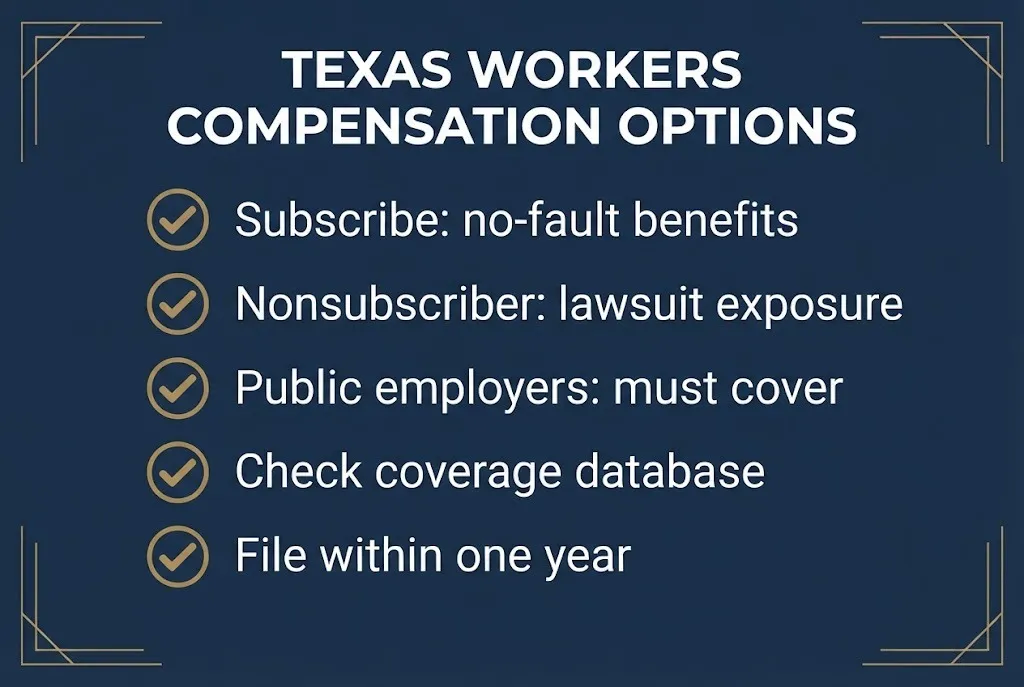
An employer can choose to subscribe to the state’s workers compensation system or opt out entirely. If they opt out, they’re called a “nonsubscriber.” That’s the legal term under Texas law.
Public employers, including state agencies, cities, and school districts, are generally required to provide workers compensation. But private businesses, from a two-person shop to a major corporation, can choose.
The choice is binary. You’re either in the system or you’re not. There’s no partial coverage option.
Key Takeaway: Texas is the only state where a private employer can legally operate without workers compensation coverage.
What Happens If an Employer Opts Out?
The employer becomes a nonsubscriber and loses critical legal protections.
In the workers compensation system, an injured worker gets benefits without proving fault, but they give up the right to sue their employer. That’s the trade.
A nonsubscriber gets no such protection. An injured worker can sue the employer directly for negligence. And here’s the catch: nonsubscribers cannot use certain common defenses in court.
Specifically, a nonsubscriber cannot argue that the worker was contributorily negligent, that a fellow worker caused the injury, or that the worker assumed the risk. Those defenses are gone.
That means a nonsubscriber faces potentially massive liability. A single serious injury can produce a judgment far larger than years of workers compensation premiums would have cost.
How Much Does Texas Workers Compensation Cost?
Texas rates have been relatively stable, with a slight downward trend in recent years.
The cost depends on the same factors as other states: your industry, your claims history, and your payroll. But Texas has a competitive insurance market, which means employers can shop around.
Typical rates by industry:
| Industry | Rate per $100 of Payroll |
|---|---|
| Office work | $0.15 to $0.40 |
| Retail | $0.50 to $1.50 |
| Construction | $3.00 to $10.00 |
| Oil and gas | $2.00 to $8.00 |
| Trucking | $4.00 to $12.00 |
These are ranges, not quotes. Your specific rate depends on your classification codes, claims history, and the insurer’s pricing.
The competitive market is an advantage for Texas employers. In state-run systems like Washington, rates are set by the state. In Texas, insurers compete, which can drive prices down.
What Are the Benefits for Workers Under Texas Workers Compensation?
If your employer subscribes, you get the standard workers compensation benefits.
- Medical care for work-related injuries
- Income benefits for missed work
- Permanent impairment benefits for lasting damage
- Death benefits for fatal injuries
- Vocational rehabilitation in some cases
The income benefit is typically 70% to 75% of your average weekly wage, up to a state maximum. That maximum adjusts annually.
The system is no-fault. You don’t have to prove your employer did anything wrong. You just have to prove the injury happened at work.
Key Takeaway: Subscribers get no-fault protection. Their workers get predictable benefits. The trade is that workers give up the right to sue.
What Are the Rights of Workers Whose Employer Has No Coverage?
Workers with nonsubscriber employers have different rights, and they can be more valuable.
If your employer is a nonsubscriber and you get hurt, you can sue for negligence. You’re not limited to workers compensation benefits. You can seek full damages, including:
- Past and future medical expenses
- Past and future lost wages
- Pain and suffering
- Mental anguish
- Punitive damages in egregious cases
And the employer can’t use the standard defenses. That makes your lawsuit stronger than it would be against a subscriber.
The downside: you have to prove fault. And litigation takes time. Workers compensation pays medical bills as they come. A lawsuit might take a year or more to resolve.
How Do You Know If Your Texas Employer Has Coverage?
The Texas Department of Insurance maintains a public database where you can check coverage.
You can search by employer name to see if they’re a subscriber or a nonsubscriber. The database is free and available online through the Division of Workers Compensation.
If your employer is a nonsubscriber, they’re required to post a notice in the workplace telling you that. They must also report nonsubscriber status to the state annually.
If you’re not sure, check the database. It’s the fastest way to know your rights.
Reality Check: No one calls or texts you about a workers compensation settlement. The Texas Division of Workers Compensation communicates through official mail and its online portal. Filing a claim is free. Third-party “helpers” who charge a fee are unnecessary.
What Is the Deadline to File a Workers Compensation Claim in Texas?
If your employer subscribes, you have one year from the date of injury to file a claim.
The one-year deadline is strict, though there are exceptions for occupational diseases that develop over time. If you miss it, your claim is barred.
If your employer is a nonsubscriber and you’re filing a negligence lawsuit, the deadline is two years from the injury date under Texas personal injury law.
The clock starts on the injury date, not the date you realized the injury was serious. That’s a common trap. A back injury that seems minor at first can become disabling months later, and the clock was already running.
Can a Texas Employer Be Sued Even With Workers Compensation?
Yes, in limited circumstances.
Workers compensation is the exclusive remedy for injured workers against their employer, meaning you generally can’t sue. But there are exceptions:
- Intentional harm: if the employer deliberately caused the injury
- Gross negligence: in rare cases involving extreme conduct
- Third-party claims: you can sue someone other than your employer who contributed to the injury
- Death cases: surviving family members may have additional claims in extreme circumstances
The third-party exception is important. If you’re injured by defective equipment made by another company, you can file a workers compensation claim and sue the equipment maker separately.
What Is the Texas Nonsubscriber System?
The nonsubscriber system is a parallel universe to workers compensation, and many large employers participate.
Some of the largest employers in Texas, including major retailers and manufacturers, are nonsubscribers. They’ve chosen to handle workplace injuries through private benefit plans rather than the state workers compensation system.
These private plans are regulated differently. They may offer similar benefits to workers compensation, or they may offer less. The key difference: the employer still faces negligence lawsuits, even if they have a private plan.
For workers, a private plan may be fine. But the legal protections are different. If the plan denies your claim, you may need to sue.
Key Takeaway: Nonsubscribers include some of Texas’s largest employers, and their workers face a different legal landscape than workers in the state system.
How Do You File a Workers Compensation Claim in Texas?
If your employer subscribes, here’s the process:
- Report the injury to your employer immediately.
- Seek medical care from an approved provider.
- Your employer files a report with their insurance carrier.
- The insurance carrier files the claim with the Division of Workers Compensation.
- You receive a decision on your claim.
- If denied, you can request a benefit review conference.
- If still unresolved, you can request a contested case hearing.
The process is designed to resolve disputes without court, but appeals can go to district court.
The most important step is reporting the injury immediately. Delays create doubt about whether the injury is work-related.
What Are the Penalties for Not Having Coverage in Texas?
There are no direct penalties for being a nonsubscriber, because opting out is legal.
The penalty is the loss of legal protections. A nonsubscriber faces uncapped liability in negligence lawsuits. That’s the incentive to subscribe.
Some states fine employers for not having coverage. Texas doesn’t, because coverage is optional. The system relies on the lawsuit risk to encourage participation.
For many employers, the math works out in favor of subscribing. The cost of coverage is predictable. The cost of a lawsuit is not.
What Should Texas Workers Do If Injured?
Your first steps depend on whether your employer is a subscriber or nonsubscriber.
- Report the injury immediately, regardless of your employer’s status.
- Seek medical care right away.
- Check the Texas Department of Insurance database for your employer’s status.
- If your employer subscribes, file a workers compensation claim within one year.
- If your employer is a nonsubscriber, consult a personal injury attorney promptly.
- Document everything: photos, witness names, medical records.
- Don’t sign anything from your employer or their insurer without legal advice.
The nonsubscriber path often requires an attorney. The legal issues are complex, and the employer will have lawyers.
What Happens Next With Texas Workers Compensation?
The system is stable, with no major legislative changes in 2026.
- Late 2026: Rate filings for 2027 expected to remain stable.
- 2027: Possible legislative session debates about whether to mandate coverage.
- Ongoing: The nonsubscriber system remains a Texas anomaly.
- Watch: Any court decisions affecting nonsubscriber liability.
Texas has debated mandatory workers compensation for decades, and the optional system persists. That’s unlikely to change soon.
For employers, the next step is reviewing your coverage decision. For workers, the next step is knowing your rights before an injury happens.
The most important date for an injured worker is the injury date itself. Every deadline starts there.
Frequently Asked Questions
Is workers compensation required in Texas?
No, for private employers.
Texas is the only state where it’s optional.
Public employers generally must have coverage.
Can I sue my employer in Texas if I’m hurt?
Only if your employer is a nonsubscriber.
Subscribers have legal immunity from negligence lawsuits.
Nonsubscribers can be sued and lose key defenses.
How do I check if my employer has coverage?
Search the Texas Department of Insurance database.
It’s free and available online.
Nonsubscribers must also post workplace notices.
What is the deadline to file a claim?
One year for workers compensation claims.
Two years for negligence lawsuits against nonsubscribers.
The clock starts on the injury date.
What benefits do injured workers get?
Medical care and income benefits.
Permanent impairment benefits for lasting damage.
Death benefits for fatal injuries.
Can a nonsubscriber be sued for pain and suffering?
Yes, and that’s a major difference.
Workers compensation doesn’t pay pain and suffering.
Negligence lawsuits do, often substantially.
What is a nonsubscriber?
An employer who opted out of workers compensation.
They lose legal defenses in injury lawsuits.
They may have private benefit plans instead.
Why would an employer opt out?
To save on insurance premiums.
They accept the lawsuit risk.
Many large Texas employers are nonsubscribers.
If you’re a Texas employer, your workers compensation decision is one of the most important legal choices you’ll make. If you’re a Texas worker, know your rights before you get hurt. The system is different here, and the difference matters.
The most important fact: Texas is the only state where coverage is optional, and that creates a fundamentally different risk landscape for everyone involved.